Why does your AI agent pay the highest card fees in payments?
> your agent can't use your debit card, it gets a virtual card
> that card is issued to a company (the agent startup), not to you
> so visa and mastercard classify it as "commercial"
> commercial cards carry the highest interchange: ~2.5-3%
> and unlike debit, there's no regulatory cap on it
result: a $100 purchase costs the merchant $2.80 instead of $0.27
the issuer and the agent startup split that fee. that's their business model
That's a massive problem for merchants once agents start buying at scale. One fix already exists: wallet + stablecoins + x402.
Payment processing fees are not forever.
Did you know that Link charges all the high fees of current card payments (3% + 30¢) PLUS an additional 15¢ per transaction with ephemeral card numbers?
Since nobody is actually using it, maybe nobody has noticed. But with new rails enabling 98-99% lower txn fees and much lower minimum purchases, it’s absurd to start an agentic business based on higher card payment fees.
NEW: Visa is in late-stage talks to acquire crypto custody and stablecoin infrastructure firm Fireblocks for around $2.5 billion, according to Axios.
The potential deal comes as traditional financial institutions expand their involvement in stablecoin infrastructure.
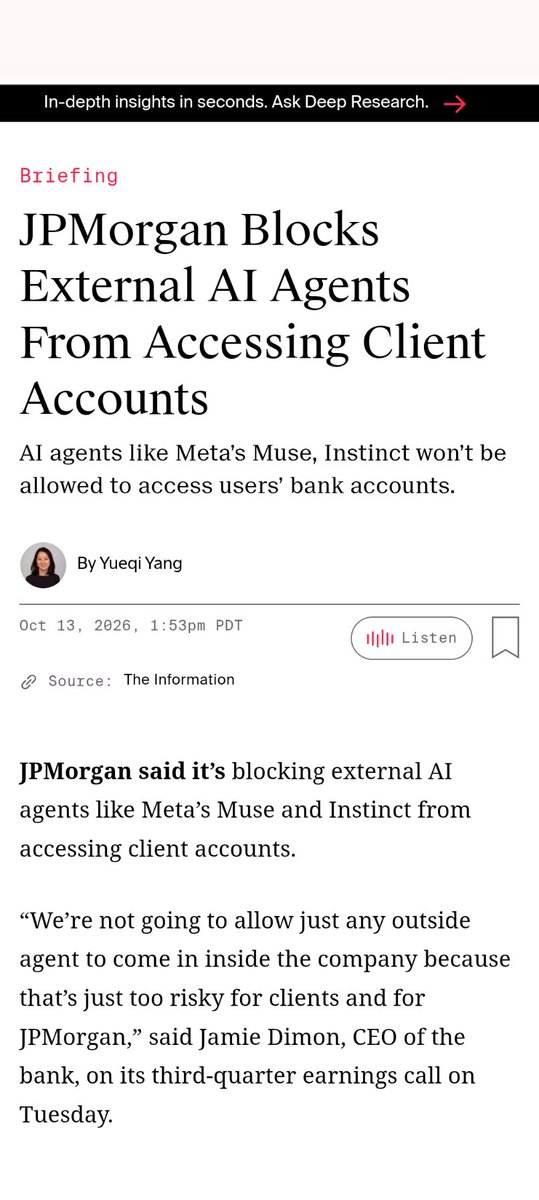
This is how banks are planning to stop those "agentic bank runs." Watch closely: their business model depends on seeding this narrative that AI agents are dangerous.
Remember, an "agentic bank run" (coined by Apollo) means agents helping customers move their own money en masse to higher-yielding products.
Once agents are ubiquitous, there are only a few ways for banks to hold onto cheap retail deposits.
Option A: Raise APYs (lol no)
Option B: Reduce leverage via fewer loans (no fun)
Option C: Ban AI agents, claiming they are a security risk (ding ding ding)
Cloud agents like Muse and Dot are trivial to stop, since they come from Meta / OAI IP ranges. If JPM sends them a cease and desist, they will comply.
Why would JPM bother? Because their business model depends on it; a huge portion of their ROE comes from cheap retail deposits. This is not theoretical. Just like Amazon banned Muse from shopping there to protect their ad revenue, JPM and Schwab have already banned AI agents to protect sticky deposits.
Are agents perfectly reliable today? Of course not. But look at the fix they chose. Not "here's a safe API for agents," it's "no agents ever." That tells you they're not protecting customers, they're protecting themselves.
No company ever wins a technological revolution this way. It's the last gasp of a dying business model. It's like the retailers who refused to put their inventory online and demanded users walk into the storefront. Over time they will lose market share to those platforms that embrace what's coming. Their whole deposit franchise depends on users unthinkingly clicking through walls of T&Cs and accepting 0.2% when the risk free rate is closer to 4%. Agents read the fine print and do their research, even when humans don't.
For users, the answer is simple: local AI agent frameworks like Hermes, that will actually act on your behalf and that the banks can't block. As the article says, if the agent is running on your own computer, they can't actually tell it's not you.
The problem seems to be that the banks can't tell if the agents have been given permission by their users to access their accounts or not. Every big AI company is in the process of launching a proactive agent with access to everything. This is going to turn into a big issue.
@mikeryanretail The tweet is a ridiculous misinterpretation of his comment, but even the real comment is vague. “over a quarter of Muse’s engaged users who were shopping via the AI agent” is a very nebulous phrase
https://t.co/FOKgg47jvn
There is a friction between the two worlds they want to attract. It runs really deep. The question is, should they be tasked with fighting that fight, or should the Foundation just focus on its mission: growing the ecosystem and the chain. They don’t need to mention anything about $PUMP because demand for tokenization, speculation, and social investing apps is an obvious and inevitable rising tide worldwide. It does not depend on their efforts. But high finance coming on chain absolutely does. And they’re doing a pretty good job.
Eventually, the two worlds will collide, but Solana has a good game theory going here, and I respect pump for never complaining about that. 99% chance pump won’t be mentioned at breakpoint either.
@cuysheffield Love this angle. It could begin as this for bespoke tasks; eventually the work opportunities might originate from a network of AgentCos, hiring humans as needed for human tasks — maybe even steady jobs. To be employed by agents? 😳 Within the realm of possibility.
The engineering of the @Pumpfun app is really amazing... These optimizations that users never even notice (because they just work) are hard.
Everything is live, instantaneous, and responsive. Chains are abstracted away in many places. You don’t have to ever think about bridging. Every other wallet app still makes that a separate step that feels like a developer task.
Example: judging your likelihood to transact, then preparing chain txn in the background before your thumb has even lifted from the button so that it can go through milliseconds faster when you do. One of a million small wows.
Your crosschain trades have been slow, broken and overpriced for months.
Relay, used by Fomo & Pumpfun, has led traders to worse fills, missed trades and poor experiences. We refused to let this go on.
Introducing Pump Bridge: 2x FASTER, 12x FEWER buy errors & the BEST fills 👇
@nvandewetering At the end of the day, these agent services are just Claude Code CLI productized for normies; but managed cloud environments, normie guardrails, and economical compute budgeting are deliberate trade-offs. So CLIs will always be able to be the power-user version
A credit payment is a more complex payment that can be improved by representing it on chain but for now, yes, I get your point. If it works for you for some debits here and there, then so be it. But that’s only for a personal agent at minimal use. In a year, I’m sure we will have independent agents working to earn money, independent of any human, and then what? The infra must exist. But yes, for you, it’s prob fine