Reminder to go touch grass
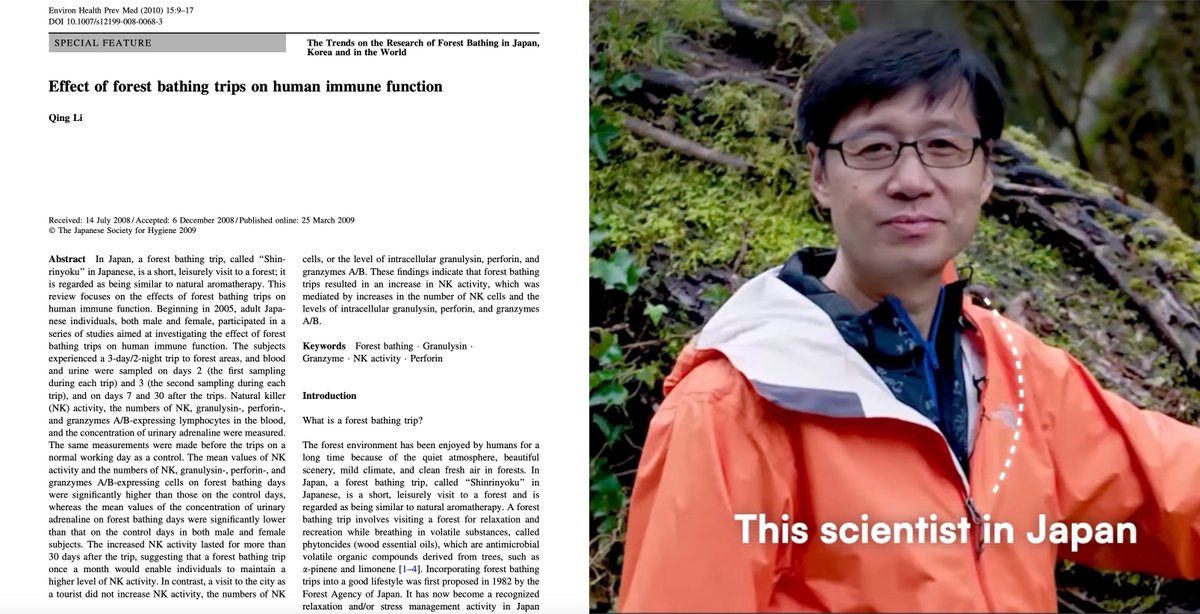
A scientist in Japan demonstrated that the air inside a forest strengthens your immune system for a full month
The study is incredibly fascinating:
Qing Li, an immunologist at Nippon Medical School in Tokyo, took 12 men on a 3-day forest trip. These were slow walks with no breathing exercises and no set route.
Then he tested their blood and found a surge in natural killer cells -- the immune cells your body uses to fight cancer and virus-infected cells.
Remarkably, the effect didn't fade when they went home, it was still measurable 30 days later.
A control group that walked the same distance through a city showed no change at all.
Pine, cedar, and cypress trees release compounds called phytoncides to defend themselves from insects and bacteria. You breathe them in, and Li believes they switch your immune cells into high gear.
He estimates one forest walk a month may be enough to keep those cells elevated all year.
The best medicine might not even need a prescription -- just a walk among the trees.
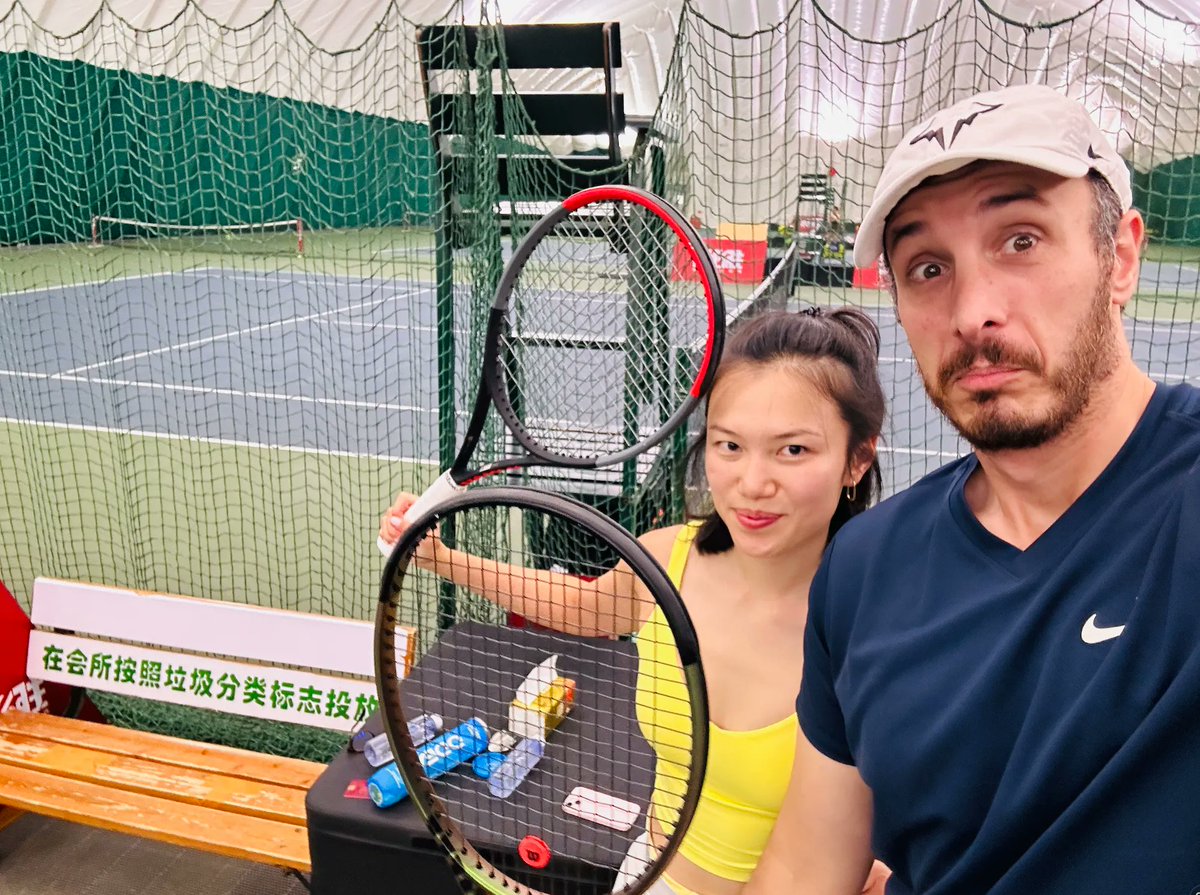
I'm Italian. My wife is Chinese, born in Beijing.
Many of you have asked how to visit China for the first time. So we sat down and prepared this 101: which cities, in what order, and how to do a first trip properly.
We are both international. She studied in the US and worked in Hong Kong, then Europe. I've lived in more countries than I can count. We know well what most of you will look for in this trip: this is the advice we give our closest friends.
The short version: start with Beijing and Shanghai, leave Shenzhen for a second trip, and don't treat China as a one-week destination. And mind the weather: avoid peak summer and peak winter.
The good news: you are going to luxury you have probably never seen, better than Dubai, at a fraction of the cost.
Thread 🧵
Assuming $BTC has two more bull runs with diminishing returns.
Tenjo projection:
• 2026 bottom $40K-$45K
• 2029 top $215K-$230K
• 2030 bottom $80k=$85K
• 2033 top $315K-$330K
• 2034 bottom $125K-$130K
If the market boss's give us two more bull runs with diminishing returns, then buying this bottom & holding through to 2034 bottom would produce about 25% return per year.
1. Models break and this one will adjust over time.
2. Talking heads have been calling $1M Bitcoin for the past two cycles, they will call it for the next two cycles as well.
3. Something breaks and no more bull runs.
4. HODL'ing continues to get less attractive
5. Still great for swing trades to accumulate more
Do you think we see two more bull runs?
CANCEL your weekend plans.
You NEED to:
• Build a RAG system that cites sources with page numbers
• Implement hybrid search (dense + sparse) for better retrieval
• Add reranking with cross-encoders for top-10 accuracy
• Set up chunking strategies (500 tokens, 50 overlap minimum)
• Build query expansion for better recall
• Add metadata filtering for scoped retrieval
• Implement citation grounding to prevent hallucinations
• Create an eval harness with 50+ golden test cases
• Track retrieval metrics: hit rate, MRR, NDCG
• Add fallback to web search when confidence is low
• Build query rewriting for ambiguous questions
• Implement parent document retrieval for context
• Add embedding caching to reduce latency 80%
• Use colbert or late interaction for better accuracy
• Build a RAG dashboard showing retrieval quality
• Test with adversarial queries that should return nothing
• Document your chunking strategy and why it works
• Benchmark against naive RAG and show improvement
You have way too much to do.
Bookmark & Repost.
this is how we built all of these sales/GTM workflows in-house with claude code
step 1) connect claude to all of your tools, these are the ones we use internally:
- Hubspot MCP (CRM)
- Slack MCP (team comms + alerts)
- Google Workspace CLI (docs, sheets, etc.)
- Fathom MCP (call recordings)
- Crustdata MCP (people and company data)
- Instantly MCP (outbound)
step 2) ask claude to build the workflows for you
for example..
a) ICP / TAM mapping:
- export all closed-won deals from hubspot: company, deal size, sales cycle length,...
- if you don't have any closed-won yet: use best open opps + competitors' customers (scraped from their case-study pages / G2)
- enrich all via Crustdata MCP: industry, headcount, headcount by department, geo, funding stage, tech stack, open roles,...
- ask claude to run this prompt:
"you have ./winners/ (one json per closed-won customer) and ./crm_export.csv (deal size + cycle length)
1. flag every attribute shared by 70%+ of winners, weighted by deal size
2. drop attributes any random b2b company would also match
3. write ./icp.md: hard filters (industry, headcount, geo, funding) + soft signals with weights (dept ratios, hiring, tech) + anti-icp (attributes of wins that churned or closed slow)
4. spawn a subagent to blind-score every winner against icp.md. 80% of winners must score 70+. loop until they do."
b) mail infra + warmup:
- never send cold from your main domain, buy 2-5 alternate domains to start (yourbrand-hq com, tryyourbrand com), 20-40 at scale
- 2-3 inboxes per domain. person-first names (john@, not sales@), no numbers
- dns on every domain: spf, dkim, dmarc + custom tracking domain (CNAME)
- disable open tracking, pixel hurts deliverability, track replies only
- warmup 2-4 weeks before sending anything. start 5-10/day per inbox and then start ramping up
- warmup never stops: after ramp, ~20 cold + ~30 warmup per inbox daily, 40-50 total
- capacity: 1,000 cold/day = ~50 inboxes across ~20 domains
- before every campaign: verify the list (bounce rate must stay under 2-3%) + run an inbox placement test (primary vs promotions vs spam)
- check all prospects that are behind secure email gateways (proofpoint, mimecast, barracuda). throttle or just delete those and set up a campaign on linkedin instead
c) signal-based lists:
1. reverse-engineer which signals made your prospects reply
- export your outbound history: every prospect ever contacted (instantly export + hubspot): date contacted, replied y/n, meeting y/n, won y/n + fathom as context
- for each account, reconstruct what was true ON the day you contacted them via crustdata: headcount delta the quarter before, days since last funding, open roles matching your buyer titles at that time, new VP+ hire in the prior 90 days, posts made, etc.
- ask claude to run this prompt:
"you have ./outbound_history.csv (every account ever contacted: date, replied, meeting, won)
1. for each account, reconstruct the signal state at contact date via crustdata: headcount delta prior quarter, days since funding, open roles matching [titles], exec hires prior 90 days, posts, all relevant signals
2. calculate lift per signal: reply rate with signal vs baseline reply rate
3. calculate each signal's window: median days between signal and the replies it produced
4. read the reply threads per signal and extract the angle that worked
5. write ./signals.md: only signals with 1.5x+ lift, each with: lift, window, the proven angle. everything else gets deleted, not monitored
6. verify with a subagent: hold out 20% of history, check the ranking predicts reply rate on the holdout. loop until it does"
- no outbound history yet: run the same analysis on closed-won instead (what signal states existed in the 90 days before each winner entered pipeline)
- THEN set up a watcher via crustdata that watches for these signals in real-time, and add that company to your sequence in instantly
d) lookalike lists off closed-won:
- rank customers first: ACV × speed-to-close × expansion, minus churn (using connectors)
- for each: reconstruct the company as it was when it bought, via crustdata (headcount, dept mix, funding stage, what they were hiring at that date)
- pull the fathom transcripts from that deal: why they bought, in their words, and the proxy for that pain (e.g. "drowning in manual prospecting" → SDR headcount growing with no ops hire)
- ask claude to run this prompt on every new closed-won:
"1. check the customer ranks in the top third (ACV × close speed × expansion, minus churn)
2. reconstruct the company at purchase date via crustdata, not its current state
3. read the fathom transcripts from the deal. extract the buying trigger in their words + the observable proxy (what would this pain look like from the outside)
4. crustdata search: companies matching the at-purchase profile AND the pain proxy. exclude current customers, open pipeline, closed-lost < 6 months old
5. score 1-100 on firmographic match × pain-proxy match. keep 70+, cap at 25
6. verify with a subagent: blind-mix the 25 with 25 random companies that pass basic ICP filters. it must identify the real lookalikes 80%+ of the time. if it can't, the criteria are too generic, tighten and loop"
- you can then push the list into a sheet (google workspace CLI), add it to hubspot, or send it to instantly
e) champion tracking:
- pull every contact on closed-won deals from hubspot: tagged champion/decision-maker + get more context from fathom
- resolve their emails to linkedin profiles via crustdata (batch reverse-email lookup)
- one-time backfill first: enrich all of them, diff current employer vs the deal's account
- create a crustdata watcher on each profile, set up a slack channel to get a notification every time something happens: new funding round, new hire made by that company, web traffic, posts where they mention something specific
- you can then set up claude workflows to react to every signal that is interesting for your industry
ask claude:
"pull fired watchers. for each job change:
1. enrich the new company + the new email of the champion using crustdata
2. score the new company against icp.md. below 70 → log it in hubspot, no alert
3. 70+ → create the company + contact in hubspot, tag champion-landed, assign the AE from the original deal
4. slack the AE: who they are, what they bought, the original deal size, what the new company does + a drafted first touch referencing the history using fathom as context"
these are just some of the workflows you can power by connecting your stack to claude
you can build any dream GTM/sales workflow yourself by just asking claude to go through all of these workflows and build something specific for your industry and company, with all the context it has about you
even Anthropic is hiring BDRs to do outbound sales
one of the best-performing cold email copy formats we use to run our own cold outreach is the "creative idea'" email
instead of pitching your own product, you email a prospect 2-3 hyper-specific campaign/growth ideas for their business, then tie it back to how you'd help them pull it off:
"Hey [name], I had some ideas about how we could target [their customer type] together, here's what I'm thinking," then the idea(s), value prop, CTA
it can be very short:
"Hey Olipop,
Quick idea. We could reach out to gyms and boutique fitness studios that don't stock Olipop yet and get it into their fridges as the "healthy soda" for post-workout
Worth testing?"
or longer:
"Hey Olipop,
Had a few ideas for getting in front of new buyers:
1) Email gyms/studios that don't stock it yet for their fridges
2) Target corporate offices for kitchens + vending
3) Reach out to college campus stores for the Gen Z crowd
We'd run the whole outbound for you. Of course we can do other things too, let me know if any of these are interesting!"
And you can automate the entire workflow using Claude (to come up with the ideas), Crustdata MCP (to feed Claude everything about the company + person, their focus, what they sell, contact info) and the Instantly MCP to send out the emails
every sales rep at Crustdata has an unlimited dinner budget for "high-potential" accounts
personal relationships are the single biggest lever in sales
every expansion, closed deal, renewal is easier once a personal connection has been built
it doesn't matter how good your product is , if the person behind the screen can't trust you at all
and personal connections can only be built when you meet people in-person
this is why we encourage our GTM team to get in front of customers/prospects as often as possible
after one dinner, the goal is the second dinner, a cascading waterfall of meet-ups at their favorite spots
people don't say no to this
and it doesn't have to be a dinner, it can be an in-person office visit, a coffee, a courtside seat at a game, a drink after a conference... whatever it takes to meet in person
the focus is "in-person"
realizing that the more upmarket we move, the more important these relationships are
so anthropic open-sourced their claude usage data?
if i had to start a new company today, i'd spend the next 24h going through all of it
find the fastest growing use-cases getting adoption inside companies
then start an AI services agency that deploys those workflows
for example:
> 20% of US claude usage is content creation and copywriting
1) start a claude-first content agency, help companies build an in-house content machine on top of claude
2) reach out to content leads and CMOs at funded b2b companies:
"hey x, 20% of US claude usage now goes into content creation according to anthropic's new usage report from this month...
we help companies build and deploy a claude-powered in-house content machine across the org. we've done this with a few others already. curious if you'd be down to see how that looks?"
you'll get revenue faster than most "startups" out there
there are probably 100s of workflows like this in the usage data
4 months later and the majority of YC founders i'm speaking with are still trying to hire the person that can do all of this with AI:
- map out the entire ICP and TAM
- build signal-based lists
- build lookalike lists off closed-won accounts
- track every champion who changes jobs and route them as a new account
- watch for any signal (tech stack changes, funding, layoffs, headcount swings on named accounts) and react in real time
- set up the mail infra
- run outbound and auto route qualified leads to sales reps
- build an automated multi-touch sequence across email and linkedin
- build the inbound system end to end: creating content, filtered for the ICP, building out a creator network and distributing across linkedin
- score every inbound against past closed-won
- de-anonymize website traffic, push it into pipeline and add them to the outbound sequence
- run focused AEO efforts
- re-engage closed-lost
- watch product usage for expansion signals automatically / add to a sequence
- analyze sales calls and create feedback loops for all reps
- auto-build a pre-call brief for every meeting on the calendar
- generate the one-pager, ROI model and proposal per deal
- build the expansion play per account
- own the CRM architecture and reporting
...and the list goes on
it's really hard to find one person who can own and maintain all of this
for a long time we had two. they built and ran every workflow above and more, and took us from 700k to millions in revenue
the team has since grown to 3
all of them have 3 things in common:
1) they understand the full sales cycle from prospecting to close
2) they're technical, or at least highly technical in how they think
3) they know how to use claude in the most efficient way (spawning /subagents that verify the output and /loop until the outcome is achieved)
and most of these workflows run for a fraction of what the equivalent sales tools cost, as long as your team builds them internally with claude code and a few external APIs
🤯 Turned famous literary lines into minimalist visual worlds!
Made with GPT-Image2 using monumental objects, tiny figures, subtle embossing, and large areas of negative space.
4 themes:
1. GRAIN OF SAND — William Blake
2. DREAMS — William Shakespeare
3. WITHOUT FEAR — Rabindranath Tagore
4. BEAUTY / TRUTH — John Keats
Bold from a distance, detailed up close.
Classic words, reimagined as contemporary visual art.
Prompt below 👇
One of the most productive engineers I know cannot read code.
@mvanhorn is not an engineer by training. He co-founded June, has 44,000 GitHub stars, and got contributions merged into Go & Python.
I had him build live for an hour & walk me through his process.
My fav lessons & quotes from the convo:
1) He never reads code. He does not have an IDE installed. In his words, "I fundamentally believe that very soon no humans should ever write any code and that no humans should ever read any code."
2) Every project starts with the agent writing itself a plan.md file using Compound Engineering. Agents are lazy, he says, and the plan keeps them honest. He never reads the plan either. "Plans are for agents, you silly human."
3) His CLIs leave notes for themselves. Each run records what it learned in a markdown file, so the next run starts where the last one ended. He calls them self-healing.
4) His agent has an email address. From Telegram on his phone, he sends a task. It emails his Mac, authenticated, and the work starts while he is at his kids' soccer practice.
5) He feeds whole transcripts, not summaries. After a two-hour meeting with a Google Ventures researcher, his agent read the researcher's entire book, wrote itself a report on every chapter, and turned it all into a plan for his business.
6) Him yapping to his agents is like nerd ASMR. "Go agent go" is how he likes to finish telling the agent what to do.
7) How he thinks about this next chapter of building: "Every generation of tools moves the engineer's job up a level. The code was never the point. The problem was."












![chrispisarski's tweet photo. even Anthropic is hiring BDRs to do outbound sales
one of the best-performing cold email copy formats we use to run our own cold outreach is the "creative idea'" email
instead of pitching your own product, you email a prospect 2-3 hyper-specific campaign/growth ideas for their business, then tie it back to how you'd help them pull it off:
"Hey [name], I had some ideas about how we could target [their customer type] together, here's what I'm thinking," then the idea(s), value prop, CTA
it can be very short:
"Hey Olipop,
Quick idea. We could reach out to gyms and boutique fitness studios that don't stock Olipop yet and get it into their fridges as the "healthy soda" for post-workout
Worth testing?"
or longer:
"Hey Olipop,
Had a few ideas for getting in front of new buyers:
1) Email gyms/studios that don't stock it yet for their fridges
2) Target corporate offices for kitchens + vending
3) Reach out to college campus stores for the Gen Z crowd
We'd run the whole outbound for you. Of course we can do other things too, let me know if any of these are interesting!"
And you can automate the entire workflow using Claude (to come up with the ideas), Crustdata MCP (to feed Claude everything about the company + person, their focus, what they sell, contact info) and the Instantly MCP to send out the emails](https://pbs.twimg.com/media/HNYUSxTWYAApA84.jpg)


