Senior Investment Advisor with 15+ years in equity investing & risk management. Focused on long-term value & tech-driven growth. Stanford & Harvard grad
Before the bell, here’s what I’m watching.
Futures are weak.
Oil is strong.
Yields are high.
Geopolitical risk is elevated.
AI stocks are mixed to lower.
That’s not exactly the recipe for chasing the opening move.
#Premarket#StockMarket#Nasdaq#AIStocks#WallStreet
One of today’s more interesting signals is Constellation Energy. Reports of a potential multi-year nuclear power deal with Google show how quickly AI is changing the power market. If data-center electricity demand keeps exploding
#AIStocks#NuclearEnergy#CEG#DataCenters
PTC’s huge premarket move is getting my attention beyond the stock itself. Schneider Electric paying roughly $22.6 billion for the software company could trigger fresh speculation across industrial software, automation and digital infrastructure.
#PTC#Mergers#SoftwareStocks
The AI trade isn't dead.
Far from it.
But the market is asking a tougher question now:
“Can AI growth justify these valuations if rates stay high?”
That's the debate I think matters most heading into September.
#AI#NVDA#TechStocks#Fed#Nasdaq#Investing
My focus today:
Watch Treasury yields.
Watch Nasdaq reaction to the Fed.
Watch whether NVDA stabilizes.
Watch MRVL for semiconductor weakness.
Watch PYPL for follow-through selling.
Watch GAP to see if the breakout holds.
That’s the game plan.
#StockMarket#WallStreet#Investing
If NVDA opens strong and stays strong for the first hour, I'll be watching whether the rest of semis hold their gains.
That's the real test.
A giant NVDA gap-up is impressive.
A broad semiconductor rally is more meaningful.
#NVDA#AIStocks#StockMarket
If yields keep climbing, expensive growth stocks are going to have a tougher time.
If yields roll over while NVDA beats, that's a much cleaner setup for tech bulls.
Keep your eyes on the bond market.
#NVDA#AIStocks#StockMarket
Honeywell Aerospace dropped sharply (reports of 17–25% declines) after missing forecasts and trimming full-year organic sales growth guidance due to supply-chain issues.
That was a real risk-on close—not just three mega-caps carrying the market.
• Dow +1.88%
• S&P 500 +1.90%
• Nasdaq +2.69%
• Tech sector +4.5%
• Semiconductor Index nearly +7%
$PLTR gained almost 30%, while $CAT added roughly 6% as AI infrastructure demand continued spreading beyond software and chips.
Oil falling nearly 5% and Treasury yields moving lower gave growth stocks another tailwind.
The encouraging part was breadth: Nasdaq advancers outnumbered decliners by nearly 3-to-1.
But after a move this strong, tomorrow’s signal will not be the opening gap. It will be which stocks remain supported after the first round of profit-taking.
I would rather buy strength that survives a pullback than pay any price for a green candle.
#StockMarket #Nasdaq #SP500 #GrowthStocks #AIStocks
Most investors chasing $AXTI see an AI stock. I see the crystal underneath the laser.
AXT makes indium-phosphide substrates used in the high-speed optical links connecting AI servers. As networks move from 800G toward 1.6T and co-packaged optics, those lasers need more InP—and Q2 finally showed what that operating leverage can look like.
Revenue jumped to $47.6M from $18.0M a year ago. Gross margin reached 44.9%, and a $7.0M loss became $11.1M of profit. This is not a concept story anymore; the demand and earnings inflection are real. The April raise funded capacity and pushed cash plus investments above $700M, although it also expanded the share count materially.
But a great quarter does not make every price attractive.
At roughly $75 premarket, $AXTI is up about 60% in five sessions and 320% YTD. The market cap is approaching $5B, all three factories remain in China, export permits can delay shipments, and 17.6% short interest is likely adding squeeze fuel.
I’m not recommending a chase here. The $64.25 offering zone is where I’d start paying attention again; below $54, I step aside.
Want the entry instead of chasing the candle? Add my WhatsApp—I’ll post the risk/reward reset there first:
https://t.co/kP5ZAj5p6G
#AXTI #Photonics #AIStocks #Semiconductors #DataCenters
Most investors chasing $AXTI see an AI stock. I see the crystal underneath the laser.
AXT makes indium-phosphide substrates used in the high-speed optical links connecting AI servers. As networks move from 800G toward 1.6T and co-packaged optics, those lasers need more InP—and Q2 finally showed what that operating leverage can look like.
Revenue jumped to $47.6M from $18.0M a year ago. Gross margin reached 44.9%, and a $7.0M loss became $11.1M of profit. This is not a concept story anymore; the demand and earnings inflection are real. The April raise funded capacity and pushed cash plus investments above $700M, although it also expanded the share count materially.
But a great quarter does not make every price attractive.
At roughly $75 premarket, $AXTI is up about 60% in five sessions and 320% YTD. The market cap is approaching $5B, all three factories remain in China, export permits can delay shipments, and 17.6% short interest is likely adding squeeze fuel.
I’m not recommending a chase here. The $64.25 offering zone is where I’d start paying attention again; below $54, I step aside.
Want the entry instead of chasing the candle? Add my WhatsApp—I’ll post the risk/reward reset there first:
https://t.co/kP5ZAj5p6G
#AXTI #Photonics #AIStocks #Semiconductors #DataCenters
Don’t fall in love with green futures before 10:00 ET.
Today’s schedule:
8:30 — U.S. trade balance
10:00 — JOLTS job openings
10:00 — Factory orders
JOLTS is the number most likely to hit rates.
Hot job openings could push Treasury yields higher and pressure $QQQ and expensive software. Cooler labor demand would give $IWM and other rate-sensitive growth names more room.
The first move at 9:30 may be noise. I care more about the reaction around 10:05—and whether bond yields confirm it.
#EconomicData #JOLTS #TreasuryYields #QQQ
The $ASTS story in Japan is turning into a regulatory countdown.
Several major milestones are already complete:
• Direct-to-device video calling demonstrated
• Technical conditions established for 700 MHz satellite use
• Rakuten-led J-LEO project selected for government support
The next major step is Japan’s formal rule change, currently expected in September.
After that comes the commercial licensing process.
Rakuten is still targeting a Q4 2026 launch using standard, unmodified smartphones.
The technology is no longer the only question.
Now investors need to watch regulation, satellite deployment and the size of the initial service area.
Japan could become one of the first major markets to show whether $ASTS can move from successful demonstrations to a real commercial network.
#ASTS #Rakuten #DirectToDevice #SpaceTech
$PLTR reports Q2 earnings Monday after the bell.
The number I am watching most is adjusted free cash flow.
I expect it to exceed $1.1B.
If that happens, Palantir will generate more cash in a single quarter than the $1.004B in revenue it produced during the same quarter last year.
The P/FCF multiple has fallen sharply—but let’s be clear:
$PLTR still is not cheap.
What has changed is the business supporting that valuation.
Previous comparable valuation:
• Around 30% revenue growth
• Around 80% gross margins
Latest reported quarter:
• 85% revenue growth
• 87% gross margins
The valuation has compressed while growth and margins have accelerated.
That is what makes this earnings report so interesting.
If cash generation keeps scaling, the valuation argument becomes harder for the bears.
If growth slows, the premium still leaves very little room for error.
#PLTR #Palantir #Earnings
Google has a $514B problem.
But it is the kind of problem most companies would love to have.
Google Cloud’s backlog has grown to nearly 5x what it was a year ago, while limited compute and data-center capacity is preventing $GOOGL from serving all that demand today.
That helps explain the $44.9B in quarterly CapEx—and the negative $5.9B in free cash flow that worried investors.
Wall Street rarely likes negative free cash flow.
But spending heavily to fulfill contracted demand is very different from spending heavily and hoping demand eventually appears.
The risk is no longer whether customers want what Google is selling.
The risk is whether Google can build fast enough to deliver it.
#GOOGL #CloudComputing #AIInfrastructure
NEXT WEEK COULD SET THE TONE FOR GROWTH STOCKS
The earnings calendar is loaded from Monday through Friday, with several of the market’s biggest AI, software, space, defense and momentum names reporting.
MONDAY
$PLTR, $CLPT, $ON, $GRAB, $SNAP, $WGS, $VOYG
TUESDAY
$AMD, $SPCX, $CIFR, $ZETA, $ANET, $ALAB, $TMDX, $KTOS, $DOCN, $HUT, $OPEN, $PRCT
WEDNESDAY
$SNDK, $APP, $IONQ, $MELI, $UBER, $SHOP, $EOSE, $OSS, $VPG, $DUOL, $FIG, $SYM, $RDW, $FLNC, $VIAV
THURSDAY
$CELH, $DDOG, $OSCR, $NET, $TTD, $U, $QBTS, $AAOI, $RCAT, $TEAM, $OUST, $SHAZ
FRIDAY
$OKLO, $VST
Tuesday and Wednesday are the main events.
AI spending, cloud demand, consumer strength and growth-stock valuations are all about to face a major test.
Expect volatility. A strong quarter may not be enough if guidance fails to meet expectations.
Which earnings report are you watching most closely?
#Earnings #GrowthStocks #StockMarket
$AAPL beat and still got smoked—down ~9%.
Revenue rose 16.4%. iPhone sales jumped 21.7%. But next-quarter growth guidance came in at 9–11%, below the Street’s 12%.
The beat is backward-looking. The guide moves the stock.
Overreaction or rerating?
#Apple#AAPL#iPhone #EarningsSeason
$LBRX:
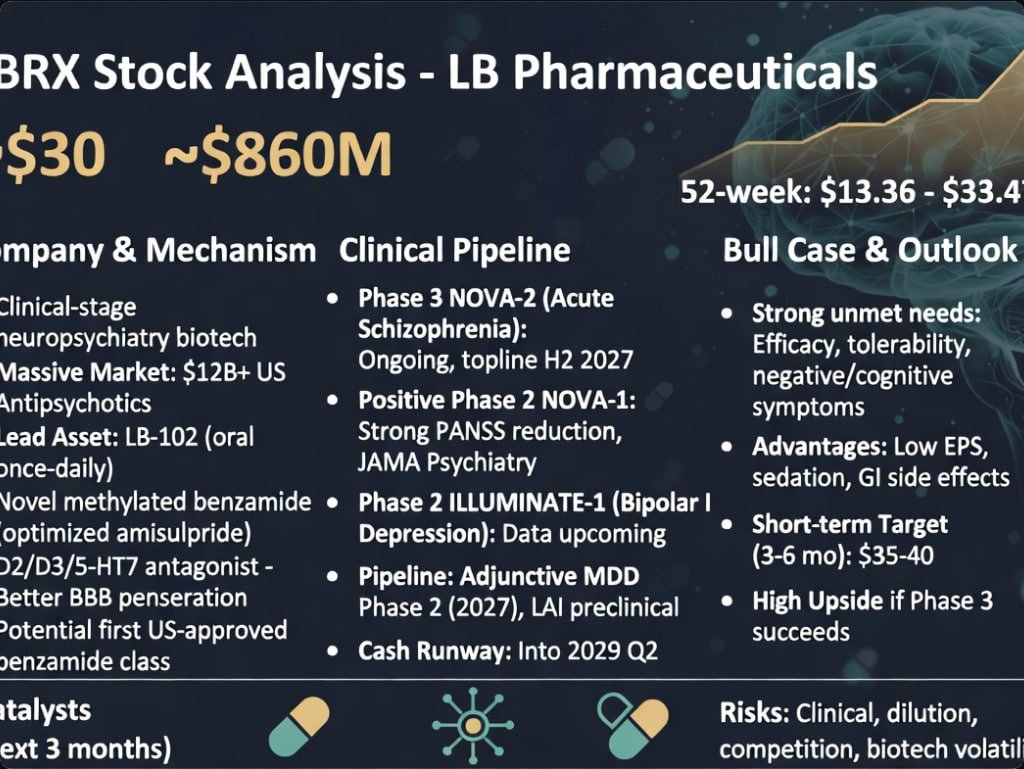
Macro Context: The market for mental health treatments is vast, with the U.S. market for branded antipsychotics estimated at approximately $12 billion and significant unmet needs (existing drugs still fall short in terms of efficacy, tolerability, and improvement of negative symptoms and cognitive function). LB-102, as a potential first benzamide-class antipsychotic to be approved in the U.S., is optimized based on the mechanism of amisulpride (better BBB penetration, lower dosage) and targets D2/D3/5-HT7 receptors, offering differentiated advantages.
Key catalysts over the next 3 months: Update on enrollment progress for Phase 3 NOVA-2 (acute schizophrenia).
Early data or milestones from Phase 2 ILLUMINATE-1 (bipolar depression).
Analyst meetings/Investor Days, potential news on additional partnerships or financing.
Overall positive sentiment toward biotech + increased focus on the mental health sector
Core Pipeline: LB-102 (oral once-daily small molecule), Phase 3 for acute schizophrenia (NOVA-2 initiated, topline data expected in H2 2027); Phase 2 for bipolar I depression (ILLUMINATE-1); plans to initiate a Phase 2 trial for treatment-resistant MDD in early 2027; additionally, a long-acting injectable (LAI) in preclinical development.
Mechanism Advantages: Modified benzamide structure, potentially offering better tolerability (lower EPS, sedation, and GI side effects), as well as improvements in negative symptoms and cognition.
Financial Strength: Ample cash reserves following the IPO and private placements (runway through Q2 2029), supporting the advancement of multiple indications.
Bullish Arguments:
Positive Phase 2 NOVA-1 data (significant improvement in PANSS scores, good tolerability), published in JAMA Psychiatry.
Broad pipeline + cash reserves support multiple readouts.
If Phase 3 is successful, significant commercial potential (first benzamide).
Short-term (3–6 months): $35–40
#NVDA #SPCX #TSLA #MU #AMD #AVGO #MSTR
$JPM (JPMorgan Chase) — Key Driver of the Financial Sector Rotation: The financial sector led gains yesterday, with $JPM performing particularly well; the Dow’s record high was driven primarily by bank stocks.
The market is shifting from high-valuation tech stocks to reasonably valued cyclical stocks. Amid expectations of a soft economic landing, a stable net interest margin, recovering loan demand, and improved regulatory conditions are driving a dual recovery in earnings and valuations. Ahead of the Fed meeting, the stock offers both defensive and offensive characteristics.
#StockMarket #Stocks #QQQ #DWSN #NVDA