@msainat1 The average number of people killed by alligators in the US annually is not six...not even close. Please use better resources than "AZ Animals". Official annual alligator attack statistics are easily found with even the most basic research.
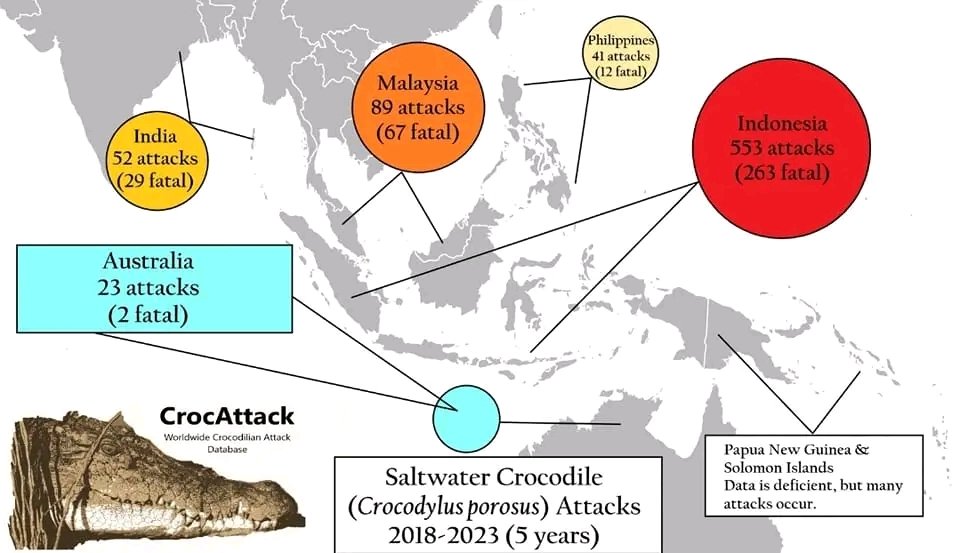
@BiologyCanBite@CDUni@abcdarwin@nt@BiologyCanBite Malaysia appears to have good reporting compared to other areas, but it is possible that non-fatal bites go unreported. In East Nusa Tenggara we recorded a fatality rate of around 60%, possibly due to the size of crocodiles or circumstances.
Saltwater crocodile attacks are rare in the Northern Territory, particularly when compared to the rest of the species range. The NT does not have a crocodile problem. @CDUni@abcdarwin@nt
Here is an odd and sad incident from this week. A non-fatal bite involving an African slender-snouted crocodile, a critically endangered crocodilian native to West Africa. The circumstances are currently unclear. https://t.co/4n3A3aoBHt
A look at human-crocodile conflict from 1/1/2011 to 12/31/2020. A large number of Nile crocodile bites go unreported throughout the entire range of the species, while saltwater crocodile bites may go unreported in New Guinea and a few other areas.
Feeding of a wild adult saltwater crocodile along the Nilwala River in Matara, Sri Lanka. Attacks on humans appear to have been reduced significantly over the past decade, but dangerous activities such as this certainly won't help keep it that way. https://t.co/lsvBlcFxeX
Evidence that the saltwater crocodile can be found as far inland as Keningau along the Padas River drainage in Sabah. There are historical records of human-crocodile conflict occurring around Tenom, but this is even further upriver. https://t.co/QeNd64fUa5
Since February of 2019 there have been 13 bites (all non-fatal) in this small area of Lampung (Sumatra). The crocodiles involve appear to be mostly small to medium in size (1.5-2.5m). https://t.co/bWaLYtrR2i
A population of saltwater crocs is present nearby in Sungei Buloh. Thankfully, the last recorded non-fatal bite in Singapore was non-fatal and it occurred in 1989 in Lim Chu Kang. The last fatality on record occurred in 1946 at the Pandan River in Jurong. https://t.co/nKnIfr3Ab1
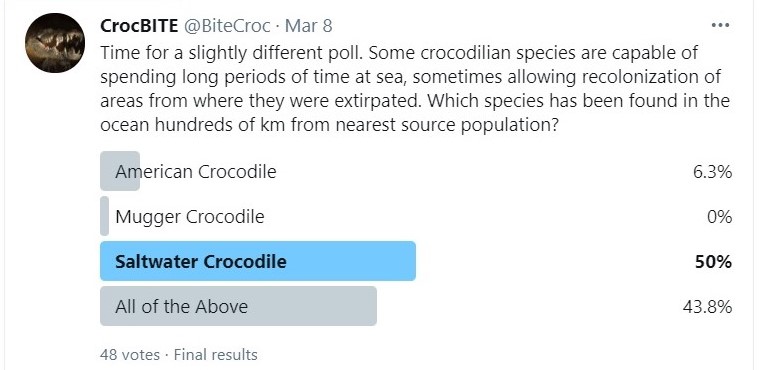
And the correct answer is...All of the Above! A few mugger crocodiles have been found in the Maldives, alongside numerous saltwater crocodiles, hundreds of km from the nearest source populations in India and Sri Lanka.
Time for a slightly different poll. Some crocodilian species are capable of spending long periods of time at sea, sometimes allowing recolonization of areas from where they were extirpated. Which species has been found in the ocean hundreds of km from nearest source population?
Please check out our new paper on saltwater crocodile attacks in East Nusa Tenggara, Indonesia. For questions, please email us.- https://t.co/i0Ot81VXIM
Looks like most of you will be surprised! The Morelet's crocodile was responsible for the most New World crocodilian attacks in 2020- 17 incidents, 2 of them fatal. Usually the American crocodile is responsible for the most.
Time for another poll. 2020 was, in some ways, a strange year in human-crocodile conflict. In contrast to all other recent years, what species was responsible for the most reported attack/bite incidents in the New World in 2020?
@s_pooley Yeah that sounds like a gross exaggeration. I was told by an Egyptian crocodile expert that attacks are very rare. The last we have on record is from 1999 and Ive been told that few have happened since then. They have a very limited distribution in Egypt.
Mushtaq Ahmed was a great friend and colleague. A great crocodile specialist and a joy to be around. I was lucky enougj to spend time with him in 2013 at the CSG meeting in Sri Lanka. This is just awful, deeply saddening news- https://t.co/POFyeJjsGq
Many of you are aware that the Nile crocodile and the saltwater crocodile are responsible for the most attacks on humans, but how many of you know which species is responsible for the third highest numbers of attacks on humans? For some of you, the answer may be obvious.