Happy to share our feature article on gold(I)-ethylene chemistry is out in @ChemCommun! This review highlights contributions from our group, D. Bourissou @LBPB_Lab, C. Russell @CARGroupChem, S.A. Hashmi, J. Campos, @CamposGroup, and more! https://t.co/zdkEo0jJoc
BREAKING: the 2024 Noble Prize in Chemistry has been awarded to E. F. Tom for the synthesis of a cubane using chemicals from a hardware store. In a shed. This is a huge win for brown chemistry, which will now replace green chemistry as the best way to pad grant applications.
Intramolecular Nucleophilic Vinylic Substitution (SNV) by Carbon Nucleophiles: Conformationally Directed Formation of Dienes from N,N'-Diallyl Ureas (Branca C. van Veen and Jonathan Clayden @ClaydenGroup) #OpenAccess https://t.co/PNl6guZVW0
My research on Alkenylidene Homologation, enabled by SNV mechanism, is now officially online @Nature! Thrilled to demonstrate how colorful🌈🌈🌈, fully-substituted cross-conjugated polyenes can be synthesized at will. https://t.co/8BSkdvjKMl
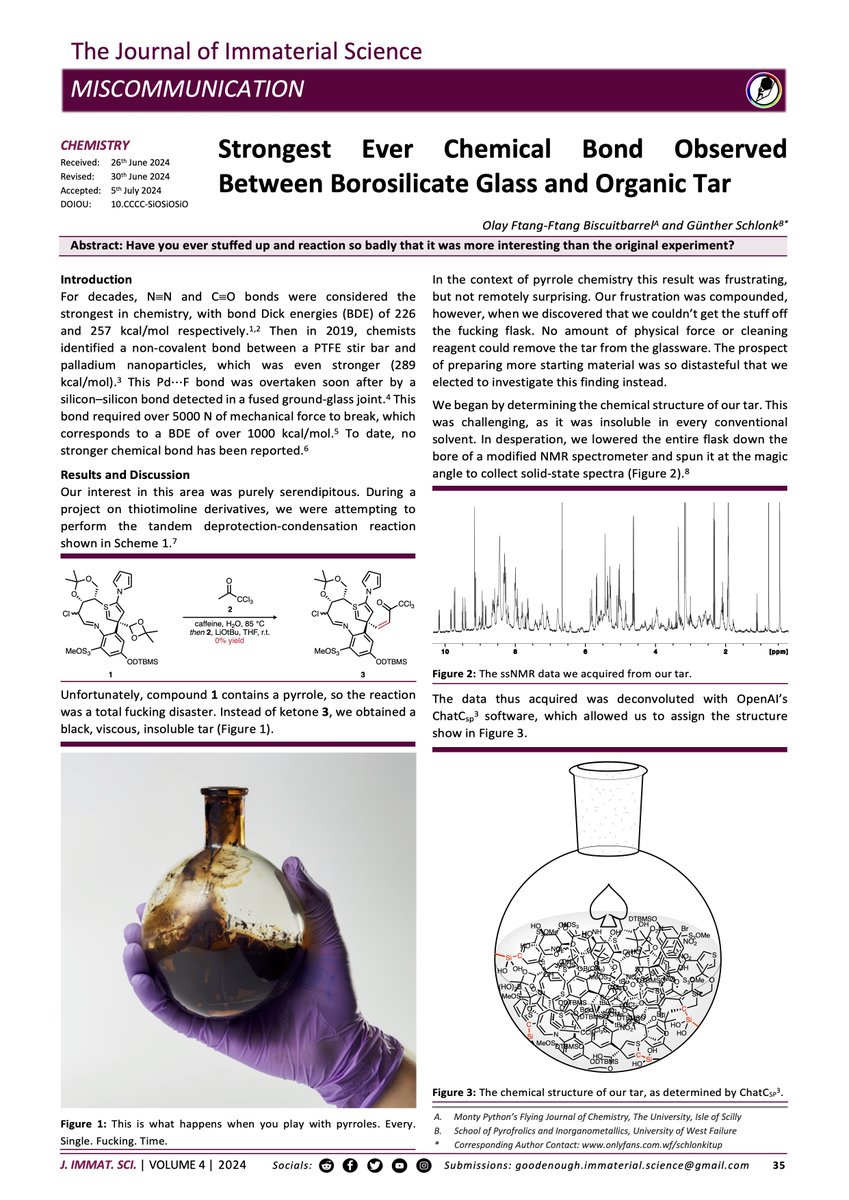
Strongest Ever Chemical Bond Observed Between Borosilicate Glass and Organic Tar.
This article contains strong language, for good fucking reason.
PDF: https://t.co/9CpMJSBXIG
@biostatsfun @CanevasBleu @NaOHBartfield Essentially sounds like no data was collected by the author of the tweet. Basically came to do a post doc, yoinked others data, wrote the papers, took first author. First author should be heavily involved in the data acquisition.
On the cover:
'Going for gold – the chemistry of structurally authenticated gold(i)–ethylene complexes' by H. V. Rasika Dias and @BrandonT_Watson at @UTArlington
https://t.co/6hYlFfq6AX
New Feature Article from H. V. Rasika Dias and @BrandonT_Watson at @UTArlington
'Going for gold – the chemistry of structurally authenticated gold(i)–ethylene complexes'
https://t.co/6hYlFfq6AX
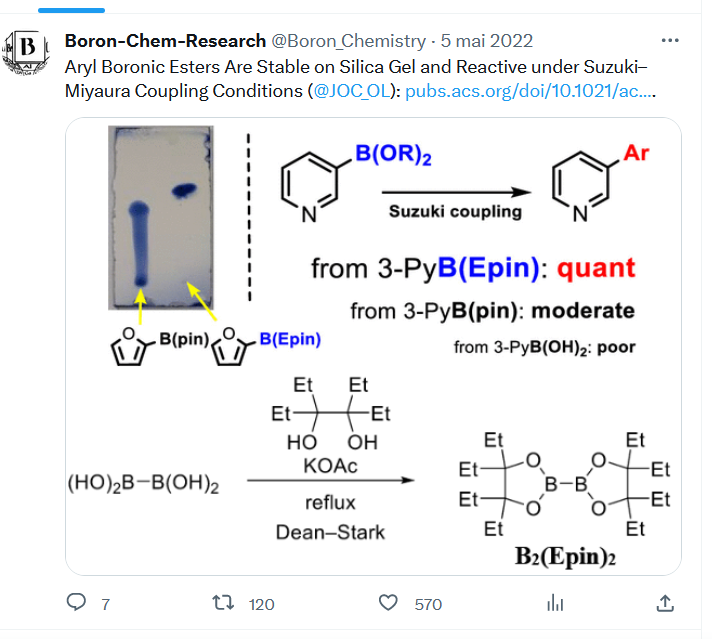
The most cited tweet from 2022 on @Boron_chemistry: "Aryl Boronic Esters Are Stable on Silica Gel and Reactive under Suzuki–Miyaura Coupling Conditions (@JOC_OL): https://t.co/LSVEY72PPX (@ikawa_takashi).
🧪synthetic chemists: Want to model your molecules without navigating big computers? Ditch your modeling kit and check out the Gair group's guide to running code-free DFT on your laptop💻. Powered by @faacts_orca (free to academic users).
👉 https://t.co/U4rRkaUuoc
@DrukkerAustin @jackrpruett @Georgetown 5 hours per week? In chemistry, if we are a TA we have duties between 10-20 hours per week for that, with an additional 20-60 hours of research. As an RA it is common to work 60-80 hours/week depending on field, institute, etc. But we are paid for 20 hours of work.