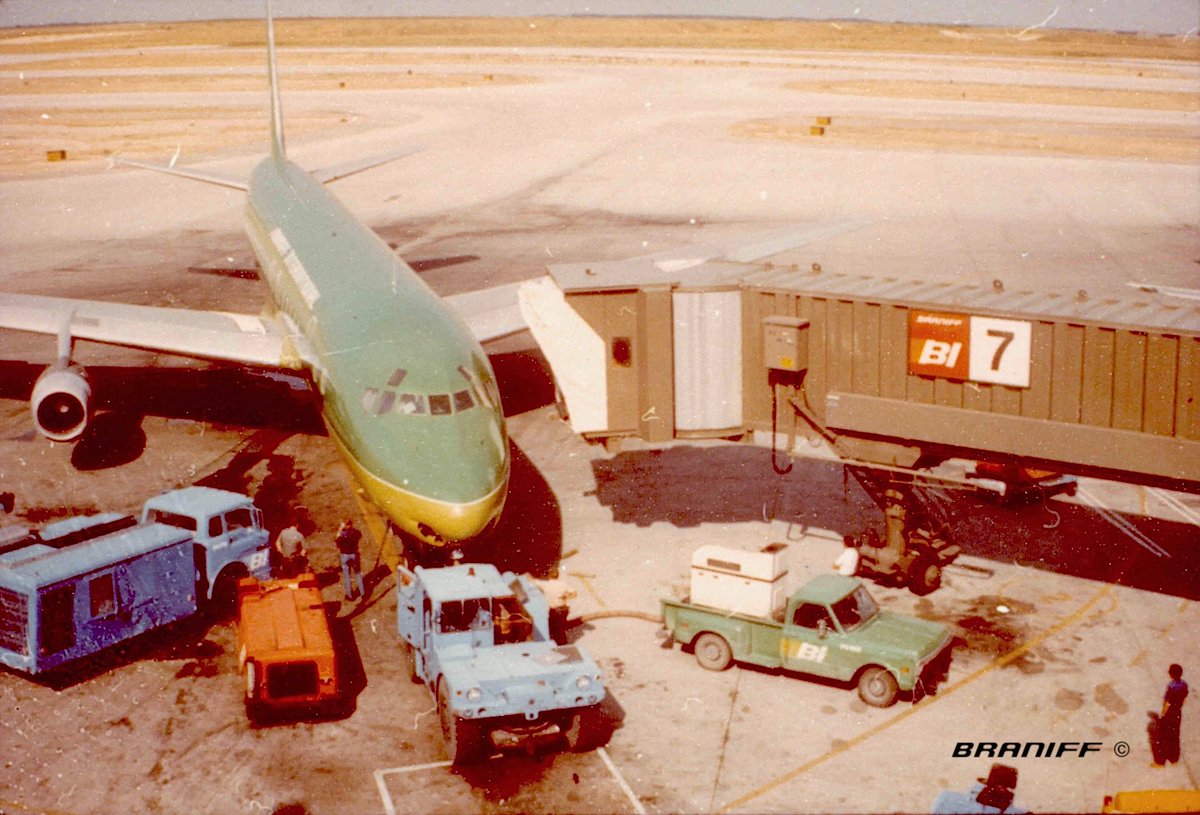
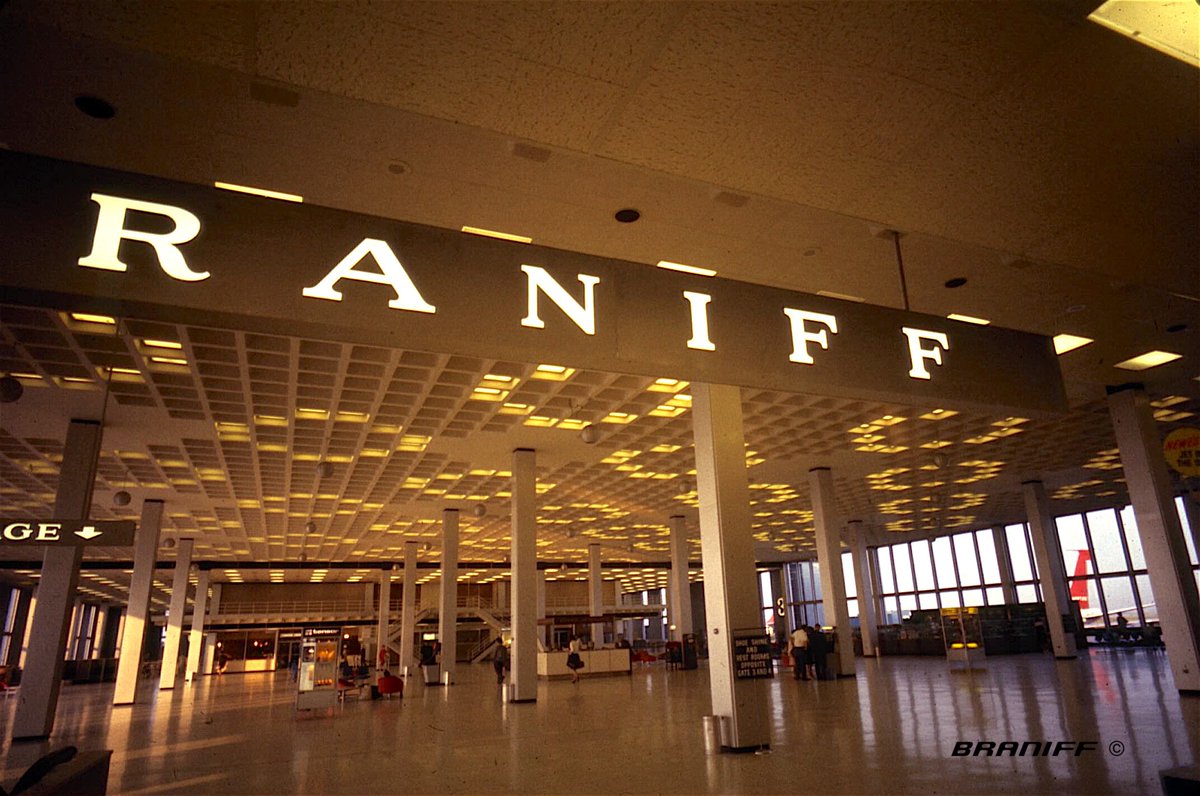
REMEMBER THOSE BRANIFF DC-8 JETS - Do you remember those great Braniff International McDonnell Douglas DC-8-51 Intercontinental Jets parked at Gate 7 at Dallas/Ft. Worth Regional Airport, Texas, and in Two Tone Green!!! Love, Braniff
Braniff Airways Foundation
Copyright 1926 2026
Photo: Braniff Airways, Incorporated, Copyright
Braniff International Heritage Archives
Now Associated with The University of Texas at Dallas System
Braniff Airways Space Sciences Endowment
https://t.co/fkQs4q0OFL
https://t.co/dxaRBgJvxE
https://t.co/rurojxHifZ
https://t.co/fDvnT9QrE0
BRANIFF ULTRA LITE HISTORY TODAY - On this day, Monday, January 22, 1968, Braniff International's first ever inflight magazine debuted aboard all company aircraft. Simply titled, "Braniff International" (with emphasis on International), the colorful and flashy magazine included the latest Braniff travel news as well as human interest stories, a unique crossword puzzle, and an introductory letter from Braniff Chairman of the Board of Directors Harding L. Lawrence.
Approximately 125,000 copies of the 24 page publication were placed in the seat backs of Braniff aircraft on January 22. Braniff Hostesses reported that the complimentary copies were widely read and taken in large numbers by passengers, indicating a high level of customer acceptance. Braniff International Magazine Editor Richard Magruder authored the first travel story titled "Exhilarating Ecuador: Land of Discovery. Mr. Magruder was hired by Braniff in the fall of 1967 as Director of Promotion in the Promotions Department.
Photo: This impressive 2-page ad was placed in the first Braniff Inflight Magazine featuring the latest products from Braniff Boutique in January 1968. Braniff Boutique today, you can get 10-percent off site wide except for posters during Black Friday Week!!!!!
Braniff Airways Foundation
Copyright 1926 2026
Photo: Braniff Airways, Incorporated, Copyright
Braniff International Heritage Archives
Now Associated with The University of Texas at Dallas System
Braniff Airways Space Sciences Endowment
https://t.co/fkQs4q0OFL
https://t.co/dxaRBgJvxE
https://t.co/rurojxHifZ
https://t.co/fDvnT9QrE0
BRANIFF HISTORY TODAY - On this day, Wednesday, November 23, 1955 Braniff International Airways was awarded a new route by the Civil Aeronautics Board between the Southwest and the Northeast. The new route enabled Braniff to provide competitive service from Dallas Love Field to Newark, New Jersey, with intermediate stops at Memphis, Chattanooga, and Nashville, in Tennessee, and Washington, DC. The new awards became available for use effective 60 days from November 23, 1955.
Several airlines, in addition to Braniff, were also awarded new service as a result of the Civil Aeronautics Board's findings in the Southwest To Northeast Service Case. The case was specifically initiated to improve airline service between Texas and Oklahoma and the Northeast, which included the destinations of New York City and Washington, DC. Delta Airlines, Trans World Airlines, American Airlines, Ozark Airlines, and Eastern Airlines were also awarded new services as a result of the case outcome.
The CAB placed two restrictions on Braniff's new route award. The first required that any Braniff flight originating in any city in one area must serve at least one city in one of the other two areas. If, for instance, a Braniff flight originated at New York or Washington DC, then it must terminate at one of the cities enroute in Tennessee or Texas. The second requirement called for Braniff to stop at Dallas, Ft Worth, Tulsa, or Oklahoma City if the flights originated south of Dallas or Ft Worth. Braniff could also operate nonstop flights as long as adherence to the two restrictions were maintained.
The CAB awarded American Airlines Houston to New York service with the stipulation that it also serve Pittsburgh, Pennsylvania. Delta Airlines received authority to operate from Atlanta to Newark via Charlotte, Washington DC, Baltimore, and Philadelphia. Delta was also authorized to fly between Dallas and the Northeast cities but with a required stop at Atlanta in addition to nonstop service between Houston and New Orleans and the Northeast. Capital Airlines could no longer operate between New Orleans and the Newark and Washington, DC, via Baltimore and Philadelphia.
Trans World Airlines was awarded new service between Tulsa and Oklahoma City and New York, Baltimore, Philadelphia, and Washington DC. Ozark Airlines was authorized to add Paducah, Kentucky, to its route map and Eastern Airlines was awarded service from Pittsburgh to New Orleans with intermediate stops at Atlanta, Mobile, and Birmingham.
As a result of the awards, Braniff became American's direct competitor between Dallas and the New York area along with Delta Airlines although it was required to stop at Atlanta. Braniff also became a secondary competitor to Eastern between Houston and New York and between New Orleans and New York but with the single-stop restrictions. Braniff would also compete with Trans World Airlines between Tulsa and Oklahoma City, and the Northeast. Braniff's new service from the Southwest to the Northeast was inaugurated three months later on February 15, 1956, using Douglas DC-6 El Conquistador aircraft.
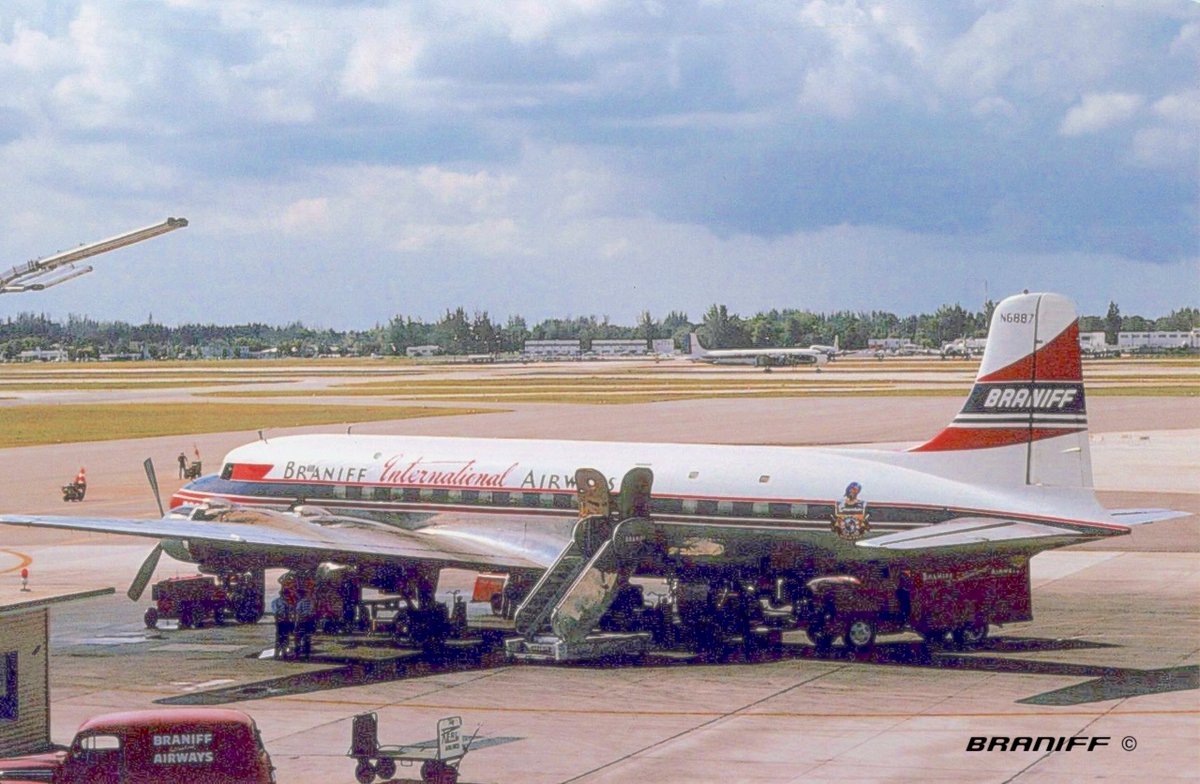
Photo: Braniff International Airways Douglas DC-6 registered as N6887 is parked on ramp at Miami International Airport awaiting its passengers for the next flight. The four-engine airliner is being readied for departure in 1960.
Braniff Airways Foundation
Copyright 1926 2026
Photo: Braniff Airways, Incorporated, Copyright
Braniff International Heritage Archives
Now Associated with The University of Texas at Dallas System
Braniff Airways Space Sciences Endowment
https://t.co/fkQs4q0OFL
https://t.co/dxaRBgJvxE
https://t.co/rurojxHifZ
https://t.co/fDvnT9QrE0
BRANIFF HISTORY TODAY - Today, we celebrate the anniversary of the birth of Braniff International Captain Wilford Woodruff Garbett, who would have been 100 years old today. Captain Garbett's formidable aviation career included extensive military and airline service that spanned over 40 years.
Captain Wilford Woodruff "Bill" Garbett was Senior Vice President of Flight Operations at Braniff Airways, Incorporated, a wholly owned subsidiary of Braniff International Corporation, that was based in Dallas, Texas. Captain Garbett was with Braniff for 35 years where he served as a line pilot before transitioning into flight operations management.
He was born on November 23, 1920, at Pocatello, Idaho, to George and Leora Garbett. Bill Garbett was named after George Garbett's younger brother who died in a drowning accident while duck hunting in 1919. He attended school and graduated from Pocatello High School in 1938. He briefly attended Idaho State College and then entered the School of Engineering at the University of Idaho in 1938.
In 1939, he left the University of Idaho and accepted a position to become an Apprentice Engineer for the Union Pacific Railroad in the early 1940s. The railroad was Pocatello’s biggest employer, and electrician jobs were considered to be the best because they received specialty training and the work wasn’t as physically taxing as other railroad jobs. During his spare time, Garbett enjoyed driving his 1936 Chevrolet Roadster and yellow Harley Davidson motorcycle.
In the early 1940's, the War Department created a Civilian Pilot Training Program to begin training pilots for the mounting overseas conflict. The program allowed young aspiring pilots, such as Bill Garbett, to receive their Private Pilot certification at Government expense. Trainees were given ground school and then 35 hours of flight training to obtain the initial license. In 1941, Garbett joined a newly formed National Guard unit, and his initial job was Battalion Intelligence Sergeant. He was then assigned to the 183rd Field Artillery Regiment of the Idaho National Guard.
Garbett joined the US Army Air Corps in 1942, and concentrated on aviation during his enlistment. He had applied for pilot training and in February 1942, received orders to transfer into the Aviation Cadet Program. Here he flew Ryan PT-22, Vultee BT-13, and Advanced Trainer Curtiss PT-9 twin-engine aircraft. He graduated from flight training in September 1942, and was commissioned as a Second Lieutenant and initially assigned to the Ferry Command at Great Falls, Montana, with the position of co-pilot on B-17 ferry missions. During World War II, he flew for the Air Transport Command in both Alaska and Africa and was assigned to the Africa-Middle East Wing of the Command. He achieved the rank of Captain during his military war time service.
On February 23 1942, he married Flossie Amanda Haines, with whom he had two children; a son, William S. Garbett born 1945, and a daughter, Beverly J. Garbett, born in 1952. Mrs. Garbett was known for her lively and active household that was always open to her children's friends. Even though Captain Garbett's flying would take him away for several days, the Garbett home was still an exciting place to be because of Mrs. Garbett's graciousness. She invited a niece and family friend, who were seniors at the time, to come live with them until they graduated. Mrs. Garbett, enjoyed golfing, entertainment, bridge and knitting, possessed a sharp wit and was exceedingly charming.
On June 1, 1945, Bill was hired by Braniff International Airways as a Co-Pilot, prompting the family to move to Dallas, Texas. This began a 35-year career with the Texas-based airline that found him flying aircraft such as the Douglas DC-3, DC-4, DC-6, DC-7 and DC-8. He also flew the Curtiss C-46 Commando, Boeing 707, 720, and 747, as well as the Convair 340 and 440 aircraft during his time at Braniff. In 1961, Garbett moved his family to Pompano Beach, Florida, where he began flying Boeing 707 jets between the US Mainland and South America.
The Garbett family moved again, in January 1970, to Dallas, Texas, Braniff's headquarters, when Captain Garbett was promoted to Staff Vice President-Flying. Prior to his promotion he served as Manager of Flight Training at Miami, Florida, and from 1968, as Manager of Flying Operations for the Miami pilot base. Captain Garbett was further promoted to Senior Vice President of Flight Operations in March 1979, and retired from Braniff, on November 30, 1980, while serving in that position.
Soon after his retirement from Braniff, he returned for a brief period, as a consultant to the company in 1981, to help negotiate a new pilot contract for the struggling airline. Captain Garbett then consulted for an aviation company in Medellin, Colombia. In 1984, the Garbett's moved to Niceville, Florida, near Ft Walton Beach in the Panhandle region of the state where Captain Garbett enjoyed his retirement. He and his wife Flossie were active members of the Rocky Bayou Country Club in Niceville, and he held various committee and board positions.
On February 9, 2008, Captain Garbett died at the age of 87. He was survived by his wife of 66 years, Flossie and their two children William, and his wife Christine of Tybee Island, Georgia, and Beverly, and her husband George A. Hritz, of Greensburg, Pennsylvania. He was also survived by two grandsons, Matthew and Michael Garbett.
The Garbett family held a Memorial Service for Captain Garbett on February 12, 2008, at Rocky Bayou Country Club, to celebrate his life and times. Friends and family remembered his brilliantly droll wit that he possessed and the many ways that he had touched and enriched their lives. He was cremated and his ashes were scattered along the shore of Grayton Beach State Park, Santa Rosa Beach, Florida. It was a special place as he would drive there with his family when they would visit, buy a loaf of bread on the way, and feed the seagulls. Flossie Garbett died two years later on March 13, 2010, at the age of 88.
Braniff Airways Foundation created a Find-A-Grave Memorial Page for Captain Garbett. Please sign the guest book at the link below:
https://t.co/LkGDuXpeyn…
Photo: Captain Garbett is standing on the boarding stairs for Braniff’s Alexander Calder South America with Flying Colors DC-8-62 Intercontinental Jet registered as N1805 in May 1975. The Calder jet was invited to the Paris Air Show and Captain Garbett piloted the big colorful jet from Dallas to New York John F. Kennedy International Airport to pick up guests going to the airshow including Alexander Calder who painted two new designs on the right side outer engine cowlings while at the massive air show event.
Braniff Airways Foundation
Copyright 1926 2026
Photo: Braniff Airways, Incorporated, Copyright
Braniff International Heritage Archives
Now Associated with The University of Texas at Dallas System
Braniff Airways Space Sciences Endowment
https://t.co/fkQs4q0OFL
https://t.co/dxaRBgJvxE
https://t.co/rurojxHifZ
https://t.co/fDvnT9QrE0
BRANIFF HISTORY TODAY - Happy Birthday to Braniff International Airways President Charles Edmund Beard, born November 23, 1900. Today we celebrate the 120th Anniversary of Mr. Beard's birth. Known by friends as Chuck Beard, he assumed leadership roles at Braniff during two of the most critical times in the Airline's celebrated history.
In 1935, Mr. Beard assumed the role of General Manager of Braniff Airways, Inc., after Braniff cofounder Paul Revere Braniff left the company. Under his and Tom Braniff's management, the airline quickly added new routes and new aircraft to the company including the its first twin-engine aircraft, the 10-passenger Lockheed L-10 Electra in 1935, which was followed by the 14-passenger Douglas DC-2 in 1937.
Mr. Beard again, brilliantly guided Braniff Airways through a highly difficult period beginning in January 1954, when co-founder Thomas Elmer Braniff was killed in a private plane crash in Louisiana. Charles Beard was instrumental in ushering Braniff into the Jet-Powered and pure jet age, which included placing orders for the Lockheed L-188 Electra turboprop and Boeing 707 turbojet aircraft in 1955. He also placed two orders for the planned US built Supersonic Transport.
In April 1964, Braniff President Beard officially placed deposits for two US made Supersonic Transport Aircraft in the amount of $100,000 USD for each aircraft. This officially assigned Braniff slots number 38 and 44 when the SST aircraft was scheduled to begin production. This was a bold and dramatic move for an airline of Braniff’s medium size but Beard’s belief in the company and especially Braniff’s employees made it an easy decision for him.
At the time this deposit was made, the SST program was being financed by the US Government under an edict from President Kennedy. Three US makers including Boeing, Lockheed, and North American were vying for the contract to produce America's first supersonic airliner. Unfortunately, the program was cancelled under the direction of Congress in 1971.
As a result of the cancellation of the US SST program, the British/French Concorde became the mainstay for high speed jet travel. In 1978, Braniff Chairman Harding L. Lawrence negotiated a unique interchange operation with British Airways and Air France to operate Concorde from DFW to London and Paris via Washington Dulles. Unlike the US SST, Concorde could only carry 100 passengers and its economic viability due to two major fuel crisis during the 1970s since its first flights crippled the aircraft's sales. Only British Airways and Air France would ultimately own Concorde aircraft.
President Beard noted that the two US SST aircraft that Braniff placed deposits on would be used on the carrier's long range US to Latin America services where the sleek new Boeing 707 was already traversing quite satisfactorily. In addition to the three airframe designs submitted, General Electric, Curiss-Wright, and Pratt and Whitney would also submit proposals for super high powered turbojet engines capable of moving the massive SST at Mach 3 or 2000 mph. The required four engines would need to be capable of producing 50,000 lbs of thrust and capable of operating at altitudes of up to 70,000 feet and be able to carry 200 passengers.
Braniff Airways Foundation has authored a Wikipedia article chronicling the fascinating and impressive life of Charles Edmund Beard and created a Find A Grave Memorial page in his honor. Both can be viewed at the following links:
https://t.co/ilmf0Jd0Ph
https://t.co/LkGDuXpeyn…
The personal archives of Charles Beard are housed in the Braniff International Heritage Archives, which are administered by Braniff Airways Foundation. This substantial archive includes papers and memorabilia from Mr. Beard’s life before and after Braniff as well those from his 30 years with the company. Mr. Beard’s archive joins the personal archives of Thomas Elmer Braniff, Paul Revere Braniff and Harding L. Lawrence housed in the Braniff International Heritage Archives.
Photo: Mr. Beard, on left, is congratulating Mr. Aubrey Costa of Dallas, Texas, on July 22, 1960. Mr. Costa was the 20 millionth passenger to fly on Braniff Airways. A striking polished aluminum model of the Boeing 707-227 El Dorado Jet was presented near the Dallas Love Field Ticket Counter by Mr. Beard for Mr. Costa's milestone flight aboard Braniff International Airways.
Mr. Beard’s Braniff papers give the researcher a unique and heartfelt look at the life an airline leader. Braniff was purchased by Greatamerica Corporation in 1964. Greatamerica was a major insurance firm owned by Troy Victor Post. In November 1964, Mr. Beard announced his retirement from the company and it was clear from his personal papers that he was being forced out and somewhat unfairly and unceremoniously.
The management of Greatamerica that had been assigned to Braniff began looking for mistakes that Mr. Beard had allegedly made to make the case for his eventual removal. The key points involved an accounting method approved by the CAB for the DC-6 fleet and the renewal of company fleet insurance three years earlier. Braniff’s incoming President Harding Lawrence was quit vocal in his defense of Mr. Beard’s actions.
Mr. Lawrence made it clear that he did not see that the accounting or insurance “mistakes” were mistakes but in fact followed government policy in the case of the accounting and company policy in the renewal of the insurance. Contrary to rumored stories, Mr. Lawrence remained friends with Mr. Beard and Mr. Lawrence made sure the Mr. Beard was invited to all company functions.
Braniff Airways Foundation
Copyright 1926 2026
Photo: Braniff Airways, Incorporated, Copyright
Braniff International Heritage Archives
Now Associated with The University of Texas at Dallas System
Braniff Airways Space Sciences Endowment
https://t.co/fkQs4q0OFL
https://t.co/dxaRBgJvxE
https://t.co/rurojxHifZ
https://t.co/fDvnT9QrE0
BRANIFF NOVEMBER 22, 1963 - A unique photo of President Kennedy at Dallas Love Field after leaving Air Force One on November 22, 1963. The President's Secret Service battalion is behind him followed by Mrs. Kennedy who is signing an autograph among the throng of thousands of admirers.
The International Arrivals Building can be seen in the background. The building is beige in color with the classic Love Field style 1960s font in bright red. This photo is taken looking Northwest.
Braniff Airways Foundation
Copyright 1926 2026
Photo: Photographer Unknown, Copyright
Braniff International Heritage Archives
Now Associated with The University of Texas at Dallas System
Braniff Airways Space Sciences Endowment
https://t.co/fkQs4q0OFL
https://t.co/dxaRBgJvxE
https://t.co/rurojxHifZ
https://t.co/fDvnT9QrE0
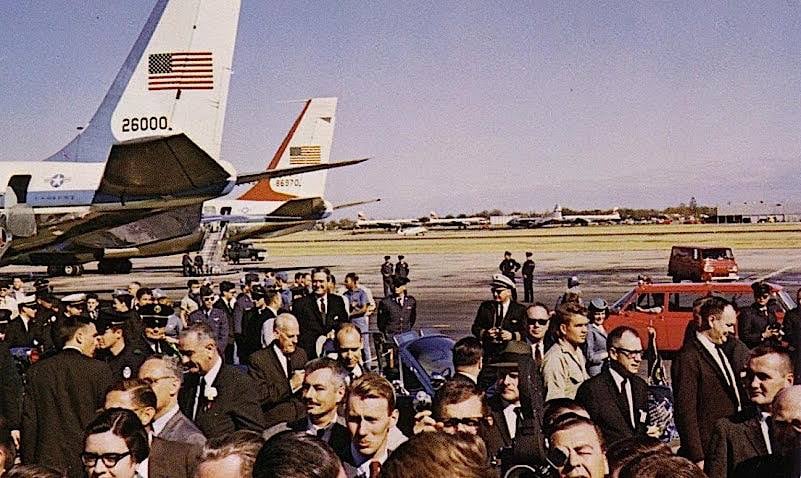
BRANIFF NOVEMBER 22, 1963 - Vice President Lyndon Baines Johnson is shown in the foreground with Air Force One and Air Force Two parked on the Red/East Concourse ramp at Dallas Love Field on November 22, 1963. The Presidential entourage has arrived only moments earlier to begin the motorcade through downtown Dallas.
In the background, several Braniff International Airways Douglas four-engine aircraft are parked on the far North Ramp of the Braniff Operations and Maintenance Base. The base, Braniff's major maintenance facility, was opened in October 1958, and is located at 7701 Lemmon Avenue on the east side of Love Field.
Braniff Airways Foundation
Copyright 1926 2026
Photo: Photographer Unknown, Copyright
Braniff International Heritage Archives
Now Associated with The University of Texas at Dallas System
Braniff Airways Space Sciences Endowment
https://t.co/fkQs4q0OFL
https://t.co/dxaRBgJvxE
https://t.co/rurojxHifZ
https://t.co/fDvnT9QrE0
BRANIFF NOVEMBER 22, 1963 - The South Ramp of the Braniff International Airways Operations and Maintenance Base on the east side of Dallas Love can be seen in the upper left corner of this WFAA TV photograph of SAM 26000 a VC-137C (707-353B) or Air Force One when the President was on board, on November 22, 1963. Vice President Johnson's aircraft, 86970 Special Air Missions SAM 970, a VC-137B (707-153B), is to the left of Air Force One and a chartered Pan American World Airways Boeing 707-321 that carried members of the Press is parked to the right of Air Force One.
The Braniff North Concourse was just to the left also known as the Yellow Concourse where Braniff remained until December 1968, when the Braniff exclusive Terminal of the Future was opened at the south end of the Red/East Concourse. The Presidential aircraft were parked on the far east end of the Red/East Concourse just to the east of Gate 28A. Eastern and Mexicana Airlines operated from Gate 28 and 28A along with American Airlines international arrivals, which was an outdoor fenced-in gated area.
The Presidential Party deplaned via an Eastern Airlines stairway. Trans Texas operated from Gates 24 and 25 at the other end of the Red Concourse and Continental used Gates 26, 27, and 27A. Gate 27 was also part of the fenced-in gated area along with gates 28 and 28A.
The Presidential Party had flown from Fort Worth Carswell Air Force Base to Dallas Love Field the morning of November 22 for a motorcade drive through Dallas and were then scheduled to proceed to the Dallas Business and Trade Mart for a luncheon and speech attended by the Dallas Citizens Council and the Dallas Assembly and Graduate Research Center of the Southwest.
After the speech, the party was scheduled to proceed back to Love Field for departure to Austin, Texas, for a fundraising dinner speech at the Municipal Auditorium. The group was then supposed to proceed to the LBJ Ranch at Hye and Stonewall, in Gillespie County, Texas, for a weekend of relaxation at the fabled Hill Country Ranch.
Mr. Kennedy had visited the LBJ Ranch previously on November 16, 1960, where he relaxed and enjoyed the beautiful Hill Country after the close of the 1960 election. Vice President-Elect Johnson was so concerned about President-Elect Kennedy's health that he made sure that Mr. Kennedy used the bedroom that was directly over Mr. Johnson's so he could hear Mr. Kennedy if he was having any difficulties. Mr. Johnson told Mr. Kennedy to bang on the floor if he needed anything and he would be right there.
In 2013, the City of Dallas officially marked the spot with an "X" where Air Force one was parked on November 22, 1963. Also, on September 3, 2015, a special plaque was placed in the ground on the ramp at Dallas Love Field where Air Force One was parked. The plaque specifically details Vice President Johnson's swearing in as President while on board Air Force One, shortly after President Kennedy's death. The plaque was donated by historian Farris Rookstool III, who also provided a second plaque for installation at the Love Landing Observation Deck inside of the newly remodeled 1958 Dallas Love Field Terminal.
In 2017, a striking etching on glass of the the Presidential airliner was placed in the large panoramic window of the Main Terminal Mezzanine that overlooks the ramp where the Kennedy jet was parked. An additional plaque indicating where the jet was parked was placed on the wall to the right of the window.
Braniff Airways Foundation
Copyright 1926 2026
Photo: Photographer WFAA-TV Dallas, Copyright
Braniff International Heritage Archives
Now Associated with The University of Texas at Dallas System
Braniff Airways Space Sciences Endowment
https://t.co/fkQs4q0OFL
https://t.co/dxaRBgJvxE
https://t.co/rurojxHifZ
https://t.co/fDvnT9QrE0
BRANIFF NOVEMBER 22, 1963 - Air Force One arrives at San Antonio, Texas, on November 21, 1963, with the President and Mrs. Kennedy on board, along with Congressman Henry B. Gonzalez of Texas, and other dignitaries. The Presidential entourage disembarked at the Braniff International Airways ramp via a Braniff stairway.
The First Couple began their Texas trip in San Antonio with a dedication speech given by the President for the new Air Force School of Aerospace Medicine at Brooks Air Force Base. The group continued to Houston, Texas, and the Rice Hotel for an evening dinner to honor Congressman Albert Thomas, of Texas.
Later in the afternoon, Air Force One departed Houston for Fort Worth, Texas, where the Presidential Party stayed at the Hotel Texas. A white Lincoln Continental Convertible (Mr. Kennedy and Mr. Johnson's favorite automobile) car would take them to the hotel where a Chamber of Commerce breakfast speech was given by the President on the morning of November 22, 1963.
Braniff Airways Foundation
Copyright 1926 2026
Photo: Photographer Steve Vinciguerra, Copyright
Braniff International Heritage Archives
Now Associated with The University of Texas at Dallas System
Braniff Airways Space Sciences Endowment
https://t.co/fkQs4q0OFL
https://t.co/dxaRBgJvxE
https://t.co/rurojxHifZ
https://t.co/fDvnT9QrE0
BRANFF BOUTIQUE BLACK FRIDAY WEEK BEGINS NOW THROUGH THANKSGIVING WEEK!!!!!!!!!!!!
10 PERCENT OFF SITEWIDE!!!!!!!!!!!!!
USE CODE AT CHECKOUT: 10BIHOLIDAY2026
https://t.co/8bSTYjQoQE
BRANIFF FALL WINTER 2026 COLLECTION
AT BRANIFF BOUTIQUE
BRANIFF RAINBOW OF COLOR IS ABUNDANT THIS FALL!!!!!
BRANIFF BOOK BACK IN STOCK!!!!!!!!!!
SUPPORT BRANIFF AIRWAYS FOUNDATION....
SHOP THE NEW BRANIFF FALL WINTER COLLECTION!
CLICK BELOW:
https://t.co/uwxdOtroSh
BRANIFF GETS YOU THERE WITH FLYING COLORS - On this day, Thursday, November 20, 1975, Braniff International's second flying mobile, designed by Master Alexander Calder, a Boeing 727-291 registered as N408BN departed Dallas/Ft Worth Regional Airport on its first scheduled flight. The flight officially began the Flying Colors Campaign that celebrated the 200th Anniversary of our nation's birth throughout the remainder of 1975 and during all of 1976.
The Calder 727 was the centerpiece of a series of ceremonies at each Braniff destination where the aircraft first visited. Forty domestic Braniff destinations welcomed a visit from the exciting Flying Colors of the United States Boeing trijet where well wishers and local dignitaries heralded the beginning of the Bicentennial celebration with the arrival of the Calder painted jet. The patriotic red, white and blue airliner flew over 15,000 route miles between Braniff's forty domestic destinations and was seen by over 1 million people during 1976 alone.
While the Calder 727 was the only Braniff jet painted in the Bicentennial scheme, all seventy Braniff Boeing 727 aircraft received unique Flying Colors titles in white on the center engine nacelle to identify the excitement of the Bicentennial celebration. McDonnell Douglas DC-8-62 Intercontinental Jets were scheduled to have the Flying Colors titles placed just under the cockpit windows on each side but it was ultimately decided that they would only be applied to the 727 fleet. A new slogan was adopted for the airline that served to impress upon on customers that Braniff had once again reinvented airline service and recommitted itself to providing the best service possible:
Braniff Gets You There With Flying Colors
Photo: Braniff International Boeing 727-291 registered as N408BN is flying high over Texas in November 1975. The Calder jet embarked on the Flying Colors Inaugural Tour of domestic United States cities earlier that month and was the centerpiece of Braniff’s celebration of the Nation’s 200th birthday, which was dubbed the Flying Colors Campaign. The main core of the Flying Colors Campaign was launched on Flag Day 1976, lasted through Independence Day and included an array of special events and promotions to demonstrate that Braniff Gets You There With Flying Colors.
Braniff Airways Foundation
Copyright 1926 2026
Photo: Braniff Airways, Incorporated, Copyright
Braniff International Heritage Archives
Now Associated with The University of Texas at Dallas System
Braniff Airways Space Sciences Endowment
https://t.co/fkQs4q0OFL
https://t.co/dxaRBgJvxE
https://t.co/rurojxHifZ
https://t.co/fDvnT9QrE0
BRANIFF HISTORY TODAY - On this day, Tuesday, November 20, 1956, Braniff Airways took delivery of its first two of five Convair 440-32 Metropolitan twin-engine airliners. The new aircraft entered scheduled service three weeks later on December 10, 1956. Arrival of the 440s was part of the Airline’s $83 million USD flight equipment improvement program, which also included the purchase of new Douglas DC-7Cs, Lockheed L-188 Electra turboprops and Boeing 707-227 four-engine pure jets.
Delivery ceremonies were held at the Consolidated Vultee Aircraft Company plant at San Diego, California. Braniff Airways President Charles Edmund Beard and Executive Vice President J. W. “Bill” Miller were accompanied to California, by Reginald K. Rex Brack Vice President Traffic and Sales and Captain R. V. Carleton Vice President R. V. Carleton. Representing Convair, a Division of General Dynamics Corporation, at the event was company President Gen. Joseph T. McNarney. The group was joined by Miss Gay Cowie, who was the current Miss San Diego of 1956. The ceremony included discussion of the new Convair’s “quiet as a mouse” theme of operation.
Mr. Brack stated during the ceremonies that, “The new Convair 440s will be used to provide air travelers with more seats on our heavy traffic segments.” Once the ceremonies ended, the group was ready to fly the new Metropolitan. Captain Carleton commanded the first flight back home to Texas, in the sharp new airliner, while the second aircraft took off one minute later with Captain George Cheetham at the controls. Mr. M. G. Saffrit and Emmett Haley served as First Officers on the return flights. With the help of strong tailwinds, both flights averaged 290 mile-per-hour ground speed over the 1230 mile distance back to Dallas. The flights were completed in only 4 hours and 15 minutes.
Braniff ordered five of the airliners and the three other new Metropolitans were delivered in December 1956 and January 1957. However, the Airline bought an additional Convair 440 in the Fourth Quarter of 1957, bringing the 440 fleet to a total of six aircraft. The first two 440s were placed in service between Kansas City and New Orleans and Dallas and Amarillo, replacing Douglas DC-3s on both routes. Braniff operated the aircraft until 1966 with phase out beginning in 1962. Allegheny Airlines bought all of Braniff's 440's and converted them to Convair 580 Jet-Powered models.
The 44-passenger airliner could be outfitted to carry up to a maximum of 52 passengers with a Maximum Weight of 49700 pounds. The big Convair was powered by two Pratt and Whitney 2500hp R-2800-CB16 or -CB17 Double Wasp piston radial engines. Maximum cruising speed was 261 knots with an economical cruising speed of 250 knots and a service ceiling 24,900 feet.
Convair 440's range with maximum payload was 408 nautical miles, or a range with maximum fuel was 1677 nautical miles. The 440 featured a wing span of 105 foot 4 inches with a length 81 feet 6 inches, which was two feet longer than the sister Convair 340, and a height 28 foot 2 inches and wing area 920 square feet. Braniff's new Convair was the perfect compliment to Braniff’s large Convair 340 fleet.
Braniff President Charles Edmund Beard stated that the 440s would be used on Braniff's heavy traffic routes and would hasten the retirement of the aging Douglas DC-3 fleet. Mr. Beard touted the increased acoustics of the new Convairliners that would allow Braniff passengers to enjoy a quieter and more comfortable flying experience. Window frames floated in a rubber seal and featured double glass for decreased noise. A new rectangular exhaust and increased cabin insulation further enhanced the luxurious environment of the new airliner.
On January 7, 1956, Braniff International Airways placed an order for five Convair 440-32 Metropolitan twin-engine airliners. The Convair 440 aircraft would join the large Braniff fleet of Convair 340 aircraft and perform similar local service duties with additional passenger luxury and quiet comfort.
Mr. Beard announced the purchase, which coincided with an order for nine Lockheed L-188 Electra Turboprop aircraft. The cost of the five new Convair 440s, ordered from Consolidated Vultee was $4 million USD. The Convair 440 was an improved version of the venerable Convair 340 and featured improved sound insulation, improved engine exhaust for more silent operation, and an additional two rows of seats with the addition of another cabin window if the optional 52-passenger configuration was ordered.
Braniff was an early customer for the Convair 440 with the airliner's first two hour test flight having just been completed at San Diego the month before in December 1955. The Convairliners played a crucial role in the development of Braniff and were the backbone of the fleet for over a decade.
Photo: Braniff International Airways Convair 440-32 Metropolitan registered as N3437 is parked on the ramp at Ft. Worth Greater Southwest Airport in September 1960. While the Convair 440s were initially delivered painted in the 1949 El Conquistador Red and Blue Color Scheme with White Upper Fuselage added in 1950, they were quick repainted in the updated 1956 Red and Blue El Dorado Color Scheme, shown here.
Braniff Airways Foundation
Copyright 1926 2026
Photo: Braniff Airways, Incorporated, Copyright
Braniff International Heritage Archives
Now Associated with The University of Texas at Dallas System
Braniff Airways Space Sciences Endowment
https://t.co/fkQs4q0OFL
https://t.co/dxaRBgJvxE
https://t.co/rurojxHifZ
https://t.co/fDvnT9QrE0
BRANIFF HISTORY TODAY - Happy Birthday to Emilio Pucci, Marchesi di Barsento, born on this day, Thursday, November 20, 1914. Today we celebrate the anniversary of the birth of the famed Haute Couturier known as "The Prince of Prints." Pucci's revolutionary uniform designs for Braniff International drew worldwide acclaim during his 12 years of association with the carrier.
Pucci, who was the only member of his Italian noble family to have worked at a job in 1000 years, designed the revolutionary Gemini IV Quick Change Costume Collection for Braniff International in 1965. He went on to design additional collections for the Texas-based luxury airline including the 1966 Supersonic Derby Collection, 1968 Pucci The Classic Collection, 1971 747 Braniff Place Pant Dress Collection, 1972 727 Braniff Place Blue Pant Dress Collection, the 1974 Classic Collection and finally a limited 1975 Flying Colors of the United States Collection.
Pucci led a colorful life beyond his dramatic fashions. Besides a Couturier, he was a bomber pilot in the Italian Air Force and a Liberal Party politician.
Photo: A Braniff International Hostess is modeling her brand new 1971 747 Braniff Place Pant Dress Collection by Haute Couturier Emilio Pucci in the intake of one of the airliner's huge Pratt and Whitney high-bypass engines. The hostess is displaying her umbrella in the 1971 Pucci Swirl Print and she is modeling the Pant Dress in solid pink and pink Pucci Swirl Print with Pink Palazzo Pants and light pink leather shoes by Herbert Levine.
Braniff Airways Foundation
Copyright 1926 2026
Photo: Braniff Airways, Incorporated, Copyright
Braniff International Heritage Archives
Now Associated with The University of Texas at Dallas System
Braniff Airways Space Sciences Endowment
https://t.co/fkQs4q0OFL
https://t.co/dxaRBgJvxE
https://t.co/rurojxHifZ
https://t.co/fDvnT9QrE0
BRANIFF HISTORY TODAY - On this day, November 19, 1962, Braniff International Airways inaugurated nonstop Boeing 707 El Dorado Super Jet Service from Dallas Love Field to the new Dulles International Airport, which served the Washington, DC area. Flying time between the two cities was a quick 2 hours 19 minutes making it the fastest service from the Southwest to the East Coast. Braniff's Boeings were the fastest in the world as result of the fitment of the biggest engines available on a standard Series -120 aircraft.
Dulles International Airport also opened for the first time on November 19, with the beginning of scheduled commercial service and the arrival of an Eastern Airlines Lockheed L-188 Electra turboprop aircraft from Newark, New Jersey. The new airport, situated 26 miles to the west of Washington, DC, in Dulles, Virginia, was named after John Foster Douglas, the Secretary of State during the President Dwight David Eisenhower Administration. The airport remained Dulles International Airport until 1984, when it was renamed Washington Dulles International Airport to show its closeness to its primary service city.
President John Fitzgerald Kennedy dedicated the airport during a special ceremony on November 17, 1962. The elegant and gracefully swept main terminal building was designed by famed Knoll International designer and architect and sculptor Eero Saarinen of the St Louis Arch and Womb Chair fame. The terminal was unique in that it featured an upward sweeping roofline that had the appearance of being in flight. It also incorporated floor to ceiling windows throughout along with new building techniques to create the uniquely shaped structure. The airport was a superb example of a government built facility.
Construction was begun in 1958, and it required the removal of a town called Willard. The airport covers 11380 acres and is operated by the Metropolitan Washington Airports Authority. A highly unique feature of the airport is the lack of long concourses or Jetways to move passengers from the main terminal to the aircraft boarding areas. Instead unique motorized coaches, called Mobile Lounges, were utilized that featured large boarding doors at either end. They were constructed much like a section of a traditional jetway but were motorized and wheeled.
Up to ninety passengers would board the adjustable height motor coach 15 minutes before departure at the terminal through one door and then be motored to their awaiting aircraft which was parked on a ramp adjacent to the main terminal building. Because of the 15 minutes of additional time, airline departure and arrival times appeared to overlap one another when in reality they were accurately accounting for the additional motor coach travel time. The coach adjusted its height to the aircraft boarding door and passengers boarded through the opposite end from where they boarded at the terminal annex. It was an ingenious idea that eliminated long walks for passengers.
However, as traffic increased at the airport and aircraft grew much larger by the 1980s, a series of concourses were added with traditional Jetways. The motor coaches were still used for transporting passengers to international flights, however, a new people moving transport dubbed Aero Train replaced the Mobile Lounges. Aero Train coaches are mounted on rubber wheels and guided along tracks much like the trains at Denver International Airport. On January 26, 2010, the last Mobile Lounge was relegated to minor service as the new Aero Train began service.
The new Braniff 707 Super Jet Service continued on to Newark, New Jersey, after stopping at Dulles International, which marked the first Braniff Jet Service at Newark. The Newark 707 service supplemented Braniff's thrice daily Jet Service from Dallas to New York Idlewild. Braniff's Flight 8 departed Dallas Love Field early morning and arrived at Dulles at slightly after noon time and at Newark by early afternoon. Flight 9 returned to Dallas via Dulles, departing Newark late afternoon and arriving Dulles a short time later before continuing to Dallas Love Field for an early evening arrival.
Braniff Vice President Robert H. “Bob" Burck noted that Braniff would continue to operate Lockheed L-188 Electra Jet service between Dallas and Washington National Airport twice daily, which also continued on to Newark. Additional new service between Houston and Chicago was also added on November 19, with Boeing 707 El Dorado Super Jets.
Photo: The Mobile Lounge is ready to pull up to the Braniff International Boeing 707-138B at Washington Dulles Airport in 1972. The long-range Braniff jet is painted in the 1971 Glenn Geddis/Harper and George Red over Tan/Aztec Gold Two Tone Color Scheme.
Braniff Airways Foundation
Copyright 1926 2026
Photo: Braniff Airways, Incorporated, Copyright
Braniff International Heritage Archives
Now Associated with The University of Texas at Dallas System
Braniff Airways Space Sciences Endowment
https://t.co/fkQs4q0OFL
https://t.co/dxaRBgJvxE
https://t.co/rurojxHifZ
https://t.co/fDvnT9QrE0
HAPPY BIRTHDAY TO GEORGE STANLEY GORDON - Today, we celebrate the 94th anniversary of the birth of advertising genius George Stanley Gordon. Mr. Gordon was born on this day, Friday, November 19, 1926. If anyone made a more indelible mark on the history of Braniff International, it was George Gordon who created the concept of inviting a world-renowned artist to paint the largest canvas in the world - a full-sized jet airliner. It was Mr. Gordon who asked Modern Master Alexander Calder to paint a Braniff jetliner.
George Gordon, who had worked for Eastern Airlines in 1962 and 1963, left the airline after overseeing one of its most important advertising campaigns dubbed Sunrise. He joined the Madison Avenue advertising firm of Foot, Cone and Belding, where he came up with the idea of asking an artist to paint a jet airliner. He chose Alexander Calder because of Calder’s whimsical and colorful way of designing his artwork, which was equally similar to the way Braniff presented itself to the flying public. Mr. Gordon felt that combining these two forces of art and business would not only forge a creative bond but also a highly lucrative advertising and marketing experience for all parties involved. His assessment was perfectly correct.
During his three years with Braniff International, Mr. Calder designed four different color schemes for Braniff aircraft but only two were applied to two airliners including the 1973 Flying Colors of South America, painted on a McDonnell Douglas DC-8-62 Intercontinental Jet. This design celebrated the 25th year of Braniff service between the US Mainland and Latin America. In 1975, he created a Bicentennial design to celebrate America’s 200th birthday, which was titled Flying Colors of the United States. This red, white and blue scheme was painted on a Braniff Boeing 727-291 Trijet and right by his side throughout the design and painting process, George Gordon was right at Mr. Calder’s side documenting every moment with film and photos.
Mr. Calder created a special color scheme for Braniff entire fleet during 1976. However, this color scheme was not used and has never been released to the public although it is highly attractive and would have again become a timeless Braniff color scheme. Also, in 1976, he designed a Salute to Mexico Color Scheme, which would have been applied to a Braniff Boeing 727-200 but on the night of November 11, 1976, having painted his last brush stroke on a 1/25 scale Westway model of a Braniff 727-200 Trijet, he died that evening in New York City. George Gordon was with him at his New York City studio and documented the painting of the final model with a film and numerous photographs.
Because of his brilliant proposal Mr. Gordon had brought to Braniff’s Chairman Harding L. Lawrence in November 1972, he was awarded the Dallas-based luxury liner’s South American advertising account. In 1974, George Gordon was awarded all of Braniff’s advertising business and created some of the Airline’s most memorable campaigns including the South America with Flying Colors and Flying Colors Campaigns in 1973 and 1975/1976, respectively. Often overlooked was the brilliant Ultra Elegance Campaign, which was introduced in November 1976, which ushered in a new era of elegance and sophistication at America’s Most Colorful Carrier.
Soon after Mr. Gordon’s death in April 2013, Braniff Airways Foundation, with the
assistance of his family, authored his Wikipedia page, which can be viewed at this link:
https://t.co/mx0RRnN3wf
Braniff Airways Foundation also provided information for a memorial to honor Mr. Gordon’s life and legacy on Find A Grave, at the following link:
https://t.co/fgqUewNrUX
Photo: Never one without the other, George Stanley Gordon, left and Alexander Calder, far right, is painting one of the Braniff Bicentennial Boeing 727-200 jet models. Mr. Gordon and Mr. Calder are at Calder’s Sache, France, studio, in the summer of 1975.
Braniff Airways Foundation
Copyright 1926 2026
Photo: Braniff Airways, Incorporated, Copyright
Braniff International Heritage Archives
Now Associated with The University of Texas at Dallas System
Braniff Airways Space Sciences Endowment
https://t.co/fkQs4q0OFL
https://t.co/dxaRBgJvxE
https://t.co/rurojxHifZ
https://t.co/fDvnT9QrE0
THE CALDER SPIRIT OF 76 TOUR BRANIFF STYLE - On this day, Tuesday, November 18 and Wednesday, November 19, 1975, Braniff International flew its latest Alexander Calder creation, a Boeing 727-291 registered as N408BN, on a tour to select large US metropolitan cities. The tour allowed for additional ceremonies to be held to commemorate the Bicentennial-themed airliner and for the public to preview the Boeing jetliner before it entered regularly scheduled service.
On the morning of November 18, the big 727 painted in Red White and Blue departed John F. Kennedy International Airport and headed northbound for Boston's Logan International Airport where local dignitaries and media gathered to greet the second Calder masterpiece for Braniff. On board the flight, was Braniff Executive Vice President Russell Thayer, who commented that, "The sheer volume and pleasing tone of the press coverage has already made the Calder project a success. We've improved our name identification from New England to the West Coast and even abroad. Now we must back up our promotional efforts with continued superior service.”
The latest Calder flying mobile was a huge hit with the media, which generated a massive amount of chatter about the exciting new centerpiece of Braniff's celebration of the nation's 200th birthday. The Boeing 727 departed Boston and headed eastbound to Detroit and Chicago. On November 19, the jet departed Chicago and flew southbound for Kansas City and finally ended the festivities with a grand celebration in Houston hosted by Mr. Thayer.
The nominal cost of the Flying Colors Campaign was returned by the priceless amount of publicity that it generated. Once again, as Braniff had achieved in 1973, a resounding success was had with another collaboration with Alexander Calder. The company quickly commissioned the renowned sculptor and Father of the Mobile and Stabile Art Forms to design a special Salute To Mexico for one of its Boeing 727 airliners, which was scheduled for release during 1977.
Photo: The original left engine cowling from Braniff International Boeing 727-291 registered as N408BN is currently in possession of the Whitney Museum of Art in New York City (as of 2020, the Whitney cannot locate the engine cowlings and is now considered a loss to Braniff Airways). The cowling was on display at the museum in 1977. Alexander Calder hand painted the serpent design on the nacelle while he supervised the painting of the patriotic jet at Braniff's Love Field Base beginning on November 10, 1975. The original serpent was later changed out for a less aggressive serpent that instead featured an abstract design.
Braniff Airways Foundation
Copyright 1926 2026
Photo: Braniff Airways, Incorporated, Copyright
Braniff International Heritage Archives
Now Associated with The University of Texas at Dallas System
Braniff Airways Space Sciences Endowment
https://t.co/fkQs4q0OFL
https://t.co/dxaRBgJvxE
https://t.co/rurojxHifZ
https://t.co/fDvnT9QrE0
BRANIFF HISTORY TODAY - On this day, Sunday, November 18, 1962, Braniff International Airways began operations from its beautiful new jet terminal at New York Idlewild International Airport. Flights began early that morning with ceremonies to dedicate the ultra-modern building following shortly thereafter. Braniff and two other carriers had been operating from a temporary terminal at Idlewild since 1961.
The $10 million USD terminal was jointly used by Braniff and two other major trunk lines, Northwest Orient Airlines and Northeast Airlines. The building was sleek and elegant and quickly became the most modern of all the terminals it joined at Idlewild. The predominant theme of the building was "to save steps," and was built with that premise in mind. Passengers were dropped off at the front of the building and only a few steps were required to walk from the curb to the ticket counter and then from the ticket counter to the gate of departure.
Braniff Assistant Vice President Airports and Facilities Roland Frost said at the terminal opening: "Our long awaited move to this efficient, new terminal will benefit both our passengers and personnel. Mr. Frost noted that the emphasis of the new terminal was to save passengers time and steps. Frost and his staff had worked closely with the building's architect Theodore F. Mariana to ensure that the design was both modern and time saving. The Braniff staff also worked closely with George A. Fuller, Co., the construction company for the project, its owner the New York Port Authority, as well as representatives of Northwest Orient and Northeast Airlines throughout the design and construction process. Mr. Frost noted that construction on the new terminal was completed early in November 1962.
Passengers loved the new terminal and were impressed with the spacious and modern facility. On arrival, passengers were greeted with an ultra-modern canopy system to protect them from the elements while walking from their ground transportation to the terminal. Three rows of octagonal umbrella shaped canopies that had the appearance of lily pads on top of thin round concrete pillars linked together to create the all-weather protection. Passengers arriving by taxi or other commercial method arrived at the Main Entrance on the Upper Level, which was accessed by the two level system of roads.
During the first weeks after the opening of the terminal, Braniff hired a doorman to greet and assist Braniff patrons. Mr. Carl Atherton of New York City, was hired by the Airline to act as official company doorman at the new terminal for four weeks beginning on November 15, 1962, and ending on December 12, 1962. The doorman was required to be on duty five and one-half days each of the four weeks Monday through Saturday. On weekdays he was required to arrive at 8AM each morning, which was an hour before Braniff's first flight and remain on the premises until a short period after the departure of Braniff's 6PM flight.
On Saturdays, Mr. Atherton worked between the hours of 1230PM and 6PM and was required to wear a uniform anytime he was on duty. He was paid a total of $500 USD for the entire four weeks, which was paid in $125 USD increments at the end of each seven day period. Mr. Atherton also received a total of $50 USD expense money for the four weeks, which was also paid incrementally in the amount of $12.50 USD each seven day period.
Once passengers left their ground transportation they were greeted with two huge vestibules that were glass enclosed. These vestibules guided the passenger into the stunning interior of the main passenger concourse. The terminal consisted of two huge floors and a mezzanine island and the passenger concourse was ten feet above the ramp level and the lower floor was four feet below the ramp level, which created a split-level floor plan. The upper level floor contained ticket counters, passenger concessionary stands as well as the ten boarding gates that were allocated to Braniff and the other two carriers. The lower floor featured airline operations offices for all three carriers in addition, to the baggage claim carousels.
Only 50 steps were required of passengers to walk to the Braniff ticket counter once they arrived on the upper level floor. As quickly as the passenger was ticketed they proceeded to their Braniff departure gate, which was only 100 steps further making the entire walking distance only 150 steps from curb to gate. Easy and convenient access was unique at the new terminal especially considering the massive size of the building, which measured an impressive 528 feet long by 205 feet wide. Another interesting feature was that the passenger could fully view his boarding gate and main terminal concourse from the Braniff ticket counter.
The passenger could elect to go directly to the gate or enjoy the various news and magazine and retail outlets as well as the restaurants while still keeping an eye on the departure gate area. The restaurant served fine cuisine and a separate Cocktail Lounge gave passengers the option of a quick beverage before their flight. Once back at the gate, boarding was accomplished via air conditioned Jetway bridges to keep passengers completely safe from inclement weather. Braniff's new building featured terminal contained boarding, which eliminated the necessity of making long treks through lengthy concourse "fingers" that were a common feature at airports. The new contained boarding system eliminated this primary passenger complaint and again followed the design theme of walking less steps.
Arriving passengers were also greeted with minimal walking with only 100 steps required from the boarding gate to the baggage claim area on the lower floor area followed by 36 short steps to ground transportation. Mr. Frost noted, "Passenger circulation throughout the terminal is extremely simple and direct." Interior design featured clean and functional lines throughout and upper level windows were floor to ceiling design, which allowed for large amounts of light to flood the building for maximum illumination. The exterior of the building was adorned in elegant bluish-gray panels that were accented in black and white metallic trim.
White terrazzo floors were standard throughout the building along with 23 foot high ceilings that featured a waffle pattern. The ceiling was supported by square columns that were covered in aluminum facing and featured stylish globes that hung down and contained the public address system speakers. The walls were paneled in light blue porcelainized aluminum that accented the vibrant clear blues of Braniff's ticket counter. The ticket counter, located on the south end of the mezzanine island, just inside the main entrance, measured an impressive 56 feet in length and was lighted by flush translucent ceiling fixtures.
To top of off the elegant terminal a VIP El Dorado Room was installed that was shared with Northwest Orient. Two massive sliding doors separated the two VIP rooms that were left open except for special occasions. Northeast Airlines had its own special VIP room in the same area. A Braniff uniformed attendant was on duty to ensure that passengers were happy and having an enjoyable time.
The new terminal opened for operations at 1201AM on November 18, 1962. At 1PM, special dedication ceremonies were held, which officially marked the opening of the new terminal. Braniff's passengers enjoyed the new terminal and were impressed by knowing that it was one of the most unique international Jetports in the nation.
Photo: Braniff International Airways new Idlewild International Airport Terminal opened on November 18, 1962, and this spectacular lobby was truly exhibited the modern international style. The new terminal was advertised in the November 19, 1962 Domestic and International Timetable. A full complement of introductory materials including an impressive two color brochure were part of the grand opening of the new Braniff terminal. The impressive "lilypad" structures that adorned the entrance to the new terminal were impressive and served to keep passengers safe from inclement weather during transition from the curb to the terminal, which was next door to Pan Am’s magnificent WorldPort Terminal.
Braniff Airways Foundation
Copyright 1926 2026
Photo: Braniff Airways, Incorporated, Copyright
Braniff International Heritage Archives
Now Associated with The University of Texas at Dallas System
Braniff Airways Space Sciences Endowment
https://t.co/fkQs4q0OFL
https://t.co/dxaRBgJvxE
https://t.co/rurojxHifZ
https://t.co/fDvnT9QrE0
BRANIFF HISTORY TODAY - On this day, November 17, 1976, Braniff International began negotiating with British Airways and Air France for a proposed interchange service between Texas and Europe using Concorde Supersonic Transport aircraft. The proposed Concorde service would operate from Dallas/Ft. Worth to Washington, DC, and then continue to either London on British Airways or Paris on Air France.
Braniff's Concorde Interchange would cut current travel times to Europe from the Southwest virtually in half in most instances. Flights would be scheduled to operate subsonically between Dallas/Ft. Worth Regional Airport and Washington Dulles Airport using leased Concorde equipment of either British Airways or Air France depending upon the final European destination or origination city. Braniff crews would fly Concorde from Dallas to Washington, DC, and then the appropriate British or Air France crew would assume control for the supersonic flight across the Atlantic.
Even though the segment between Dallas and Washington would be operated at subsonic speeds, it would still be 15 percent faster than current schedules because Concorde would be flown at 95 percent of the speed of sound. Under the proposed agreement, British Airways Concordes would operate westbound from London Heathrow to Dallas/Ft. Worth every Wednesday, Friday, and Sunday. The return eastbound Concorde would operate each Wednesday, Friday, and Sunday, with a short total flight time of only 6 hours and 30 minutes.
Air France Concorde flights would depart Paris Charles de Gaulle Airport three times for Dallas/Ft. Worth, every Wednesday, Friday, and Sunday, while the eastbound return flights would operate every Monday, Thursday, and Saturday. Total flight time between Paris and Dallas/Ft. Worth would be quick 7 hours and 10 minutes. The combined flights of both airlines would provide convenient Concorde service from the Southwest to Europe six days each week.
Braniff and Air France released a joint statement concerning the proposed new service that stated, "We have now begun negotiations and are optimistic that a final agreement can be reached in a short period of time so that appropriate government approvals can be promptly sought." British Airways and Braniff also released a joint communique about the new service that stated that the two companies were, "Optimistic and hopeful that an agreement will be reached soon on this historic milestone in aviation history."
Braniff International had long shown an interest in supersonic flight since the early 1960s. In 1961, Braniff Vice President of Operations Captain R. V. Carleton acted as Chairman of the world's first Supersonic Transport Conference. The Conference was held at Montreal, Canada, beginning on April 17, 1961. The symposium was sponsored by the International Air Transport Association and was attended by some 500 aeronautical experts from around the world. The event ultimately led to Braniff's placing of deposits on two United States SST slots in April 1964.
Over 500 aeronautical engineers attended the historic event, who were representative of the world's airlines, manufacturers, and governments. The International Air Transport Association or IATA hosted the week-long symposium. Critical discussion ensued on various aspects of SST aircraft operations that included utilization and operational costs, air traffic control needs as a result of higher speed travel, and how a predominantly super sonic world airline system might look.
Also in 1961, President Kennedy had asked for a study of the nation's aviation system and a specific request was made about the prospects of developing a US Super Sonic Transport aircraft. The program was approved by Congress and three US aircraft manufacturers submitted proposals. Boeing's unique 2707 SST would ultimately be chosen as the aircraft that would be built. However, environmental and cost concerns doomed the program and it was defunded by Congress in 1971.
The Anglo/French Concorde and Russian Tupolev TU-144 Super Sonic Transports would be the only two SSTs to enter passenger service. Two TU-144 crashes in 1973 and 1977 would doom the airliner after only one year of service ultimately forcing it into retirement in 1978. Concorde would continue as the only successful SST, however, only two airlines, British Airways and Air France would own the aircraft. Singapore Airlines and Braniff International were the only other airlines to operate Concorde via unique interchange agreements.
As a result of this conference and Captain Carleton's leadership, Braniff placed an order for two US SST transport aircraft on April 13, 1964, in addition to the three Concorde SSTs on September 1, 1966. The US SST program would be canceled by Congress in 1971 and the Oil Embargo of 1973 and 1974 caused all airlines, other than British Airways and Air France, to cancel their Concorde orders. Braniff canceled its orders for three Concordes in February 1973.
The 1973 cancellation of Braniff's Concorde orders did not end the carrier's interest in supersonic air transport, which it felt would be the next Frontier of aviation. Because of the lobbying efforts of Braniff Chairman Harding L. Lawrence, Concorde made its first flight to the United States by flying to Dallas/Ft Worth Regional Airport for the new airport's dedication ceremonies which began on September 20, 1973. In 1976, Braniff entered the negotiations with British Airways and Air France about the possibility of leasing Concordes for Braniff service from Texas to Europe and beyond. Braniff worked diligently for two years to bring Concorde to the United States and the dream of Braniff supersonic flight finally became a reality.
Once again Harding Lawrence was highly instrumental in moving forward with Concorde service. Braniff President Russell Thayer performed a great deal of the legwork during the two year process that included negotiations with two international airlines and aviation regulatory bodies in three countries. Braniff did not begin Concorde operations as a result of the freedoms that were granted to the industry as a result of the Airline Deregulation Act of 1978, as it had been working on the possibility of service since the mid-1960s. Lawrence felt that there was a large need for businessmen to be able to travel between Mid-America and Europe in one day's time. A busy executive could depart DFW at 830AM and arrive in London by 10PM or Paris by 1130PM.
Braniff had hoped to eventually operate Concorde service westbound between DFW and Singapore. An oil executive might depart Singapore at 1130AM and arrive in Dallas at 830PM via Bahrain, London, and Washington all in the same day. Only the speed of Concorde could make such an ambitious time schedule possible. Mr. Lawrence felt that Concorde represented the greatest technology in the airline industry at the time and could not believe that further innovation would not take the industry beyond the technology of the first SST model. In the regulated environment of the time, this would have been the course that the airline industry would have taken but in a free-market environment that ensued after 1978, cost-cutting to maximize profits precluded any further SST innovation.
Braniff International began operating Concorde service between Dallas/Ft Worth Regional Airport and Washington Dulles Airport with continuing service to either London Heathrow or Paris Charles de Gaulle beginning on January 12, 1979. The inaugural event was highlighted with a dramatic simultaneous landing of both a British Airways and Air France Concorde on the east and west side of the Manhattan-sized airport. This bold gesture signaled the beginning of Concorde service within the interior of the United States and the first time that a United States airline had flown the British Aircraft Corporation/Aerospatiale aircraft in scheduled service.
Braniff was the only US carrier to operate Concorde, via moist leases of 11 aircraft (six British Airways - actually only five, one was never used but leased - and five Air France Concordes) and one of only two carriers to lease Concorde for passenger services. Singapore Airlines was the other carrier that operated a similar moist lease Concorde operation first in 1977, and again in 1979. British Airways and Air France were ultimately the only carriers in the world to own Concorde aircraft.
Boeing 747 service had already been inaugurated by Braniff between Dallas and London Gatwick on March 18, 1978. However, the airline felt that there would not be any diversion of passengers from the 747 flight to Concorde flights. Schedules for both flights were designed to where departures were half-day apart and the two were being marketed as two different types of operations that operated to two different airports.
Braniff paid approximately $2000.00 USD an hour to lease Concordes from British Airways and Air France. Crew training was expensive at $1 million USD to train Braniff flight crews to fly the aircraft and maintain the cabin. Braniff International Captain Marion Griffith became the first US airline pilot to takeoff and land a Concorde aircraft in the United States.
Concorde service was operated by Braniff International until May 31, 1980. Initial Load Factors averaged only 40 percent but did begin to grow during the first few months of service. The carrier had been hopeful that load factors would settle into the 60 percent range thereby making Concorde service profitable which in turn could have led to service to the West. Overall, the service was never financially successful in large part due to the high operating costs that were exacerbated by unprecedented rise in fuel costs of over 92 percent in 1979, and its meteoric rise or 104 percent during 1980. Public perception of Braniff's Concorde service was that it was highly expensive ($5000 for a ticket on Concorde, which as not correct) even though the First Class fares were only slightly higher than Braniff's Boeing 727 First Class fares between Dallas and Washington Dulles. Braniff’s Concorde First Class fare between Dallas and Washington DC, was the most inexpensive scheduled fare available for any SST flight.
Photo: On January 12, 1979, twenty-six months after negotiations began for an interchange service, a British Airways and Air France Concorde arriving from London and Paris, respectively, landed simultaneously on the east and west runways at Dallas/Ft. Worth Regional Airport. The two jets taxied to The Braniff Terminal 2W and parked nose-to-nose, and then in a symbolic gesture to mark the beginning of the first Concorde service ever between the interior US and Europe, both aircraft lowered their noses in salute. Amidst typical Braniff fanfare, Concorde service began and the next day, January 13, 1979, the first eastbound flights departed, which completed the first roundtrip of the new interchange service. Braniff's Art Department created this special Concorde memory.
Braniff Airways Foundation
Copyright 1926 2026
Photo: Braniff Airways, Incorporated, Copyright
Braniff International Heritage Archives
Now Associated with The University of Texas at Dallas System
Braniff Airways Space Sciences Endowment
https://t.co/fkQs4q0OFL
https://t.co/dxaRBgJvxE
https://t.co/rurojxHifZ
https://t.co/fDvnT9QrE0
BRANIFF HISTORY TODAY - On this day, November 17, 1967, the Civil Aeronautics Board approved the acquisition of Braniff Airways, Inc., d/b/a Braniff International by Dallas, Texas-based conglomerate Ling Temco Vought. LTV would purchase Braniff's current parent company, Greatamerica Corporation, who purchased the airline on July 8, 1964. The purchase of Braniff International also included the carrier's sister company, National Car Rental in addition to controlling interest in Greatamerca.
The original LTV purchase plan was announced a few months earlier on August 4, 1967. LTV would make an offer to purchase all of the the shares of Greatamerica Corporation, which received unanimous approval from the board's of both companies. The offer was submitted to the Civil Aeronautics Board shortly thereafter, because the purchase involved controlling interest in Braniff Airways, Incorporated. The purchase of an air carrier required that a hearing be conducted by the Civil Aeronautics Board so that the required approvals could be obtained, which would allow the sale to commence.
The CAB rendered its decision on October 20, 1967, which mandated certain stipulations that were mainly designed to prevent LTV from using Braniff as a vehicle to promulgate its aerospace business. LTV could not transact more than $100,000 USD in air travel business with Braniff unless specifically approved by the CAB prior to the transaction. LTV could not market a new aircraft, if it were to build or sell one, to Braniff, again without prior CAB approval. And finally, the CAB retained its ability to reexamine the purchase and make appropriate changes to the agreement as might become necessary as the companies business environment might change.
This unique 1968 LTV historical and management review film presents a fantastic overview of the massive size and scope of business that LTV had grown into. There is an interview by founder Jim Ling and about two-thirds of the way through the film there is a portrait of Braniff Chair Harding L. Lawrence and a review of Braniff's importance to the LTV corporate structure:
https://t.co/NZIMYynG3q...
LTV was originally founded as an electric company and grew to a major conglomerate that emphasized aerospace, defense, and steel production and was the nation's third largest steel producer. Mr. Ling initially founded Ling Electric Company in Dallas, Texas, in 1947. He took his company public in 1955, and found creative ways to market his stock that included door to door selling and even setting up a booth at the State Fair of Texas. This creativity enabled Ling to acquire other entities while quickly and efficiently growing the LTV dynasty. In 1969, LTV employed 29,000 people and offered 15000 different products and services.
The relationship between Braniff and LTV was relatively harmonious. Mr. Lawrence stated at one point that he rarely had any contact with LTV or Mr. Ling during the time that LTV was in control of Braniff. Jim Ling's personal diaries state that the only contact that the two CEO's ever had was when Mr. Lawrence's salary and contract required negotiation. However, Braniff executives have stated publicly that LTV was using cash-rich Braniff to fund its purchase and acquisitions. As a result of an unrelated antitrust settlement, LTV would divest itself of Braniff in 1971.
Photo: LTV featured an article about its newly acquired subsidiary in the company's newsletter, dubbed LTV Image. On the front cover, a striking Braniff International Boeing 720 Super Jet is flying high painted in the 1957 Alexander Girard/Harper and George New Dark Blue Solid Color Scheme.
Braniff Airways Foundation
Copyright 1926 2026
Photo: Braniff Airways, Incorporated, Copyright
Braniff International Heritage Archives
Now Associated with The University of Texas at Dallas System
Braniff Airways Space Sciences Endowment
https://t.co/fkQs4q0OFL
https://t.co/dxaRBgJvxE
https://t.co/rurojxHifZ
https://t.co/fDvnT9QrE0
THE FIRST LADY MR CALDER AND BRANIFF CELEBRATE AMERICA - On this day, Monday, November 17, 1975, Braniff International dedicated its latest flying masterpiece from Alexander Calder that he designed for the carrier to celebrate the 200th Birthday of the United States. The Boeing 727-291 registered as N408BN was officially dedicated to the nation at Washington Dulles International Airport with a huge crowd of onlookers and dignitaries in attendance for the red, white and blue gala affair.
Braniff officials, local Dallas press and dignitaries flew to Washington Dulles early Monday morning for the mid-day dedication by First Lady Betty Ford. Braniff Chairman of the Board of Directors Harding L. Lawrence, Alexander Calder and his wife Louisa Calder, J. Carter Brown, Director of the National Gallery of Art, and Elizabeth Taylor's husband Former Secretary of the Navy John Warner, who chaired the American Revolution Bicentennial Committee were all in attendance for the event. The group took center stage behind Mrs. Ford on the grandstand in front of the Calder Boeing 727. The original Calder 1/25 scale Westway brand 727 model was on the grandstand in front of Mrs. Ford. This model was given, at Mrs. Ford's request, to the Art Museum of Grand Rapids, Michigan, where it remains today but is displayed at the Grand Rapids Airport Terminal.
Mrs. Ford commented that, "I particularly approve this combination of business and the arts, this marriage between Alexander Calder and Braniff. This is an attractive bigger-than-life reminder that 1976 is our Bicentennial year." Bicentennial Committee head John W. Warner commented that the project shows "what initiative and imagination can create." J. Carter Brown commented after the ceremony, "Purely in art terms, the plane is a great success." He went on to state that this shows what a corporation can do in the arts "with imagination, initiative, and a bit of spunk." Mr. Brown was one of the five art experts who chose the final Calder 727 design from the four designs that Calder painted on four Westway 1/25 scale Boeing 727 models.
This dramatic photo depicts the exciting spectacle that took place at the Calder Bicentennial dedication on November 17, 1975. From left to right behind Mrs. Ford and the 1/25 scale 727 model are J. Carter Brown, John Warner, Alexander Calder, Louisa Calder and Harding L. Lawrence. Behind the grandstand is the Braniff Color Guard composed of fifty of Braniff's best employees who traveled to Dulles on the Calder 727 to take part in the ceremonies. The Color Guard also toured the National Capital Building in Washington DC, later in the day before returning to their respective Braniff cities. And, the star of the show behind the Color Guard, is Braniff International Boeing 727-291 registered as N408BN featuring the 1975 Alexander Calder Flying Colors of the United States Bicentennial Color Scheme.
During 1976, the Calder Flying Colors of the United States jet traveled some 1,000,000 miles in scheduled service throughout the country between forty cities. This enabled millions of people to view the world's second flying mobile. The first jet design that Alexander Calder created for Braniff was dubbed South America With Flying Colors and was painted on a Braniff Douglas DC-8-62 Intercontinental Jet in October 1973. This was the world's first flying artwork and it had traveled over 3,000,000 miles between the United States and South America, since 1973.
After the ceremonies, the big Calder 727 departed for a ceremonial visit to New York City slated for later in the afternoon. The patriotic jet then began a brief two day tour to some of America's larger metropolitan areas.
Braniff Airways Foundation
Copyright 1926 2026
Photo: Braniff Airways, Incorporated, Copyright
Braniff International Heritage Archives
Now Associated with The University of Texas at Dallas System
Braniff Airways Space Sciences Endowment
https://t.co/fkQs4q0OFL
https://t.co/dxaRBgJvxE
https://t.co/rurojxHifZ
https://t.co/fDvnT9QrE0