Firmly believe that if you think you know whats going on you don't understand the situation. Nurse, friend, reformed hopeless romantic (but not quite cynic yet)
@MegOfficiall I used to work Monday Tuesday Thursday Friday. Having Wednesday to do all my errands while having the weekend free was marvellous. Also still got the Monday public holidays and got invited to the pub after work Fridays. I loved it.
@luv1bun I had a conversation about travel with a bloke I volunteered with. Seems his travel, and his opinions on those countries, counted for more because he was with the British army. My backpacking through Africa including Egypt, Jordan, Syria wasn’t worthy. Or maybe it was my gender.
@thevaccstat@SarahLudford@BiffoProp Maybe not, but to quote the article above they were “a gross parody of a man dressing up as a woman”. If it wasn’t such a parody it wouldn’t have been funny. Barry Humphries was a genius IMO and I doubt you can ban one without the other. I’d have banned Mrs Browns boys if so.
This is possibly the saddest thing I've seen in a long time..an immigrant nurse talking about fleeing her home..she saved her UNIFORM. So she could still WORK for our communities.
I'd fill this country with a thousand of this woman than one of those good for nothing thugs.
God help this poor woman.
@BraveRoyal@MRB_AI24 Most hospitals I’ve worked have dedicated arrest teams, in Australia these are called METeams who respond to ward emergencies. ER docs don’t have clinics.
@LampkeTina@MRB_AI24 You are correct. They do rounds. In packs. House officers, registrars, often a couple of each. The consultant should be able to make their clinic.
@MagaKristine@Pontifex Mate he’s posting on Twitter. I would say the majority of people on this platform know all of these words. At least the ones interested in the Popes views. Not to mention they can look them up. Or would you prefer the ramblings of the US president? Did we ever work out COVFEFE?
Dr. Frank Mayfield was visiting the Tewksbury Institute when, on his way out, he accidentally bumped into an elderly cleaning lady. To make conversation, he asked, “How long have you worked here?”
“I’ve worked here almost since it opened,” she said.
“What can you tell me about the history of this place?” he asked.
“I don’t know much,” she said, “but I can show you something.”
She led him down to the basement under the oldest part of the building and pointed to a small, rusted cell. “That’s where they used to keep Annie Sullivan,” she said.
“Who’s Annie?” he asked.
The maid explained that Annie was a young girl who had been brought there because no one could control her. She screamed, bit, and threw her food. The doctors and nurses couldn’t even examine her.
“I was just a few years younger than Annie,” the maid said. “I used to think, ‘I’d never want to be locked in a cage like that.’ I wanted to help her, but if the doctors couldn’t, what could I do?”
“One night I baked some brownies after work. The next day, I put them outside her cage and said, ‘Annie, I made these for you. You can take them if you want.’ Then I walked away, afraid she’d throw them. But she didn’t. She took the brownies and ate them. After that, she was a little kinder to me. I started talking to her, and one day, I even made her laugh.”
“One of the nurses saw this and told the doctor. They asked if I’d help them with Annie. So whenever they needed to see her, I went in first to calm her, explain things, and hold her hand. That’s when they discovered Annie was almost blind.”
After a year of slow progress, Annie was sent to the Perkins Institute for the Blind, where she learned to read, write, and later became a teacher herself.
Years later, Annie came back to Tewksbury to visit and help. The Director told her about a letter he had just received from a desperate father. His daughter was blind, deaf, and thought to be “crazy.” He didn’t want to send her to an asylum and asked if anyone could come teach her.
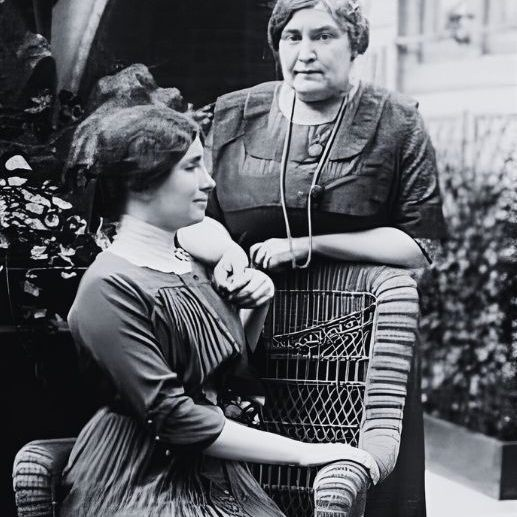
That’s how Annie Sullivan became the lifelong teacher and companion of Helen Keller.
When Helen Keller later received the Nobel Prize, she was asked who had most influenced her life. She said, “Annie Sullivan.”
But Annie replied, “No, Helen. The woman who changed both our lives was a maid at Tewksbury who once brought a little girl some brownies.”
In 1705, an Irish woman named Marjorie McCall fell gravely ill with a fever in Lurgan, Ireland. Believing she had died, her family hastily buried her to prevent the spread of contagion. Her husband, John McCall, a local physician, had been unable to remove her valuable ring because her finger was badly swollen — a detail that soon attracted the attention of grave robbers.
That same night, body snatchers dug up the fresh grave. Unable to pull the ring from her finger, they began cutting it off. The sudden flow of blood shocked the still-living Marjorie out of her deep coma. She sat upright in the coffin and screamed, terrifying the robbers, who fled and reportedly never returned to their grim trade.
Covered in dirt and still wearing her burial clothes, Marjorie climbed out of the grave and walked home. When she knocked on the door, her husband John, still in mourning, jokingly remarked that if his wife were alive, he would swear it was her at the door. Upon opening it and seeing Marjorie standing before him — alive, bleeding, and in her shroud — he collapsed from shock and died on the spot.
John McCall was later buried in the grave originally dug for his wife.
Marjorie survived the ordeal, eventually remarried, and had several children. When she died many years later, she was laid to rest in Shankill Cemetery in Lurgan. Her headstone famously reads:
“Lived Once, Buried Twice.”
In 1937, Rupert Mayer stood in his pulpit at St. Michael's Church in Munich and preached against Hitler.
By then, Germany had been a Nazi dictatorship for four years. Most priests remained silent. Most bishops tried to negotiate with the regime. Most Germans cheered. Mayer preached the opposite.
He was 61 years old—a Jesuit priest in a black cassock, standing on a wooden prosthetic leg. He had lost his original leg 21 years earlier. Here is how he got there.
Rupert Mayer was born in Stuttgart on January 23, 1876, the son of a prosperous merchant. He wanted to be a Jesuit from his teens, but at his father’s request, he became a diocesan priest first. He was ordained in 1899 at age 23, and a year later, he finally entered the Jesuit novitiate.
By 1912, he had settled in Munich, the city he would serve for the rest of his life. After World War I, Munich was a broken place—full of jobless veterans, hungry families, and people drifting in from the countryside with no housing or hope. Mayer went to work. He collected food and clothing, found jobs, and walked the streets at night to visit the poor. He walked, then hobbled, then walked again on that wooden leg.
He had lost his leg during the Great War. Having volunteered as a military chaplain, he served in field hospitals and the trenches across France, Poland, and Romania. On December 30, 1916, a grenade exploded near him, destroying his left leg. He was awarded the Iron Cross, First Class—the first priest to receive one of Germany’s highest military honors.
Back in Munich, he never stopped. By 1921, he was preaching at St. Michael's and celebrating Mass at the train station at 3:10 AM so workers could attend before their early shifts. The city began calling him "the Apostle of Munich."
Then came 1933. Adolf Hitler became Chancellor, and the Nazi Party began closing Catholic schools and trying to replace Christian identity with Nazi ideology. While much of the clergy stayed quiet to protect what they had, Mayer went straight to the pulpit. He preached against the Nazis by name, stating that a Catholic could not be a National Socialist and that Hitler’s racial theories contradicted the Gospel.
The Gestapo began sending informants to his sermons. In 1937, they ordered him to stop speaking in public altogether. He obeyed the letter of the law by avoiding rallies, but he returned to his pulpit and preached harder than ever.
He was arrested on June 5, 1937. At his trial, he told the judge: "Despite the ban imposed on me, I shall preach further, even if the state deems it a punishable act." He was given a suspended sentence, but he didn't stop. He was arrested a second time in 1938, then a third time in 1939. This time, the Gestapo tried to force him to break the seal of confession to reveal the names of Nazi opponents. Mayer refused.
At age 63, the one-legged priest was sent to the Sachsenhausen concentration camp and placed in solitary confinement. His health collapsed quickly. Fearing that his death in the camp would create a martyr, the Nazis moved him to Ettal Abbey under house arrest in 1940. For five years, he was forbidden to preach, leave, or receive visitors. He waited and prayed while his country destroyed itself.
On May 11, 1945, American soldiers liberated the Abbey. A U.S. officer personally drove Mayer back to the ruins of Munich. He climbed back into his damaged pulpit at St. Michael's and told the congregation: "Even a one-legged Jesuit, if it is God's will, can live longer than a 'thousand-year' dictatorship."
He spent his final months preaching reconciliation and forgiveness, refusing to call for revenge. On November 1, 1945, while preaching during Mass on All Saints' Day, he suffered a stroke and collapsed. He died within minutes, still in his vestments, still in his pulpit.
Mayer’s story matters because when most chose survival over witness, he chose the truth. He could have stayed quiet, but as he told a Gestapo interrogator, ....
NEW: Pope Leo XIV has named Salvadoran immigrant Evelio Menijar-Ayala to be West Virginia’s lone Catholic bishop.
As a teenager, he made three attempts to enter the United States illegally.
He finally arrived in California in 1990, having been smuggled in the trunk of a car with his brother over the border crossing between Tijuana and San Diego.
Over the next several years, Menjivar-Ayala worked janitorial and construction jobs in California before deciding to become a priest.
It’s a remarkable choice in a state that is over 90% white and voted for President Trump by 42 points.
There are two Texel ewes that share Keith's field in summer.
They are not Keith's ewes. They are not part of any active breeding plan. They are two retired ewes that the farmer's wife took on from a flock dispersal in 2023, and that have been living on the bottom pasture of Dave's farm because the bottom pasture is, after Keith has worked it, in better condition for grazing than it has been in any of the previous tenancies the farm has known.
The ewes' names are Pat and Margaret.
Keith's relationship with Pat and Margaret is the following.
He ignores them.
Specifically, he ignores them in the way that a goat ignores sheep, which is not the way that, for example, a sheep ignores another sheep, or that a horse ignores a sheep, or that any other animal on this farm ignores any other animal. Keith's ignoring is structural. It is not absent-minded. He is aware of where Pat and Margaret are at all times. He simply does not allow this awareness to influence his behaviour.
Pat and Margaret are also aware of where Keith is at all times.
They have, however, learned to follow Keith.
Not closely. Not in any way that Keith has acknowledged. But when Keith opens a gate, Pat and Margaret are, on average, through it within four minutes. When Keith identifies a section of bramble that is going to be addressed, Pat and Margaret are nearby within ten. When Keith is on the barn roof, Pat and Margaret are usually in the shade of the barn, looking up at him with the specific patient expression of two old sheep who have decided that whatever the goat is doing is, on balance, probably worth being near.
Dave has noticed.
Dave has not mentioned it to Keith, because Keith would deny it.
Dave has also noticed that Pat and Margaret have, in their last two years on this farm, lambed at a rate that the previous flock-keeper would have considered impossible for ewes their age, eaten weeds they had not previously touched, and produced fleece that the local mill paid more for than any of their previous fleeces.
The ewes have got better.
The ewes have got better because they have been doing what the goat does.
The goat does not know they have been doing what the goat does.
This is, in agricultural terms, a mixed grazing system.
It is one of the oldest systems known to British farming. Cattle, sheep, and goats together, sharing pasture, each handling the vegetation the others won't touch, parasites broken up by interspecies grazing, the field improving over years rather than declining over months.
The system was lost when farms specialised after the war.
Dave did not set out to recreate it.
Dave bought a goat for the knotweed.
The system has reassembled itself.
Pat and Margaret are at the gate.
Keith is on the roof.
The pasture is the best it has ever been.
In any normal country, purchasing stolen goods is an act that entails legal liability. This applies, in particular, to grain stolen by Russia. Another vessel carrying such grain has arrived at a port in Israel and is preparing to unload. This is not – and cannot be – legitimate business. The Israeli authorities cannot be unaware of which ships are arriving at the country’s ports and what cargo they are carrying.
Russia is systematically seizing grain on temporarily occupied Ukrainian land and organizing its export through individuals linked to the occupiers. Such schemes violate the laws of the State of Israel itself. Ukraine has taken all necessary steps through diplomatic channels to prevent such incidents. However, we see that yet another such vessel has not been stopped. I have instructed the Ministry of Foreign Affairs of Ukraine to inform all partners of our state about the situation.
Based on information from our intelligence services, Ukraine is preparing a relevant sanctions package that will cover both those directly transporting this grain and the individuals and legal entities attempting to profit from this criminal scheme. We will also coordinate with European partners to ensure that the relevant individuals are included in European sanctions regimes.
Ukraine counts on partnership and mutual respect with every state. We are genuinely working to enhance security, particularly in the Middle East region. We expect that the Israeli authorities will respect Ukraine and refrain from actions that undermine our bilateral relations.