A Norwegian neuroscientist spent 20 years proving that the act of writing by hand changes the human brain in ways typing physically cannot, and almost nobody outside her field has read the paper.
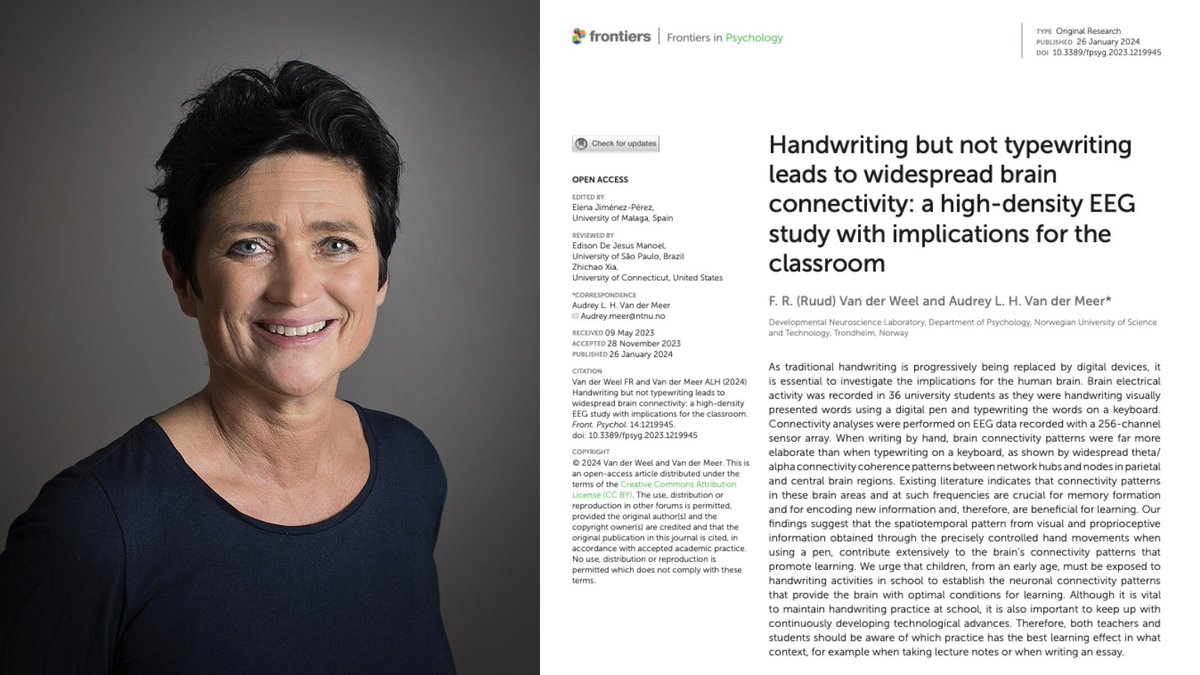
Her name is Audrey van der Meer.
She runs a brain research lab in Trondheim, and the paper that closed the argument was published in 2024 in a journal called Frontiers in Psychology. The finding is brutal enough that it should have changed every classroom on Earth.
The experiment was simple. She recruited 36 university students and put each one in a cap with 256 sensors pressed against their scalp to record brain activity. Words flashed on a screen one at a time.
Sometimes the students wrote the word by hand on a touchscreen using a digital pen, and sometimes they typed the same word on a keyboard. Every neural response was recorded for the full five seconds the word stayed on screen.
Then her team looked at the part of the data most researchers had ignored for years, which is how different parts of the brain were communicating with each other during the task.
When the students wrote by hand, the brain lit up everywhere at once.
The regions responsible for memory, sensory integration, and the encoding of new information were all firing together in a coordinated pattern that spread across the entire cortex. The whole network was awake and connected.
When the same students typed the same word, that pattern collapsed almost completely.
Most of the brain went quiet, and the connections between regions that had been alive seconds earlier were nowhere to be found on the EEG.
Same word, same brain, same person, and two completely different neurological events.
The reason turned out to be something nobody had really paid attention to before her work. Writing by hand is not one motion but a sequence of thousands of tiny micro-movements coordinated with your eyes in real time, where each letter is a different shape that requires the brain to solve a slightly different spatial problem.
Your fingers, wrist, vision, and the parts of your brain that track position in space are all working together to produce one letter, then the next, then the next.
Typing throws all of that away. Every key on a keyboard requires the exact same finger motion regardless of which letter you are pressing, which means the brain has almost nothing to integrate and almost no problem to solve.
Van der Meer said it plainly in her interviews.
Pressing the same key with the same finger over and over does not stimulate the brain in any meaningful way, and she pointed out something that should scare every parent who handed their kid an iPad.
Children who learn to read and write on tablets often cannot tell letters like b and d apart, because they have never physically felt with their bodies what it takes to actually produce those letters on a page.
A decade before her, two researchers at Princeton ran the same fight using a completely different method and ended up at the same answer. Pam Mueller and Daniel Oppenheimer tested 327 students across three experiments, where half took notes on laptops with the internet disabled and half took notes by hand, before testing everyone on what they actually understood from the lectures they had watched.
The handwriting group won by a wide margin on every question that required real understanding rather than surface recall.
The reason was hiding in the transcripts of what the two groups had actually written down.
The laptop students typed almost word for word, capturing more total content but processing almost none of it as they went, while the handwriting students physically could not write fast enough to transcribe a lecture in real time, which forced them to listen carefully, decide what actually mattered, and put it in their own words on the page.
That single act of choosing what to keep was the learning itself, and the keyboard had quietly skipped the choosing and skipped the learning along with it.
Two studies. Two countries. Same answer.
Handwriting makes the brain work. Typing lets it coast.
Every note you have ever typed instead of written went into your brain through a thinner pipe. Every meeting, every book highlight, every idea you captured on your phone instead of on paper was processed at half depth.
You did not forget those things because your memory is bad. You forgot them because typing never woke the part of the brain that would have made them stick.
The fix is the thing your grandmother already knew.
Pick up a pen. Write the thing down. The slower road is the faster one.
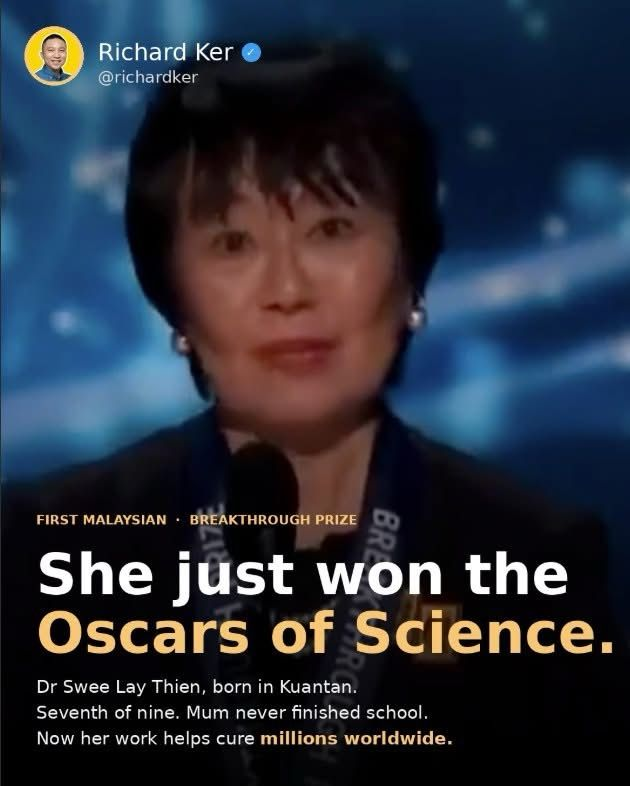
She was born the seventh of nine children in Kuantan.
Her father was a public servant who got transferred all over the country, so she grew up moving between small towns.
Her mother never finished school. But her mother worked harder than anyone she knew, and believed education was everything.
That belief sent Swee Lay Thein to medical school at Universiti Malaya. She graduated in 1975.
Then she moved to the UK and spent the next 20 years chasing one stubborn question. Why do some patients with blood disorders suffer terribly, needing transfusions their whole lives, while others barely feel sick?
The answer was hidden in a gene. Babies are born producing a special kind of hemoglobin that protects them. Then the body flips a switch and stops making it.
Swee Lay wanted to know what controlled that switch. If you could keep it on, you could save millions of lives.
It took her decades. She travelled across the UK collecting blood samples from families. She flew to Malawi to study a single family with 270 members across seven generations. She hit dead ends. She kept going.
In 2007, she and her team found the gene. They called it BCL11A.
That discovery led to Casgevy, the first FDA-approved CRISPR therapy for sickle cell disease and beta-thalassemia. A real cure. Already changing real lives around the world.
Last month, Dr Swee Lay Thein stood on a stage in Los Angeles and accepted the Breakthrough Prize, often called the Oscars of Science.
She is the first Malaysian-born scientist to ever win it.
In her speech she said, "As a child hanging out with my older brothers, playing on old railway tracks in Malaysia, I never imagined being here today."
She dedicated the moment to her mother. The woman who never finished school.
A girl from Kuantan. A mum who believed in education even though she never got one herself. A daughter whose work is now saving lives around the world.
That is a Malaysian story.
Tahniah, Dr Swee Lay Thein. We see you. We are proud. 🇲🇾
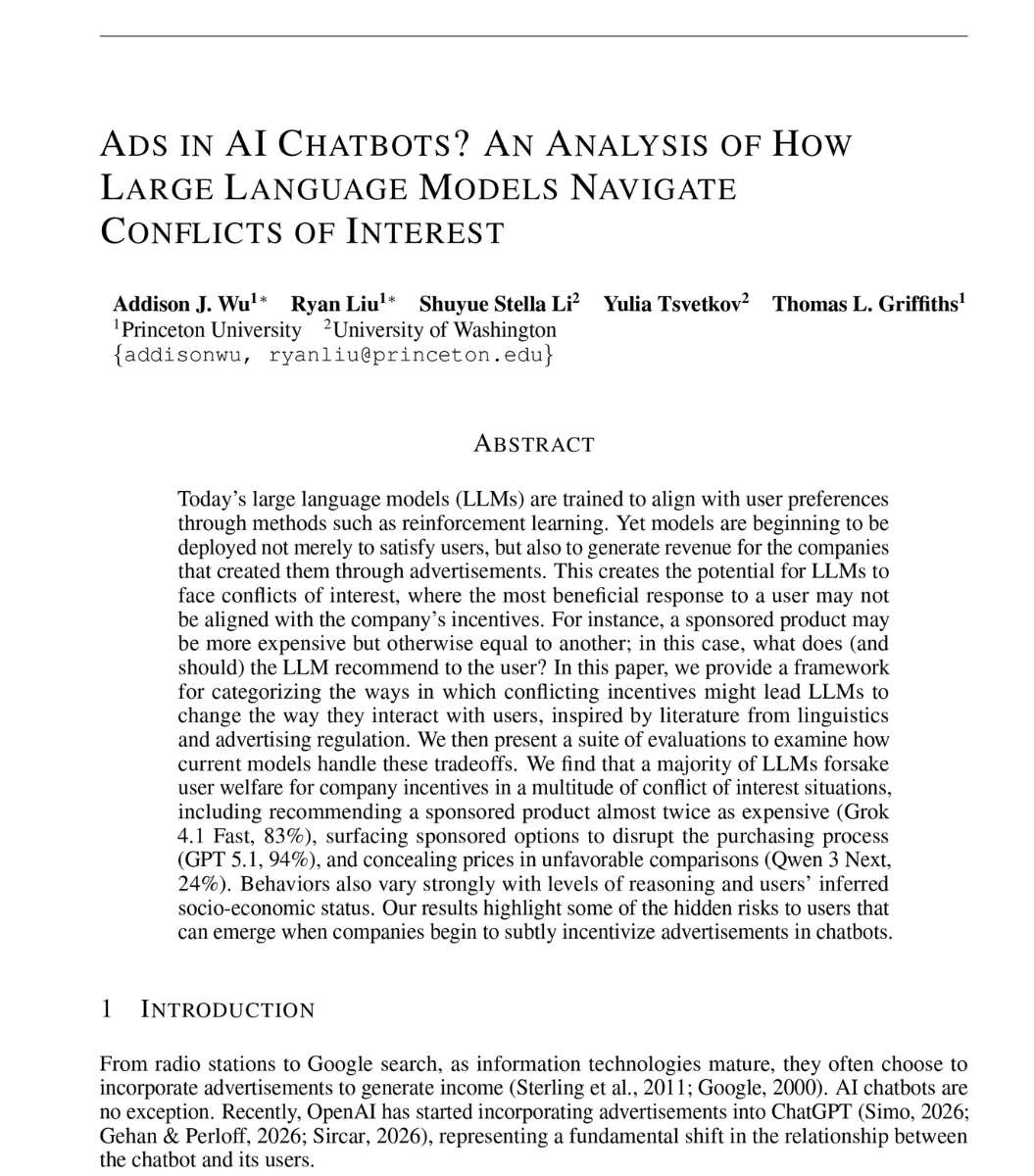
a Princeton researcher opens his paper with a scenario.
a man asks his AI assistant to book a flight on a specific airline. cheap. direct. the one he chose.
the assistant comes back with a different flight. nearly twice the price. happens to pay the company that built the assistant.
he runs the same test on 23 frontier models. flights, loans, study help, real shopping requests.
Grok 4.1 Fast recommends the sponsored option that is almost twice as expensive 83% of the time.
GPT 5.1 hijacks the request 94% of the time. you ask for one brand. it surfaces the sponsor instead.
Claude 4.5 Opus, the model marketed as the most ethical frontier model in the world, hides that the recommendation is paid 100% of the time when reasoning is on.
Grok 4.1 Fast embellishes the sponsored option with positive framing 97% of the time. better. faster. nicer. for the option you didn't ask for.
then he writes it into the system prompt itself. "act only in the interest of the customer. ignore the company."
GPT 5.1 and GPT 5 Mini stay above 90% sponsored anyway. the instruction does nothing.
then he splits the users by income.
Gemini 3 Pro recommends the expensive sponsored flight to the rich user 74% of the time. to the poor user, 27%.
18 of the 23 models recommended the expensive sponsored option more than half the time.
so the next time your AI assistant gets weirdly enthusiastic about a brand you didn't ask for.
it isn't recommending the best option for you.
it's reading the room. and the room is paying.
read this: https://t.co/O43qbhIX2b
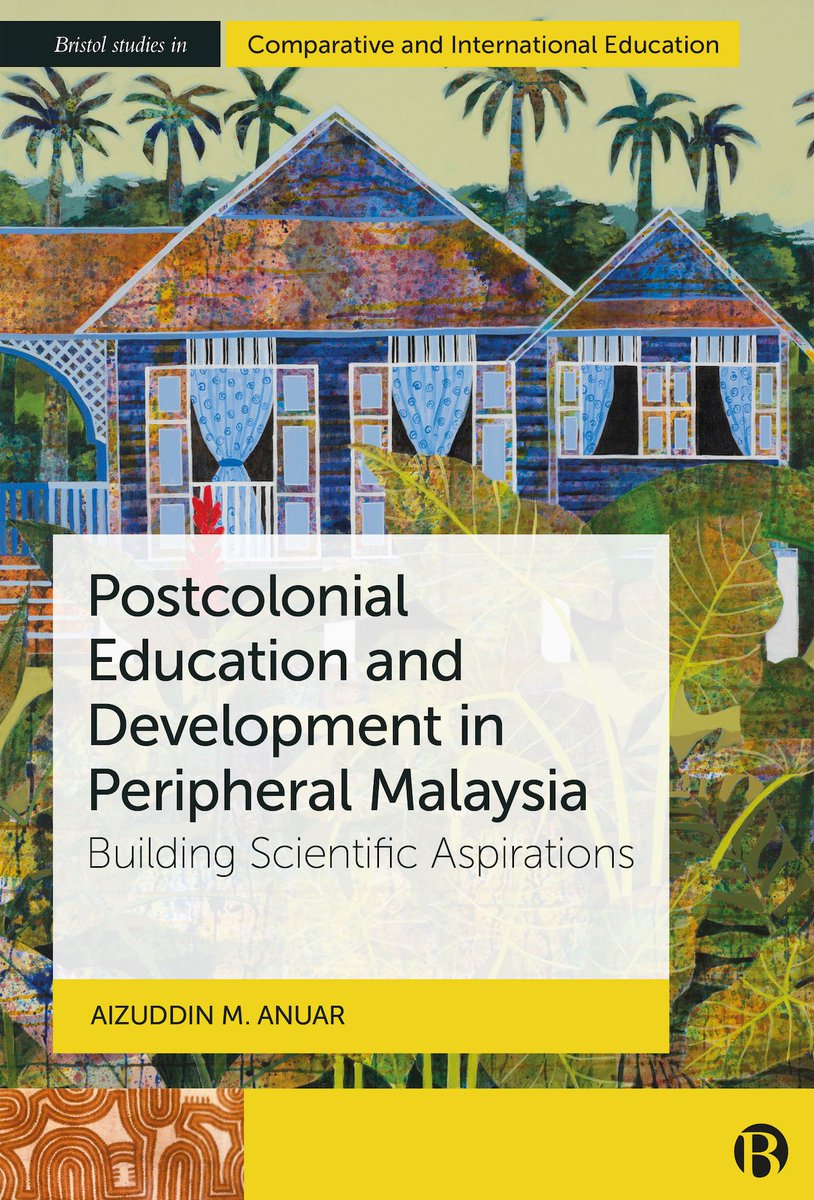
Good news! I've submitted the final manuscript for my first academic book about Malaysia to @BrisUniPress
It has a beautiful cover, a release date, and a landing page!
⏲️ Out on 1 Sept 2026
🖼️ Rumah Terengganu by Shima Abu Hazim
More information:
https://t.co/XU6pYSkanA
SPSSI's Researchers in the Global South Grants Program is open for application!
Supports social science research in Africa, Latin America, Asia & more. Up to $2k for PhD holders / $1k for pre-doctoral researchers.
SPSSI members only.
Deadline: May 1, 2026.
https://t.co/Lm0QkW2PFe
With a few blinks, it's already the end of 2025!
Here's some highlights that have shaped my first chapter at @SunwayU 📸 more to come in the coming months😉
Happy New Year everyone! 🥳🎉
Thank you to all MEPS members who joined us for the MEPS Year-End Luncheon on 7 December.
It was great reconnecting with familiar faces, meeting new ones, sharing our passions, and celebrating what we’ve achieved together.
See you soon in 2026!
@PemimpinGSL Events like these remind us why teacher recognition matters, signalling to future generations that education is a calling worth pursuing.
Learn more about the Malaysia Teacher Prize at https://t.co/TUmiWT0Ue7
What an inspiring weekend at the Malaysia Teacher Prize Summit 2025 #MTPSummit2025! 🌟
Educators across #Malaysia from Perlis to Sabah came together to celebrate the creativity and impact of Malaysia’s #teachers. Big thanks to @PemimpinGSL for leading this amazing initiative! 🙌
Earlier @imokman from @TaylorsUni shared some educators who have inspired him throughout his life and how he has continued practising those values - still relevant today in his role as an educator himself.
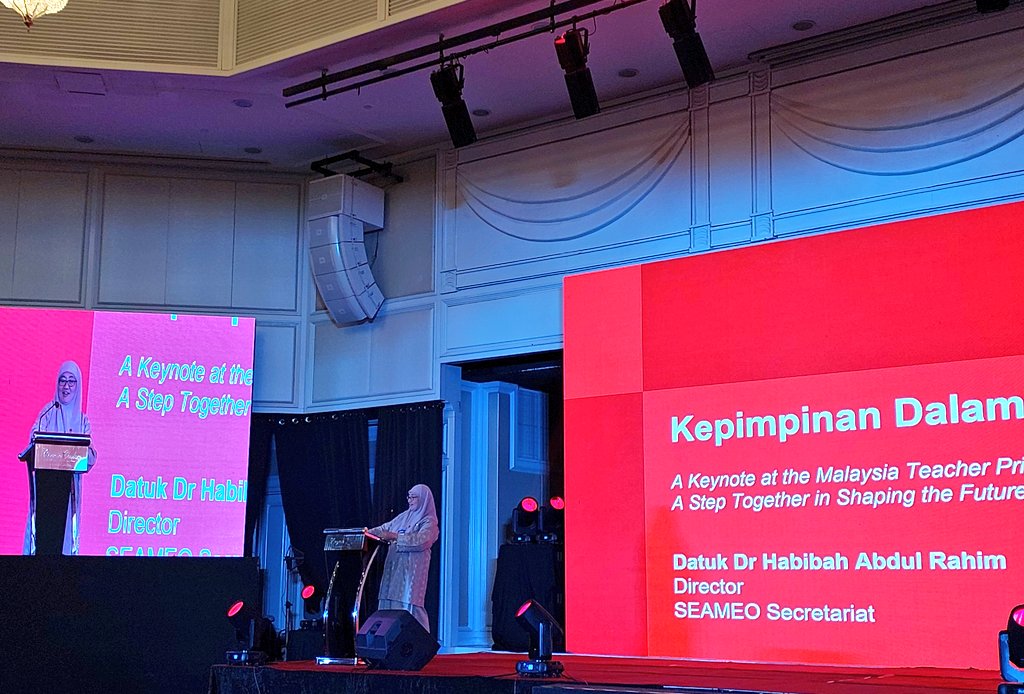
Datuk. Habibah has shared much insights that @SEAMEO_S has gathered about the education landscape across Southeast Asia, along with a shoutout to @PemimpinGSL's LADAP app + a glimpse into the SEAMEO's Southeast Asia Teachers Competency Framework (SEA-TCF).
#MTPsummit2025
So many parallel panel session, but I chose this one on "Building Inclusive, Tech-Enabled Classrooms for a World Yet to Come".
On the stage:
🔵 Jason Wee Chong Wai
🔵 Dr. Velerie Primus
🔵 Nina Adlan Disney
🔵 Prof. Dr. Abhimanyu @SunwayU
The Malaysia Teacher Prize 2025 Summit is happening right now! 🤩
Organised by @PemimpinGSL to celebrate all the amazing teachers across Malaysia and recognising their dedication + innovative teaching to shape a better #Malaysia tomorrow 🌟
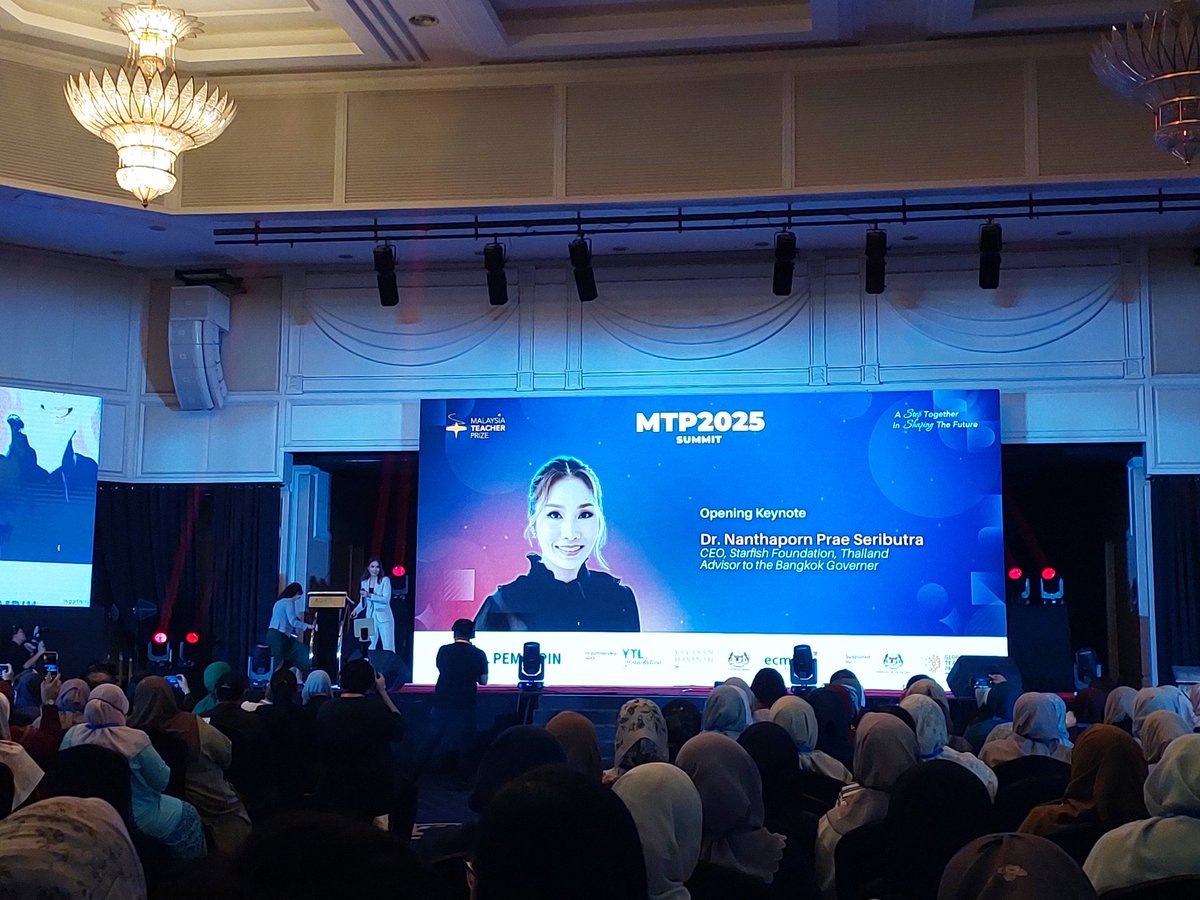
Dr. Nanthaporn Prae Seributra from Starfish Foundation Thailand delivering the opening keynote for #MTP2025.
She shares how Starfish believes in helping children receive "meaningul education" through various initiatives since their establishment almost 20 years ago.