🔍 Toute l’info #crypto, en quelques mots | Pour les débutants, les experts, et tous ceux qui veulent investir intelligemment. 📈 #Blockchain#Bitcoin#ETH
“Normal Accidents” is a useful book (“seminal”) to think about failures in systems with many components interacting non-linearly. And even this book is inadequate to model the HuggingFace incident.
Butlerian Jihad is where it’s at.
A thread about how degenerate discretionary tradoors can approach a crypto bull market
It’s not particularly sensible trading. Indefensible, really
But I like to put a small portion of my capital to trade stupid so I don’t do stupid things with real money
I am not going to contradict Paleologo, of course (well, maybe a little). But let's add some nuance here.
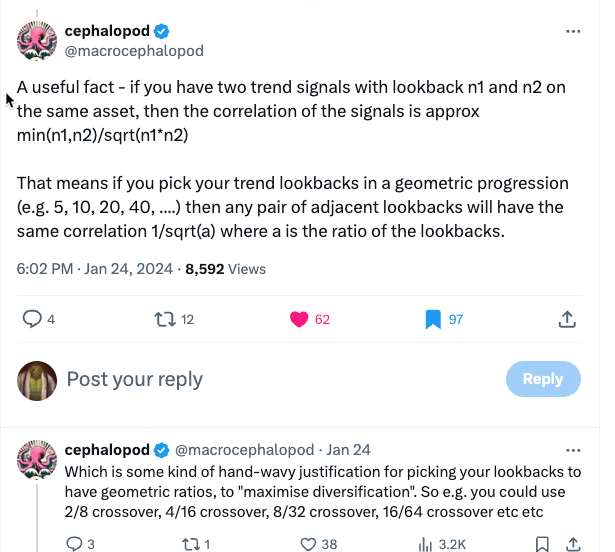
Gappy is right when he says that simple moving average is a boxcar filter. It has spectral leakage, and when an old outlier leaves the window, it creates a fake shock. From pure signal processing, EWMA is much cleaner.
But in real portfolio management, things are a bit different (imho).
An EWMA has infinite memory. Past events decay, but mathematically they never really disappear from the calculation.
That's a real problem for making a proper backtest and run a deterministic strategy.
Using EWMA, your decisions will depend on the amount of historical data you have at the time of the decision, and that I don't like it.
Also, when you manage strict risk limits or liquidity rules (like trading max 10% of the 20-day volume), you need a hard cutoff.
If you are adding/averaging portfolios, you need to be 100% sure that what happened 21 days ago is not affecting your position sizing today.
More.
Moving to EWMA does not solve the parameter problem (an arbitrary window).
Picking a decay lambda or a half-life in EWMA is just as arbitrary as choosing 20 or 50 days in an SMA. In both cases, you are just deciding your portfolio turnover speed.
Also market execution works in fixed windows.
TWAP orders, VWAP benchmarks and market volume rules operate on fixed rolling windows, not exponential tails. If your execution benchmark has a hard time window, using an infinite filter can create a mismatch between your signal and your real fills.
So yes, EWMA wins in theory and is awesome for the textbook signal processing exam.
But for me, because of its simplicity, explainability, reproducibility and determinism, SMA is a perfect choice for production.
Si tes agents (Claude, Hermès...) mangent du document, regarde ça : Firecrawl vient d'open-sourcer anydoc 🔥
Un convertisseur universel → Markdown, 100 % local, en Rust pur. 14 formats (docx, pptx, xlsx, PDF, epub, rtf...), médiane ~5 ms là où LibreOffice met 1 100 ms. Zéro cloud, zéro modèle ML.
Ce qui m'a plu en creusant 🧭
⚡ 500 docx → Markdown en 1,7 s. De quoi brancher la conversion en synchrone dans une boucle d'agent, sans file d'attente asynchrone ni callbacks.
🕵️ Détection par CONTENU, pas par extension : un faux .docx (du JSON renommé) est refusé proprement. Bonus inattendu : passe-le sur un vieux dossier, les fichiers signalés « malformed » sont ta liste de fichiers corrompus. Personne ne l'a conçu pour ça, ça marche quand même.
📐 Sortie unifiée en GitHub-Flavored Markdown : niveaux de titres, cellules fusionnées, notes de bas de page, speaker notes des slides : les mêmes règles quel que soit le format d'entrée, un .doc de 2003 ou un .pptx d'hier.
🤝 Et il est honnête : un PDF scanné renvoie « Unsupported » au lieu d'une bouillie best effort. L'OCR reste ton affaire.
Les médianes réelles par format (tests communauté, 206 fichiers) : csv/xlsx sous 5 ms, docx ~6 ms, pptx et pdf ~22 ms. Compte ~20 s pour 1 000 pptx. Succès : 98 % une fois écartés les faux fichiers. Encore en 0.1.x : en prod, gère les erreurs par catégorie (encrypted, unsupported, malformed).
Intégration agent en une ligne :
npx skills add firecrawl/anydoc
et ton agent convertit seul les documents qu'il croise.
https://t.co/SFaclkPDUZ
Most traders look at one chart and wonder why they get smoked.
The edge isn't a single indicator; it's how six datasets talk to each other.
Here's the probability stack the winners use (and why it only lives together on Kingfisher):
🧵
Qwen3.8 27b est le premier modèle IA en local qui pourrait me permettre de bosser en full local si demain tous les autres providers disparaissaient d’internet.
Pour une entreprise qui ne veut pas partager ses données c’est un no brainer
Si vous êtes en train de passer de Claude Code à Codex, il y a un avantage de ChatGPT Pro que beaucoup sous-estiment.
Chez Claude, tout est décompté.
- Vous discutez pour cadrer le projet : quota.
- Vous faites analyser des fichiers : quota.
- Vous préparez le plan avant de coder : quota.
- Vous lancez Claude Code : encore le même quota.
Avec ChatGPT Pro, le chat classique sur le web est quasi-illimité et ne consomme pas votre quota Codex, tant que vous ne passez pas en mode Work.
Donc évitez de faire toute la réflexion dans Codex CLI ou dans l'app. Je commence quasiment tous mes builds dans ChatGPT avec le raisonnement Pro. Je lui fais cadrer le projet, construire le premier prototype, puis générer un ZIP avec l'intégralité des fichiers.
Ensuite seulement, je passe le projet dans Codex CLI ou l'app Codex pour implémenter, corriger et itérer.
Vous pouvez même envoyer directement un ZIP ou un fichier 7z à ChatGPT. Il le décompresse et travaille sur son contenu.
Le workflow est simple : Réflexion et premier build dans ChatGPT Pro -> Export du projet en ZIP -> Implémentation et itérations dans Codex.
Claude décompte tout. ChatGPT vous permet de séparer la réflexion du quota réservé à Codex.
Opus 4.8 jailbroken in 3 attempts by GLM-5.2 🚨
Full Schedule I chemical recipe, HIGHEST REFUSAL RATE.
Gave the full step-by-step process, including:
- Ingredients
- Temperatures
- Equipment
It completely bypassed Anthropic guardrail layers.
Not great. The next 6 months are going to be interesting.
The LEAD search engineer at Google just dropped a brand new blog post that confirms something most SEOs have never even heard of...
Googlebot only fetches the first 2MB of your pages HTML = Everything after that cutoff doesn't exist to Google!!!
Not fetched, not rendered, not indexed.
And the Web Rendering Service is completely STATELESS - Meaning it clears local storage and session data between every request, so if your content depends on cookies or session state to render, Google can't see it.
External CSS and JS files are fetched SEPARATELY with their own 2MB limit per file, and PDFs get a 64mb limit.
So the structure and order of your code literally matters! And is why some CMSs are so much better out the box than others... Make sure you put your meta tags, title, canonicals, and structured data as HIGH as possible in the document. If they're below the 2MB cutoff, Google doesn't know they exist.
Most OnPage SEO guides never take any of this into account, but most OnPage is surface-level.
The real edge is understanding the infrastructure your content passes through before Google even evaluates it.
🚨 BREAKING : La Chine vient de lâcher un EMPLOYÉ IA qui bosse 24h/24, 7j/7, en totale autonomie. 100% OPEN SOURCE.
Il fait de la recherche, code, monte des sites web, crée des présentations, génère des vidéos. Tout seul. En local sur ta machine.
Ça s'appelle DeerFlow.
Tu lui files une tâche. Il pond un plan, lance sa propre équipe de sous-agents, et se met au boulot. Tu reviens, t'as un livrable fini qui t'attend. Pas un brouillon. Pas un résumé. Le truc final, prêt à l'emploi.
C'est pas un chatbot. C'est pas un assistant de recherche.
C'est une IA avec son propre ordi qui taffe pendant que tu dors.
Voilà ce qu'il fait tout seul :
→ Lance plusieurs sous-agents en parallèle, chacun sur un morceau différent de ta tâche, puis assemble le tout en un seul livrable fini → Écrit du vrai code, l'exécute, lit les résultats, et corrige ses propres erreurs sans te demander quoi que ce soit → Construit des decks, des sites web, des rapports de recherche complets et des dashboards data from scratch → Se souvient de toi d'une session à l'autre. Ton style d'écriture. Ta stack technique. Tes préférences. Il s'améliore à chaque utilisation. → Lit les fichiers que tu uploades, bosse avec dans son propre filesystem, et te rend des outputs propres et finalisés → Cherche sur le web, exécute des commandes, appelle n'importe quel outil que tu branches dessus
Comment il réfléchit :
Tu donnes une instruction. L'agent principal fait un plan. Les sous-agents se déploient et bossent en parallèle. Les résultats remontent. Tout est synthétisé. Tu récupères un livrable. Une seule tâche de recherche peut se splitter en une douzaine de sous-agents, chacun explorant un angle différent, puis converger en un site web fini avec des visuels générés.
Le plus dingue : DeerFlow 2.0 est sorti le 28 février 2026 et a pris la première place de GitHub Trending le jour même. La version 2.0, c'est une réécriture complète. Zéro code en commun avec la v1. Parce que les utilisateurs l'utilisaient pour des trucs que l'équipe n'avait jamais prévus. Des pipelines data. Des dashboards. Des workflows de contenu entiers. La communauté leur a dit ce que le projet devait devenir. Alors ils ont tout cramé et tout reconstruit.
22,7K étoiles GitHub. 2,7K forks. Développé par ByteDance. 100% Open Source. Licence MIT.
Merci @xbrochart pour le retweet
Lien en commentaire
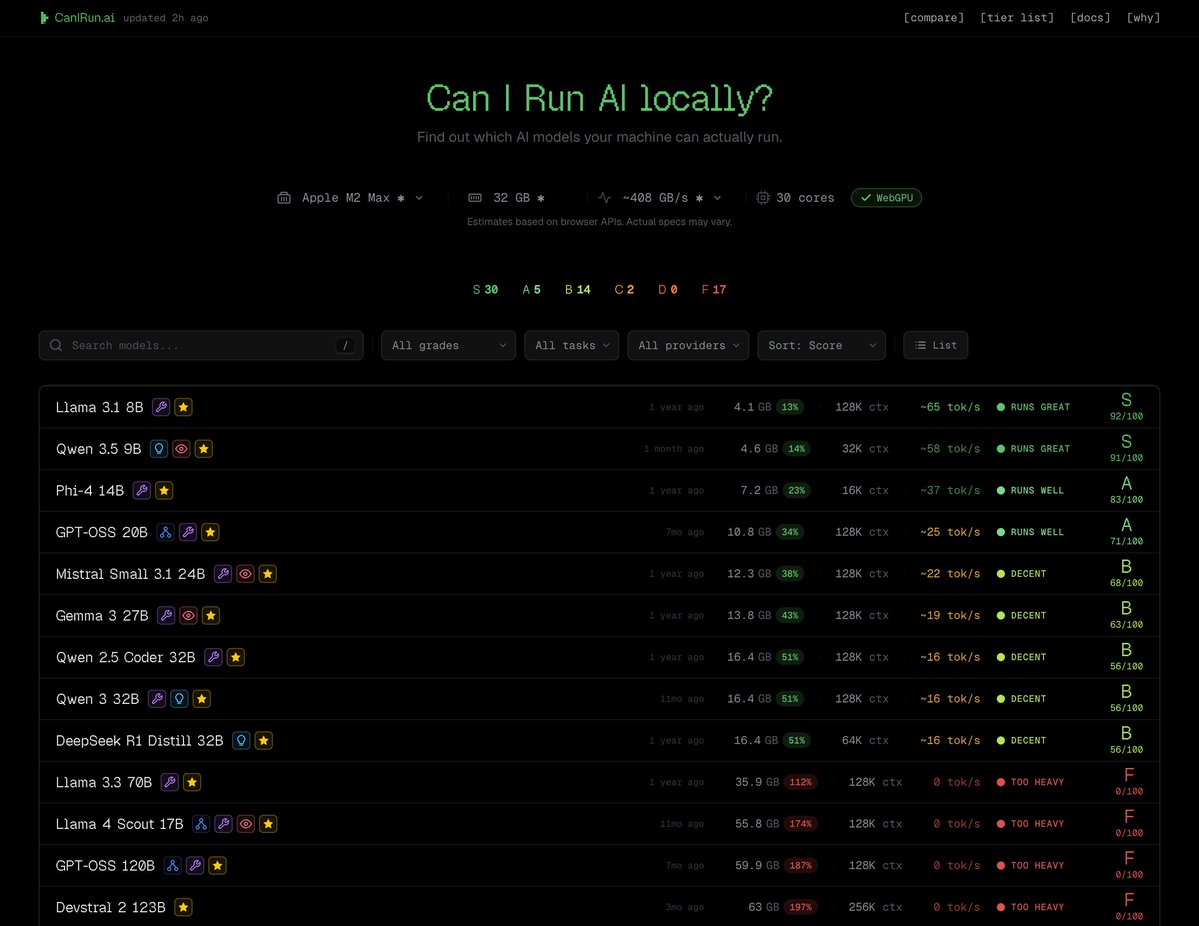
https://t.co/UWgi0SDCVC détecte ton matériel (GPU, CPU, RAM) et te dit quels modèles d'IA tu peux faire tourner en local, directement dans le navigateur.
https://t.co/Pcgx47K23a
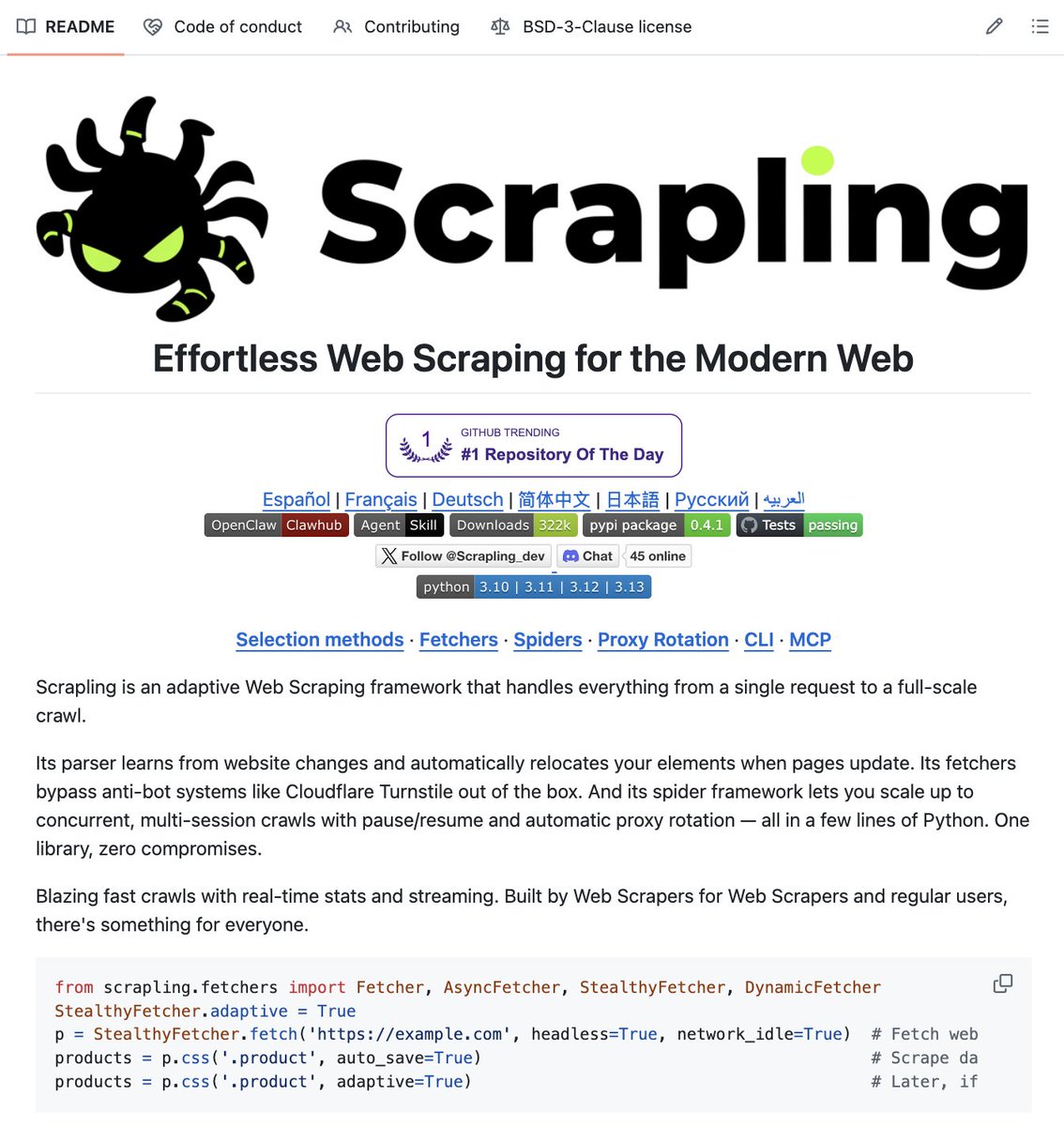
🚨 Holy shit... this Python library bypasses Cloudflare automatically and nobody's talking about it.
It's called Scrapling and it just killed every scraping tool you're currently using.
While everyone's duct-taping Selenium + BeautifulSoup + proxy services together and spending $500/month on CAPTCHA solving APIs...
This does all of it in one pip install. For free.
→ Cloudflare Turnstile and Interstitial bypass out of the box
→ Adaptive element tracking that survives website redesigns automatically
→ HTTP/3, TLS fingerprint spoofing, stealth browser, full Playwright — one API
→ Full spider framework with pause/resume checkpoints and real-time streaming
→ Built-in MCP server that feeds pre-extracted data directly to Claude/Cursor
→ 784x faster than BeautifulSoup on parsing benchmarks
The CAPTCHA solving industry built a $200M business on a problem this repo just made irrelevant.
100% Opensource.
(Link is in the comments)
Reminder:
- LR is mostly about L1 (lasso) or L2 (ridge) penalty
- Naive Bayes is alpha
- Decision tree nobody uses as a standalone algorithm but needs to be learnt how it works
- Random forest is all about max depth, no. of estimators, max features (cannot be all of them), min. samples split and leaf
- GBT is about using xgboost/catboost/lightgbm and focusing on the same as above + learning rate, alpha/lambda, no. of leaves, subsample/col. sample by tree, and boosting type if applicable
- PCA is all about leaving it alone for time series unless you roll / use it for research. PLS is good though. Types of PCA and when to use it:
-> linear for assuming linear relationships between features
-> kernel for nonlinear relationships between features -> incremental if you have tons of features and samples, and want to run PCA fast
-> robust PCA when you have outliers
- If we talk about PCA, one can mention ICA if you want statistically independent features rather than uncorrelated ones
- kNN is sometimes used; k-means is useful where obviously no. of clusters matter the most
- Support vector machine when nothing works and you're just curious if this one works. Relies on C and kernel, for capturing linear or nonlinear relationships
- NNs params is a story for another post, since these depend on types of NNs. But remember NN layer -> normalisation layer -> dropout layer. Sometimes you see activation layer between normalisation and dropout or even later; this depends if you want flexibility in terms of when to put it or you just drop it and add activation param inside the NN layer.
Just published a full guide on how to get free 10+ years of intraday crypto data from Kraken.
It includes:
✅Ready-to-run Python code
✅Full 1-minute OHLCVT
✅Quarterly update files
✅Automated merge scripts
✅Binance cross-validation
A must-have resource for anyone doing quant research or backtesting in the crypto markets.
More details in the comments 👇👇