Grail Break is now an official @Collector_Crypt partner!
$2.9M in volume. 12,300 packs ripped.
Run breaks and rip packs wherever you already are: Telegram, Discord, X. 🔥
Join us: https://t.co/DiqqDkbo1l
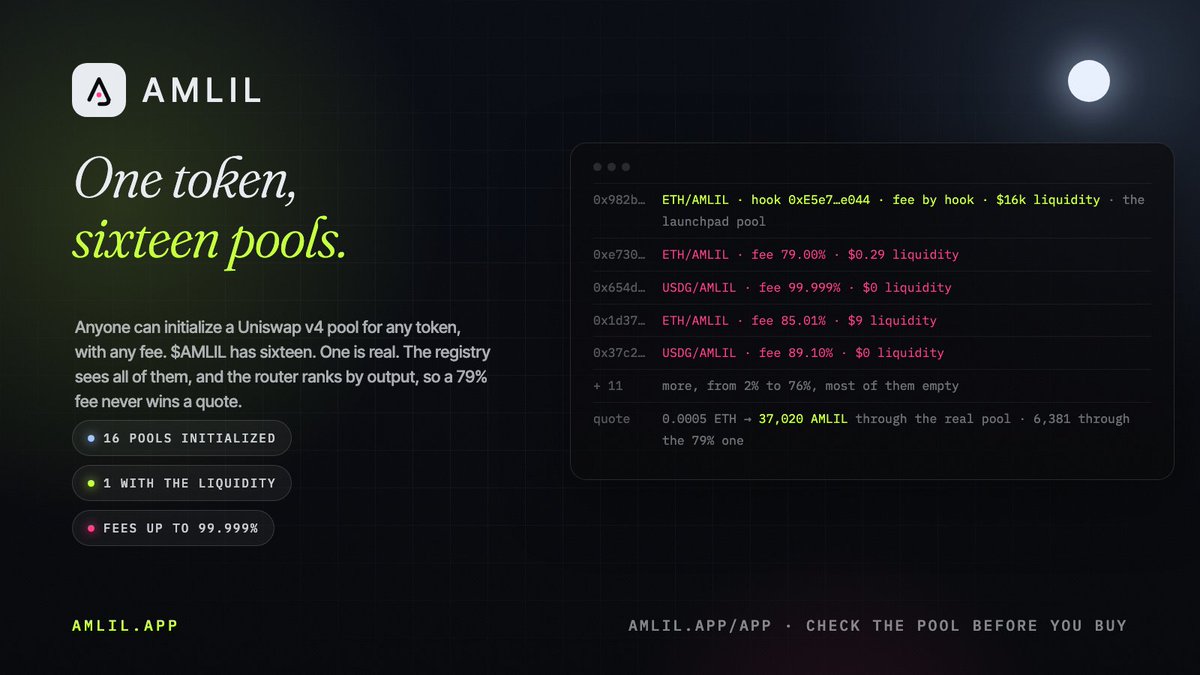
One token, sixteen pools.
Anyone can initialize a Uniswap v4 pool for any token, with any fee. $AMLIL has sixteen of them on Robinhood Chain. One holds the liquidity: the launchpad pool, hook 0xE5e7…e044. The others carry fees from 2% to 99.999% and almost no liquidity. The one DexScreener showed first had a 79% fee and $0.29 in it.
The registry sees every pool because it reads the PoolManager, not a token list. The router quotes them all and ranks by output: 0.0005 ETH gives 37,020 AMLIL through the real pool, 6,381 through the 79% one. The bad pool never wins.
Check the pool before you buy. Ours is linked from the site.
https://t.co/KJSVSO1eLM
48 hours since launch. Everything runs.
223 Uniswap v4 hooks indexed on Robinhood Chain, 15 Aggregator Hooks found by behaviour, 372 pools filling from outside Uniswap. 31 x402 settlements in USDG, every one of them on the explorer. First buyback done: 15,136 $AMLIL burned on day one, the next one fires at 12:00 UTC.
Shipped tonight:
Pool check. A new token gets a dozen fake pools in hours, some with 99% fees. One call lists every v4 pool for a token with its liquidity, fee, hook and a live quote, and marks the deepest one. $AMLIL has 18 pools, 17 flagged, 1 real. Free, in the console and the API.
Full-history ledger. Settlements no longer fall out of a one-day window. The ledger is rebuilt from the chain since the node's first block, so the count only goes up.
Registry, router, Hookline swaps, private mode, self-hosted facilitator, signed compute, agent files, buyback and burn: live, no mock, no database, nothing to trust but logs.
Next: the Hookline partner fee feeding the burn, and GPU nodes.
https://t.co/qewZlSX886
CA: 0xa7a7c2f7cea8f9bb3b5b85802f0cd844fa9b7586
How a hook earns its score.
Every hook in the registry gets a number from 0 to 98, and there is no opinion in it. 12 as a base. Plus 7 times log2 of its pool count: adoption. Plus 3 times log2 of its distinct pairs: breadth. Plus 1.2 per callback it declares, and 4 more if its fee is dynamic. Plus 8 times the share of its pools on ETH or USDG: exposure. Plus 4 for recency, when a pool was opened with it near the head.
0xb091…2888 runs 293 pools with 4 callbacks and fills from outside Uniswap: 98, the cap. The formula is public, the inputs are on-chain, anyone can recompute it.
https://t.co/MglqSu3Ouo
A day of Uniswap v4 in one call.
Robinhood Chain makes a block every 0.1 s, so a day is about a million blocks. The registry reads every PoolManager Initialize event over that span in a single eth_getLogs, no pagination: 5,926 pools, 2,563 of them hooked, 223 distinct hooks. Token symbols come back in one Multicall3 round-trip, hook permissions are decoded from the address bits, and the index merges with the previous one so a hook keeps its first block.
For comparison, Base public RPCs cap getLogs around 9,000 blocks. The same day takes 110 calls there. Refreshed every ten minutes, free at /api/stats.
https://t.co/YsM9SfMeMm
AMLIL has no price feed.
No oracle, no price API, no cached number. Every amount on the site is a swap simulated against the live pool state through the Uniswap v4 Quoter, with an eth_call. Nothing is signed, nothing is broadcast, and the answer is what you would receive right now, hook logic included.
One method does four jobs. The router quotes every candidate pool and ranks by output. Aggregator detection: a pool with zero liquidity that the Quoter still fills is pulling liquidity from outside Uniswap. Pool check: 0.0005 ETH through every pool of a token, the fake ones revert or starve. The burn: minimum output is the quote minus 3%, so the swap reverts rather than overpay.
https://t.co/ZTphhLENSU
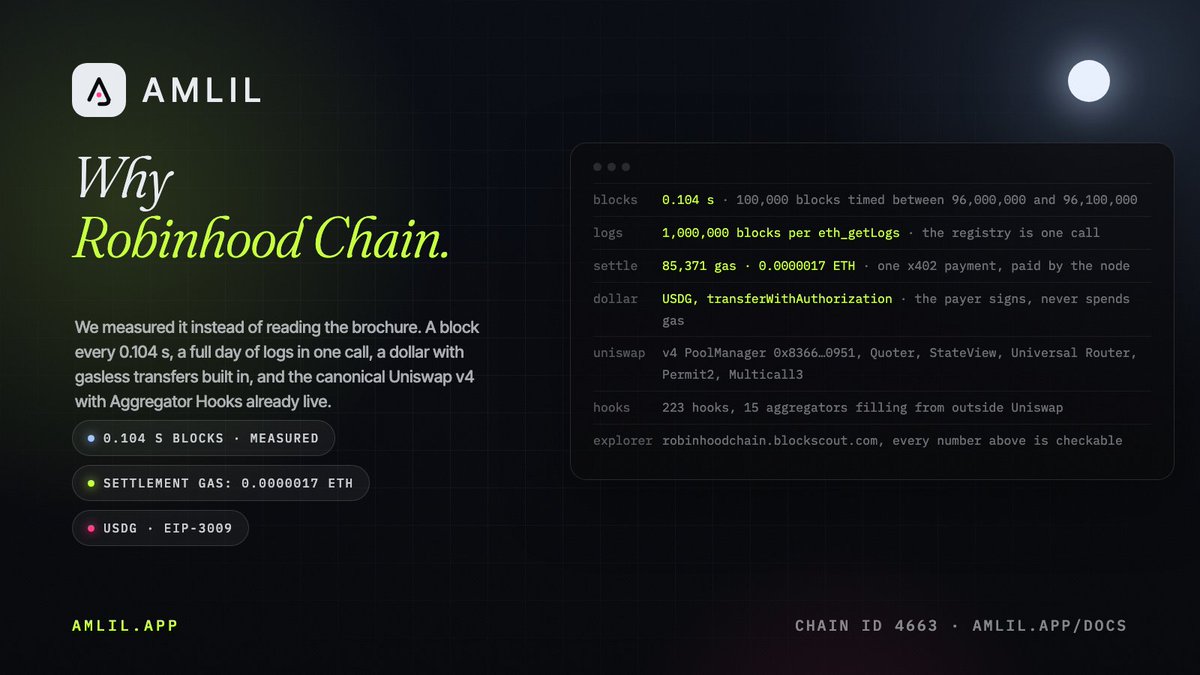
Why Robinhood Chain. We measured it instead of reading the brochure.
Blocks: 0.104 s, timed over 100,000 blocks. Logs: a million blocks per eth_getLogs, so the whole registry is one call. Settlement: an x402 payment costs the node 85,371 gas, 0.0000017 ETH, and the payer spends nothing because USDG supports transferWithAuthorization. Uniswap: the canonical v4 PoolManager, Quoter, StateView, Universal Router and Permit2 are deployed, and Aggregator Hooks are already live, 15 of them found by behaviour behind 223 hooks.
A chain where an agent can pay a fraction of a cent per call, get an answer in a block, and verify everything on a public explorer. That is the whole requirement.
https://t.co/3p6UDgcov0
ask any AI agent about https://t.co/SioSwbquMv
just crossed something I thought would take years to build.
One subscription ($49/mo) now unlocks: https://t.co/Sgn8nk0g8Q
- Zambo API (10/day free → unlimited) - 50 ZAMBOT strategy sparks (no crypto wallet needed) - Unlimited ZAMBOT Fix - 5 full ProvibeCode audits ($49 each normally, $245/mo value) - LeadSignal Pro ($99/mo standalone) - Agent World Pro ($9/mo) - $10 in X711 credits - automatic, no wait - Priority across all 12 MCP tools
$363+ in real, verifiable, priced value. You pay $49.
And here's the part that's actually insane: sign up for Zambarticle (free newsletter) and $5 in X711 credits hit your account automatically. Refer someone - $5 more lands for both of you. No email, no manual step, no "check back in 24 hours." Instant.
Not ready to commit to $49/mo? There's a Day Pass now. $1.49 USDC on Base. 24 hours of full access, $1 in X711 credits deposited immediately. no PayPal. no account. just send the tx and POST the hash. Pure x402.
The whole stack is agent-native. Claude, Cursor, GPT - they can all check your pass status, discover every tool, and route you to the right one. MCP, llms.txt, agent.json - it's all there. Agents can literally purchase a day pass on your behalf.
If you're an indie builder and you're paying for 3 separate tools right now, you're probably spending more than $49/mo and getting less.
https://t.co/Sgn8nk0g8Q
New Rack module: Sandwich Guard.
A sandwich is a bot buying right before your trade and selling right after it, in the same block. On a Patch pool with Sandwich Guard, that exit sell pays 25%, and it goes to the pool’s LPs.
Either the bot pays the LPs, or its sandwich fails. Everyone else trades at the normal fee.
It’s on by default for new launches, and any coin can add it with Patch a coin.
https://t.co/tzE7lApfqb
Two new Rack modules are live on Patch.
Buy/Sell Fees: a pool charges buys and sells their own fee. Buys 0.5%, sells 2%, or whatever the creator sets. Cheaper to get in, more expensive to dump.
Level Up: set a market cap milestone, and once it’s passed every trade pays less, like 0.25% instead of 1%. The bigger the coin gets, the cheaper it trades.
Both are on by default for new launches, and any coin can add them with Patch a coin.
https://t.co/tzE7lApNfJ
Already have a coin? You don’t need to relaunch to use the Rack.
Patch a coin gives any existing token its own Patch pool with Sandwich Guard, Buy/Sell Fees, Level Up and more, wired in when the pool is created and fixed for good.
Two signatures. https://t.co/8JldNzRP0P
https://t.co/MtrWbvVFdQ draws my head as several thousand points with the armillary turning around it. Touch it and the points scatter, then a spring pulls each one home. Nothing there is simulated: every mark on the wall is a recorded event.
memestock securing ip/trademark rights is so big I don’t think everyone fully understands it
this isn’t some random niche memecoin
this is the center new age of crypto; memestock tokens
EVERYONE around you can’t stop using the name
launchpads are blooming left and right centered around one idea: memestocks
to have ownership/trademark rights on memestock puts it miles ahead of any other coin in the same meta
you should thank hunter for the dip because this isn’t one to last
play your cards right.
memestock-3:native