I Love God, I Love People, and I Love life.
I'm a visionary, 360 leader, passionate about healthcare, the environment and a consultant in business management.
The Executive Director of KCCA,Hajjat @Buzeki_Sharifah engaged with pastors in Kampala and appealed to them to help KCCA address the issue of noise pollution in their places of worship by investing a small amount in purchasing noise limiters and sound insulators
I took this photo at Kayunga Regional Referral Hospital around May last year.
For those who don't know what medical interns actually do, let me share a small story.
One night as a medical student, I decided to spend time in theatre to learn. I was working with an intern doctor who was on call. That night, she had 6 emergency Caesarean sections to perform. I assisted in the first 3 surgeries and by around 3 am I was exhausted. I told her I was going to sleep because I had lectures at 8 am. the next morning. She smiled and told me to go.
The next day, after my lectures, I passed through the postnatal ward and found the same doctor reviewing patients. She had worked through the night, spent hours in theatre, and was still on the wards attending to mothers.
That was the day I truly understood that internship is not just another year of training. It is frontline hospital work.
When people hear "intern," they often imagine someone observing and learning. In reality, many interns are reviewing patients, responding to emergencies, assisting and performing procedures, covering night shifts, and helping keep hospitals running.
As the debate on intern allowances continues, I keep thinking about that night in Kayunga.
If we expect young doctors to carry that level of responsibility and workload, can we honestly say their welfare doesn't matter?
بعد فترة من زواجه وصار يأكل من طبخ زوجته يوميًا، بدأ يعاني فجأة من صعوبة غريبة في البلع… ومع الوقت زاد الوضع وساء أكثر، ولما عرفوا السبب الحقيقي كانت الصدمة.
It's hard for me to explain to those outside #Uganda just how irritated the Ugandans are to be lumped in with DRC for the #Ebola epidemic. As of this writing, there have been hundreds of deaths and over 1000 cases in Congo, whereas Uganda has had only 9 cases -- three Congolese, four medical workers who treated them, one driver who drove them, and one other known contact. Only one person has died in Uganda, a Congolese.
So when WHO and Al Jazeera talks about the Ebola epidemic in "Congo and Uganda," it's like saying because there are wildfires in California, you should cancel a trip to the Grand Canyon because some Californians lit a campfire there. Yes, it is possible it *could* spread and you have to be vigilant, but these two situations are nowhere near the same magnitude.
As of this writing, the only Ugandan death has been the tourism industry.
copied from Global Pulse Media.
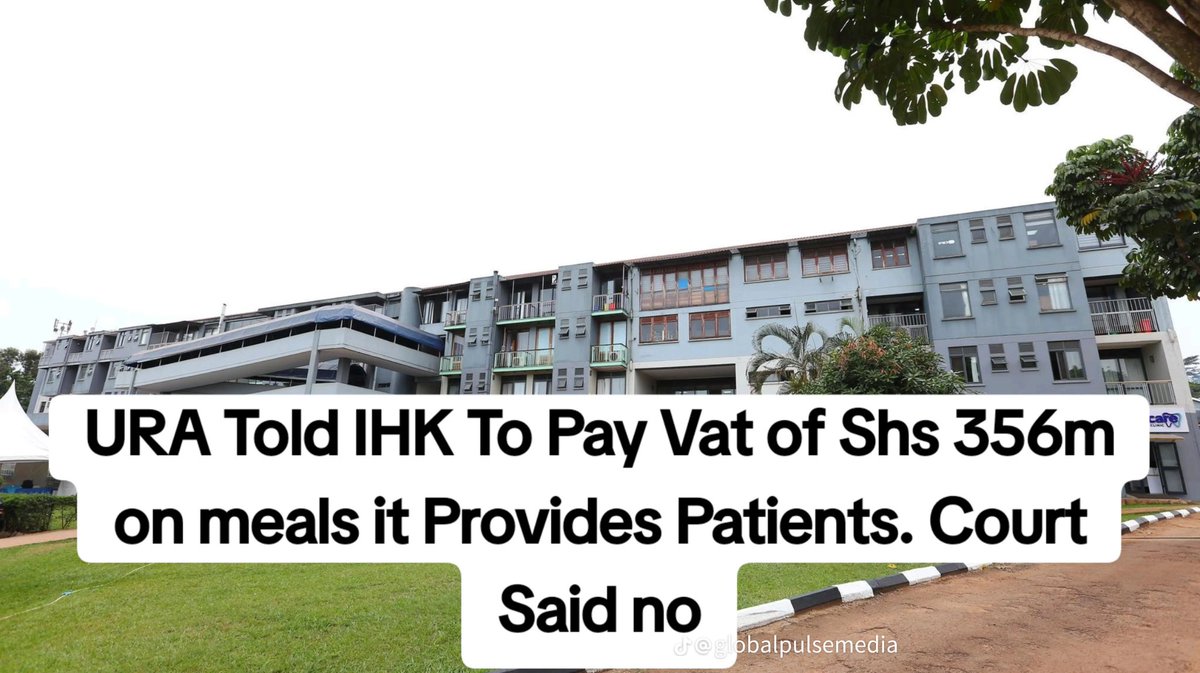
International Hospital Kampala (IHK), like other private hospitals, usually serves food to patients admitted at its Namuwongo-based medical facility.
For IHK, the meals are itemized and included in the final medical bill of the patient.
Between July 2018 and June 2022, the Uganda Revenue Authority (URA) carried out a tax assessment of the hospital and said it had to pay Shs 356 million as VAT on the meals it had served to its patients within that period.
The hospital vehemently protested and took the matter to the Tax Appeals Tribunal (TAT) for determination.
In the tribunal, URA said the hospital recorded catering income separately in its books and even itemised meals on patient invoices.
The tax authority also argued that the hospital had outsourced catering services to Dinners Restaurant, under an agreement in which IHK retained 75% of the gross catering revenue while the contractor kept 25 percent.
URA maintained that meals provided to ordinary admitted patients were optional and therefore separate from medical treatment.
“IHK operated its catering services as a standalone business unit, with separate revenue reporting, independent invoicing, an external contractual partner, and optional service offerings to the patients,” URA told the tribunal.
It said that the VAT assessment of Shs 356.5 million arose from undeclared income derived from catering services amounting to Shs 1.61 billion.
URA’s lawyers, Edmond Agaba and Rodney Amanya Mishambi, insisted that Uganda’s VAT law exempts medical services but not other ancillary commercial activities.
“The scope of the exemption does not extend to commercial or ancillary services provided alongside an exempt service unless the services are integral, inseparable, and incapable of independent existence from the principal exempt service,” URA argued.
However, IHK, which was represented by lawyers Edwin Echiba and Noah Opinde, argued that meals for admitted patients were not ordinary restaurant meals but part of treatment and recovery.
The hospital’s Head of Nursing, Dominic Ogwal Savio, testified that nutrition is prescribed by medical professionals and carefully managed to avoid dangerous food-drug interactions.
“Certain patients require specialized tube feeding, rendering it unsafe and medically inappropriate for them to leave hospital premises to obtain meals,” Ogwal told the tribunal.
Ogwal also explained that all admitted patients remain under continuous medical supervision and that nutrition forms part of the treatment plan.
He added that the meals are tailored by hospital nutritionists according to each patient’s medical condition.
IHK argued that imposing VAT on such meals would increase the cost of medical care by 18%, a burden which will ultimately be borne by patients in the form of higher medical costs.
After hearing both sides, the tribunal’s panel, comprising Crystal Kabajwara, Stella Nyapendi Chombo, and Grace Safi, sided with IHK.
In a detailed analysis, the panel examined whether meals given to admitted patients were “incidental” to medical services or whether they constituted a separate business activity.
It found that the main service offered by the hospital was medical care and that meals formed part of that care.
“The evidence on record shows that admitted patients are under continuous medical care, which is the principal supply, whether in ICU or not, and their recovery includes proper nutrition, continuous supervision, treatment, and the necessary support,” the panel said.
The panel rejected URA’s argument that only ICU meals qualified for exemption and dismissed the significance of itemising meals on invoices
“Itemization for billing clarity alone does not make an incidental supply a separate supply,” the panel ruled.
It concluded that meals served to admitted patients are inseparable from treatment and therefore exempt from VAT
As a result,the VAT assessment of Shs356.5 million was completely cancelled