So, Jensen Huang is back in charge of Nvidia. Let me explain why Trump and his corrupt clowns pressured the board to do this: You need Bernie Madoff to unwind the books he’s been cooking since ~2016 (or earlier) so you can all get paid out before it crashes.
I think the political pressure to reinstate Jensen was because the entire economy falls now if the AI trade fails.
That should terrify you, because that means the entire global economy is now built on a lie.
AI stocks were tanking for completely economic reasons before he resigned.
None of those systemic failures are corrected this morning. None.
My best guess is this is going to be a short-lived rally as reality continues pulling hard on this fiction.
54,000 jobs were cut last month.
But that’s not the headline.
This year’s cuts are up 55%...and we’re on pace to break a million.
Seasonal hiring is at its lowest point since 2009.
Welcome to the job market they really don’t want you to see.
Now ask yourself:
Who benefits from keeping this quiet?
Black Friday used to be a hiring event, too.
Last October I wrote, “Seasonal hiring is at its lowest point since 2009.”
Then the final numbers came in. Retailers added 461,500 jobs in Q4, their weakest holiday hiring season since 2008.
Challenger’s forecast this year? 450,000.
You’ll hear plenty this week about how much Americans are expected to spend. Bet you don’t hear much about how many used to pick up a paycheck in the process.
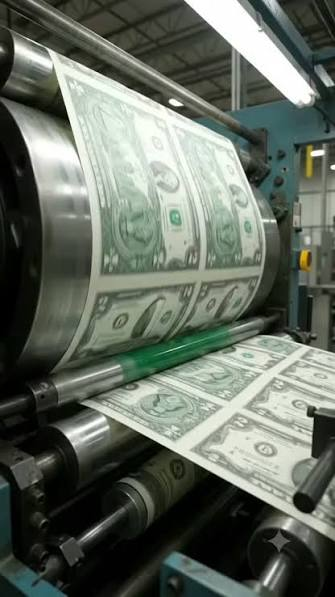
@Handre The US essentially had two money printing spikes that have caused the inflation we feel today: 2008 and 2021. Since 1971 when the dollar went fiat, it has lost ~87% of its purchasing power.
Every dollar the Federal Reserve prints dilutes the purchasing power of every dollar you already hold. This is not a bug in the system; it's the entire reason it exists.
Fiat currency, unbacked by gold or any commodity, gives central banks the power to expand the money supply at will. The Fed created $4.5 trillion in new money between March and June 2020 alone, more than doubling its balance sheet in three months. No wealth was produced to match it. The Fed simply conjured digits, and the existing pool of dollars became worth less the moment it did.
The process works through what is called the Cantillon effect, named for Richard Cantillon, the 18th-century banker who noticed that new money never enters an economy uniformly. It enters at a specific point: the Treasury, the primary dealers, the connected banks. Those institutions spend the fresh money before prices have adjusted upward. They buy assets, properties, equities. By the time that money filters down to wage earners and savers, prices have already risen. You absorb the inflation without ever touching the stimulus.
Redistribution by stealth. No congressman votes to cut your purchasing power by 8.3 percent (as happened in 2022). The Federal Reserve does it administratively, and your savings account takes the loss while bond markets celebrate cheap credit.
Then there is the problem of malinvestment. When the Fed holds interest rates artificially below their market-clearing level, it sends a false signal. Entrepreneurs borrow heavily and deploy capital into projects that only appear profitable under cheap-money conditions: speculative tech startups in 2021, subprime mortgage securities in 2006. When the rate cycle eventually turns, those projects collapse, and real resources have been wasted. Workers trained for industries that should never have existed. Buildings half-finished. Capital burned.
Sound money advocates have traced this boom-bust pattern across every major cycle since the Federal Reserve's founding in 1913. The institution was sold to the public as a "stabilizer," but the dollar has lost over 97 percent of its purchasing power since then. Judge it by results, not intentions.
The exit from this system is straightforward in principle and politically radioactive in practice: separate money from state control, return to a commodity anchor, and strip central banks of the authority to manufacture purchasing power from nothing.
BREAKING: "Anthropic is unprofitable, less than six years old and Wall Street isn’t confident it will meet its long-term obligations. The debt market expects credit-rating firms to rate its bonds as junk, or below investment grade," per WSJ
The Mississippi River is 10 miles away from Middletown, Iowa.
It provides the drinking water for 20 million Americans and is the largest 4th largest river basin in the world.
They're literally poisoning our wells.