THE CATHOLIC RULE OF LIFE I WISH SOMEONE HAD TAUGHT ME SOONER
A few years ago, I thought becoming a better Catholic meant learning more.
More theology.
More apologetics.
More books.
More Catholic content.
Those things are good.
But I eventually discovered something surprising.
Most saints did not become saints because they knew more.
They became saints because they consistently did a few simple things every day.
That realization changed how I view the spiritual life.
So after studying Sacred Scripture, the Catechism, and the lives of the saints, I began noticing a pattern.
Different saints.
Different centuries.
Different personalities.
Yet they all built their lives around the same foundations.
If someone asked me today:
“How do I actually live like Jesus Christ every day?”
This is the framework I would share.
And honestly, it is the framework I am still trying to live myself.
1. GIVE GOD THE FIRST MOMENT OF YOUR DAY
Before the notifications.
Before the messages.
Before the news.
Before social media.
Give God the first moment.
Make the Sign of the Cross.
Thank Him for another day.
Offer everything to Him.
The first voice you hear should not be the world.
It should be God.
2. READ THE GOSPEL BEFORE YOU READ OPINIONS
One verse.
One paragraph.
One chapter.
Whatever you can manage.
The point is simple:
Let Christ shape your mind before the world shapes it for you.
Many of us spend hours consuming information and only minutes receiving formation.
That imbalance affects everything.
3. PROTECT THE STATE OF GRACE LIKE YOUR GREATEST TREASURE
Because it is.
The Church teaches that sanctifying grace is God's own life within the soul.
Nothing on earth is worth losing that.
Not success.
Not money.
Not pleasure.
Not popularity.
Go to Confession regularly.
Take sin seriously.
Take God's mercy even more seriously.
4. BUILD YOUR LIFE AROUND THE EUCHARIST
The saints never got tired of speaking about the Eucharist.
Neither should we.
The closer they drew to Jesus in the Blessed Sacrament, the more they began to resemble Him.
Sunday Mass is the minimum.
Not the goal.
If possible, attend daily Mass.
Visit Jesus in Adoration.
Stay after Communion.
Speak to Him.
Listen to Him.
Remain with Him.
5. STOP LOOKING FOR HOLINESS IN EXTRAORDINARY THINGS
Most holiness happens in ordinary moments.
Being patient when you are tired.
Forgiving when you would rather hold a grudge.
Remaining kind when someone is difficult.
Serving when nobody notices.
The saints did not become saints because they did spectacular things every day.
They became saints because they loved God in ordinary circumstances.
6. CARRY YOUR CROSS INSTEAD OF RUNNING FROM IT
Every day brings a cross.
A disappointment.
A struggle.
A wound.
A sacrifice.
A burden nobody else sees.
Modern culture says:
“Avoid suffering.”
Jesus says:
“Follow Me.”
The difference is enormous.
One path seeks comfort.
The other seeks transformation.
“The best men have been broken.”
Chris Williamson shared this line from Alain de Botton on his Modern Wisdom podcast. He says you can see it in the eyes, a quiet humility, a recognition of limits, even in high achievers.
After two brutal years dealing with serious health issues, Chris realized that getting kicked in the teeth forces you to examine your patterns, motivations, and goals under a microscope. It’s uncomfortable in the moment, but it becomes a gift.
He believes almost all of our greatest accomplishments are born from our lowest points. Adversity is a terrible thing to waste.
This hit me hard. The guys who seem most grounded and impressive often carry some invisible scars. The smooth, effortless path rarely produces the same depth.
In a culture obsessed with constant wins and highlight reels, remembering that struggle forges real character is a powerful reminder. The lowest points often plant the seeds for what we become.
What’s one hard season in your life that ended up shaping you for the better?
Nobody talks about the lonely part.
“People always talk about talent, but what they don’t wanna talk about is loneliness. The empty gym…”
- Larry Bird
Confidence.
Nobody gives it to you.
You build it rep by rep.
In the gym when no one’s watching. https://t.co/4zIilqfX40
When a person stops being absorbed in the horizontal world
and starts orienting toward higher realities
they discover that most people are staring in the wrong direction.
Do not love based on your passions and your desires, but love the Lord your God with all your heart, all your soul, all your mind, and all your strength, which means your passions are to be turned in His direction and no other.
We must reject the lie that says there is no love that is out of bounds because ultimately that lie that says “there is no love that’s out of bounds” is a lie that says there is no truth in God. — Voddie Baucham
GREEN FLAGS IN A MAN WHO WILL BE A GREAT FATHER:
1. He is patient with things that don't deserve patience
2. He gets on the floor and plays with kids
3. He never mocks anyone for being emotional
4. He apologises to children when he's wrong
5. He talks about his own father honestly
6. He shows up for the boring, invisible moments
7. He protects without controlling
8. He teaches by example, not by lecture
9. He makes children feel safe around him
10. He already loves what he hasn't been given yet
Throwback to pro-life celebrity Tim Tebow hosting a red carpet event to humanize people with special needs, including children with Down syndrome.
These people are valuable and worthy of life. 🤍
Rediscovering Christ From Catholicism to Spiritual Warfare
It’s all about Christ. ✝️
Raised in many different churches, I drifted from faith. But in my darkest hour, I remembered the teachings. I prayed. I quoted Scripture. I prayed some more.
And God met me there. He’s always faithful—ready to help anyone who truly seeks Him.
It’s all about Christ. 🙏 I’m a Christian, not Catholic or Baptist just Christian 💪
#shawnryan #joshduhamel
Breaking: Pope Leo XIV tells states that Catholic Colleges and Universities must teach "sound doctrine" and that it is not enough to teach intellectual truths but they must teach the "Truth that is Christ."
Marriage stuff the church never warned me about:
1. Sex is a skill. It’s a gift from God and It’s worth learning how to do well. Being better at sex (only with your wife) only blesses your marriage. And the “best sex” isn’t what you think. It’s facilitated through intimacy, safety, and love. For the man - this means you need intimacy with the Holy Spirit, first. You need to view your wife as a daughter of the King and love her in way she’s worthy of. You need to die to yourself, serve her, protect her, provide for her financially, emotionally, and spiritually. You need to LEAD her. That typically translates into more frequent, more pleasurable, more intimate sex - which energizes a marriage.
2. Your view of money matters. If all you want is more, you won’t steward it well, you'll still live in comparison to what you want next, and funny enough - you'll probably end op with less of it. On the contrary, if you don’t prioritize increasing your wealth, you’ll miss out on the abundant opportunities God gives you to glorify him through what money can do. Money is a tool. It's a gift God has given you to steward and multiply for his glory (yes you can buy nice things to the glory of God, and you can exhibit financial discipline to the glory of God). Worship him with every dollar you receive, and every dollar you deploy.
3. Pray together every single day, even if you're really tired or you just fought. The divorce rate for the average couple is 50%. The divorce rate for couples that pray together is less than 1%. God hates divorce. Divorce is hell. God can always redeem divorced believers, but avoid it if you can. Establish the basic discipline of praying together every single day. This is more important than brushing your teeth and eating food.
4. Be willing to cut friendships. Especially ones that began before you were married. The two of you have became one flesh. Your dynamic with every human being you interact with has forever changed. Everything you do directly affects your wife, everything she does directly affects you. Have conversations early on about who is no longer welcomed in your life, cut them quickly. And if there are people who simply need to be kept at greater distance, orient your calendars accordingly. Do the same in reverse. The couples who sharpen you, draw near to them, prioritize them. They will be there for both of you in your hardest times. They will fight for your marriage in moments where you offend one another. Your friends matter. And no - your wife cannot have male friends that are not directly friends with you, or vice versa.
5. You are not part of your parent’s family anymore. Non-believers have a harder time with this, but the Bible speaks to it so directly. You are no longer part of your parent’s family. They are now extended family. If your parents have friction with how you live your lives, that’s OK. There is tension between consistently honoring your parents, while being OK if they disagree with you. Bring that tension to the Holy Spirit and ask for his guidance in every interaction, every boundary, and all communication.
6. Marriage isn’t the goal. It’s the beginning of a journey. It’s a common temptation to become complacent in improving yourself after getting married. There’s this mindset of “jobs done! We’ve arrived.” and that’s absolutely hilarious. The most challenging, and most rewarding work begins after you’ve gotten married. This is where you’re now directly cleaved with the person who’s supposed to sharpen you. Then this means men, you need to lead, cast vision, and continually grow. And women, you are the person this man is willing to die for, you’re the person he’s trusting to deliver his child, and nurture his offspring. You’re the primary helper God designed to support his mission. It is your duty as a woman of God to continue to grow. A proverbs 31 woman was not a weak, powerless housewife scrolling Instagram all day. Read it.
7. Set the culture of how you’re going to steward your bodies in the home, early. How you honor the temple of God is such an integral part of your daily life, it impacts sleep schedules, grocery lists, it impacts every single meal, it impacts how you use your time. If there’s not agreement in the home about how you’re going to honor your bodies, it will become an intense point of contention in your day-to-day life. The person with greater health will be burdened with taking care of the one who has worse health. And although some things are not preventable, most prognosis are totally preventable. Don’t burden your partner because you couldn’t stop eating Twinkies and never worked out. Do your part so that you can show up well with them, with energy, presence, and confidence in who God made you. Your health will be the #1 determinant of your quality of life in your later years when grand babies come. Heck - after your relationship with God, it's one of the primary determintants of your quality of life even before grand babies come. And - back to my first point, you want to be able to keep those hips moving as you guys get older 👍
8. Marriage is not a thing you do for mutual benefit. He provides, she makes the home - in practice yes, but that's not the point. The point of marriage is so that you know Christ more deeply. It's a reflection of the most valuable thing in the universe. Eternal life, knowing God. Take that view into every trial, and every mountain top - you work towards an excellent, intimate marriage - to know Christ more deeply, as a testemant and service to his people, and to glorify his Holy name.
Married people, what would you add?
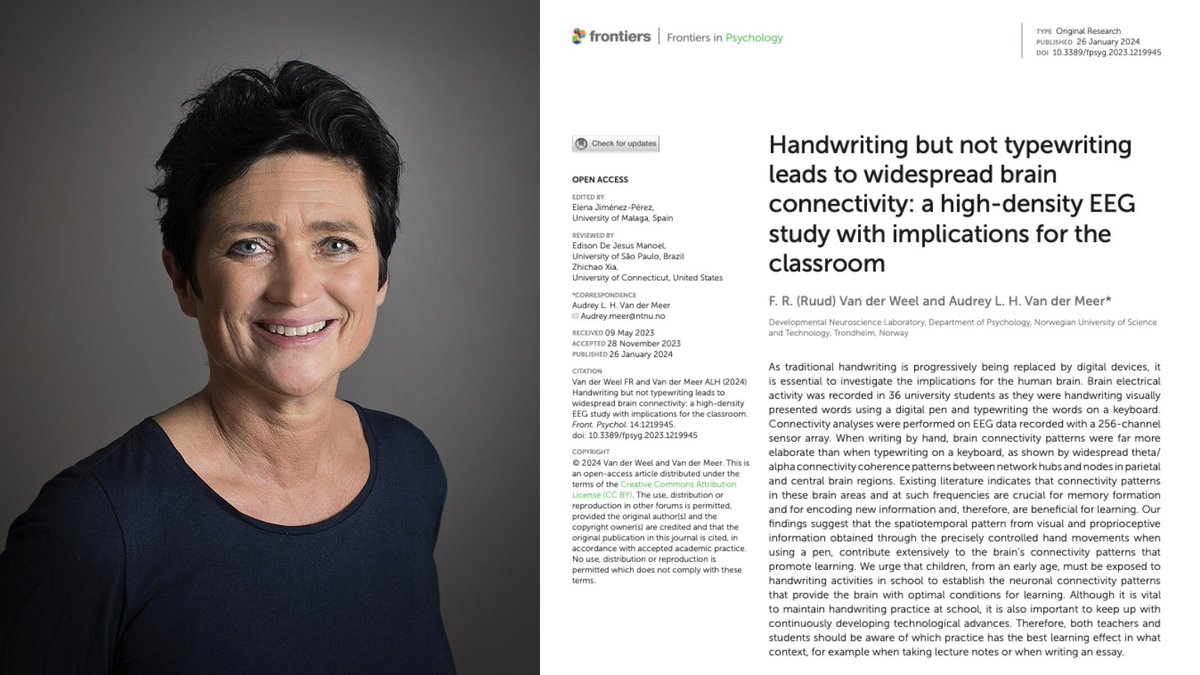
A Norwegian neuroscientist spent 20 years proving that the act of writing by hand changes the human brain in ways typing physically cannot, and almost nobody outside her field has read the paper.
Her name is Audrey van der Meer.
She runs a brain research lab in Trondheim, and the paper that closed the argument was published in 2024 in a journal called Frontiers in Psychology. The finding is brutal enough that it should have changed every classroom on Earth.
The experiment was simple. She recruited 36 university students and put each one in a cap with 256 sensors pressed against their scalp to record brain activity. Words flashed on a screen one at a time.
Sometimes the students wrote the word by hand on a touchscreen using a digital pen, and sometimes they typed the same word on a keyboard. Every neural response was recorded for the full five seconds the word stayed on screen.
Then her team looked at the part of the data most researchers had ignored for years, which is how different parts of the brain were communicating with each other during the task.
When the students wrote by hand, the brain lit up everywhere at once.
The regions responsible for memory, sensory integration, and the encoding of new information were all firing together in a coordinated pattern that spread across the entire cortex. The whole network was awake and connected.
When the same students typed the same word, that pattern collapsed almost completely.
Most of the brain went quiet, and the connections between regions that had been alive seconds earlier were nowhere to be found on the EEG.
Same word, same brain, same person, and two completely different neurological events.
The reason turned out to be something nobody had really paid attention to before her work. Writing by hand is not one motion but a sequence of thousands of tiny micro-movements coordinated with your eyes in real time, where each letter is a different shape that requires the brain to solve a slightly different spatial problem.
Your fingers, wrist, vision, and the parts of your brain that track position in space are all working together to produce one letter, then the next, then the next.
Typing throws all of that away. Every key on a keyboard requires the exact same finger motion regardless of which letter you are pressing, which means the brain has almost nothing to integrate and almost no problem to solve.
Van der Meer said it plainly in her interviews.
Pressing the same key with the same finger over and over does not stimulate the brain in any meaningful way, and she pointed out something that should scare every parent who handed their kid an iPad.
Children who learn to read and write on tablets often cannot tell letters like b and d apart, because they have never physically felt with their bodies what it takes to actually produce those letters on a page.
A decade before her, two researchers at Princeton ran the same fight using a completely different method and ended up at the same answer. Pam Mueller and Daniel Oppenheimer tested 327 students across three experiments, where half took notes on laptops with the internet disabled and half took notes by hand, before testing everyone on what they actually understood from the lectures they had watched.
The handwriting group won by a wide margin on every question that required real understanding rather than surface recall.
The reason was hiding in the transcripts of what the two groups had actually written down.
The laptop students typed almost word for word, capturing more total content but processing almost none of it as they went, while the handwriting students physically could not write fast enough to transcribe a lecture in real time, which forced them to listen carefully, decide what actually mattered, and put it in their own words on the page.
That single act of choosing what to keep was the learning itself, and the keyboard had quietly skipped the choosing and skipped the learning along with it.
Two studies. Two countries. Same answer.
Handwriting makes the brain work. Typing lets it coast.
Every note you have ever typed instead of written went into your brain through a thinner pipe. Every meeting, every book highlight, every idea you captured on your phone instead of on paper was processed at half depth.
You did not forget those things because your memory is bad. You forgot them because typing never woke the part of the brain that would have made them stick.
The fix is the thing your grandmother already knew.
Pick up a pen. Write the thing down. The slower road is the faster one.
My dad built something truly special out of nothing.
He walked away from a lucrative Big Law job to launch something unheard of--fighting for everybody's religious liberty? Even the religions you disagree with?
It was a huge risk--he would always half-joke that in Becket's first office, you couldn't open the door all the way because it would hit his desk. They had many tough months getting off the ground--and he always paid himself last, if at all. But he never lost faith because he knew in his heart he was doing it in service to God.
Today, Becket has dozens of Supreme Court precedents--Little Sisters of the Poor, Hobby Lobby, etc--to its name and is largely responsible for the words "under God" remaining in the Pledge of Allegiance.
My dad kept running Becket while battling Parkinson's for years--and then had the humility to step away when the time was right (a rare trait in Washington!)
A truly special organization founded by a truly special man.