A Norwegian neuroscientist spent 20 years proving that the act of writing by hand changes the human brain in ways typing physically cannot, and almost nobody outside her field has read the paper.
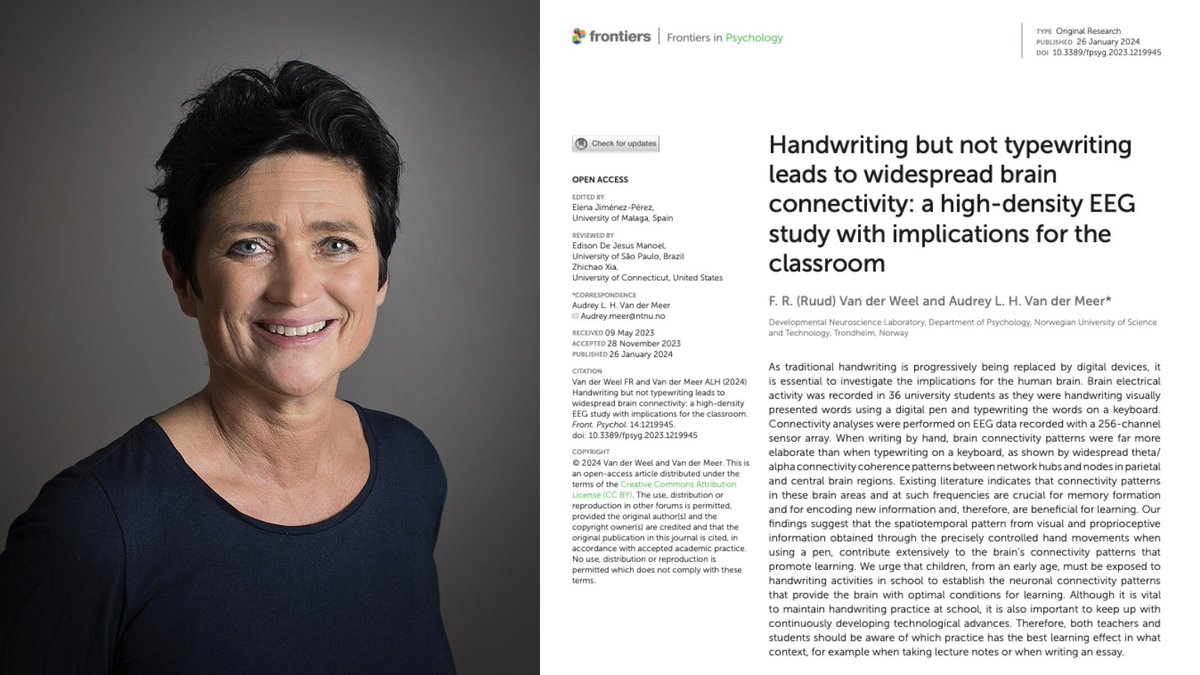
Her name is Audrey van der Meer.
She runs a brain research lab in Trondheim, and the paper that closed the argument was published in 2024 in a journal called Frontiers in Psychology. The finding is brutal enough that it should have changed every classroom on Earth.
The experiment was simple. She recruited 36 university students and put each one in a cap with 256 sensors pressed against their scalp to record brain activity. Words flashed on a screen one at a time.
Sometimes the students wrote the word by hand on a touchscreen using a digital pen, and sometimes they typed the same word on a keyboard. Every neural response was recorded for the full five seconds the word stayed on screen.
Then her team looked at the part of the data most researchers had ignored for years, which is how different parts of the brain were communicating with each other during the task.
When the students wrote by hand, the brain lit up everywhere at once.
The regions responsible for memory, sensory integration, and the encoding of new information were all firing together in a coordinated pattern that spread across the entire cortex. The whole network was awake and connected.
When the same students typed the same word, that pattern collapsed almost completely.
Most of the brain went quiet, and the connections between regions that had been alive seconds earlier were nowhere to be found on the EEG.
Same word, same brain, same person, and two completely different neurological events.
The reason turned out to be something nobody had really paid attention to before her work. Writing by hand is not one motion but a sequence of thousands of tiny micro-movements coordinated with your eyes in real time, where each letter is a different shape that requires the brain to solve a slightly different spatial problem.
Your fingers, wrist, vision, and the parts of your brain that track position in space are all working together to produce one letter, then the next, then the next.
Typing throws all of that away. Every key on a keyboard requires the exact same finger motion regardless of which letter you are pressing, which means the brain has almost nothing to integrate and almost no problem to solve.
Van der Meer said it plainly in her interviews.
Pressing the same key with the same finger over and over does not stimulate the brain in any meaningful way, and she pointed out something that should scare every parent who handed their kid an iPad.
Children who learn to read and write on tablets often cannot tell letters like b and d apart, because they have never physically felt with their bodies what it takes to actually produce those letters on a page.
A decade before her, two researchers at Princeton ran the same fight using a completely different method and ended up at the same answer. Pam Mueller and Daniel Oppenheimer tested 327 students across three experiments, where half took notes on laptops with the internet disabled and half took notes by hand, before testing everyone on what they actually understood from the lectures they had watched.
The handwriting group won by a wide margin on every question that required real understanding rather than surface recall.
The reason was hiding in the transcripts of what the two groups had actually written down.
The laptop students typed almost word for word, capturing more total content but processing almost none of it as they went, while the handwriting students physically could not write fast enough to transcribe a lecture in real time, which forced them to listen carefully, decide what actually mattered, and put it in their own words on the page.
That single act of choosing what to keep was the learning itself, and the keyboard had quietly skipped the choosing and skipped the learning along with it.
Two studies. Two countries. Same answer.
Handwriting makes the brain work. Typing lets it coast.
Every note you have ever typed instead of written went into your brain through a thinner pipe. Every meeting, every book highlight, every idea you captured on your phone instead of on paper was processed at half depth.
You did not forget those things because your memory is bad. You forgot them because typing never woke the part of the brain that would have made them stick.
The fix is the thing your grandmother already knew.
Pick up a pen. Write the thing down. The slower road is the faster one.
Magically, that last paper towel lasts as long as the rest of the roll. Suddenly everyone in my family (including me) turns into a depression-era miser.
Christ’s resurrection is the single most important event in the history of mankind. His promise to do so is the most important promise ever fulfilled. If he had not completed this work, then we as believers are of all men to be most pitied. In fact, it is the resurrection that gives us not only hope for eternity but also power in the present and forgiveness for the past.
It is because of the resurrection — because Jesus did precisely what he said and is a living savior — that the way in which I treat my children, my spouse and my community matters.
Today we celebrate the open invitation he extends to all, saying that whosoever will come in repentance and faith can become a child of God.
And by contrast, Claude doesn't even let you switch from Claude Pro to a team account. It's actually easier to switch from Claude to Gemini than Claude to Claude.
Switching to Gemini from other AI apps just got easier.
Starting to roll out today on desktop, you can now bring your preferences and chat history into Gemini, so you can pick up right where you left off in just a few clicks. 🧵
The Anxious Generation was published two years ago today, in a very different world. Back then, the most common objection I got was resignation: "The train has left the station." "You can't put toothpaste back in the tube." "It's how the kids connect today."
Today, the world looks very different. It turns out that if our kids were all on a train and we learned it was heading toward a collapsed bridge, we'd find a way to stop it and bring them safely back to the station. That’s what’s happening now.
After the historic verdicts in Los Angeles and New Mexico, today is a great day to reflect on the capacity of people in democratic societies to take action, even when opposing some of the most powerful corporations in history. We're getting access to the courts. We're getting phone-free schools. We're seeing whole neighborhoods letting kids out to play, unsupervised, which is what we older folk all remember as the best part of childhood.
So I want to recognize:
--The mothers (and, right behind them, fathers) who rose up by the millions and powered the movement.
--The farsighted governors and legislators in red states and blue states who have been innovating on policy solutions.
--The leaders of a dozen of nations, who are raising the age to 16 for opening social media accounts (with a special shoutout to Australia, for going first).
--The teachers and school administrators who had their classrooms disrupted for 15 years, and who are now eager to think through new solutions as screens have taken over and obstructed learning.
--The grassroots organizations who have been dedicating their efforts to advocate for all of the above in their local communities.
--The millions of members of Gen Z who have been rising up, demanding agency over how they spend their lives in the digital era, and finding better ways to connect in real life.
And one final group: the survivor parents--the ones you saw in those pictures of people embracing on the front steps of the LA courthouse. I have met many over the years. I am in awe of their courage and tenacity, their willingness to tell their stories of loss, over and over again, to different audiences, in the hope that no other parent would have to endure what they have endured. At long last, juries and legislatures are hearing you, and are acting.
Together, we are calling the train back to the station. Together, we are rolling back the phone based childhood and reclaiming life in the real world.
The work continues. If you’re not already involved, join us: https://t.co/HdJDTKOQ3T
Okay... I'm going to sound like real-life @ChrchCurmudgeon here, but here goes...
If you are a church musician, and you honestly want to "lead people in worship" through music, you may want to do the following:
1) Pick a singable key for the median person who doesn't sing all the time. Don't pick a key to highlight your voice.
2) Lower the volume so people can hear the voices of those around them, and themselves.
3) Let people sing the melodies that are familiar to them. While you may want to jazz up or do the latest CCM twist of "Hark the Herald" or "Silent Night"--people can't follow you. They just want to sing the song.
Picking keys to highlight your voice; playing at concert volume; doing creative rearrangements to make the familiar suddenly unfamiliar... all discourage us from singing.
There's NOTHING wrong with highlighting your voice, or playing at concert volume, or doing creative rearrangements of songs... if you are a performer.
Book a gig somewhere! Play out! Be great! Build a following! But please, when we all get together and sing, don't put up barriers to stop us.
"Please, Aslan," said Lucy. “Before we go, will you tell us when we can come back to Narnia again? Please? And oh, do, do, do make it soon.”
“Dearest,” said Aslan very gently, “you and your brother will never come back to Narnia.”
“Oh, Aslan!!” said Edmund and Lucy both together in despairing voices.
“You are too old, children,” said Aslan, “and you must begin to come close to your own world now.”
“It isn’t Narnia, you know,” sobbed Lucy. “It’s you. We shan’t meet you there. And how can we live, never meeting you?”
“But you shall meet me, dear one,” said Aslan.
“Are—are you there too, Sir?” said Edmund.
“I am,” said Aslan. “But there I have another name. You must learn to know me by that name. This was the very reason why you were brought to Narnia, that by knowing me here for a little, you may know me better there."
--The Voyage of the Dawn Treader
In 1783, King George III asked an American painter what George Washington would do now that he had virtually won the war. The painter replied that the General intended to return to his farm in Virginia. The King was stunned. He reportedly said, "If he does that, he will be the greatest man in the world."
Throughout history, victorious generals almost always seized the throne. From Caesar to Cromwell, military success usually meant political dictatorship. The concept of voluntarily walking away from absolute power was practically unheard of.
But George Washington wasn't like other men.
By December 4, 1783, the British surrender at Yorktown was past, and peace was finally assured. Washington commanded a powerful, seasoned army that adored him. Conversely, many of his officers were unpaid and angry at the inefficient Congress. They had the guns, the manpower, and the loyalty to install a new monarch.
He could have been King George I of America.
Instead, on this day in history, Washington walked into the Long Room at Fraunces Tavern in lower Manhattan. The room was filled with his most loyal officers—men like Henry Knox and Baron von Steuben—who had frozen with him at Valley Forge and bled with him for eight long years.
The atmosphere wasn't celebratory. It was heavy with inevitable separation. Washington, usually stoic and commercially reserved, poured a glass of wine and looked at his brothers-in-arms with visible emotion.
"With a heart full of love and gratitude, I now take leave of you," he said, his voice shaking. "I most devoutly wish that your latter days may be as prosperous and happy as your former ones have been glorious and honorable."
He didn't order them. He didn't demand their allegiance. He hugged them.
One by one, the hardened soldiers wept openly. Washington embraced each man in silence. There was no pomp, no ceremony, and no speeches about future conquests. It was just a quiet goodbye between warriors who had done the impossible.
Immediately after leaving the tavern, Washington didn't march on Congress to demand payment or power. He rode to Annapolis, Maryland, resigned his commission, and went home to Mount Vernon to plant crops.
He did the impossible.
He refused the crown.
He trusted the people.
By stepping down, he ensured that the United States would be a republic ruled by laws, not a kingdom ruled by force. He proved that the military serves the people, not the other way around. It was the final, and perhaps greatest, victory of the Revolution.
The world watched in awe as the American Cincinnatus returned his sword to its sheath, proving that character is the strongest constitution of all.
Sources: Mount Vernon Ladies' Association / Library of Congress
It's time to remove laptops from classrooms.
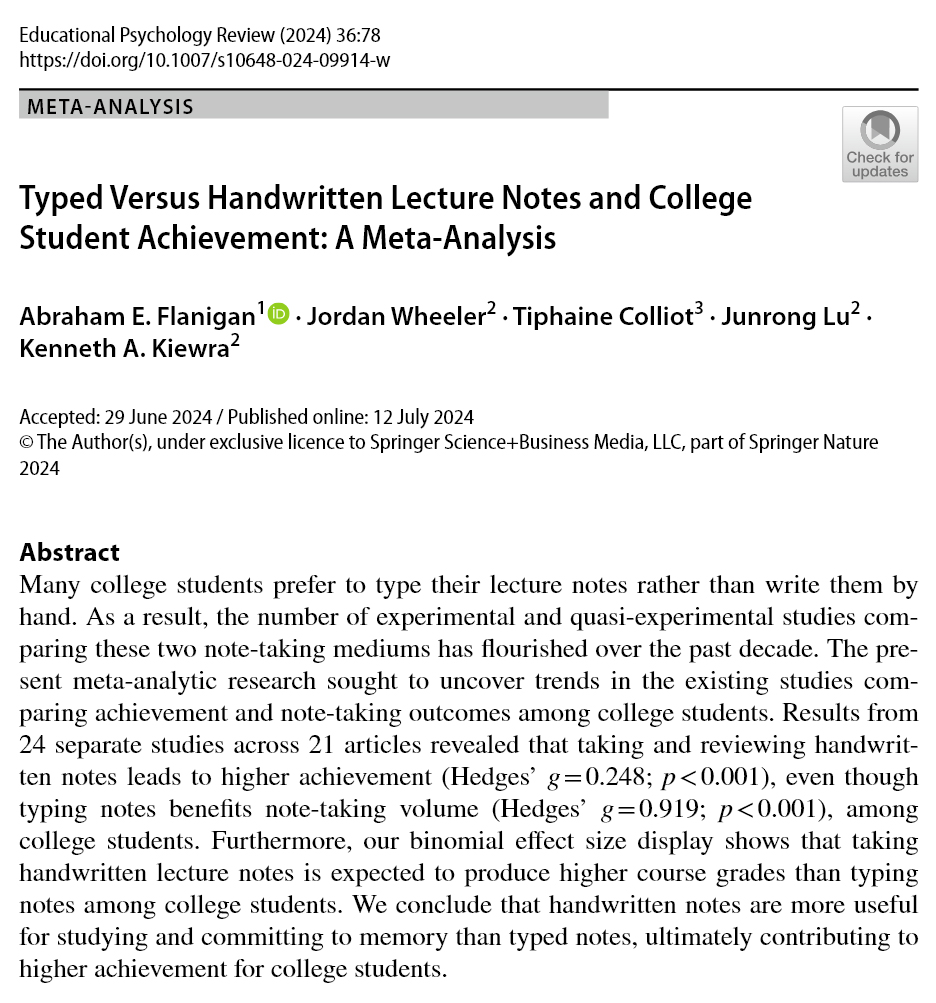
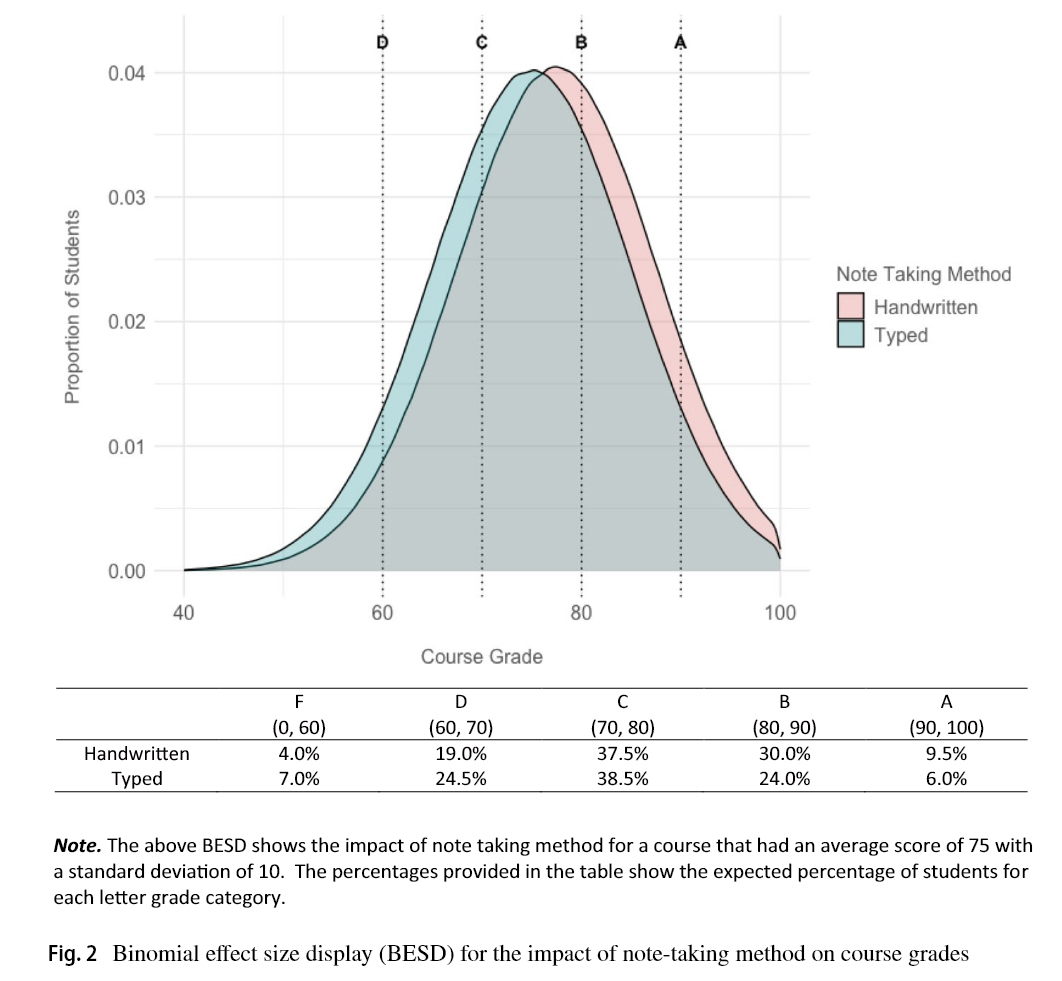
24 experiments: Students learn more and get better grades after taking notes by hand than typing. It's not just because they're less distracted—writing enables deeper processing and more images.
The pen is mightier than the keyboard.
“Although it once seemed like a good idea to give every child his or her own device, it’s clear that those policies have been a failure.”
💯
School-issued laptops distract students at school and home, expose them to things they shouldn’t see, and hurt learning.
🧵