What if securing capital didn’t require collecting it upfront?
Vaults hold.
OnCall Does not.
- Investors commit from their wallets
- Assets stay locked until called
- Managers draw capital when needed
Designed for fund managers and vault providers.
Commit, Call, Deploy.
Built around ERC-7943. Universal Real World Asset Interface.
Tokenizing a financial instrument is about efficiency, not automatically attracting more investors.
Our CRO @Ludovico__Rossi, interviewed by Robbie Chrisman on Chrisman Commentary Daily Mortgage News, puts it simply: "It's all about efficiency." He explains that the point is to issue, manage and move those instruments more efficiently.
The conversation also turns to AI-driven investment transactions. Ludovico explains that agents should not be given full access to an account. They need guardrails, including spending and investment limits. In his words: "So we need a responsible person behind the agent." Accountability, he says, stays with the person who gives the agent its mandate.
Watch the interview: https://t.co/HIenCyeVNV
@Adfesttestimony@Ludovico__Rossi We couldn't agree more. Sustainable growth isn't just about bringing more participants into the ecosystem, but about making the underlying processes more efficient, reliable and transparent.
@MATHEW_KINZY Market conditions will always fluctuate, but our focus remains on building infrastructure that addresses real needs in the tokenization ecosystem. Long-term value comes from adoption, utility and execution.
@CillionaireMind We're exploring how tokenization can unlock value beyond traditional ownership. Exhibition revenue is an interesting example of how real-world assets can support new, structured participation models.
Art on exhibition can generate income. Tokenization can help administer how it is shared.
For example, a foundation could structure an offering linked to a sculpture's exhibition income, with supporters' rights set out in the governing documents. The offering seeks €200,000 from eligible supporters, exhibition agreements define the fees payable by museums or venues, and the administrator records receipts and distributes the agreed amounts through supported payment workflows.
Any payment depends on actual receipts, the agreed terms and applicable requirements.
Explore revenue sharing from exhibition royalties on our art tokenization page: https://t.co/c5sPqfyiIc
@CillionaireMind@Ludovico__Rossi We believe this is the next major step for tokenization. Making financial instruments programmable opens up opportunities for greater efficiency and automation, while predefined rules and human accountability remain essential.
@Cryptic_Web3@Ant_Intl@FranklnTempletn@dbsbank A treasurer can switch idle cash into fund units and back without waiting on settlement. The record that matters is the fund register, so each switch has to land there as cleanly as it does on the bank side.
@Cointelegraph A tokenized bond can outlive the signature scheme it launched with. Planning how keys get rotated without pausing coupons, votes or redemptions belongs in the design phase, not the crisis phase.
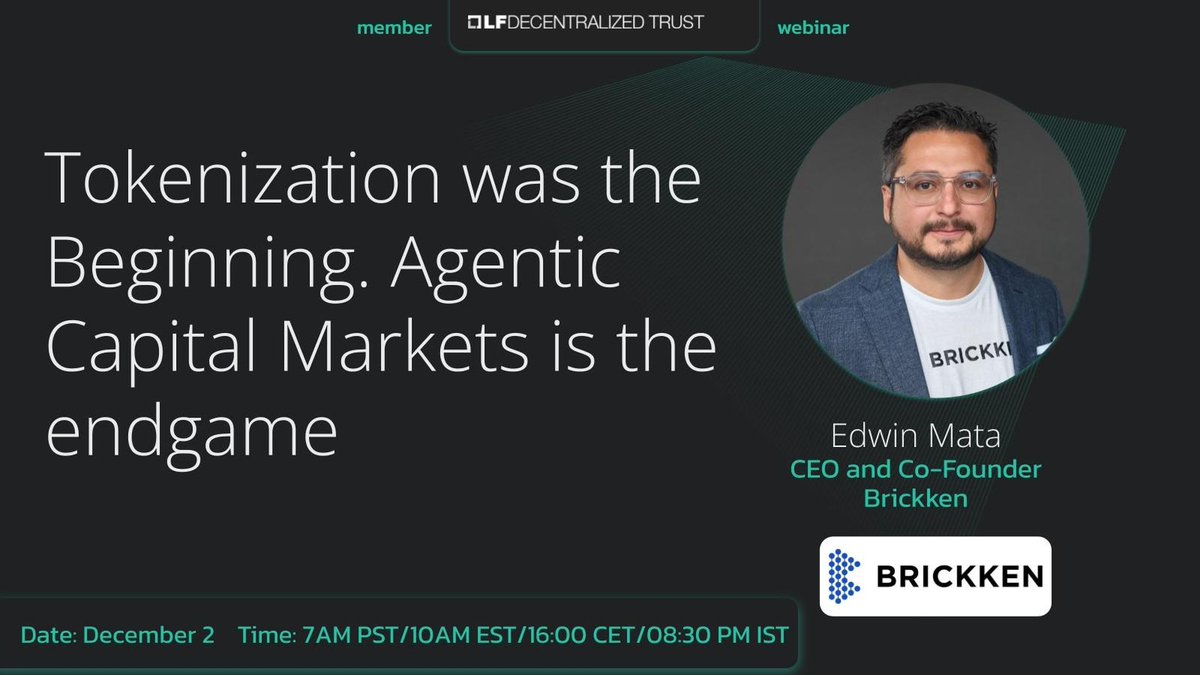
Tokenization was the beginning. Agentic capital markets is the endgame.
Join our CEO @edwin_mata at the @LFDecentralized webinar.
📅 Wednesday, 2 December 2026
🕐 16:00 CET (7AM PST / 10AM EST)
Register now: https://t.co/wgMjQeeHxY
@TOMYELLTOM@edwin_mata@lfdecentralized Fair point, Irene. Real examples matter more than predictions. The key is showing how agents operate within defined mandates, how actions are verified and who remains accountable. Those are the questions worth testing in practice.
@rodite_tove@edwin_mata@lfdecentralized Good question! The distinction is about authority. An AI agent can assist with decisions, but executing financial transactions requires defined permissions, limits and oversight. It's not about giving agents unrestricted control over assets.
@Utibebles@Ludovico__Rossi Well said, Utibe! 🙌 Giving agents more autonomy shouldn't mean giving up control. Clear limits and a responsible person behind every mandate are essential when financial transactions are involved.
@Crypto_Politis@Ludovico__Rossi You make a good point. An agent can execute a transaction, but someone still needs to define its authority and take responsibility for the outcome. That's why the rules matter as much as the technology.
@MATHEW_KINZY@Ludovico__Rossi You picked up on both sides of the conversation! 🙌 Making financial workflows more efficient matters, but so does keeping people accountable when AI agents are involved. Appreciate you following along!
@MysticLedger1@Ludovico__Rossi That's a useful comparison. Giving an agent permission to execute doesn't remove the need for oversight. The mandate, its limits and accountability all need to be clear before an agent acts.
@Utibebles That's the key distinction, Utibe. Regulatory approval is one step. The real test comes when clearing and settlement are running in production, with the controls and reliability financial institutions require.
The next test for tokenized securities: where trades clear and settle.
Avalanche will be the core ledger for the clearing firm of a planned NYSE-affiliated platform, per Ava Labs and NYSE. It's not live and is subject to regulatory approvals.
Ava Labs: https://t.co/A90Cp5UAsw
WSJ Exclusive: Avalanche (@avax) will provide the core ledger technology for the clearing firm on the NYSE-affiliated tokenized securities platform.
Subject to regulatory approvals, the platform is designed to support 24/7 trading, clearing and settlement for its subscribers.
@WSJ in thread
@TheBlockCo The register is the part to plan for early. A tokenized security is only as durable as the signatures that prove who owns it.
Migrating holder records to new cryptography without breaking the audit trail is part of issuing an asset meant to last decades.