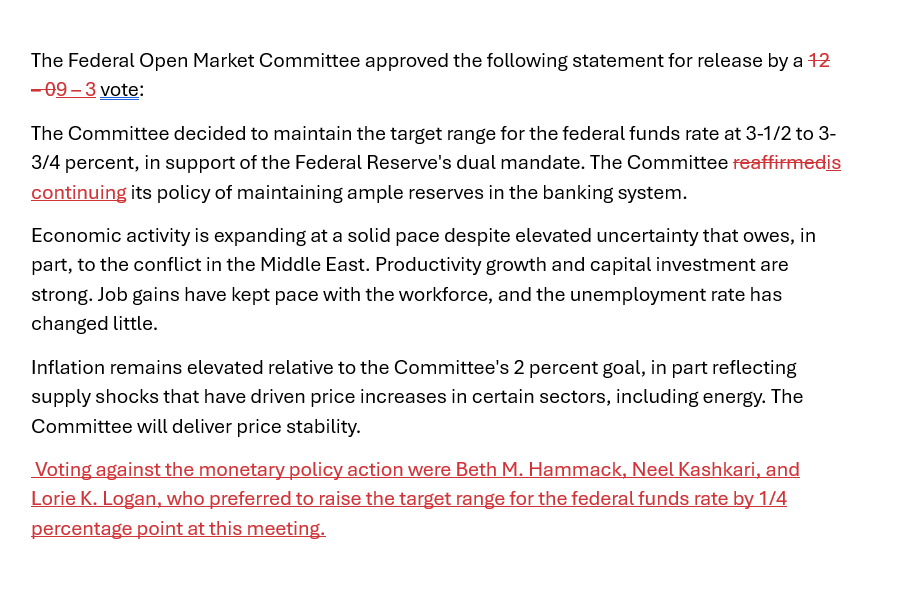
Two take-aways from the Warsh press conference:
1) Warsh exudes both competence and reasonableness. Everyone should feel good with him at the helm.
2) This is a more modest Fed. We've been trained over the past 15 years to think the Fed is the most important actor in the market. It's obviously still important, but I don't think it's going to jerk markets around like it has in the past. It will let the market lead.
Fed's Next Move.
Removes statement about commitment to Ample Reserves.
Lowers Rates paid to Banks on Excess Reserves.
No Fed Watchers are calling this, but Warsh is literally telling us that is what he wants.
No need for forward guidance. The plan is explicit.
Equities and bonds dropping will not humble Warsh.
That is what he wants, if that is what the market wants.
He doesn't want to influence the market when times are normal.
Why can't these commentators get it?
Mark It.
The next FOMC move that will change things is in the statement, not in the rate move.
They will drop the statement that the Fed is committed to maintain Ample Reserves.
This, may or may not come with the Rate change of Lower Rates.
Warsh is on record, in multiple interviews prior to being the Chair, that the Fed can lower rates and lower the Balance Sheet simultaneously and fight inflation.
This is why the Task Forces exist, to provide academic cover.
Warsh is a Monetarist.
The past 16 years of Fed Watchers need to do some ideological deep dives into Keynesian vs. Monetarists in order to accurately predict where this Fed is headed.
Mark It.
The next FOMC move that will change things is in the statement, not in the rate move.
They will drop the statement that the Fed is committed to maintain Ample Reserves.
This, may or may not come with the Rate change of Lower Rates.
Warsh is on record, in multiple interviews prior to being the Chair, that the Fed can lower rates and lower the Balance Sheet simultaneously and fight inflation.
This is why the Task Forces exist, to provide academic cover.
Warsh is a Monetarist.
The past 16 years of Fed Watchers need to do some ideological deep dives into Keynesian vs. Monetarists in order to accurately predict where this Fed is headed.
Mark It.
The next FOMC move that will change things is in the statement, not in the rate move.
They will drop the statement that the Fed is committed to maintain Ample Reserves.
This, may or may not come with the Rate change of Lower Rates.
Warsh is on record, in multiple interviews prior to being the Chair, that the Fed can lower rates and lower the Balance Sheet simultaneously and fight inflation.
This is why the Task Forces exist, to provide academic cover.
Warsh is a Monetarist.
The past 16 years of Fed Watchers need to do some ideological deep dives into Keynesian vs. Monetarists in order to accurately predict where this Fed is headed.
More evidence the past 16 years of ideology at the Fed that the Balance Sheet doesn't matter was misguided.
There is a real cost to society in believing the Fed replacing treasuries for bank reserves is just plumbing.
BREAKING: The wealthiest 1% of US earners now own 50.1% of US equity and mutual fund holdings.
To put this into perspective, their ownership stood at 40.1% in 1990 and 39.6% in 2001.
At the same time, the next 9% wealthiest households own 37.3%, and the middle 40% own just 11.7%.
By comparison, the bottom 50.0% of earners hold just 1.1%.
As a result, the top 10% of earners now own ~87.4% of all equity and mutual fund assets.
Asset owners are the only winners in this economy.
This is the Realized Cost of Govt Debt being financed by a Central Bank.
Warsh, being a monetarist, has the ideological line that could positively influence this trend.
The past 16 years of Keynesian chairs have cost us so much as a nation.
Monetarists aren't Freedom.
However, they are more on the path than Keynesians and we should support Warsh's potential.
Contrary to many modern professionals in finance,
Money is NOT Debt.
Money and debt describe different economic phenomena.
Debt is a contractual relationship involving obligations across time.
Money is generally defined by its economic functions: a medium of exchange, a unit of account, and a store of value.
The two often overlap institutionally, but overlap does not imply equivalence.
Debt frequently contributes to money’s creation, especially within modern banking systems, but a method of issuance does not determine essential character any more than widespread financing of mortgages makes houses themselves into debt.
Whatever form money takes, its defining characteristic lies primarily in what it does rather than how it was created.
Institutional importance does not imply conceptual identity.
Accounting classifications reveal institutional structure, but they do not necessarily determine economic meaning.
Excessive leverage can destabilize economies.
Governments can borrow imprudently, and central banks can make costly policy mistakes.
These concerns are real and deserve serious attention.
https://t.co/oqrplP5CL8
I agree with James that Wall St and commentators grouping Warsh into a pigeonhole with Keynesians like Yellen/Powell/etc. is totally misreading Warsh.
Where I disagree with James is that the 2yr and other market pricing will have more influence on the Fed, not less.
The over-reliance on backward data and trying to control rates, thinking a group of intellectuals knows better for everyone, is a Keynesian philosophy.
Warsh comes from the Friedman, monetarist school of thought.
A Warsh Fed Means the Old Playbook Is Dead.
The 2 Year UST is no longer the Fed’s North Star.
A Warsh Fed means the Fed is done worshiping stale Keynesian models and done pretending the 2-year Treasury runs monetary policy. It means judgment is back, price stability comes first, and the central bank will think for itself instead of outsourcing decisions to Wall Street’s latest consensus.
Wall St consensus is still using the old playbook and anchored off the 2 year UST. As I keep saying Wall St, is wrong on Warsh and views him as a Powell/Bernanke clone.