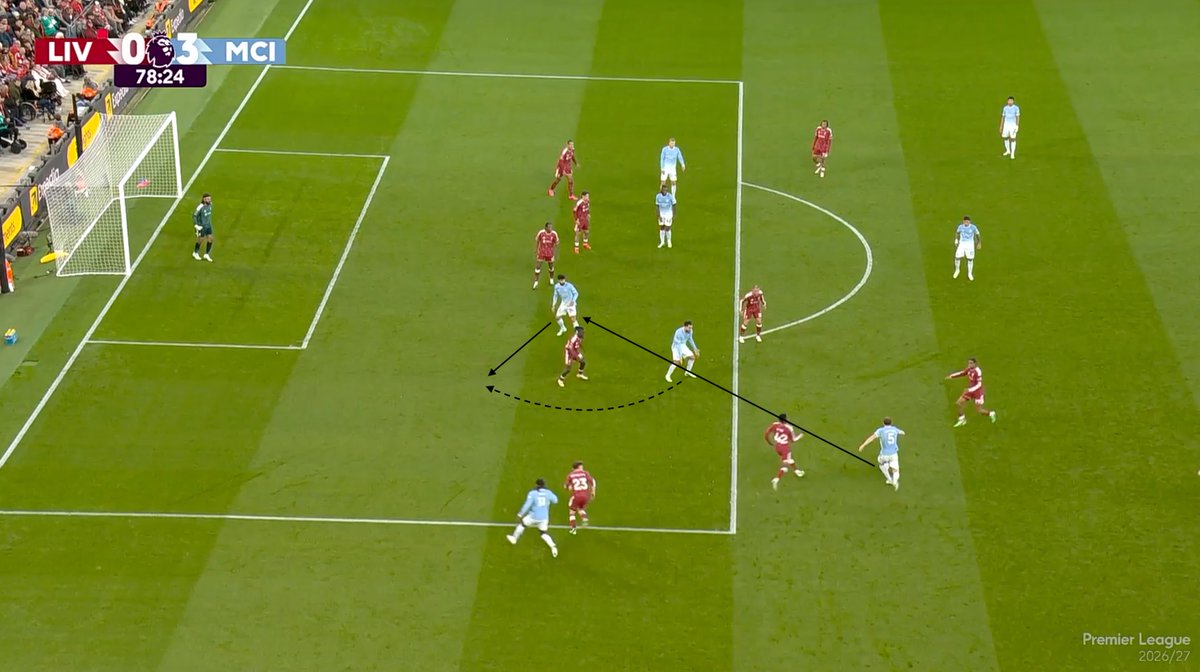
Let’s use Cherki’s goal yesterday to explore relationist concepts, small-space specialists, tactical freedom, dynamic advantages, and what makes him such a rare exception.
Cherki, one step ahead of the rest. He has imagined the play five seconds before anyone else.
First, he moves from the opposite side towards the ball area. Cherki is much more ball-oriented than space-oriented. Rather than staying in his usual position on the right, he moves across to the left to get closer to the ball and become involved in the combination.
Second, he positions himself between Anderson and Gvardiol to create the 'ladder', three players aligned along the same diagonal. His positioning and body language trigger Anderson’s pass.
Third, he lets the ball run through his legs with a 'dummy' and immediately runs in behind, triggering Gvardiol’s pass.
Cherki is the one triggering everything. The others simply follow his lead.
He already knows when and where he will run, allowing him to arrive one second before the defender, who can only react to what is happening. This is what I call a dynamic advantage: an advantage that doesn't exist yet, but will emerge through movement.
This brings us to the discussion about giving certain players the freedom to overload the ball area. Cherki is one of those players who can imagine and execute these combinations. It makes perfect sense to allow him to move towards the ball more frequently, creating the conditions for more actions like this.
Cherki is allowed to be more ball-oriented than space-oriented, compared to his teammates who maintain their positions and respect the team's spatial structure.
But Cherki is a specialist in small spaces. He thrives on short connections and the dynamic advantages created by one-twos, short runs in behind, ladders and similar combinations. Near the box, these advantages can be lethal.
But move him into deeper areas, and the picture changes. The distances between players are much larger, and his more limited athletic profile makes him less threatening when trying to create dynamic advantages, particularly against man-to-man pressing. Opponents can afford to get closer to him, knowing that he poses less of a threat in behind. This reduces the space available for him to operate and can ultimately limit how often he receives the ball.
In these situations, giving him more freedom to roam can become counterproductive, potentially disorganising the team without generating enough attacking value to compensate.
Unfortunately, modern football doesn't produce many players like him. Part of the explanation, in my opinion, lies in the way we develop young players: academy coaching that can be too focused on space and structure, combined with fewer opportunities to play freely in the streets than previous generations had.
Because these are precisely the kinds of actions you might learn on the streets. Imagine playing hundreds of times against your friends, with a large number of players defending the goal. You struggle to figure out how to create chances. Then, one day, after playing these kinds of games over and over again, perhaps by accident, a situation like this emerges. You execute the combination and score. Your brain registers what happened. You begin to recognise the possibility, and sooner or later, you try it again. Eventually, what started as an accidental discovery becomes an intentional action.
However, in professional football, at least in the modern era, I believe these concepts are better developed when coaches deliberately incorporate them into their training. As I mentioned earlier, players like Cherki are unusual.
Unfortunately, you can't rely on players to discover these solutions instinctively, like Cherki does. Coaches need to create the conditions for them to emerge, helping players recognise these possibilities and turn them into repeatable behaviours.
Pascal Groß is nailed on to be a top coach one day.
One of the most tactically intelligent players I’ve ever seen with and without the ball but also a leader + standard setter.
Played a variety of different roles in his career (even as an inverted fullback) and has 232 goal contributions in nearly 700 club games played.
But perhaps what is the most incredible thing about him is that he leads Brighton for minutes played this season and has also covered the third most distance in the entire Premier League this season, despite being 35!
I’ve seen him play high and between the lines with the ball and lead the press without it or dictate games from the pivot in this season alone.
He is the mid-table Bernardo Silva. The only real difference between the two is that Bernardo is naturally a much better dribbler.
Either way, Groß is one of the most underrated footballers of the last decade in every sense.
He might even be Brighton’s best player of all time with everything that he has done for the club, although their fanbase can settle that debate…
The most technical teams will dominate football in the next 5 years. Playing vertically, using every advantage, always playing on the edge where you might loose the ball is the way forward. We are in for so much fun.
⚽️ Crossing + Finishing into 4vs3 ⚽️
• Wide combination + cross for ST’s (⚪️) and other WG
• 4 other 🔴 attack vs 3 ⚫️ defenders.
• Make competitive- count scores
• Defending team get points by playing into ST’s
• Rotate defensive team
⚽️⚽️⚽️
@TacticalPad@SundayShare10
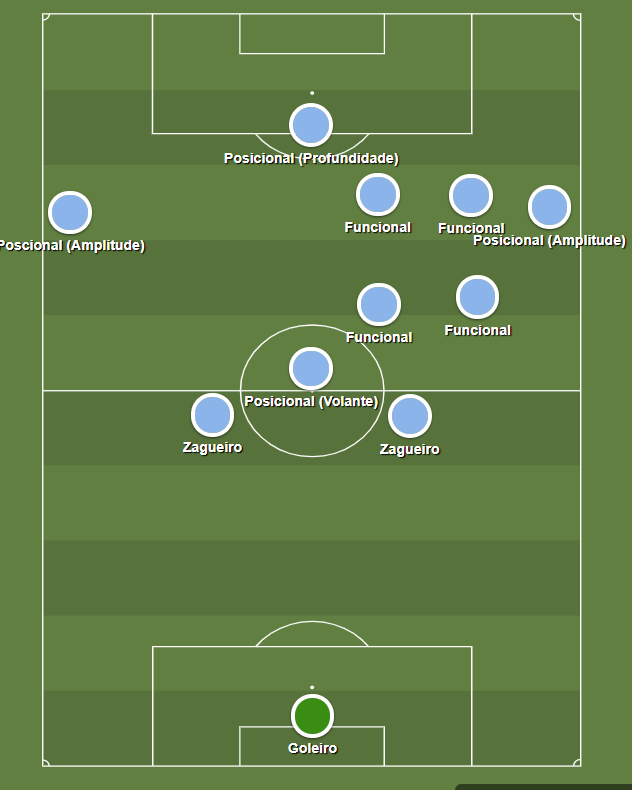
É provável que nos próximos anos muitos utilizem uma organização ofensiva mista com predomínio funcional. No seguinte sentido: dois homens presos nas zonas de amplitude, um preso dando profundidade, outro preso na base da jogada (mediocentro?),
2 key mistakes from Melbourne City in the game tonight in my opinion:
1- Not going full throttle for the second goal before half time after the Victory red card, especially when they had them on the ropes.
#MVCvMCY