UoB AFAF promotes academic freedom and free speech for Bristol University staff alumni affiliates & students. Branch of the wider AFAF network. Since June 2025.
This story gives an insight into how university LGBTQ+ activist networks pressure universities not to follow the law.
University of the West of England announced they would be changing their policies in line with the Equality Act.
The university’s own LGBTQ+ Society set up a petition calling for Bristol Pride to refuse UWE's sponsorship.
Bristol Pride announced that it cannot accept sponsorship from UWE while their current (legally complaint) trans and non-binary policy is in place.
The LGBTQ+ soc petition (link in replies) claims that last year's FWS Supreme Court Ruling is 'not yet law' 🙄
https://t.co/ZC1JMIjIeS
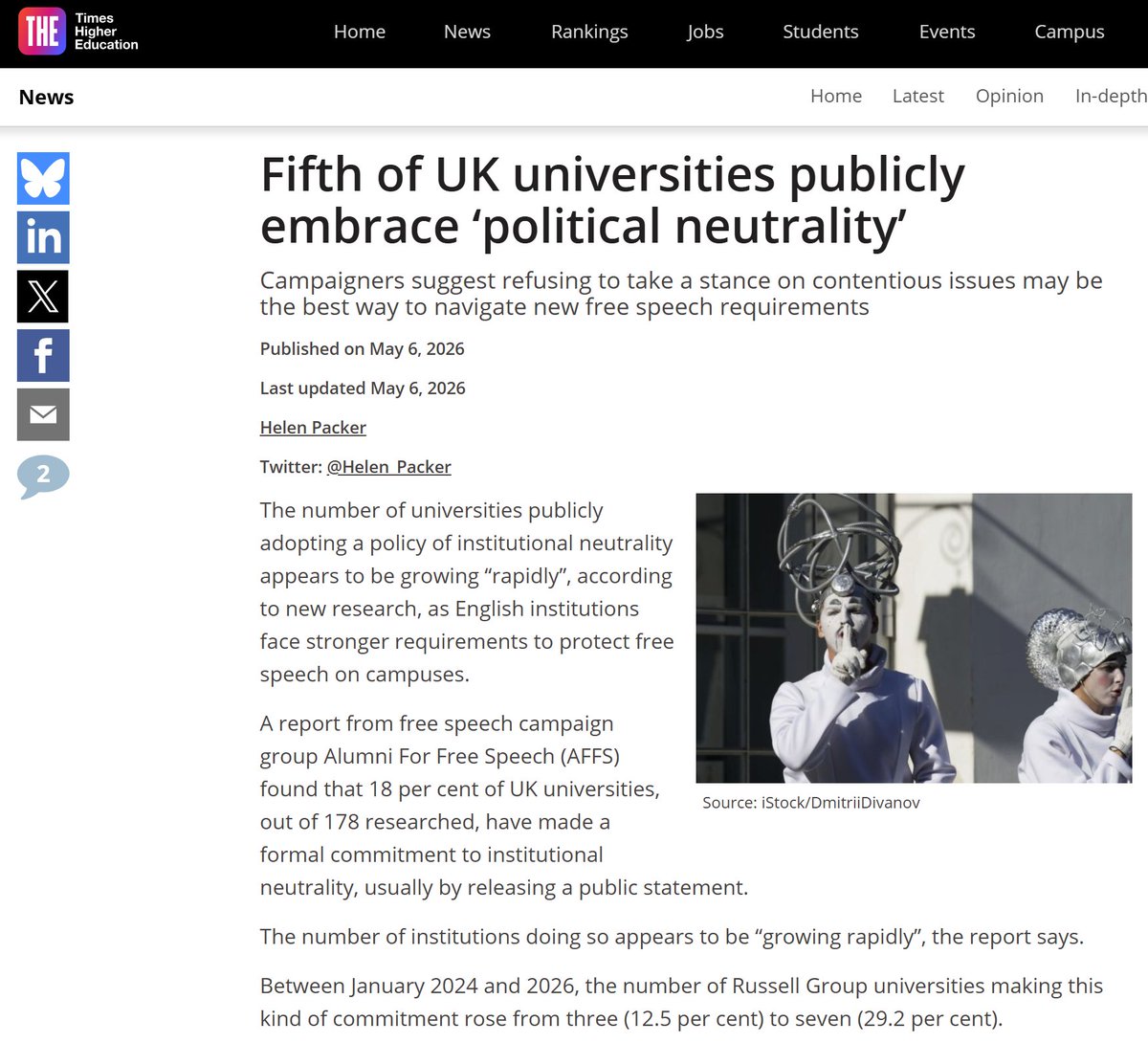
The number of universities publicly adopting a policy of institutional neutrality appears to be growing “rapidly”, according to new research, as English institutions face stronger requirements to protect free speech on campuses. @Helen_Packer reports #freespeech#highered
https://t.co/Qx1vpwKXHD
Britain’s wokest university has just won a court victory that will be disastrous for free speech. Sussex has been granted the right to censor academics who dissent from its trans and nonbinary policies. We are going backwards, says Freddie Attenborough
https://t.co/fblInIxZVw
🚨 A growing number of UK universities are formally adopting “institutional neutrality” policies designed to protect free speech, viewpoint diversity and academic freedom, according to new research by Alumni for Free Speech (AFFS).
Published a year after AFFS and allied campaign groups wrote jointly to vice-chancellors urging universities to adopt such policies, our latest UK-wide survey suggests the principle is gaining traction as universities face mounting legal, institutional and reputational pressures to take official positions on contested social, political and moral issues.
Between January 2024 and January 2026, the number of Russell Group universities with formal public commitments to institutional neutrality more than doubled, rising from three institutions to seven. Across the sector as a whole, AFFS identified 32 universities that have now adopted such commitments.
As the report explains, institutional neutrality is designed to create an open environment in which academics and students can freely explore contested questions, from Net Zero and reparations for empire to women’s sex-based rights and “decolonisation”. When a university, and by implication its senior leadership, adopts an official position on such questions, it can chill speech, narrow viewpoint diversity and make the university less hospitable to free inquiry.
With the Office for Students-administered free speech complaints scheme due to commence on 1 September 2026, adopting institutional neutrality is also a practical way for universities to reduce the likelihood of non-compliance with their enhanced statutory duties under the Higher Education (Freedom of Speech) Act.
AFFS and its partner organisations have now written to UK university leaders, urging institutions that have not yet adopted institutional neutrality to do so formally and publicly.
Times Higher Education coverage:
https://t.co/Rs3J1t6akM
Letter to university leaders:
https://t.co/ECZjCKeYko
Full report:
https://t.co/AxLvz5MuSs
@ObhishekSaha@drianpace@AFAF_freespeech@ProfAliceS@SpeechUnion
The Free Speech Union has posted a video of the launch event last month for Steven Greer’s important new book
Islamophobia and Free Speech https://t.co/JQO4rlLuao via @YouTube
The Free Speech Union has posted a video of the launch event last month for Steven Greer’s important new book
Islamophobia and Free Speech https://t.co/JQO4rlLuao via @YouTube
The strictures of critical race theory, often taught as doctrine and influencing much EDI policy, precludes taking seriously contemporary UK antisemitism. Above all because they hold as an article of faith that racist views from people of colour are trivial because non-structural
“For ultimately it is the moral crazes rippling periodically through universities that constitute the biggest threat to freedom of expression there, and the regulator needs to catch up” writes Kathleen Stock.
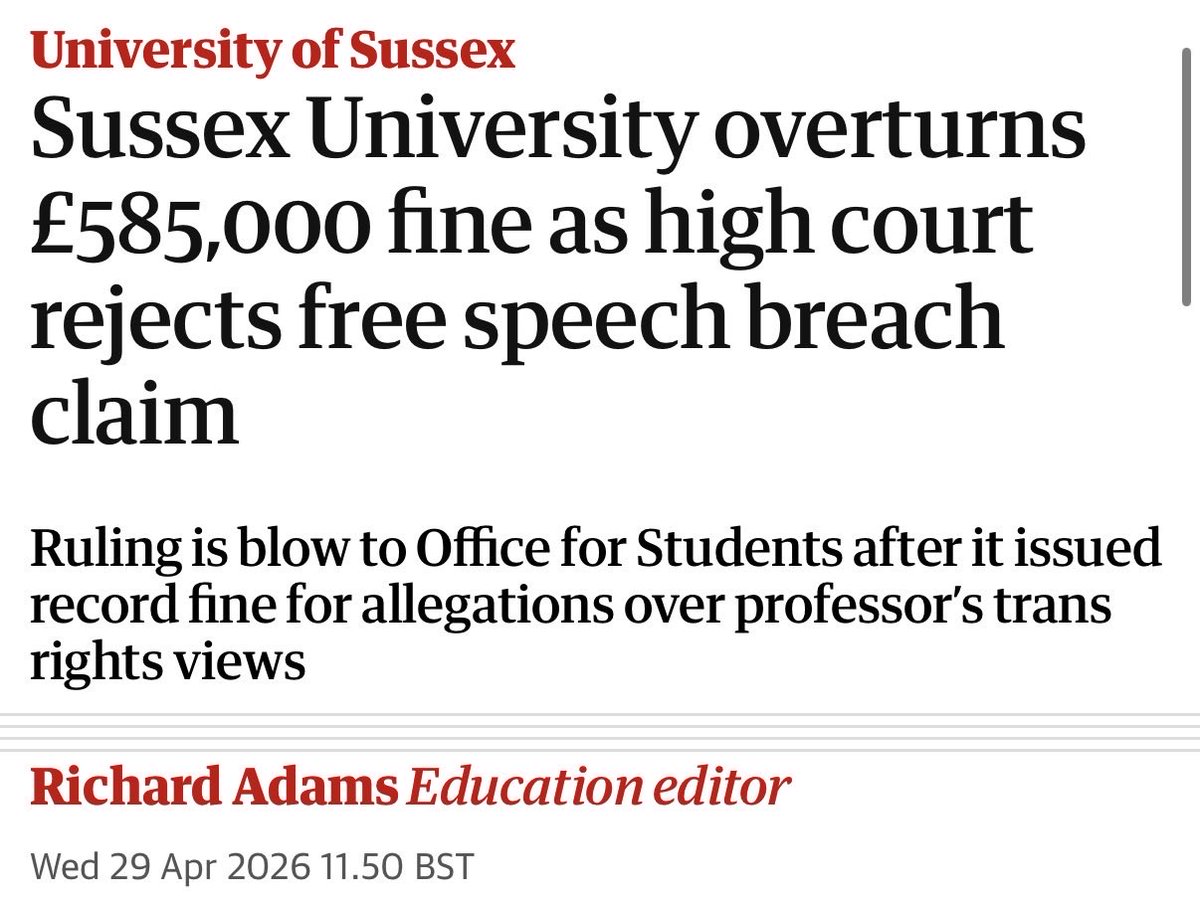
Last week’s High Court judgment was a step backwards for free speech on university campuses. In one fell swoop, it defanged the regulator, the OfS.
Universities are meant to be open forums for free debate, yet a toxic, stifling culture of censorship is taking root.
The treatment of Kathleen Stock for her lawfully held views shocked us all. Sadly, as a result of the High Court judgment, more academics will inevitably face the same treatment.
Universities must do more than pay lip service to their free speech duties under the Higher Education (Freedom of Speech) Act 2023 (HEFSA).
Read more from @Docstockk 👇
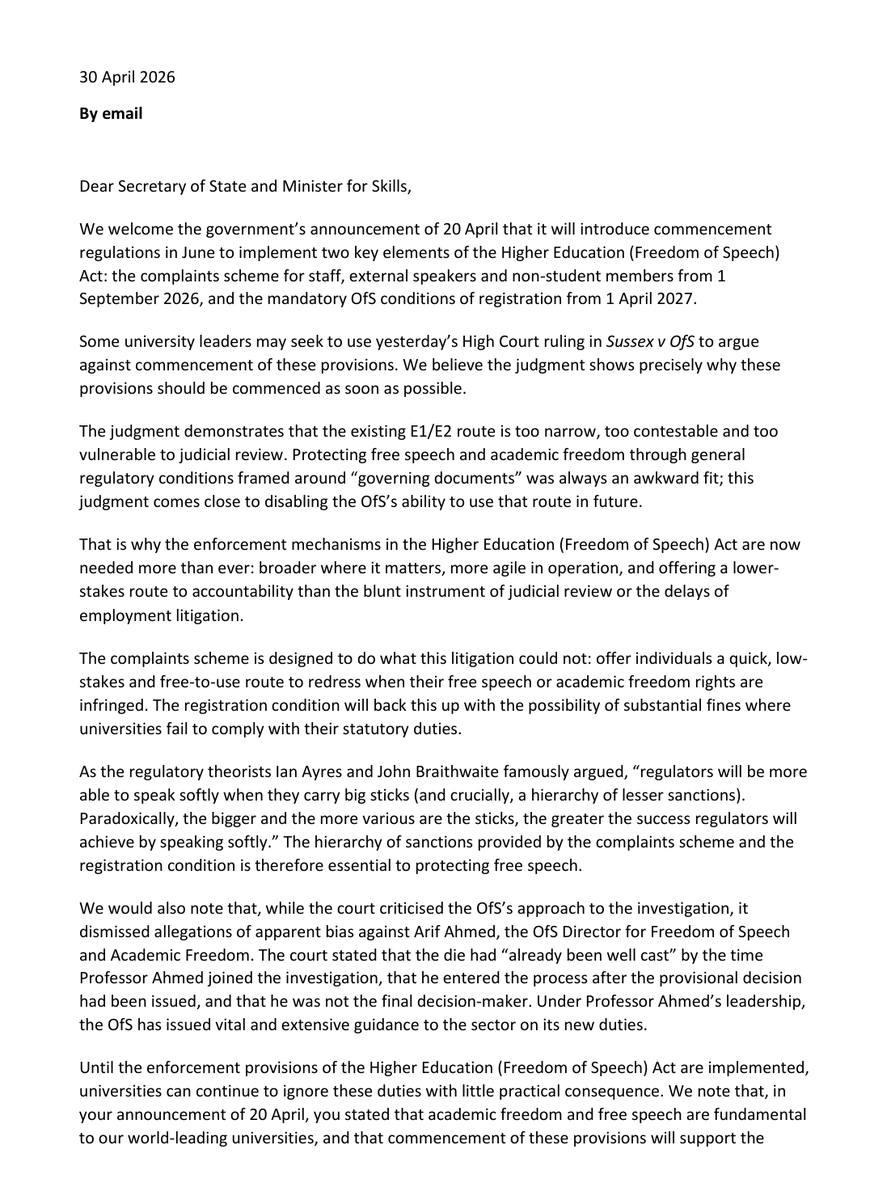
The Committee for Academic Freedom (CAF), together with a group of leading academics and campaigners, has written to Secretary of State for Education Bridget Phillipson (@bphillipsonMP) and Minister for Skills Baroness Jacqui Smith (@Jacqui_Smith1) urging the Government to proceed without delay with new #freespeech protections for universities following this week’s High Court judgment in the Sussex case.
The letter, organised by CAF Advisory Board member Professor @ObhishekSaha, warns that some university leaders may seek to use the judgment as a pretext to resist the commencement of key provisions in the Higher Education (Freedom of Speech) Act 2023.
In fact, the judgment shows precisely why these provisions — in particular the new complaints scheme — should be brought into force as soon as possible.
If, as the ruling suggests, the existing enforcement route under the Higher Education and Research Act 2017 depends on a restrictive interpretation of what counts as a “governing document”, the OfS may be confined to scrutinising only universities’ formal, high-level rules, rather than the internal policies through which speech — indeed, campus culture more generally — is managed in practice.
As the letter argues, this makes the complaints scheme, alongside strengthened registration conditions and the possibility of financial penalties, more necessary than ever.
Due to open in September, the scheme is designed to provide a low-stakes, free-to-use route for individuals to seek redress when their free speech or academic freedom rights are infringed — something the Sussex litigation itself could not deliver, and a far more accessible remedy than the delays and expense of employment tribunal proceedings.
Without these provisions, universities face little practical incentive to align their internal policies with their legal duties. With them, there is at least the prospect of a regulatory framework capable of giving those duties real effect.
CAF’s message to ministers is clear: the Sussex ruling is not a reason to hesitate, but a reminder of why the new protections are needed, and why they should be implemented in full, without delay.
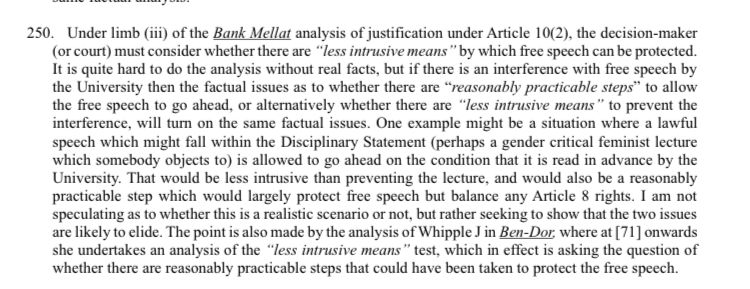
There is much that is troubling in Mrs Justice Lieven's judgment in favour of the University of Sussex, but this stands out.
The judge suggests that if someone objects to a 'gender critical feminist lecture' it might be reasonable for the university to demand that the lecture should be read in advance by 'the university'.
So lecturers who believe that sex is real should have their lectures vetted by administrators if someone complains in advance of the lecture.
This type of incentive is exactly what activists thrive on. And it suggests a regime which strips academics of all autonomy and acadmic freedom.
https://t.co/kSSMqwTBQ6
This is a disappointing judgment which effectively renders the Higher Education (Freedom of Speech) Act toothless. It sends a message to universities that they only need to pay lip service to the new free speech duties in the Act and not actually do anything concrete to uphold academic freedom and free speech on campus.
This judgment will effectively leave academics like Kathleen Stock defenceless, while empowering activists to hound off campus anyone they disagree with. We very much hope the Office for Students appeals and if it does we hope to intervene.
One step forward, two steps back.
When the fine was issued, many were at pains to explain that the fine was not focused on the treatment and case of Kathleen Stock, and that therefore the judgment did not condemn the University’s actions and omissions in that particular case. The line was that the OfS fine was more about the drier application, or misapplication, of policy.
Now that Sussex has won the case at this level, my money’s on at least some people spinning this (wrongly) as some kind of vindication of the University’s treatment of Stock.
1/ LUCAF welcomes the government’s decision to bring the complaints scheme into force from the next academic year, together with new conditions of registration from next April.
These are important steps that will strengthen free speech and academic freedom on campus.
CAF's Threats to Freedom bulletin goes out weekly with the key UK #academicfreedom stories: investigations, casework, EDI mandates, legal breaches and the quiet procedural changes that rarely make headlines, but often do the most damage to #freespeech on campus.
Latest edition:
https://t.co/thayUCflYe
Sign up to receive our free weekly newsletter:
https://t.co/zwSgRONPLN