The law has changed. The culture hasn’t. Exposing threats to academic freedom in UK universities — and pushing institutions to meet their free-speech duties.
🚨 EXCLUSIVE: In 2023, David Harris, Professor Emeritus at Plymouth Marjon University, became one of the first academics to raise serious questions about the scholarly standards of Professor Jason Arday’s published work, shortly after Arday had been appointed Professor of Sociology of Education at the University of Cambridge.
Since Arday’s death, Harris’s role in scrutinising his work and highlighting possible evidence of plagiarism has made him the target of online abuse and personal smears, including potentially defamatory public allegations that he was motivated by racism. In this interview with the Committee for Academic Freedom (CAF), he gives his own account of what happened, explains how he came to investigate Arday’s work, and reveals previously unreported details about his attempts to raise his concerns privately with senior figures at Cambridge.
Among them was Professor Hilary Cremin, Head of Cambridge’s Faculty of Education, whom Harris approached with detailed concerns about Arday’s scholarship. He recounts Cremin’s response, including her apology for the tone and manner of emails in which Arday threatened to report him to the police for harassment, and her invitation to Harris to visit Cambridge “for tea” to discuss their differences.
But Cremin was not the only senior figure at Cambridge whom Harris approached. He reveals that he separately took his concerns to the University’s Head of Policy, Governance and Integrity, only to be told that the issues he had identified pre-dated Arday’s arrival at Cambridge and were therefore not the University’s responsibility.
The interview also sheds new light on suggestions that scrutiny of Arday’s work formed part of a wider campaign against him — a “vicious campaign”, as Diane Abbott has described it. Harris is categorical that he had no contact whatsoever with Dr Nathan Cofnas, and says that his own investigation was conducted independently, privately and through conventional academic channels.
His account raises important institutional questions about academic scrutiny, research integrity — and what Cambridge knew about concerns surrounding Arday’s work years before they became a matter of public controversy.
What better occasion than International Pronouns Day to remind universities that there’s no law requiring academics to declare their pronouns, and that demanding they do so may have legal consequences?!
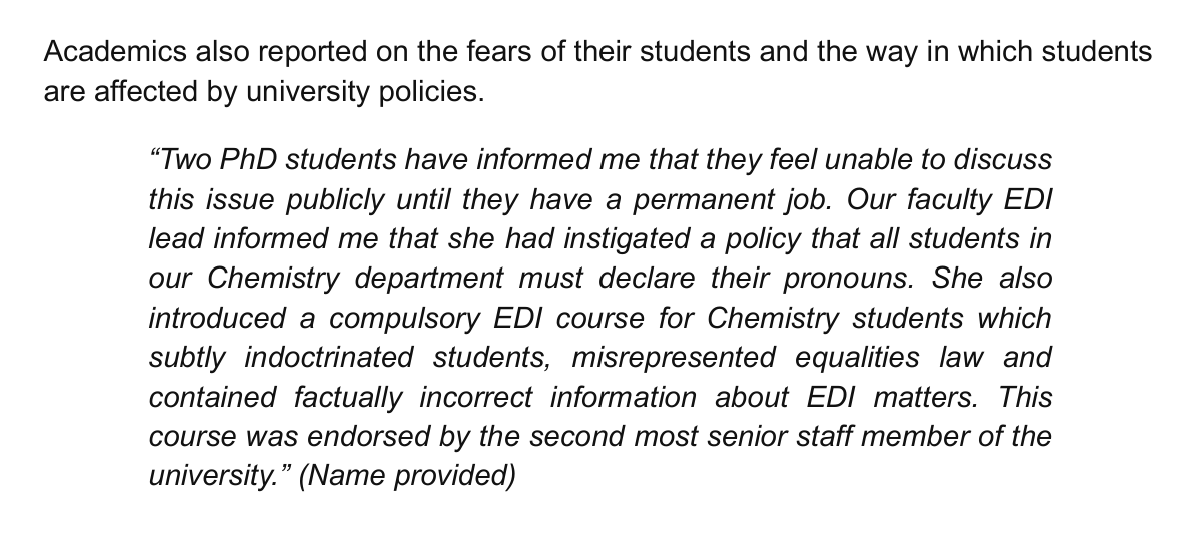
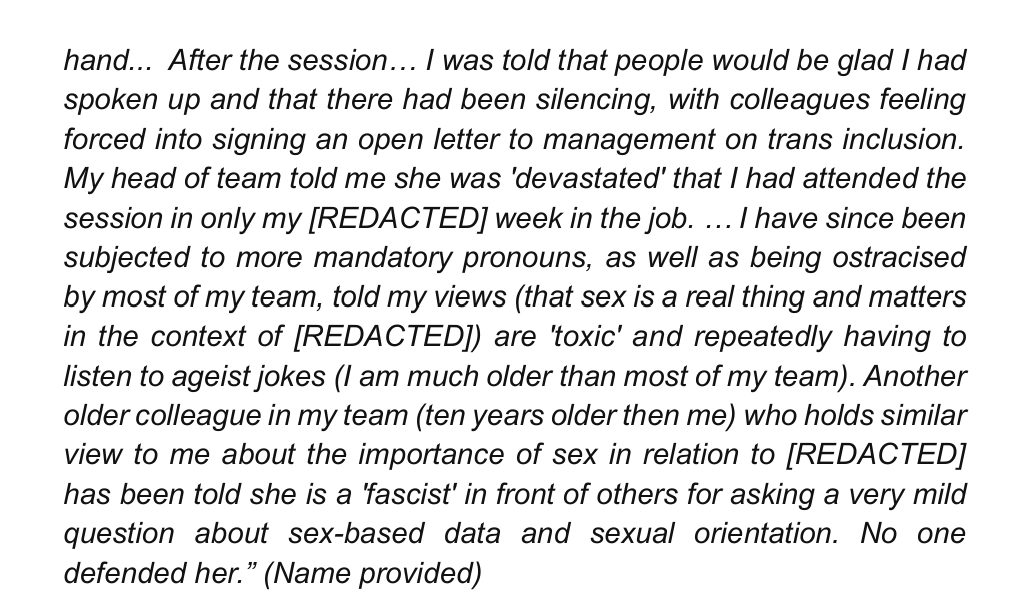
CAF often hears from academics who have come under pressure — formally or through “invitations” from senior administrators — to display their pronouns in email signatures or participate in “pronoun circles”.
There’s obviously nothing wrong with declaring your pronouns if you wish. But for some academics, doing so means affirming beliefs about sex and gender that they don’t share, either personally or in their research.
Even where participation is nominally voluntary, the expectation that everyone will join in can make declining professionally difficult.
Sadly, the academics we’ve spoken to are far from alone. The government-commissioned Sullivan Review (2025) documented pressure to declare pronouns in email signatures and meetings, sometimes from senior university staff.
One respondent said refusing would jeopardise her job, while others regarded such declarations as demands to affirm gender-identity theory. The Review also recorded academics experiencing ostracism and denunciation by colleagues for refusing to comply.
But if academics are expected to affirm contested propositions in routine workplace interactions, what confidence can they have in their freedom to investigate those propositions in their research? This is why pressure to declare pronouns often forms part of a wider institutional climate in which gender-critical academics face professional and reputational consequences for challenging prevailing orthodoxies, whether concerning the collection and use of sex-disaggregated data, the distinction between biological sex and gender identity, or the implications of that distinction for women’s rights and single-sex services.
Thankfully, gender-critical beliefs are protected under section 10 of the Equality Act 2010, and universities that pressure employees to make declarations contrary to those beliefs — particularly where objections are met with disciplinary action — may expose themselves to claims of unlawful discrimination or harassment.
So if your university insists that you declare your pronouns contrary to your protected beliefs, consider emailing your manager or HR to explain why the requirement conflicts with them. If you feel obliged to comply for fear of the consequences of refusing, you can make clear that you are doing so under protest, without withdrawing your objection.
Keep a dated record of your objections, the university’s response and any subsequent pressure or adverse treatment. These records may prove important if you later pursue a legal claim.
If you believe you’ve suffered discrimination or harassment because of your philosophical beliefs, CAF may be able to help. We provide confidential casework support to academics facing infringements of their rights and, where appropriate, can secure specialist legal advice and representation.
Get in touch: [email protected]
If you’ve got concerns about academic standards or recruitment practices at Cambridge, but are worried about what might happen if you raise them through formal channels, the independent Arday Investigation wants to hear from you.
https://t.co/jHP96aEaNG
Cambridge University cannot be relied upon to investigate how it came to hire Jason Arday, so an independent investigation is being launched.
My latest post for subscribers is now up. Read here: https://t.co/S6Xt2uejWG
The Office of the Independent Adjudicator (OIA) has published new guidance on how it will handle freedom of speech and academic freedom complaints brought by students under new free-speech laws in England — and there are encouraging signs that it has taken on board some of the concerns recently raised by CAF about how the limits of its statutory remit would operate under the new regime.
https://t.co/lUavTEF8FN
Concerning to see what happened to @AdamWagner1 KC at City St George’s last week, where masked protesters interrupted a public lecture about his legal work representing British families of hostages in Gaza with chants of “war criminal”, “settlers go home”, and demands that he be disbarred. The Association of Student Activism for Palestine subsequently claimed responsibility for the disruption.
Protesters are entitled to express opposing views, including those that offend, shock or disturb. But in the context of a university lecture, there is an important distinction between legitimate protest and a “heckler’s veto”, where protesters seek to prevent others from speaking or being heard by drowning them out.
That’s why, in its regulatory advice, the Office for Students recognises that sustained shouting which prevents others from being heard or participating in a lecture may justify restrictions on the time, place and manner of protest. City’s own Freedom of Speech Code similarly requires organisers to intervene where heckling prevents others from being heard.
Was this an attempted heckler’s veto? The interruption lasted approximately ten minutes, with protesters apparently leaving only when they learned security was arriving. Sloganeering denunciations delivered from behind masks are, in any case, liable to look less like an effort to debate than an attempt to intimidate and chill speech.
If those involved are City students, disciplinary action may well be warranted. But disciplinary proceedings alone cannot address the underlying cultural problem, and may simply reinforce a sense of grievance among those involved.
The deeper question here concerns campus culture, and how universities can foster a commitment to intellectual pluralism in an increasingly polarised climate.
These protesters had researched the time and venue, and made their way into a lecture theatre where one of the UK’s leading human rights barristers was discussing a subject about which they evidently held strong views. So far, so good. Why not then listen, reflect and, having done their homework, attempt to challenge his arguments, putting difficult questions to him and seeing how he answered them?
Students will inevitably feel passionately about contentious political questions. But as J. S. Mill observed in On Liberty: “He who knows only his own side of the case, knows little of that … if he is equally unable to refute the reasons on the opposite side, he has no ground for preferring either opinion.”
For that reason, “He must be able to hear [opposing arguments] from persons who actually believe them; who defend them in earnest, and do their very utmost for them. He must know them in their most plausible and persuasive form.”
So beyond regulatory guidance and the enforcement of university policies, the more pressing task is surely to cultivate the habits of intellectual curiosity, openness and serious disagreement that might help students turn their convictions into arguments, rather than slogans.
Good to see Times Higher Education covering the launch of CAF’s independent investigation into Cambridge’s appointment of Jason Arday, and some of the wider questions it raises about academic standards, merit and institutional decision-making. Full story here:
https://t.co/AS8lSByPY7
Good to see Times Higher Education covering the launch of CAF’s independent investigation into Cambridge’s appointment of Jason Arday, and some of the wider questions it raises about academic standards, merit and institutional decision-making. Full story here:
https://t.co/AS8lSByPY7
If you’ve got concerns about academic standards or recruitment practices at Cambridge, but are worried about what might happen if you raise them through formal channels, the independent Arday Investigation wants to hear from you.
https://t.co/jHP96aEaNG
The Office of the Independent Adjudicator (OIA) has published new guidance on how it will handle freedom of speech and academic freedom complaints brought by students under new free-speech laws in England — and there are encouraging signs that it has taken on board some of the concerns recently raised by CAF about how the limits of its statutory remit would operate under the new regime.
https://t.co/lUavTEF8FN
Concerning to see what happened to @AdamWagner1 KC at City St George’s last week, where masked protesters interrupted a public lecture about his legal work representing British families of hostages in Gaza with chants of “war criminal”, “settlers go home”, and demands that he be disbarred. The Association of Student Activism for Palestine subsequently claimed responsibility for the disruption.
Protesters are entitled to express opposing views, including those that offend, shock or disturb. But in the context of a university lecture, there is an important distinction between legitimate protest and a “heckler’s veto”, where protesters seek to prevent others from speaking or being heard by drowning them out.
That’s why, in its regulatory advice, the Office for Students recognises that sustained shouting which prevents others from being heard or participating in a lecture may justify restrictions on the time, place and manner of protest. City’s own Freedom of Speech Code similarly requires organisers to intervene where heckling prevents others from being heard.
Was this an attempted heckler’s veto? The interruption lasted approximately ten minutes, with protesters apparently leaving only when they learned security was arriving. Sloganeering denunciations delivered from behind masks are, in any case, liable to look less like an effort to debate than an attempt to intimidate and chill speech.
If those involved are City students, disciplinary action may well be warranted. But disciplinary proceedings alone cannot address the underlying cultural problem, and may simply reinforce a sense of grievance among those involved.
The deeper question here concerns campus culture, and how universities can foster a commitment to intellectual pluralism in an increasingly polarised climate.
These protesters had researched the time and venue, and made their way into a lecture theatre where one of the UK’s leading human rights barristers was discussing a subject about which they evidently held strong views. So far, so good. Why not then listen, reflect and, having done their homework, attempt to challenge his arguments, putting difficult questions to him and seeing how he answered them?
Students will inevitably feel passionately about contentious political questions. But as J. S. Mill observed in On Liberty: “He who knows only his own side of the case, knows little of that … if he is equally unable to refute the reasons on the opposite side, he has no ground for preferring either opinion.”
For that reason, “He must be able to hear [opposing arguments] from persons who actually believe them; who defend them in earnest, and do their very utmost for them. He must know them in their most plausible and persuasive form.”
So beyond regulatory guidance and the enforcement of university policies, the more pressing task is surely to cultivate the habits of intellectual curiosity, openness and serious disagreement that might help students turn their convictions into arguments, rather than slogans.
Following an intervention by CAF, the Master of one of Cambridge University’s oldest colleges has acknowledged that students were wrongly told that controversial new “inclusivity training” was mandatory.
But while Gonville and Caius College has offered welcome reassurances about freedom of expression and the value it places on respectful disagreement, important questions remain unanswered about the content of the sessions, delivered by the charity Stop Hate UK.
Full story:
https://t.co/CezABxH799
The Committee for Academic Freedom (CAF) has commissioned an independent investigation into Cambridge’s appointment of Dr Jason Arday: in a Critic exclusive, Research Director Freddie Attenborough tells us why.
https://t.co/vdIoa0LWs8
The CAF-commissioned independent investigation into Cambridge University’s appointment of Jason Arday is seeking information from those who know Cambridge best.
We strongly encourage current and former academics, students and other members of the University community, as well as anyone else with relevant knowledge, to come forward.
This might include policy documents, internal correspondence or first-hand accounts concerning Arday’s academic record, his appointment and subsequent time at Cambridge, the University’s response to concerns about his scholarship and its treatment of those who raised them, and the development and application of institutional policies relating to recruitment, promotion, academic misconduct, research integrity and equality, diversity and inclusion.
Anyone wishing to contribute can contact the Investigator directly at:
[email protected].
The investigation website provides further guidance on submitting information, including arrangements for particularly sensitive material:
https://t.co/5hIoPtTZrD
Please help us spread the word. We want this appeal to reach as many Cambridge academics, past and present, and others with relevant knowledge as possible. If you know someone who might be able to assist, please consider sharing it with them directly.
Full story in The Telegraph:
https://t.co/UWpMCamp2y
🚨 EXCLUSIVE: In 2023, David Harris, Professor Emeritus at Plymouth Marjon University, became one of the first academics to raise serious questions about the scholarly standards of Professor Jason Arday’s published work, shortly after Arday had been appointed Professor of Sociology of Education at the University of Cambridge.
Since Arday’s death, Harris’s role in scrutinising his work and highlighting possible evidence of plagiarism has made him the target of online abuse and personal smears, including potentially defamatory public allegations that he was motivated by racism. In this interview with the Committee for Academic Freedom (CAF), he gives his own account of what happened, explains how he came to investigate Arday’s work, and reveals previously unreported details about his attempts to raise his concerns privately with senior figures at Cambridge.
Among them was Professor Hilary Cremin, Head of Cambridge’s Faculty of Education, whom Harris approached with detailed concerns about Arday’s scholarship. He recounts Cremin’s response, including her apology for the tone and manner of emails in which Arday threatened to report him to the police for harassment, and her invitation to Harris to visit Cambridge “for tea” to discuss their differences.
But Cremin was not the only senior figure at Cambridge whom Harris approached. He reveals that he separately took his concerns to the University’s Head of Policy, Governance and Integrity, only to be told that the issues he had identified pre-dated Arday’s arrival at Cambridge and were therefore not the University’s responsibility.
The interview also sheds new light on suggestions that scrutiny of Arday’s work formed part of a wider campaign against him — a “vicious campaign”, as Diane Abbott has described it. Harris is categorical that he had no contact whatsoever with Dr Nathan Cofnas, and says that his own investigation was conducted independently, privately and through conventional academic channels.
His account raises important institutional questions about academic scrutiny, research integrity — and what Cambridge knew about concerns surrounding Arday’s work years before they became a matter of public controversy.
If you've got concerns about academic standards or recruitment practices at Cambridge, but are worried about what might happen if you raise them through formal channels, the CAF-commissioned independent Arday Investigation wants to hear from you.
➡️ https://t.co/jHP96aEIDe
If you've got concerns about academic standards or recruitment practices at Cambridge, but are worried about what might happen if you raise them through formal channels, the CAF-commissioned independent Arday Investigation wants to hear from you.
➡️ https://t.co/jHP96aEIDe
Is Cambridge appointing academics on merit, or is the pursuit of “equity” changing what counts as merit in the first place?
Writing for @TheCriticMag, CAF’s Freddie Attenborough examines what the Jason Arday affair reveals about Cambridge’s recruitment practices, the increasingly blurred boundaries between equality law and equity politics, and the uncomfortable questions the University’s own investigation may leave unanswered.
Read the full essay here:
https://t.co/Kg2T1TMQEv