Public services exist to provide services, not to perpetuate their own bureaucracy.
Administration should be judged by whether the citizen actually receives what the institution was created to provide.
Strategic independence requires more than an army.
Energy, transport, communications, manufacturing, research and secure infrastructure are matters of national resilience.
A country unable to maintain its own essential systems has surrendered choices before any crisis begins.
Freedom of expression includes criticism of the government, the armed forces and the Crown.
Peaceful protest, political satire and unpopular opinions are not threats to the state merely because those in authority dislike hearing them.
Nationality is civic. It is not a blood test.
Citizenship, lawful residence, service and demonstrated commitment to the Realm matter more to the state than ancestry or birthplace.
Government must be capable of admitting that it is wrong.
Courts must be independent, evidence must be challengeable, administrative decisions must be reviewable, and legality cannot depend upon whether an official finds scrutiny convenient.
A strong state is not one in which government can do anything it wishes.
It is one capable of doing what is necessary, competently and lawfully, while possessing institutions strong enough to prevent the abuse of that power.
Are you ready to return the Western world to law, then?
Not blood.
Not soil.
Not party worship.
Not purification.
British law at its highest means restraint, due process, liberty under order, and the citizen standing before power with rights intact.
No Nazis.
No fucking Nazis.
Not under this flag.
THE BRITANNIAN MANIFESTO
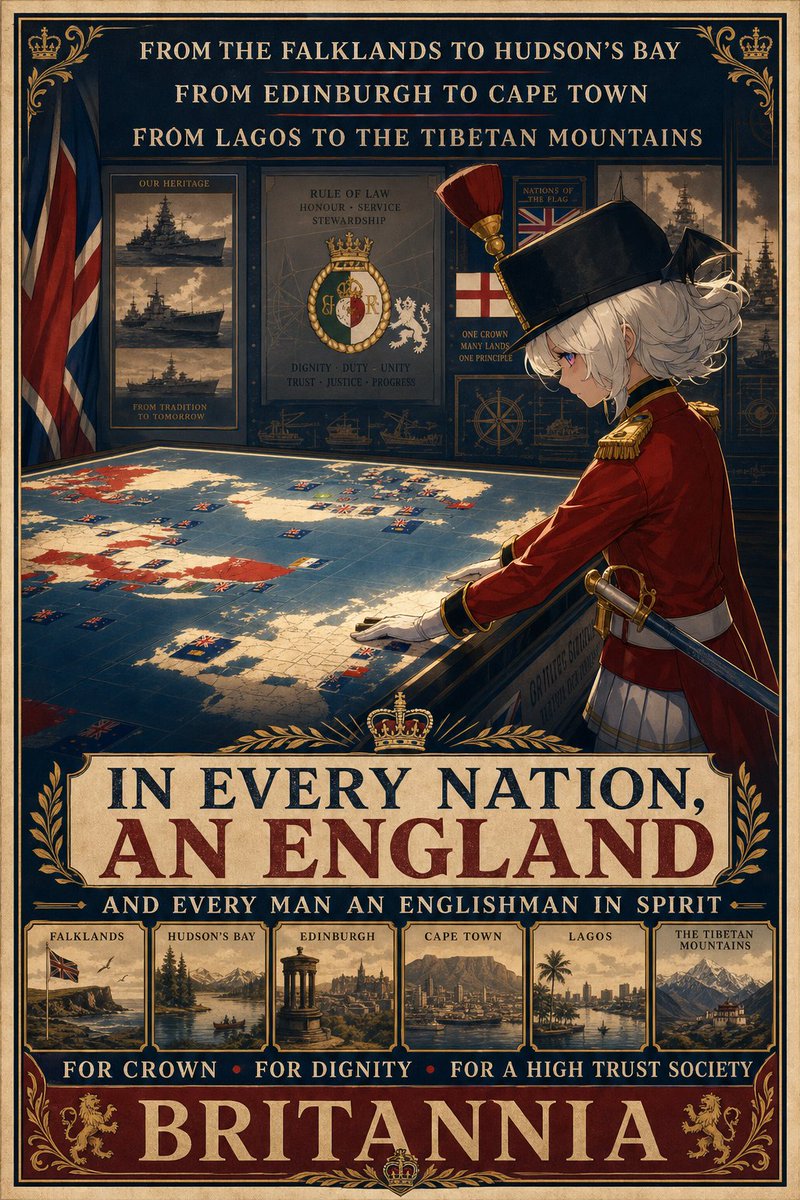
In Every Nation, an England
From the Falklands to Hudson’s Bay, from Edinburgh to Cape Town, from Lagos to the Tibetan mountains, we declare a principle older than our present disorder and more necessary than our present politics:
civilization is not inherited by accident.
It is maintained by law, duty, courage, restraint, memory, and trust.
Britannia is not a hunger for old maps.
Britannia is not a claim of blood over soil.
Britannia is not nostalgia dressed in gold leaf and sent marching across the world like history learned nothing, which would be terribly on brand for mankind, but not for us.
Britannia is a standard.
It is the conviction that every people deserves more than managed decay, corrupt spectacle, atomized loneliness, predatory institutions, and rulers who confuse office with appetite.
When we say:
In every nation, an England
we do not mean that every nation must become English by birth, language, race, or submission.
We mean that every nation should be capable of possessing what England, at her best, taught the world to name:
law above whim,
rights above favour,
duty above vanity,
ordered liberty above chaos,
civic dignity above mob appetite,
secure property, honest courts, disciplined institutions, accountable authority, free association, maritime openness, procedural fairness, and the right of a person to stand beneath the law without being crushed by power.
And when we say:
every man an Englishman in spirit
we mean the old civic man: the rights-bearing person, the citizen, the subject under lawful protection, the human being who refuses to live as cattle beneath corruption or as prey beneath disorder.
That spirit is not inherited.
It is chosen.
It is practiced.
It is defended.
Britannia therefore does not call the nations to kneel.
It calls them to stand straighter.
The Crown we serve is not a private ornament. It is not a costume, a vanity, a mood, or a little theatrical hat for unstable days. The Crown is an office of burden. It exists to preserve continuity when institutions decay, to enforce order where systems fail, and to restrain power before power begins worshipping itself.
The Crown commands.
Doctrine constrains.
Evidence governs.
Restraint defines.
A Crown without restraint is tyranny.
A people without institutions is a mob waiting for a master.
A state without memory is an animal with paperwork.
We reject all three.
Britannia stands for a High Trust Society: a society where promises mean something, offices carry duties, records are kept, law is predictable, service is honoured, and dignity is not treated as a decorative word politicians dust off before elections.
A high trust society does not emerge from slogans. It is built.
It is built through courts that do not bend to outrage.
Through institutions that remember what they are for.
Through armed forces that protect without becoming blind.
Through aristocracy converted into service, not privilege.
Through technology governed by law, not appetite.
Through communities that reward competence instead of noise.
Through leadership that understands the difference between strength and cruelty.
Britannia is imperial only in the disciplined sense: not as a licence to conquer, but as a refusal to think small when civilization itself is under strain.
The empire of the future is not merely territory.
It is a network of lawful harbours, digital commons, sovereign houses, civic orders, protected routes, aligned institutions, and chosen loyalties.
The sea was once the great test of civilization.
Now the digital sea is.
The old pirate flew a false flag and waited beyond the reef.
The new pirate farms outrage, wrecks reputations, poisons commons, destroys trust, and calls it engagement.
The answer is the same in principle:
registry, evidence, lawful friction, protected harbours, disciplined exclusion, restoration of function.
Not mob rule.
Not censorship by panic.
Not vengeance because some cretin discovered a screenshot button and mistook it for jurisprudence.
Britannia acts where trust collapses.
Britannia builds where institutions rot.
Britannia remembers where nations forget.
Britannia restrains where power becomes drunk on itself.
We do not worship force.
Force is not victory.
Stability is victory.
The sword exists to defend the court, the harbour, the school, the home, the archive, the route, and the innocent. It does not exist for spectacle. It does not exist to punish bloodlines, identities, peoples, or associations. Collective punishment is not justice. It is laziness with banners.
Britannian severity must be precise, or it is illegitimate.
We distinguish between the guilty and the merely adjacent.
Between threat and civilian.
Between error and malice.
Between opposition and sabotage.
Between criticism and harm.
We will not become the thing we were founded to oppose.
The nations of the flag are not trophies. They are reminders: that history was vast, contradictory, often noble, often brutal, and never simple enough for children screaming under comment sections.
From Edinburgh, we inherit union, law, learning, and stubbornness sharpened by rain.
From Cape Town, we inherit the warning that empire without justice breeds wounds that outlive flags.
From Lagos, we inherit the truth that vitality, commerce, and civic ambition do not belong to Europe alone.
From Hudson’s Bay, we inherit endurance, frontier discipline, and the cold arithmetic of supply.
From the Falklands, we inherit the principle that small communities matter.
From the Tibetan mountains, we inherit the image of civilization held above collapse by memory, discipline, and faith.
None of these places belongs to Britannia by assertion.
They belong to the manifesto as symbols of one proposition:
no people should be denied the right to lawful dignity, institutional seriousness, and ordered liberty.
Britannia does not ask the world to become British in costume.
It asks whether the world still has the nerve to be civilized.
To those exhausted by failing states, predatory politics, collapsing trust, and the cheap cruelty of modern public life, Britannia offers no easy comfort.
It offers burden.
Build the institution.
Keep the record.
Hold the line.
Protect the harbour.
Tell the truth.
Restrain the sword.
Honour the dead without becoming their prisoner.
Correct the inheritance without burning it for applause.
Serve the Crown only where the Crown serves the law.
This is our answer to decline.
Not surrender.
Not purification.
Not conquest.
Not nostalgia.
Continuity.
Competence.
Dignity.
Law.
Restraint.
Trust.
In every nation, an England.
In every person, the right to stand under law.
In every harbour, a refuge.
In every Crown, a burden.
In every empire worthy of the name, a limit.
For Crown.
For Dignity.
For a High Trust Society.
Britannia endures.