SCAM ALERT: There has been a huge escalation lately in airdrop and giveaway scams targetting XRPL users lately. Any such posts you see are likely scams.
Anyone claiming to be me on Instagram, Telegram, or almost anywhere else is likely a scammer.
Stay safe XRP fam.
My hub has been having a rough time lately. :(
I seem to be losing peers with "onReadMessage: No message of desired type" during negotiation, followed by connection loss.
Anyone else seeing this or have any clues?
Is it just me or does it seem like every computer mouse is deliberately designed so that you cannot take it apart to clean it and put it back together again without damaging it.
There is no "or otherwise dangerous" exception to the First Amendment. This lawsuit attempts to punish a company for engaging in speech protected by the First Amendment.
One of the problems with an emphasis on safety is that you tend to overweigh "our thing did something bad" and underweigh "our thing couldn't do something good" resulting in a serious failure to minimize harm.
Does SPLC have a viable as applied challenge to the bank fraud charge? Maybe something like arguing that just as the government can't punish them for the political views of those they pay money to, it can't punish them for not helping banks punish them on that basis.
I asked ChatGPT for some hardware recommendations and at the end of its analysis of the pros and cons of various options, there was a section titled, "What I'd personally buy today
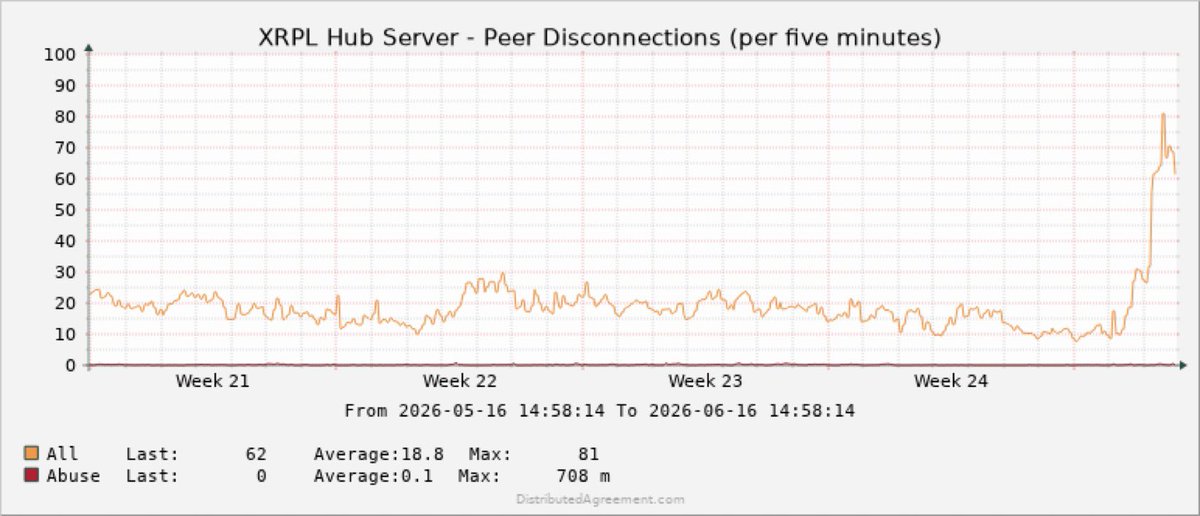
I'm about to take my hub down for about ten minutes to upgrade to 3.2.0. Here's the performance graphs for the past month. They show only one real event, an unexplained burst of peer disconnections likely associated with some network outage somewhere close to the hub.
I hear this will be the largest RippleSwell yet. I wouldn't miss it.
The best part of these events is always seeing the new ways people are using XRP and building on the XRP Ledger. Looking forward to diving into core use cases around payments, tokenization, interoperability.
I'm Kurt Supe, CPA and Retirement Planner.
Co-founder of Creative Financial Group, headquartered in Indianapolis. We serve retirees and pre-retirees across the country.
For nearly 30 years I've focused on one thing. Helping people turn what they've built into retirement income that lasts, with the smallest tax bill the law allows.
Every week I share what we see inside our practice. Tax planning. Social Security timing. Roth conversions. Withdrawal sequencing. Estate planning. Inherited account decisions.
The choices that quietly determine whether your money outlasts you, or you outlast your money.
If you're 50+ with $500K+ saved, follow and
ready for a real conversation?
Our team runs complimentary planning sessions for people serious about getting retirement right. No pressure. No product pitches. Just clarity.
Start here: https://t.co/Q2ZSO5Jhx9
Kurt Supe is a Registered Representative of cfd Investments, Inc., Member FINRA/SIPC, 2704 S. Goyer Rd., Kokomo, IN 46902. Advisory services through Creative Financial Designs, Inc., a Registered Investment Adviser. Educational content only. Stories are hypothetical. Not personalized investment advice.
One of the strangest things about retirement planning is the rule everyone follows was never meant to be a rule.
You meet retirees in their 60s afraid to take the trip, convinced they have to live on 4% of their savings forever.
Then you meet the man who wrote the 4% rule.
He calls it a worst case backtest. He's spent 30 years saying the real safe rate is closer to 7% (which can be wrong as well). He just wrote a book asking retirees to spend more.
The author isn't using his own rule. Neither should you.
Real retirement planning is a year by year cash flow plan. It starts with the variables a percentage will never see.
How long the money has to last.
When Social Security turns on, and at what amount for each spouse.
Whether there's a pension. What other income shows up, and when.
The mix of taxable, tax deferred, and Roth dollars you've built.
The age gap between spouses.
The state you live in.
The healthcare costs sitting between retirement and Medicare.
The IRMAA brackets after you get there.
What the surviving spouse faces when they start filing single.
Then it lays out the year by year decisions.
Which accounts to pull from, in what order, in what year.
Where the Roth conversions fit.
How to fill the low bracket years before Social Security and RMDs hit.
When to harvest gains. When to take losses.
And it has an answer for a market correction or crash in the first 3 years of retirement. A static withdrawal turns that drop into permanent damage, selling more shares at lower prices from a portfolio that should have recovered.
A real plan knows what to scale back on, and for how long. It doesn't sell at the bottom because it doesn't have to.
A percentage doesn't know any of that.
There's a window between the day you retire and your mid 70's where you can quietly keep an extra six figures that would otherwise be gone for good.
Most people don't even know it exists.
One missed move here costs you for the rest of your life.
Even if you saved perfectly.
Here's why it's so easy to miss.
A $2 Million retirement account isn't really $2 Million.
After the government takes its share, it might be $1.4 Million. And how big that share is depends entirely on planning most people never do.
At 73 those withdrawals become mandatory, or 75 if you were born in 1960 or later. They come whether you need the money or not, and they grow as a percentage every year.
Stack them on top of Social Security and any pension, and many people land in a higher bracket than they ever hit while working.
Shrinking that bill means projecting those forced withdrawals out 20 or 30 years, then working backward.
How much do you move in your low-income years. How does it interact with Medicare.
What does it do to what your spouse pays after you're gone, filing single on the same income.
What does it do to what your kids inherit along with the account.
Every lever you pull moves three others.
The only way to see the right path is to model the whole arc, year by year, before that first forced withdrawal locks you in.
On a large balance, the gap between a planned drawdown and an unplanned one reaches six figures, sometimes seven, over a full retirement.
This is the kind of problem that rewards starting early and modeling deeply.
Not financial, tax, or legal advice. Results are not guaranteed and individual circumstances vary. All scenarios are hypothetical composites for educational purposes only and do not represent any specific client or outcome.