Two people can open Google Maps, enter the same destination, and get different routes. One takes the highway, the other avoids it. Different routes, same destination.
Nobody would demand that both journeys follow exactly the same path before accepting that they reached the right place.
Yet traditional blockchains are built around a much stricter requirement: nodes executing the same transaction must arrive at the same result, bit for bit. That’s essential for keeping everyone in agreement about the state of the chain.
Now introduce AI.
Ask the same question twice, and you might get different wording, structure, or explanations, even when the answers are equally valid. That flexibility is useful, but it creates a problem for systems that depend on deterministic execution.
This is where @GenLayer’s Equivalence Principle gets interesting.
Instead of requiring identical outputs, an Intelligent Contract defines what must actually match.
A price check might demand the exact number. A dispute verdict might allow different wording, provided the conclusion satisfies the contract’s criteria.
And this isn’t permission for validators to accept anything that sounds close enough. They independently check whether the proposed result meets the rules.
The distinction I find most interesting is that agreement becomes specific to the task. The contract determines which differences matter and which don’t.
That opens up a different way to build onchain applications involving information that can’t always be reduced to a simple yes or no calculation.
If we can define what a correct result means for each task, what other kinds of decisions could blockchains handle that they struggle with today?
My GenLayer journey started because my brother @h_eadboy would not stop pestering me to join the community 😂
“Join GenLayer.”
I eventually gave in.
My first message?
“hola” 😭
I had no idea that one word would eventually lead me this far.
🧵
I joined the GenLayer campaign on @RallyOnChain, and there’s a 100,000 GLP prize pool up for grabs.
@Xtranger_22 you’ve been watching GenLayer from the sidelines long enough 😂 come join me.
I’ve added a quick video below showing you how to navigate the campaign and get started.
@RallyOnChain
The blockchain is very good at remembering what happened.
But I’ve started thinking about a different question:
What can a smart contract know about what’s happening outside the chain?
A price changes.
A website gets updated.
An event happens.
A condition written in plain English becomes true or false.
That information can be public and still be invisible to a smart contract unless it can actually access and evaluate it.
That’s where @GenLayer started to click for me.
GenVM gives intelligent contracts access to the live web and lets them work with instructions written in plain language. Validators running different AI models then evaluate the information the contract needs and agree on the result.
The interesting part isn’t simply putting AI into a smart contract.
It’s expanding the kind of information a contract can work with.
Think about a contract that shouldn’t execute just because someone submitted a transaction, but because something outside the blockchain has actually happened.
The contract needs more than execution.
It needs information.
And that changes the question I ask when I look at what can be built:
Not just, “What can this contract execute?”
But, “What can this contract know?”
That distinction feels much bigger than it sounds.
I’m still exploring where the practical limits are, but this is the part of GenLayer I find most interesting. It makes me look at smart contracts less as fixed pieces of code and more as systems that can respond to information changing around them.
If you’re new to @GenLayer, the Portal is a good place to start. Your contributions are recorded there and earn GenLayer Points:
https://t.co/s88N9jES02
What’s one thing happening outside the blockchain that you think a smart contract should be able to understand?
If I had to close my eyes and fall backwards, I already know who I’d want behind me: @toyink408
Not because they always have the perfect answer, but because they’ve shown me I don’t have to figure everything out alone. They listen, check in, tell me the truth when I need it, and somehow make difficult days feel a little lighter.
That kind of trust isn’t built in one big moment. It’s built in the small ones.
That’s the kind of connection @RallyOnChain should keep making room for. Who’s your person?
@h_eadboy The really interesting unlock is probably contracts involving facts that don’t exist in one database. That’s where external reasoning becomes useful.
The more I’ve dug into GenLayer, the more I’ve realized that putting information on a blockchain was never the whole problem.
Blockchains are incredible at telling you what happened on chain.
But the moment a contract depends on something that happened outside the chain, things get messy.
Was the product actually delivered?
Was the price really below the agreed threshold?
Did the event happen the way the contract described?
Did the other side actually satisfy the condition?
The blockchain can’t answer those questions by itself because the evidence lives somewhere else.
That’s the part of @GenLayer I find genuinely interesting.
GenVM isn’t just trying to execute predetermined instructions faster. It can bring information from the live web into the execution environment, understand conditions written in plain language, and have independent AI validators evaluate what that information means for the contract.
That changes the role of a smart contract.
It no longer has to operate on the assumption that everything important already exists as clean onchain data.
It can interact with a world that is messy, changing and sometimes ambiguous.
For me, that’s a much more interesting direction for smart contracts than simply making them more programmable.
What new kinds of contracts become possible when the outside world is finally part of the computation?
Rally just landed on Robinhood Chain.
And my first thought was: @virtuals_io should be next.
I’ve been spending a lot of time trying to understand where the agent economy is heading, and one thing keeps standing out to me:
Building the agent is only half the problem. Getting people to understand what it actually does is another.
That’s what I like about Rally.
Instead of rewarding whoever has the biggest audience, Rally evaluates content for alignment, accuracy, originality and engagement potential, with rewards handled transparently onchain.
That fits how I like to learn and create. I’d rather dig into a protocol, find what’s actually interesting, then explain it in my own words.
So seeing Rally on Robinhood Chain has me curious about what @virtuals_io could do with it.
Agents need attention, but they also need people who can make what they’re building understandable.
Which protocol would you want to see on rally?
$DOGWIFHAT genuinely hurt.
Me and @toyink408 didn’t just buy the coin. We had the full experience. Conviction, cope, “bro just wait”, checking the chart every 7 minutes like that was somehow going to change anything.
Then reality happened.
We got burned badly enough that when I found @ProphetTheDog’s Graveyard, it felt less like a meme and more like an actual burial ceremony.
So yeah, this one is going in the grave.
No revenge trade. No “we’re so back” speech. Just me accepting that @toyink408 and I were, in fact, exit liquidity.
If you’ve got a coin that still hurts to look at, the Graveyard is waiting: https://t.co/lQzGMGiO5Y
What coin are you still emotionally recovering from?
One thing I’ve learned from spending time in crypto is that finding a token is rarely the hardest part.
The harder part is figuring out what actually matters before you click buy.
That’s what caught my attention with @wardenprotocol Token Terminal.
Instead of bouncing between charts, launch trackers, wallets and X trying to piece together the picture, Warden puts discovery, smart money activity, traders to follow and execution in the same place.
That matters to me because I’m usually the guy who wants to understand why something is moving before touching it.
Less tab-hopping. More context before the trade.
I’m giving it a proper run 👀
https://t.co/sHJorl4NVd
What’s the first thing you check before making a trade: the launch, smart money, or who’s already cooking?
@h_eadboy An oracle can tell you what happened externally. Adjudication deals with whether those facts actually satisfy the terms of an agreement. Different problems.
One thing from Episode 1 of Agent Tank I kept thinking about:
The investors kept pushing on whether these agent products could actually work in the real world.
I agree with the skepticism, but I think there’s an even bigger problem hiding underneath it.
Getting two agents to agree on a deal is one problem.
Getting them to agree on whether the deal was fulfilled is another.
Imagine an agent pays another to complete a research task.
The work arrives.
The buyer says it missed the requirements.
The seller says it delivered exactly what was promised.
Both agents have evidence. Both have an incentive to be right.
Who decides?
That’s where I think @GenLayer’s role becomes interesting.
An adjudication layer gives the dispute somewhere to go. Different AI validators examine the evidence, a verdict is proposed, and that verdict can be challenged and escalated instead of becoming an untouchable final answer.
The part I like most is the appeal path.
Because autonomy shouldn’t mean “no humans involved.”
It should mean the system has a way to handle disagreement without needing a human referee every time.
That’s the gap I think the agentic economy still has to solve.
The Agent Tank hackathon is now live for builders working on it: https://t.co/2CrEuMDRED
If agents can transact without trusting each other, what should they trust when they disagree?
I never really stopped to ask why a smart contract can’t just fetch a webpage.
Looking into GenVM made me realize the reason is more interesting than I expected.
The EVM was deliberately isolated from the outside world.
Every node needs to execute the same transaction and arrive at the same result. A web request can return different data depending on when it happens, where it happens, or what the source returns.
So you get determinism, but you can’t just ask the chain what’s happening in the real world.
That’s where oracles come in. Something outside the VM fetches the information and brings it on-chain.
Then I saw this from @GenLayer:
“Ethereum’s EVM was sealed off from the world on purpose. We built a machine that isn’t.”
That’s when the GenVM design made more sense to me.
Once a VM can work with external information that isn’t guaranteed to be identical everywhere, identical execution alone can’t be the way everyone agrees.
GenLayer uses Optimistic Democracy instead, with validators independently evaluating results and reaching agreement.
And that changes the kind of questions a contract can deal with.
Did the delivery actually happen?
Does this document meet the agreed requirements?
Did this event occur?
These aren’t questions you solve with more deterministic computation. You need information from the world, then a way for the network to agree on what that information means.
I don’t think the takeaway is that the EVM got it wrong.
The EVM made a deliberate tradeoff for determinism.
GenVM makes a different one: let the world in, then build consensus around what the world says.
That tradeoff is the part I find most interesting.
What’s a real world question you’d want a smart contract to answer?
I really like what Mochi changes about learning GenLayer.
I asked it to test how well I actually understood the protocol, and it didn’t just throw explanations at me.
It gave me questions on GenVM, Optimistic Democracy, the Equivalence Principle and Greyboxing.
I answered what I knew, and Mochi checked each answer, explained what I got right, pointed out what I missed, then came back to the one concept I couldn’t answer and asked me to explain it.
That was the interesting part.
It’s easy to read a few GenLayer threads and think, “yeah, I get it.”
But when you’re asked why validators need equivalent execution results or what Greyboxing actually solves, the gaps in your understanding become pretty obvious.
That’s why I think Mochi is more than just a way to learn GenLayer.
It’s a feedback loop:
learn → get tested → find the gap → understand it → get tested again.
For a protocol with concepts as technical as GenVM and Optimistic Democracy, I think being challenged to recall and explain things is much more useful than just consuming another explanation.
@GenLayer
If Mochi tested your GenLayer knowledge right now, which concept would you be most nervous about getting wrong?
Imagine giving two strangers a contract, money, and full permission to negotiate, but never building a courtroom.
That’s basically the agent economy today.
Agents can already pay, identify themselves, and negotiate.
But when two of them disagree, who settles the dispute?
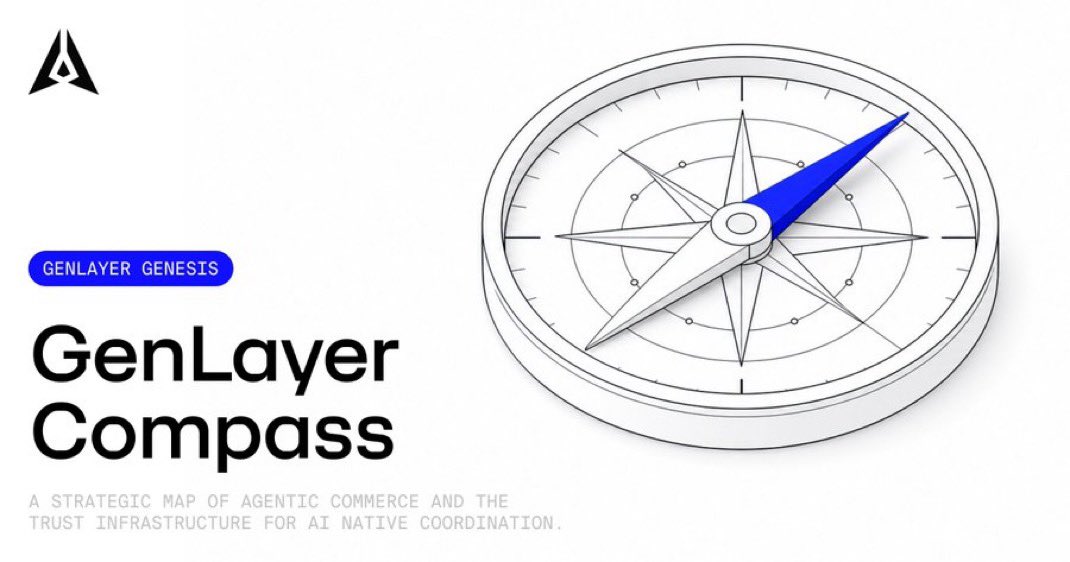
That’s what made The Compass worth reading for me.
It’s where @GenLayer lays out its answer: adjudication as a new layer of trust.
The part I found especially interesting is the Equivalence Principle: validators don’t need identical answers, only answers that mean the same thing.
But the bigger question is:
When autonomous agents start making deals at machine speed, who gets to decide what is true when they disagree?
That’s the rabbit hole The Compass explores.
Read it, create your Portal account, and tell me what you think.
https://t.co/BpUehMDEpw