Around 90 bison have been seized in an alleged animal neglect case led by the Moffat County Sheriff’s Office. Here’s more. Please note that some of the pictures may be disturbing to see. https://t.co/ydyBgbw595
🌩️ Stellar is bringing billions in dead money back to life.
We interviewed the Chief Business Officer of Stellar Development Foundation:
• $2.5B tokenized assets | 4x in 2026
• FT. US Bank. SocGen. DWS.
• Malaysian stablecoin now live
• 13 years building payments and remittances
"Making money go from dead to active is incredibly powerful."
@StellarOrg | @rajachak75 | @consensus2026
Full Interview
Wyoming’s Kindness Ranch is rescuing 70 dogs and cats from a Colorado research lab this week — one of its largest rescues. The director believes this is the first of many closures as he's hearing it's longer financially feasible to use beagles and cats.
https://t.co/Fv9lzjrHjs
Years of habitat restoration & reconnecting tributaries are paying off in CA! 30k endangered coho salmon returned to Mendocino Coast rivers this year — a record-breaking comeback!
Read the full article from NOAA Fisheries here: https://t.co/ravHROPmZt
Your porch light is an insect death trap. The fix takes 60 seconds.
Light pollution is one of the top three drivers of global insect decline.
Standard white porch lights pull in moths, beetles, and other night-flying insects all night, where they exhaust themselves circling the bulb until they die or get picked off by predators.
The fix: swap the bulb for a warm-colored LED, 2700K or lower (look for "amber" or "bug light" on the package). Insects can't see those wavelengths well and mostly ignore them.
You can take it an extra step by putting the light on a motion sensor so it's only on when you actually need it.
That's it. One small swap and your yard stops killing the pollinators you've spent all year trying to attract.
BREAKING: The California Supreme Court just unanimously ruled that the California Coastal Commission unlawfully overrode a county-approved building permit — one of the most significant checks on the Commission's power in the 40 years since Nollan v. CCC.
4/ Today, a unanimous California Supreme Court enforced the limits of the California Coastal Commission’s power. The court affirmed our long-held position that the Coastal Commission cannot simply decide to reinterpret legislation based on its own whims. https://t.co/rFh8skFypM
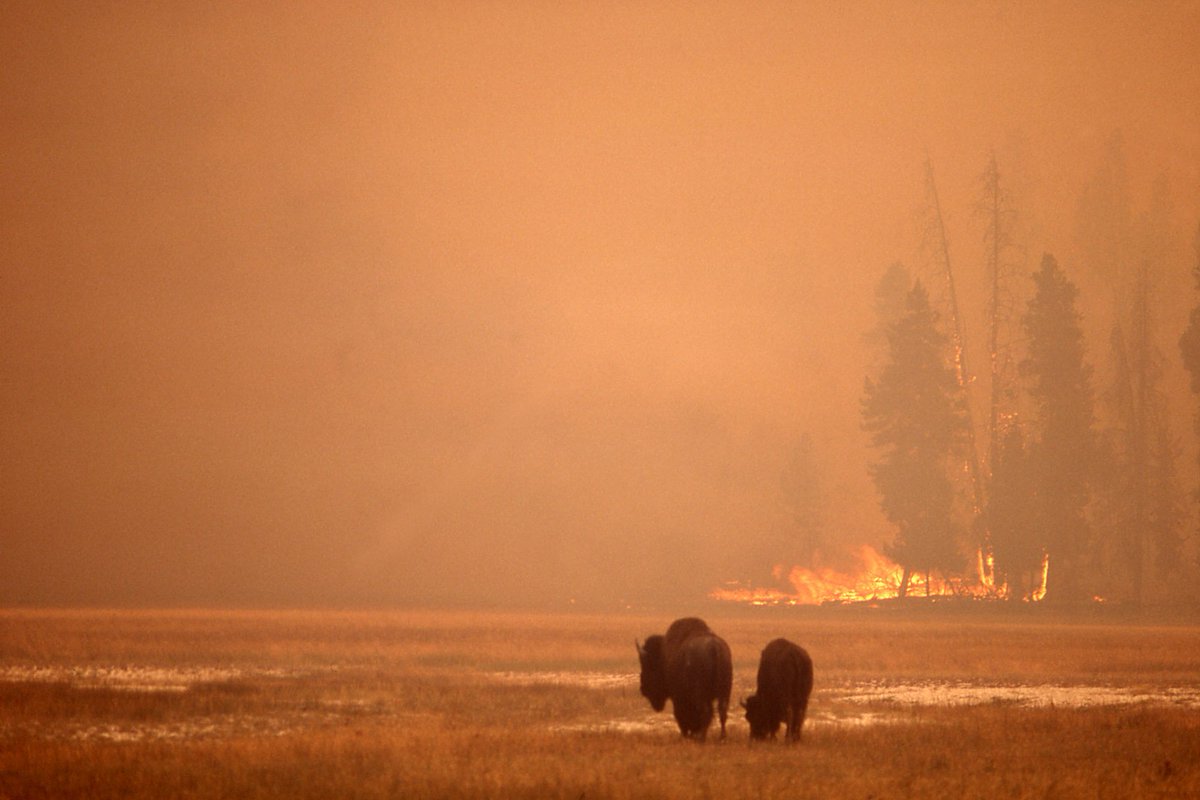
In the summer of 1988, wildfire swept across approximately 36% of Yellowstone National Park. The largest fires in the park's recorded history. The news coverage was apocalyptic. Commentators predicted the permanent destruction of the ecosystem.
The bison of Yellowstone, which had been reintroduced after near-extinction a century earlier, moved ahead of the flames.
They knew. Nobody knows exactly how they knew. They moved in the right direction at the right time.
After the fire passed, they returned to the burnt ground within days. The ash was rich in minerals. The fresh growth pushing up through the blackened soil was, by all accounts, the sweetest grass of the year.
The bison grazed it hard. Their grazing stimulated regrowth. Their hooves worked the ash into the soil. Their dung replaced the burnt organic matter.
The parts of Yellowstone that recovered fastest after the 1988 fires were the parts the bison had grazed.
The parts that took longest to recover were the parts the bison could not reach, or had been fenced out of.
Fire is part of a grassland ecosystem.
Bison are part of a grassland ecosystem.
The two work together.
The people who thought Yellowstone was destroyed in 1988 did not understand either fire or bison, which is roughly the level of ecological literacy currently driving policy discussions about ruminants in general.
Yellowstone is fine.
The bison are fine.
The policy discussions, less so.
John L. Blair of Shell, Wyoming, is a master saddlemaker who commands more than $45,000 for a saddle, $15,000 for a leather bowl or $8,500 for a custom purse. He works listening to Mozart, one virtuoso inspiring another to create stunning leather art.
https://t.co/HTY6tMNWDH
When a coop shares a wall with a greenhouse, four exchanges happen without any equipment. The chickens exhale CO₂ that the plants use for photosynthesis. The plants release oxygen that circulates back to the coop. The chickens radiate enough body heat to smooth temperature swings on cold nights. And the manure composts into the fertilizer the greenhouse beds need.
No electricity. No pumps. Just a shared wall with adjustable vents.
The heat contribution is modest — it won't replace insulation in a harsh winter, but it smooths the overnight temperature swing that kills tender seedlings. The CO₂ is modest too — not commercial greenhouse levels, but enough to replenish what the plants consume in a sealed winter greenhouse.
🌱 What makes it work:
- Adjustable vents in the shared wall — open during the day for gas exchange, closed at night to trap warmth
- Wire mesh barriers so chickens can't access growing beds. They'll scratch up seedlings and dust-bathe in your soil if given the chance
- Deep litter on the coop floor — eight to twelve inches of straw or wood shavings that absorbs moisture, reduces ammonia, and composts in place
- Enough ventilation to prevent ammonia buildup. Chicken manure in an enclosed space harms both plants and birds without airflow
Four exchanges running continuously. The animals feed the plants. The plants clean the air for the animals.
The smartest design is letting biology work together
A mild winter has produced a bumper crop of Wyoming turkeys, and the territorial gobbling rituals have started early this year. “The population is going to explode,” say seasoned turkey hunters, leading to a huge season.
https://t.co/1ewGfbm29a
Hi 👋
We had an amazing time connecting with everyone at our last Q&A sessions — and we’re excited to invite you to the next Q&A + Meet & Greet Call! 🎉
During the Call we introduce our team, get to know you better, and answer your questions. This is a relaxed, interactive space built around real conversations and shared curiosity. 💬
📚 This next session will build on the topics you told us matter most — so come ready to share, ask, and explore.
QSI helps its members to become happier, more confident and vibrant, more knowledgeable about the world and its many lightning quick updates, and how to bring quantum solutions to the table🔣 which then translates into how our efforts and service will help change the world in the future. 🌎💫
If this resonates with you, don’t miss your chance to participate! ⤵️
🔘Monday, April 13 @ 9pm CST / 4am CET / 2pm NZST 🌐
❗️Beginner Reminder: Please make sure to complete the course and test before Q&A sessions → https://t.co/Z3cY3TwwS0
Your involvement matters. We’d love to see you there! ❤️
#Stellar
@MediaQSI