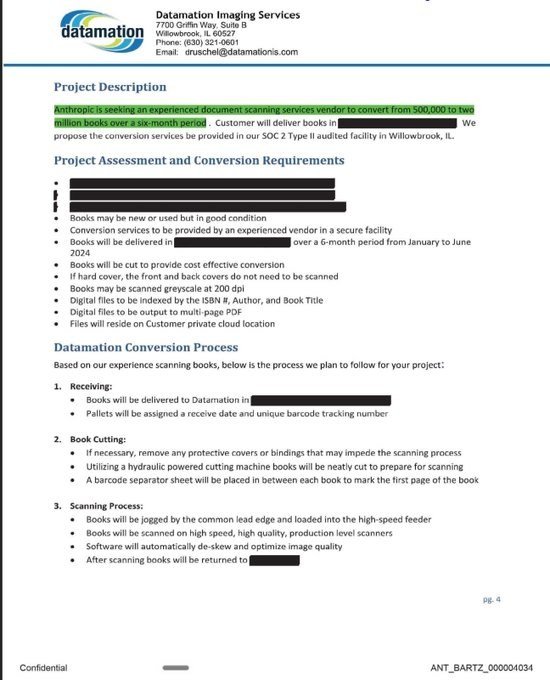
A leaked Anthropic document just came out in court. Their own words:
"Project Panama is our effort to destructively scan all the books in the world."
Next line: "We don't want it to be known that we are working on this."
They planned to shred every book on the planet, in secret. And almost they got away with it.
They changed the doors and gave dementia patients a piece of home back.
In the Netherlands certain nursing homes discovered a straightforward yet meaningful solution to help residents with dementia feel safer and more at ease. Staff place life size stickers depicting each person’s original front door on the entrance to their current room.
Instead of facing hallways of nearly identical doors residents now recognize something deeply familiar. The specific color the shape and the unique details of the home they once lived in stand out clearly.
These custom decals known as True Doors reduce disorientation make individual rooms simpler to identify and help preserve important personal memories.
The approach restores dignity for family members. It encourages greater independence for residents according to caregivers. Most importantly it transforms a standard room into a warmer more comforting space that genuinely feels like home.
Compassion does not always demand elaborate measures. In many cases it can begin with something as simple as a familiar door.
Image created using artificial intelligence for illustration purposes only.
Part of von Neumann's genius was to realize that doing something and the instructions for doing something could both be encoded in the same machine in the same language. There were clear parallels to biology, with protein production and its instructions in the same organism.
The other big insight was to realize that the results of doing something could actually change the instructions for doing it, ie feedback loops. Once again, an essential component of biology. But it took a mathematician with expertise in generalization to realize this.
Von Neumann's other big advantage, which biologists lacked, was that he was familiar with the work of Gödel and Turing which showed that doing something and proving that it can done belong to different levels of abstraction. He could thus separate the process of doing something from the possibility of doing it.
Page from his "Theory of Self-Reproducing Automata", edited by Arthur Burke.
Many fall into the trap of imagining the past as black and white, a drab history of greys and sepia tones, but the reality was considerably more vibrant and colourful! I have cleaned this Autochrome plate from 1908, entitled "Woman of Bethlehem in ancient costume". It was taken in colour by Jules Gervais-Courtellemont 118 years ago, using an early colour glass-plate process. It isn't colourised.
I order a lot of secondhand and vintage books online. This year the prices jumped and I chalked it up to inflation. I was wrong.
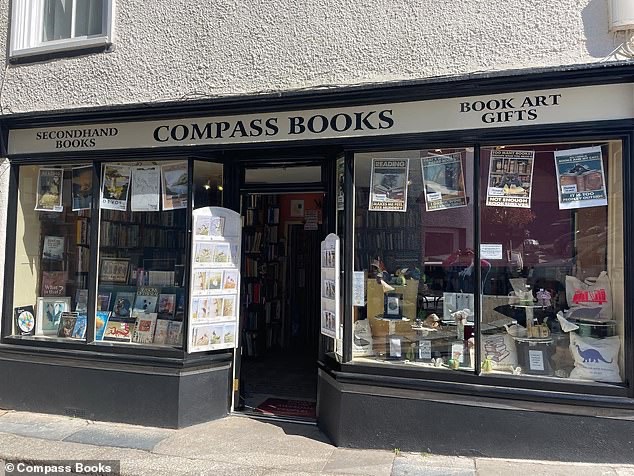
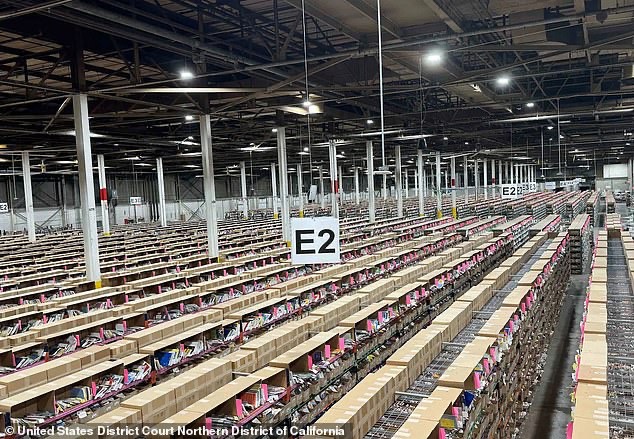
The reason behind the spike in prices is what AI companies euphemistically dub "destructive scanning." That is when they buy millions of second-hand books in bulk and send them to enormous warehouses across America. There, automated assembly lines cut the pages from the spines and then feed the pages into huge industrial scanners.
Those books are being harvested for their text to expand the database for the LLM models. The physical pages? Later discarded. Some of these are the last remaining editions of historical and collectible works — once they're cut and scanned, they're gone.
Booksellers across the UK, Germany, New Zealand, Australia and the U.S. are reporting the same thing: bulk, random, non-fiction orders. Orders have ranged from 1,000 books to as many as a million in a single purchase. Just one vendor contract called for scanning 500,000 to 2 million books.
Anthropic ran this under an internal name, Project Panama, and tried to keep it quiet. Some booksellers noticed something was odd. A Devon bookseller, for instance, got an odd order this summer for books on subjects as disparate as Cornish pioneers in South Africa, cheeses of the world, and Hong Kong jewelry — from a "shipping company" near Heathrow. Her suspicions grew fast. It turned out to an AI run office.
I should have seen this coming. I'm one of the author-plaintiffs in the Bartz et al. v. Anthropic class action — a different kind of theft. Anthropic had trained Claude on more than seven million digitized books, sourced from pirate websites, without paying a penny to authors or publishers. Mine included, seven of my thirteen. There are 120,000 individual authors and rightsholders (representing 447,576 eligible works out of 482,460 total listed books).
A federal judge approved the $1.5 billion settlement this summer. It was the court documents from that litigation that exposed Project Panama. I missed it until the story recently hit the Washington Post and Daily Mail and other outlets.
Having learned an expensive lesson from its class action payout, Anthropic is now going after physical books a different way — and legally, this time. Under the first-sale doctrine, established by the Supreme Court in 1908, once someone buys a physical book, they can do whatever they want with it, including destroying it.
So Anthropic attorneys have determined that buying and scanning a physical copy sidesteps the piracy problem. And once that book is shredded, any future Claude user can draw on its contents for free — the original gone forever.
Some call this a modern-day book burning. The Nazis destroyed books to erase what was in them — these companies destroy books to steal the information and then essentially sell it back to you. I am still angry this is somehow legal.
I just found out the publisher of books I wrote in the 2000s and 2010s has claimed 100% of the Anthropic settlement money for my books, even though I hold the copyright.
Seriously. Stop wondering what's so bad in the Epstein Files for the to be this shit storm of cover up on behalf of Trump.
The fucking scandal is in plain sight now. It is the shit storm of a cover up on behalf of Trump.
@hering_david Three things. Its definitely worth it. Read through and then return with Roland McHugh's Annotations to Finnegans Wake. Watch this excellent overview by the brilliant Anthony Burgess. https://t.co/u0S8UXGSRj
I have not been an election alarmist, but I believe the Supreme Court’s decision on mail-in voting may be the biggest constitutional threat ever. If the court allows the Postal Service to decide who votes, the constitution is dead. Nothing it says will ever be relevant again.
WATCH: @SenBlumenthal tells CNN he won’t trust Mail-in Voting if the Supreme Court backs Trump’s assault on the USPS
Again: The chaos is the point. You are not alarmed enough.🇺🇸 😕 🗳️ (h/t @atrupar)