I'm a writer, teacher, speaker, and follower of Christ. My greatest passion is seeing people step into God's vision for their lives serving with love and joy!
This mom came up with the smartest way to keep her four young kids well-behaved in public… and it’s about so much more than just surviving the grocery store.
She created the “Compliment Game.” The goal is for her kids to earn real compliments about their manners and kindness — holding doors, helping strangers, being polite. Those compliments turn into a treat once they get home.
What I love most is the bigger picture. She’s not just managing chaos in the moment. She’s actively teaching her children how to be kind and respectful to other people, and that kind of training is going to shape them into much better adults one day.
This feels like one of those small parenting ideas that can have a lasting impact.
Christian singer Matthew West shared a powerful story about taking his daughter to camp. During an exercise, the daughters were blindfolded and the dads were told to guide them through the woods after repeating three instructions: I will never leave you. You can ask me anything. And only listen for my voice.
At first, he could guide her easily. Then the counselors signaled for him to remove his hand. He was no longer allowed to speak unless his daughter remembered she could ask him anything. Eventually, they got off track on their hike and a counselor quietly led her into a ditch without her realizing it.
After standing there blindfolded and confused, she finally asked, “Dad, are you there?”
Matthew said he teared up as he answered, “Yeah. I’m here.”
This moment reminded him how often we forget the same truths about God: that He never leaves us, we can ask Him anything, and we need to listen for His voice.
The Dartmouth Scar Experiment.
"This is why teaching people victimhood is so dangerous, because it makes them victims."
In the study, female undergraduate participants were told the research examined how physical stigmas (like a facial scar) affected social interactions.
A makeup artist applied a realistic-looking facial scar using theater makeup, and participants viewed it in a mirror to confirm its presence. However, under the pretext of applying moisturizer to prevent cracking, the experimenter secretly removed the scar completely before the interaction began—leaving participants unaware that their face now appeared normal.
I became a father yesterday.
My wife did this without an epidural. I watched her suffer in ways I will never fully comprehend, carrying a weight I could not share no matter how I tried. For nine months, I was present but powerless.
Pregnancy forced me to confront something modern life constantly tries to erase: you must wait. Painfully. Excruciatingly. There are no shortcuts to life. No hacks. No optimizations. Just time, and flesh, and blood.
Women bear the disproportionate burden of bringing life into the world. I still don’t fully understand why. Only that it’s true, and profound, and humbling beyond words.
I witnessed pain in its rawest form. À suffering that creates. That’s the poetry of it. Imperfect, brutal, but so precisely orchestrated that it cannot be coincidence. I saw Eden play out; the curse and the promise, together in one body.
There is no way you witness how life begins and conclude this is random. No way you watch a body break itself open to bring forth another person and think we are here by accident, that existence is a cosmic joke. The process is too terrible, too sacred, too exactly what it needs to be.
If everyone began life by witnessing a full pregnancy and labour, we would understand the weight of human existence differently. We participate in it, but we do so as children and forget. This is the passage. The one that strips away pretense and forces you to reckon with the fact that we are here for something.
I always assumed fatherhood would arrive in my thirties, after I’d figured myself out as robustly as I imagined I’d want, after life had settled. Instead, it showed up at 27. No warning. No badge of readiness. Just reality.
Two things haunted me throughout these nine months.
The first: What is a father?
For nine months, you wait for someone you do not know. You count weeks, feel kicks, watch your wife’s body transform and suffer, but the person at the center remains a mystery. I kept asking my wife, half-joking: Who the hell is this guy? He could be anyone.
That realization struck me harder than expected: the sheer nothingness of human fatherhood at the start. You don’t author a child. You don’t summon him by will. You are present, but not primary.
And that’s when it became clear.
There is a greater Father.
One who was with him in the womb when I was not.
One who willed him, shaped him, knit him together before I ever felt useful.
One who knew him before he was visible, before he was named, before he was handed to me.
Pregnancy made that impossible to ignore. It stripped me of the illusion of control.
A child is not a possession. He is a gift. And like all real gifts, he comes from Someone higher.
I’ve been able to slowly understand that parenting is not ownership. It’s stewardship. Helping this little man discover his real Father. The One who loved him before the foundations of the world.
And more than that, parenting is trust.
Trusting that the same God who found me in my confusion and chaos will find him too.
Trusting that I don’t have to be the savior to be a good father.
Trusting that my role is presence, love, discipline, humility. Not replacement.
I understand I am not the source. I am a signpost.
And strangely, that is very freeing. Because it means I don’t have to pretend to be God. I just have to be faithful.
So help me God.
"Your son might work in a grocery store bagging groceries for the rest of his life."
Someone said this to me right after my son Jack was diagnosed with autism.
Over the years, the words stuck with me.
I thought about them when he couldn't sit for circle time in kindergarten.
When he couldn't take the bus home from school safely.
When he started middle school, then high school.
Fast-forward.
Jack is twenty-one now.
He works in a grocery store.
He cuts fruit in the produce department.
He works from 8:00 - 2:00 three days a week.
He sets his alarm.
He puts on his uniform.
He walks to the bus station.
He arrives on time.
In this life alongside autism, I've learned it's not always about the destination, but how you got there in the first place.
I've learned that a life lived differently is not a life less lived.
Any any work, not matter what kind, is honorable.
What a beautiful thing.
Please join me in congratulating my son Jack on the first four months at his job.
We are fiercely proud of him.
Credit: Carrie Cariello
A man said "I accept Jesus Christ" on his deathbed.
The church asked if he really meant it.
I need to ask you something.
When did we become the gatekeepers of grace?
I've watched Christians dissect Scott Adams' final words like prosecutors.
They parsed his phrases. They weighed his tone. They measured his faith against some invisible scale and found it wanting.
"That doesn't sound like surrender," they said. "That sounds like a man hedging his bets."
And I understand the instinct. I do.
But there's a verse that haunts me. Not because it's obscure—because it's too simple.
"Whosoever shall call upon the name of the Lord shall be saved."
(Romans 10:13)
Whosoever.
Not "whosoever truly believes in their heart of hearts." Not "whosoever demonstrates sufficient sincerity." Not "whosoever calls early enough in life that we trust their
motives."
Whosoever.
The moment we add prerequisites to that promise, we've traded the Gospel for religion.
We've smuggled works back in through the side door labeled "authentic faith."
I know what some of you are thinking.
But he admitted he wasn't a believer.
He talked about "risk and reward."
He said he hoped he'd "qualify."
Yes. He did.
And those words make us uncomfortable. They don't sound like the confident declarations we want from converts. They sound uncertain. Calculating. Human.
But here's what I need you to hear:
The thief on the cross didn't have time to develop mature theology either.
He was a criminal. Hours from death. He looked at Jesus and said, "Lord, remember me when you come into your kingdom."
That's it.
No profession of belief in the resurrection. No renunciation of his former life. No evidence of transformed character.
Just a desperate man, reaching for a hand he wasn't sure would take his.
And Jesus said, "Today you will be with me in paradise."
We have a problem, and it's not Scott Adams.
It's us.
We've internalized a law that God never gave us. A natural sense of fairness that says late arrivals should get less. That deathbed conversions are suspicious. That the math
should somehow work out—more faith, more years, more sacrifice equals more standing before God.
Jesus told a parable about this.
We skip over it because it offends us.
A landowner hired workers throughout the day. Some came at dawn. Some at noon. Some showed up with one hour left.
At the end, he paid them all the same.
The early workers were furious.
"These who were hired last worked only one hour, and you have made them equal to us who have borne the burden of the work and the heat of the day."
(Matthew 20:12)
And the landowner replied:
"I am not being unfair to you, friend. Didn't you agree to work for a denarius? Don't I have the right to do what I want with my own money? Or are you envious because I am generous?"
There it is.
The scandal of grace is that it feels unfair.
A man who mocked God for sixty years gets the same inheritance as the saint who served since childhood. A skeptic who hedged his bets at the last breath stands in the same kingdom as the martyr who gave everything.
And something in us recoils.
That's not grace rejecting us.
That's us rejecting grace.
Let me tell you what I see when Christians interrogate a dead man's faith.
I see the older brother standing outside the party, refusing to go in.
The prodigal came home reeking of pig filth and poor decisions. The father ran to him. Threw a robe on his back. Killed the fattened calf.
And the older brother?
"Look! All these years I've been slaving for you and never disobeyed your orders. Yet you never gave me even a young goat so I could celebrate with my friends. But when this son of yours who has squandered your property with prostitutes comes home, you kill the fattened calf for him!"
(Luke 15:29-30)
He couldn't celebrate the return because he was too busy auditing the journey.
Sound familiar?
Here's the truth we don't want to face:
We can't see hearts. We can only see words.
And the words Scott Adams spoke were: "I accept Jesus Christ as my Lord and Savior."
Were they perfect? No.
Were they confident? No.
Were they the words we would have scripted? No.
But they were the words.
And the God who receives those words is not checking for tone. He's not running sentiment analysis. He's not grading on a curve.
He's looking for open hands.
Paul wrote something that lands differently now:
"Who are you to judge someone else's servant? To their own master, servants stand or fall. And they will stand, for the Lord is able to make them stand."
(Romans 14:4)
Scott Adams was not our servant to judge. He answered to his own Master.
And the Lord is able—able—to make him stand.
That's not my promise. That's Scripture's promise.
The question is whether we'll submit to it.
I know why we do this.
I know why we parse and weigh and question.
Because if grace is really this free, then we didn't earn our place either.
If the deathbed convert gets in, then our decades of service weren't the price of admission. They were the privilege of knowing Him longer.
And that reframes everything.
It means the faith we've built isn't a resume. It's a relationship.
It means our years weren't buying something. They were receiving something.
It means we were never the workers earning a wage.
We were always the prodigals coming home.
So did Scott Adams get saved?
I don't know.
But I know what the Scripture says.
Whosoever shall call upon the name of the Lord shall be saved.
I know what Jesus promised the thief who had nothing to offer but a desperate plea.
I know what the father did when his son came crawling home with a rehearsed speech that never even got finished.
And I know what the landowner said to the workers who were angry that grace didn't do math the way they wanted.
"Are you envious because I am generous?"
The gate is narrow, but it's not locked.
The standard is high, but it's not ours to enforce.
The Judge is holy, but He is also the one who ran to meet the prodigal while he was still a long way off.
Stop auditing the dead.
Start marveling at the grace that let you in.
"Whosoever shall call upon the name of the Lord shall be saved."
Whosoever.
Even him.
Even you.
What saith the Scriptures?
That's the only question that matters.
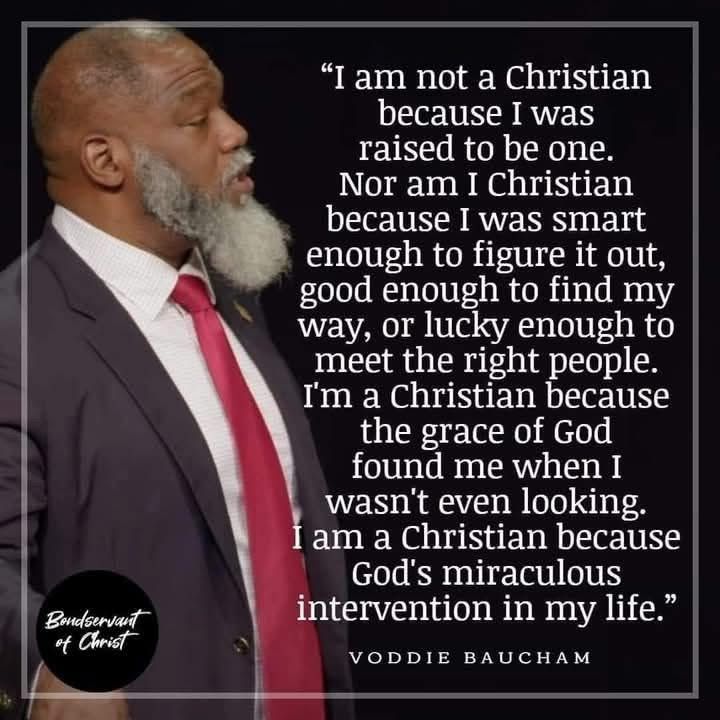
Voddie Baucham:
"All the gospel requires is repentance and faith. That's it. Nothing else. Some of you are going, 'Well, what about obedience?' That's not what the gospel requires, it's what the gospel produces."
Did u know that Vincent Van Gogh's painting were worthless at one time?? Nobody wanted them—not even after his death. They were headed to rot forgotten in storage... Shocking, but check this out, it really brought me to tears and explains everything! 🤯
SNOW DAY! I wrote this song in May 2022 [in May? WHY???] and worked on the arrangement/recording remotely with Mike Ford. Then I animated it the old-fashioned way: a frame at a time. Why? The same reason people climb Mt Everest: stupidity.
As a parent, I think this video has taught me something useful.
I recommend that you should try it on your kids, too.
I have also shared it with my wife.
Credit: joe_drummer_boy on IG.
For your baby the whole world is a puzzle waiting to be solved. 🧩
Check out this clever little one as she combines background knowledge and trial and error in an effort to put on a pair of socks.
She clearly understands their purpose and knows they wrap around her feet. But exactly how, remains a bit of a mystery.
So it’s time for the scientific method.
Note how each of her hypotheses differs.
Our hero seems to know (from past experience) that the process begins at the toes, but when pressing the sock into them doesn’t work she moves progressively down the foot - next wrapping it around her foot just below the toes.
While this method covers part of her foot, the heel is still exposed, so she tries again, draping it over the full length of her foot, mimicking the coverage and visual appearance of a successful effort.
Don’t you just love the way this video provides a window on her thinking?
This miniature scientist was shared to IG by oykkubudak.
By the way, the Turkish caption asks if this is the way to wear socks?
✝️🕊️🙏🏻Why the Bible is different…
✝️🕊️I stumbled upon this video and watched it till the end if you’ve ever questioned your faith or questioned God or Jesus, give it a listen, you might find your answer🙏🏻🙏🏻🙏🏻
“I support abortion in cases of rape.”
Tell that to Mark.
He was conceived when his mom was raped at a 4th of July Party.
Thankfully, she refused to take his life.
Every child deserves a chance at life - no matter how they were conceived.