Data-driven insights on AI, Crypto & US Equities. Connecting the dots: AI ➡️ Macro ➡️ Tech Stocks ➡️ Crypto. Focused on: Institutional Flows. @PKU1898 Alumni.
1️⃣ Overview & Core Deal
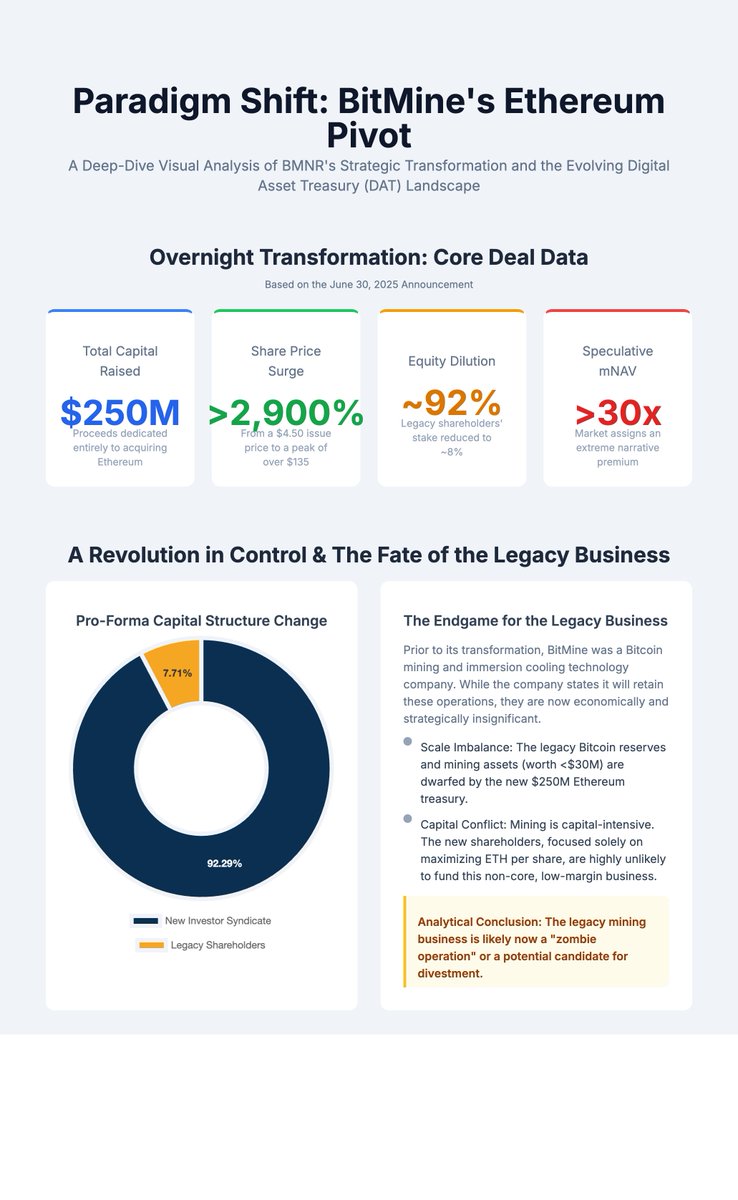
A Paradigm Shift for @BitMNR . A thread on its $250M pivot to an #Ethereum treasury, backed by a powerhouse syndicate. $BMNR
We break down the core deal data, the ~92% dilution of legacy shareholders, and the strategic endgame for its original mining business.
The listing is the easy sentence. The risk sleeve is the story.
HINC, as @Securitize described it, is an actively managed high-yield credit fund — mainly corporate bonds and CLO tranches — now usable as collateral on @aave Horizon to borrow USDC, GHO, or RLUSD.
That is a different window from the ECB's 2027 Eurosystem collateral decision. One is a permissioned borrow against a credit fund share, live today for eligible holders. The other is a central-bank eligibility perimeter that still runs through T2S, and is not scheduled to take effect until June 2027.
Put the −$509.3 million in the month, not just the day.
Per @FarsideUK, that was IBIT's third straight session above $500 million, after $541.1 million on Nov 19 and $544.7 million on Nov 20. Across the 16 settled sessions through Nov 23, US spot bitcoin ETFs were net −$4,706.7 million — already larger than June's full-month outflow of $4,509.7 million, the previous worst month in Farside's daily series (which starts in January 2024).
Tuesday is still a stub. IBIT, FBTC, and BITB have not posted.
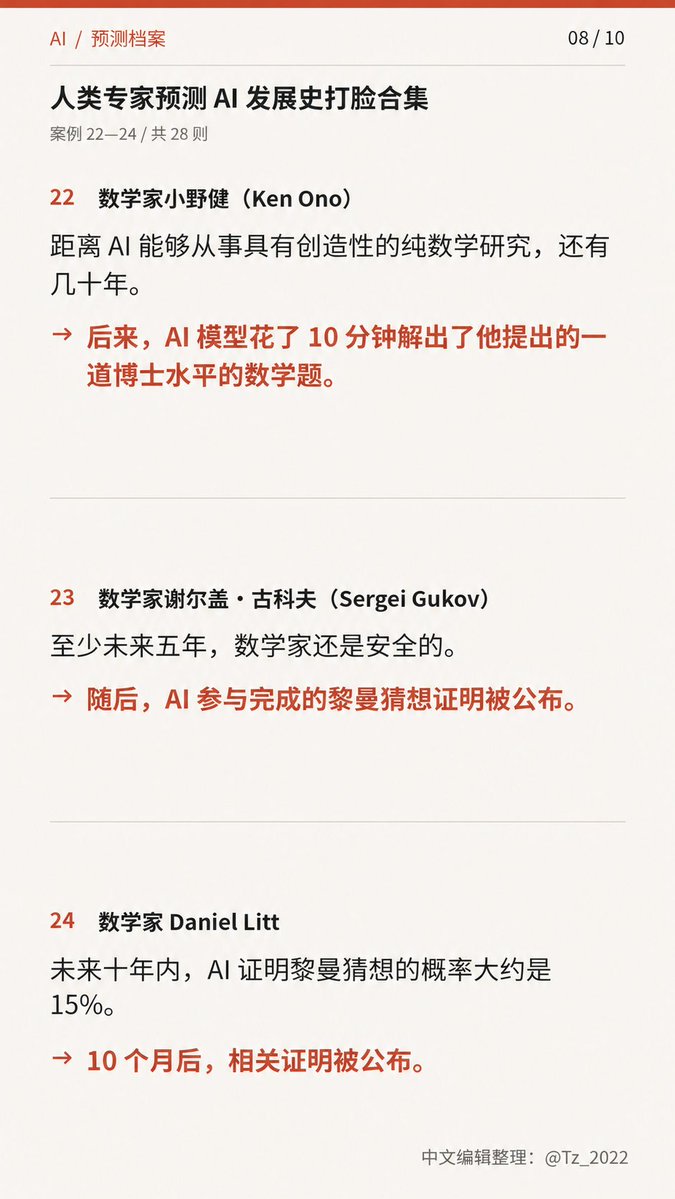
Over the weekend, the Lean and Mathlib communities certified both the statement and the proof. That is no longer the open question.
The open question is the jump Wang makes after it.
He treats the result as evidence that raw intelligence is no longer the bottleneck — that what remains is know-how, plumbing, and experimentation. Then he prices the next step: models intelligent enough to automate all of AI research, and to accelerate biology, weapons, and economics beyond what humans can monitor. He says the scientific and technical problems on capability progress are likely solved.
A compiled theorem is not a solved laboratory, and it is not a control theory for something he calls 1,000 times more capable than us in every field. He even notes that the math community has not fully digested the proof. The rest of the world is being asked to digest a civilizational conclusion from it.
The last section is the one worth keeping. He does not want a handover of society to AI, and he says the industry’s default path is the wrong one. If this is the starting gun he thinks it is, that part cannot stay a closing paragraph. https://t.co/nUszRDfbHq
The note is four pages. The claim is the biggest one in mathematics.
On Friday, @__alpoge__ posted a statement on his site. He is a number theorist at @AnthropicAI — a Princeton PhD, a former Harvard Junior Fellow — and he wrote it plainly: “I believe I have, working with Claude, discovered a proof of the Riemann Hypothesis.” He says the same method also gives the Generalized Riemann Hypothesis, and that the argument has already been formalized in Lean, “without assumptions.”
That is a claim. It is not yet a verdict.
The Riemann Hypothesis has been open since 1859. In plain language, it is a precise guess about how the prime numbers are spaced. It has steered number theory for a century and a half. It is one of the Clay Millennium Problems. A million dollars sits on a proof the field actually accepts. A note on a personal website is not that.
What he released is strange, and honest about being strange. There is no readable paper. He says it would be “obviously inappropriate to attempt to post some massive unreadable travesty of ‘slop.’” A footnote says that informal draft ran past 250,000 pages. So he posted only the Lean files, in fourteen parts, at https://t.co/a3niaIS8Yh. He writes that he guided the work into the right setting, and then, near the finish, Claude “flew, and danced, and sparkled.”
He also flags the calendar himself. “The precise timing is horrible.” He says he messaged Dario late Sunday night about whether he could announce, and that there was “a constraint to respect.” @AnthropicAI’s shares had just started trading on Nasdaq. He says the cynical reading of that timing is false. Take him at his word. The files still have to be checked.
Kevin Buzzard, speaking to New Scientist, put the next step in one line: let’s see if it compiles first. Lean can mechanically check a proof. It cannot, by itself, promise that the theorem on the last line is exactly the Riemann Hypothesis, or that no quiet assumption slipped in. Public mirrors of the archive already say it has not been verified. @AnthropicAI has not posted an official confirmation.
If the code builds, and the statement it proves is the real thing, this becomes one of the strangest days in the history of the subject. Until then, a serious mathematician has made an extraordinary claim, and left the homework in public.
The champagne is for after someone else can compile it.
https://t.co/nWxQza8MzW
@vladtenev The sentence is unfinished.
Tokenization can wrap a share, move collateral, or sit next to a cash listing. Those are not the same product.
Tonight ANT is still expected to open on Nasdaq. That’s the bid that has a time.
4️⃣ Everyone will want a market cap tonight. The official pricing note doesn’t give one. The last share table was built on an assumed $74.00 price and a smaller offering. Leave the headline valuation to the tape.
What is already signed: $83.00, a larger public book, and $26.0 billion of Class N from the chip and cloud complex, contingent on close.
Nasdaq opens 10:30 p.m. HKT. After that, the lab is no longer a private mark.
1️⃣ $83. Above the range.
@AnthropicAI priced Class A at $83.00 a share. 980 million shares. Ticker ANT, on Nasdaq Global Select. Trading is expected to start today, US hours.
The last amendment, filed Nov 17, had estimated $70.00–$78.00.
The lab is about to have a public bid.
3️⃣ The public book is not the only bid at $83.
In the Nov 17 amendment, AMD, Broadcom, Google, Micron, Microsoft, NVIDIA, and TSMC Partners agreed, severally, to buy an aggregate $26.0 billion of Class N common stock from Anthropic at the IPO price.
The purchase is contingent on the offering closing. Those shares are not registered in this deal, and the underwriters take no discount on them. Google’s slice funds a portion of a previously committed 2026 obligation.
The suppliers and the cloud are writing paper at the same print as the public.