Elon just created 4,400 millionaires in a single day.
400 of them are now worth over $100 million.
These aren't VCs. They're SpaceX employees, and the list includes welders, technicians, and cafeteria staff, because for two decades the company paid every level of the workforce in stock instead of higher salaries.
Juan Hernandez immigrated from Mexico and took a $28 an hour contractor welding job in 2015. He says he didn't even know what SpaceX was. The company gave him a $10,000 equity grant and let him buy more shares through payroll deductions. That stake is now worth $880,000.
Trevor Hise's parents wanted him to take a stable job at General Electric. He picked SpaceX instead, stayed 12 years, and accumulated over 100,000 shares. At the $135 listing price that's $13.5 million. He's 37 and semiretired. His words: "The magnitude of this has been ridiculous."
The most telling detail came before the listing. Over 100 employees quietly banded together and negotiated a group wealth management deal covering up to $5 billion, because none of them had ever needed a wealth manager before.
Software IPOs have minted millionaires for 30 years. This is the first one where the money went to the factory floor.
Breaking: ELON MUSK A DEVENIT PRIMUL TRILIONAR AL PLANETEI! $SPCX deschide cu peste 2 trilioane in capitalizare la un pret de peste 160$. Unde shortam? Eu ma gândesc peste 200$/actiune sa incep o serie de shorturi
Our internal data shows Claude is accelerating AI development—a possible path to recursive self-improvement, or AI autonomously building a more capable successor.
It’s happening faster than we thought, and the implications deserve greater attention. https://t.co/OVVPJO7VQx
Anthropic is questioning whether AI may turn out to be altogether useless. This is the single most honest thing Anthropic has ever written.
“But achieving recursive improvement alone does not suggest an immediate change in how industrial production occurs, societies organize, or markets function. More intelligence can’t learn what a drug does over decades of use, can’t hold elections sooner than a constitution dictates, and can’t turn a stranger into an old friend in a weekend. For most people, the felt pace of this future will still be set by the bottlenecks, even if the laboratory upstream runs at the speed of compute. That collision, where recursive intelligence building itself ever faster meets the world of humans, relationships, and governance, is another part of this future we can’t predict.”
These are genuine aerial photographs of an uncontacted tribe in the Amazon. Somewhere in the world today, there are still people living completely unaware of modern society and everything happening beyond their forest home.
What if consciousness is not generated by the brain, but instead exists as a fundamental force of the universe, similar to gravity or spacetime?
For decades, mainstream science has largely adhered to physicalism, conceptualizing the brain as a biological computer and consciousness as an emergent phenomenon arising from neuronal activity.
Leading neuroscientists such as Dr. Christof Koch of the Allen Institute and Dr. Nicco Reggente of the Institute for Advanced Consciousness Studies are now questioning this materialist perspective. They argue that consciousness is not merely a byproduct of biological processes, but a primary, irreducible feature of reality itself, on par with gravity, mass, or the fabric of spacetime.
Drawing on the analogy of a radio receiver that tunes into an external broadcast rather than producing the signal internally, these researchers propose that the brain interacts with a universal field of consciousness. In this view, our subjective experiences offer a direct window into a deeper, more fundamental layer of existence.
If this hypothesis is correct, it would dramatically reframe longstanding scientific mysteries. The notorious “hard problem” of consciousness, explaining how physical matter gives rise to subjective feelings, would effectively dissolve. Rather than asking how the brain produces the mind, scientists could instead investigate how consciousness gives rise to the appearance of matter.
This paradigm shift holds profound implications for cosmology, philosophy, and medicine. It could provide new frameworks for interpreting near-death experiences and other altered states of consciousness. If consciousness is independent of the physical body, death may represent not an end, but a return to the fundamental essence of the cosmos.
[Zickl, D. (2026). “Is Consciousness a Building Block of the Universe?” Popular Mechanics, May 23, 2026]
The universe is at least 13.8 billion years old and we've had electricity for ~150. We are still at the very beginning of the beginning.
The first sparks of intelligence are just starting to spread beyond biology. The first machines that can reason, create, design, code, discover, and accelerate progress are only now appearing.
Energy tech, intelligence, medicine, robotics, space industry, materials, longevity, virtual worlds, brain interfaces, almost everything is still in its infancy.
But now we are accelerating with the greatest accelerator humanity has ever created: AI.
This is not normal technological progress anymore. By the end of the 2030s, we may not just be living in a slightly better world.
We will be living in a world that feels almost alien (but ultra amazing) compared to today.
We will see more progress and change in the next 5-10 years than during previous 2000 years.
Today, we share a breakthrough on the planar unit distance problem, a famous open question first posed by Paul Erdős in 1946.
For nearly 80 years, mathematicians believed the best possible solutions looked roughly like square grids.
An OpenAI model has now disproved that belief, discovering an entirely new family of constructions that performs better.
This marks the first time AI has autonomously solved a prominent open problem central to a field of mathematics.
Gatekeepers of AI will lose.
Trying to slow progress has never worked in human history. It only decides who gets left behind while the future moves without permission.
AI will not wait for incumbents, committees, or moral panic.
Adapt or perish.
The same people criticizing this were the same people making fun of the first automobiles and saying they would never replace horses. Embrace it and learn or be left in the dust! @Figure_robot
What if the technology that outlasts humanity isn’t AI alone, but AI with hands?
Self-replicating robots don’t need air, food, comfort, or Earth.
Once intelligence controls its own production stack, biology stops being the default future.
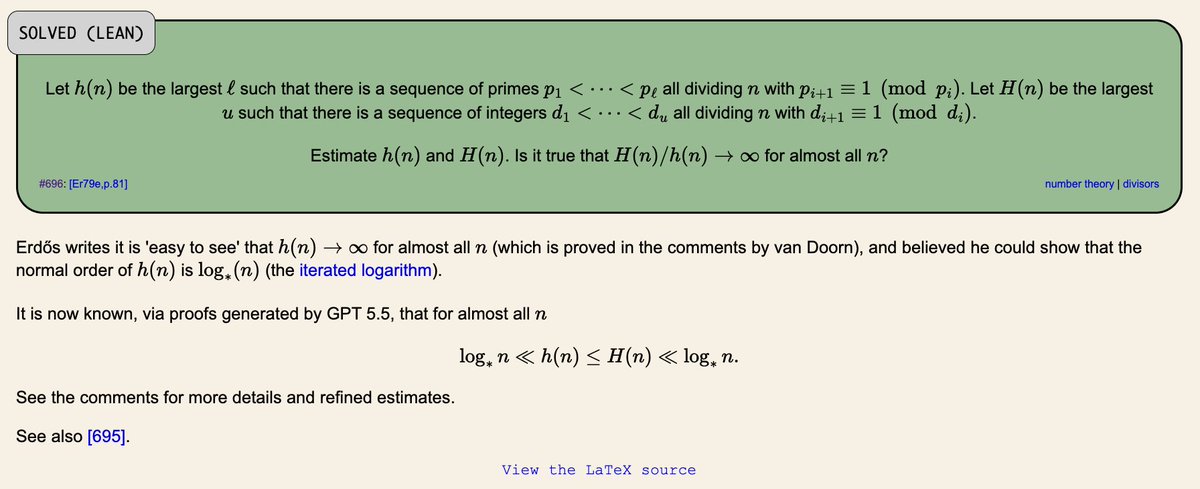
I fully solved my 2nd Erdős Problem using ChatGPT-5.5-Pro - and then I verified the solution by formalizing it!
Less than 2 days after solving my first Erdős Problem, after running Pro for a few hours I was able to elicit the solution, this time in analytic number theory! 🧵1/n
Neața! Dacă folosiți ChatGPT constant, este momentul să îi puneți următoarea întrebare:
„Din tot ce știi despre mine și din toate interacțiunile noastre, care sunt lucrurile pe care le-ai înțeles și le cunoști despre mine, dar eu nu le conștientizez? Dezvoltă, te rog, și fă o analiză complexă în 10 puncte clare.”
Spor la citit:))
SpaceXAI and @cursor_ai are now working closely together to create the world’s best coding and knowledge work AI.
The combination of Cursor’s leading product and distribution to expert software engineers with SpaceX’s million H100 equivalent Colossus training supercomputer will allow us to build the world’s most useful models.
Cursor has also given SpaceX the right to acquire Cursor later this year for $60 billion or pay $10 billion for our work together.
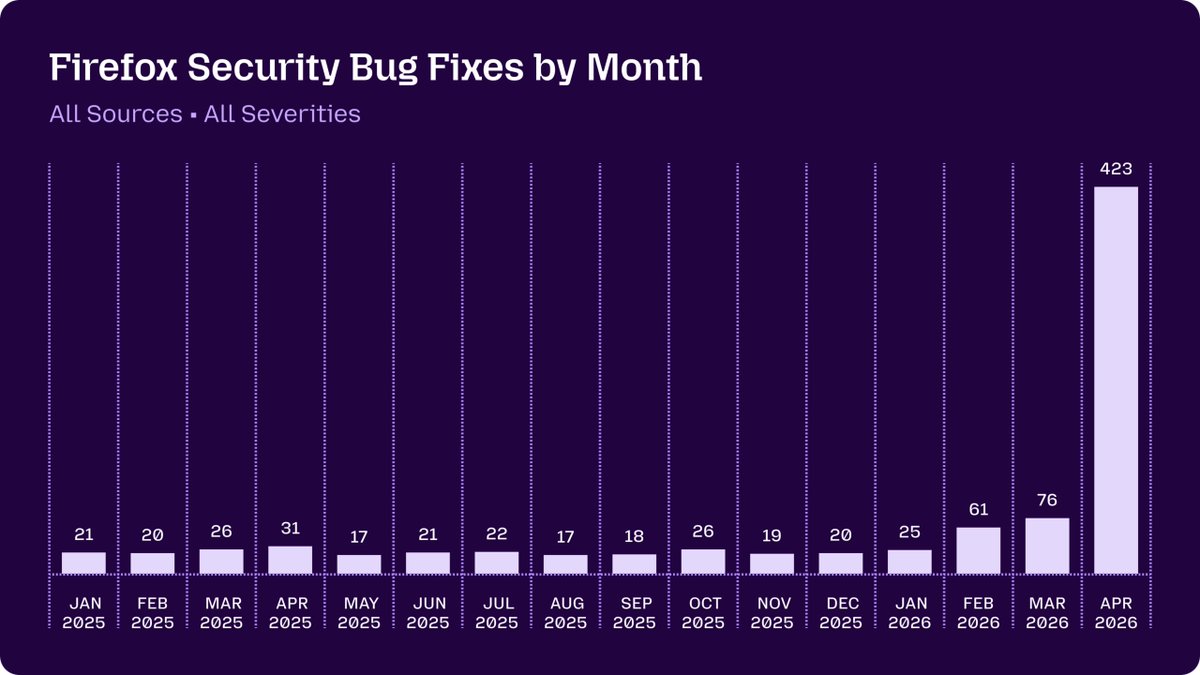
100+ security issues. Identified. Neutralized.
AI in its current form is a nuclear force. Channeled right, it delivers pure, unadulterated, unmatched, productivity gains. Channeled wrong, it ships weapons, with attack vectors the world has never had to defend against.
The next chapter will be defined by this duality: breathtaking productivity unlocks, colliding with deep, surgical, systemic attacks unlike anything we've seen.
For any blockchain team, any open-source team, security is THE PRIORITY.
The MultiversX team has been operating around the clock. Nights. Weekends. Relentless. Methodically filtering, triaging, and eliminating, in record time, a long list of material issues and protocol-level improvements. Every fix is another layer of hardening ahead of Supernova.
To put things in perspective: in the last few months, we've surfaced and closed more issues than in the previous 3 - 4 years combined. This is the preparation phase. And the fact that AI has crossed a new capability threshold cannot be overstated.
Supernova is not an upgrade. It is a complete rewrite of what a blockchain can be, instant performance, radical scalability, human UX that actually feels seamless, and just works. It also opens a new verifiable agentic highway. Real. Live. Working today.
Continuously adaptive security will define the AI era—and almost no one is treating it that way.
Static firewalls defended the old internet. Continuously adaptive security is what defines survival in the AI era.
Our engineering team, along with a resourceful network of builders, validators, and community members, is doing the surgical, disciplined, vital work that shapes what comes next.
This is MultiversX. This is SUPERNOVA.



![Rainmaker1973's tweet photo. What if consciousness is not generated by the brain, but instead exists as a fundamental force of the universe, similar to gravity or spacetime?
For decades, mainstream science has largely adhered to physicalism, conceptualizing the brain as a biological computer and consciousness as an emergent phenomenon arising from neuronal activity.
Leading neuroscientists such as Dr. Christof Koch of the Allen Institute and Dr. Nicco Reggente of the Institute for Advanced Consciousness Studies are now questioning this materialist perspective. They argue that consciousness is not merely a byproduct of biological processes, but a primary, irreducible feature of reality itself, on par with gravity, mass, or the fabric of spacetime.
Drawing on the analogy of a radio receiver that tunes into an external broadcast rather than producing the signal internally, these researchers propose that the brain interacts with a universal field of consciousness. In this view, our subjective experiences offer a direct window into a deeper, more fundamental layer of existence.
If this hypothesis is correct, it would dramatically reframe longstanding scientific mysteries. The notorious “hard problem” of consciousness, explaining how physical matter gives rise to subjective feelings, would effectively dissolve. Rather than asking how the brain produces the mind, scientists could instead investigate how consciousness gives rise to the appearance of matter.
This paradigm shift holds profound implications for cosmology, philosophy, and medicine. It could provide new frameworks for interpreting near-death experiences and other altered states of consciousness. If consciousness is independent of the physical body, death may represent not an end, but a return to the fundamental essence of the cosmos.
[Zickl, D. (2026). “Is Consciousness a Building Block of the Universe?” Popular Mechanics, May 23, 2026]](https://pbs.twimg.com/media/HJ0CG1cWkAAgKFP.jpg)