Now announcing the 2023 Cybersecurity Law and Policy Conference Call for Papers! Please consider submitting an abstract for consideration! https://t.co/rNly6aa8BL
Let's talk about why cryptocurrency is the single factor that created the ransomware plague that is ravaging our healthcare system and public infrastructure. (1/) 🧵
Delighted to report I've been promoted to Associate Professor with tenure @OSU_Law & CSE. Incredibly grateful to everyone who helped, encouraged, supported, and mentored along the way. There were so many! I hope I can pay it forward.
@Klonick@blakereid@reckless@cagoldberglaw I must point also to Jane Chong's terrific essay, "Bad Code," which continues to inspire and resonate with much of my thinking on this question. https://t.co/L2Q9qrZ11E
Another way of looking at it is that the Board cares much more about general principles than individual cases, and it takes particular cases almost entirely because they raise important issues in a crisply presented concrete form.
I find it highly amusing that they wrote this like they were judges issuing a legal opinion. The board has some fabulous lawyers, so I get it, but at bottom it's just a for-profit company making a product decision. https://t.co/WtG8Yvw4o9
Bottom line: the cyber insurance market is incapable of fixing cybersecurity through a market-driven approach without legislative or regulatory intervention. 7/fin
Enjoying this informative article on “Five Approaches to Insuring Cyber Risk” by Christopher French @PennStateLaw (https://t.co/ck4X0OuPag). Some takeaways: 1/
How to fix? (1) do nothing, (2) require CGL coverage of cyber risk, (3) create standalone "all cyber risk" policies, (4) use fed govt as excess insurer, (5) hybrid of 3 and 4 (author favors this). 6/
Though I very much support it, I don’t see us shifting traffic enforcement towards automation at scale anytime soon. Police don’t favor it and among the public, debate is still embryonic and plagued by conflicting assumptions, ideas, and priorities, as well as misinformation:
In the next year or two, the Supreme Court is likely to decide how and whether the border search exception applies to digital devices?
But which cases should it take, and which issues should it decide?
A thread.
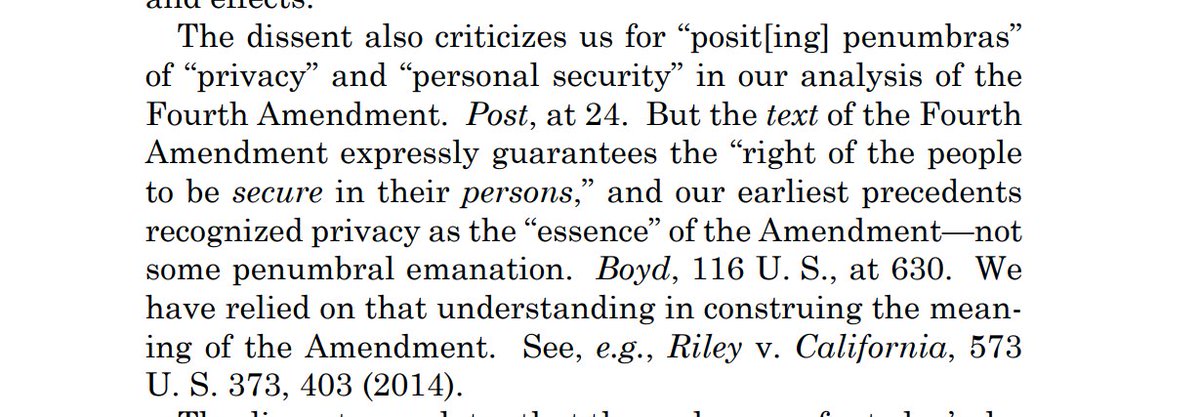
Really interesting snippet from Torres, where the 5-3 majority emphatically places privacy at the center of the Fourth Amendment as a historical/textual matter:
I'm going to talk about something I'm really proud of, even though I sometimes had scarcely any role. At @UWSchoolofLaw, we have had a number of JD students who have worked with faculty or students in other disciplines on original research. I think this is a big deal.