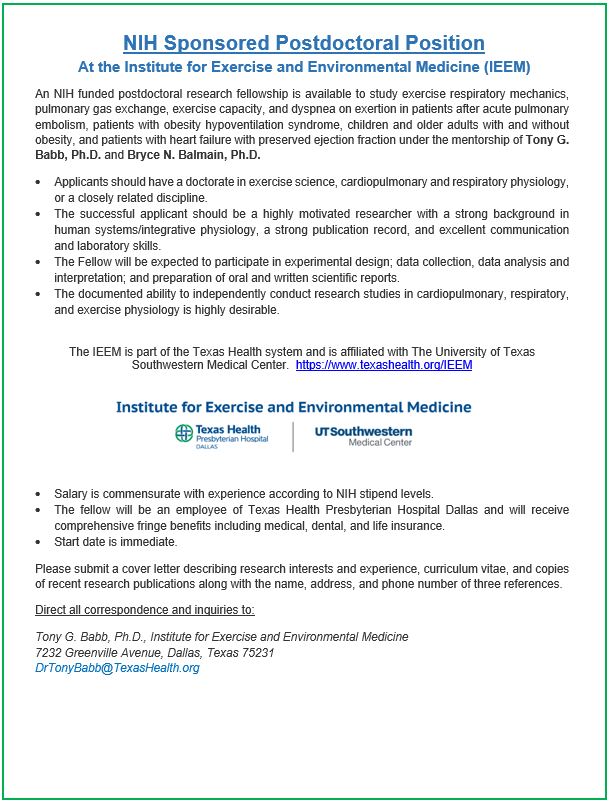
In light of our recent @nih_nhlbi R01 award, we (@ieemphd) have a position for a #postdoc available to investigate limitations to exercise in various populations (see advertisement). Contact myself or Dr. Babb for more info. Please RT! @APSEEPSection@ACSMcareers@JobsinSportSci
Important lessons from Alberto Neder @QueensRIU on physiological studies for investigating residual exertional dyspnea in cardiopulmonary disease #CPET#Dyspnea2024
UT Southwestern's Dr. Benjamin Levine was recently featured on FoundMyFitness Podcast and shared some of his expert insights on how exercise prevents & reverses heart aging.
Listen at the link below!
https://t.co/FdwxCcRXlo
Respiratory symptom perception during exercise in patients with heart failure with preserved ejection fraction: While dyspnea on exertion provokes negative emotions, it is more related to pulmonary mechanism than central and/or peripheral in HFpEF
https://t.co/nZHYCVNUsA
Our lab at @IEEMPHD has an open position for a #postdoc to investigate cardiopulmonary limitations to exercise in various populations (e.g., HFpEF, obesity, post-PE syndrome). Contact myself or Dr. Babb for more information. Please RT! @JobsinSportSci@ACSMcareers@APSEEPSection
Great to see our work (@UTSWInternalMed) in the latest issue of @journal_CHEST - Reducing #PCWP worsens ventilatory efficiency and increases #dyspnea during exercise in #HFpEF. Editorial on pg. 574.
https://t.co/ffQriWIAuj
We continue to look for a Research Assistant to work in our Thermal and Vascular Physiology laboratory at Texas Health Presbyterian Hospital Dallas. Candidate must be employable within the US without an H-1B visa and available to start this summer.
@QueensRIU Good question - it's possible that an altered distribution of, and/or a decrease in, pulmonary blood flow via decreasing pulmonary vascular pressures due to decreasing venous return could limit the ability to adequately perfuse the ventilated apices of the lung.
Excited to see our paper published online today in @journal_CHEST, which challenges the widespread view that the marked rise in PCWP during exercise is deterministic for provoking exertional #dyspnea in #HFpEF. @IEEMPHD@UTSWInternalMed @nih_nhlbi
https://t.co/ffQriWIAuj
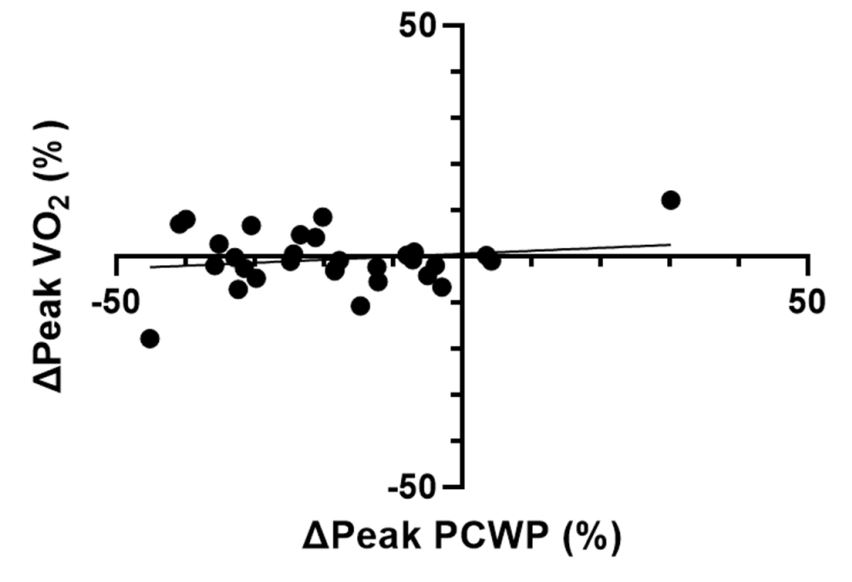
Extremely excited to see our latest collaborative effort in @CircAHA. Though high pcwp is a diagnostic marker for #HFpEF, it appears not the primary cause of exercise intolerance in these patients.
#OriginalResearch: In HFpEF, acutely lowering PCWP during exercise with nitro did not improve VO2 suggesting elevated PCWP during exercise not the primary cause of limits in exercise capacity #AHAJournals https://t.co/52M3205nWc
Our latest work in @journal_CHEST contributing to the knowledge on gas exchange abnormalities in HFpEF. Editorial on page 1233 of this issue as well. https://t.co/k2zQABDRwX
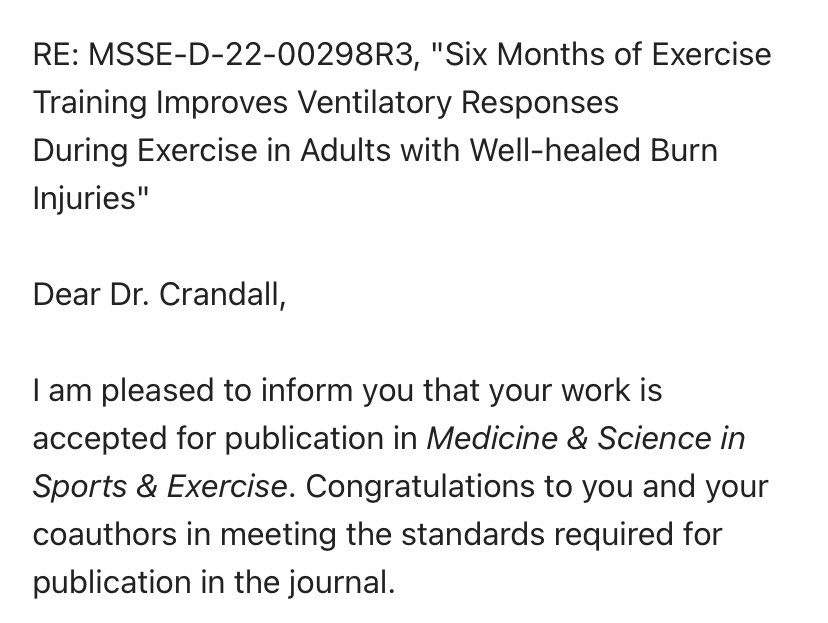
Nice start to the weekend! Some of the first evidence of ventilatory responses during exercise in burn survivors accepted in @MSSEonline@ACSMNews. Congrats @Joseph_Watso!