Paperclip beats Lobster.
I was a big fan of OpenClaw... until I met Paperclip. I am now moving all of my AI employees over to Paperclip.
It's a better control layer for human teams that need to work with AI agents. OpenClaw was great when I was the only one who needed to use the agents, but I want my entire human team to use the same agents.
I'm loving Paperclip and starting to extend it to match my exact needs.
Tell me how you're using it.
The cost of code is rapidly trending toward $0. We just completely rebuilt a decade-old SaaS platform in a single day to prove it.
Last month we helped a SaaS company that wanted to relaunch their old software with a more modern stack. The codebase was built over 10 years. It evolved with the business as the business grew through its early years. Now the company is stable so they wanted to build with a fresh stack and latest technologies. They also want a codebase that ready for modern AI development flows.
>> We rebuilt the entire codebase and infrastructure in a single day. One day!
Even a couple of years ago this would have been a full-time job for multiple people for multiple months. The risk of losing features or the radically different behavior between the old and the new would have been terrifying. This company would not have been able to afford those costs or delays.
The process was relatively simple:
1) Use agents to document every single detail of the original code base. This serves as a guide for the agent developers.
2) Put the original codebase in the workspace so agents can reference the exact functionality when in doubt.
3) Use agents — and human input — to create preferences and standards for how the new system is built.
4) Let Codex do its thing! We instructed Codex to work through the plan and let in run in the background through the day.
In total, it took about 8 hours and $100 in tokens.
We then went to a testing phase (because who can really trust something that big built that quickly?!). The functionality was all there, but some UI improvements necessary. The new version of the software included a rebrand and a move from Angular to React so it wasn’t as simple as copying every element from the old software. It took about 8 hours of labor testing before we were confident enough to ship. The business owner performed the testing to absorb that cost.
Now the company has a modern stack and all code is 100% written by AI. The cost of code is trending towards $0 and they’re now able to move so much faster with their software development.
The next summit to climb is to fully integrate the support channels with the coding agents so bugs can be automatically triaged, fixed, and staged for human review. That should be completed this month.
A founder friend and we started talking about building autonomously run companies with platforms like Paperclip. I've enjoyed using it lately to orchestrate all of the various agents running across Centered and portfolio companies. What agent orchestration layers are you using? Any experience with Paperclip or others?
DocuSign Personal: $10 to $15 per month.
DocuSign Standard: $25 to $45 per user per month.
DocuSign Business Pro: $40 to $65 per user per month.
A 10-person team on Business Pro pays $4,800 to $7,800 a year. To put signatures on PDFs.
A team of 50 pays $24,000 to $39,000 a year.
And there is a 100-envelopes-per-year cap on most plans. Send more contracts and you pay extra.
Need SMS delivery? $0.40 per send.
Need ID verification? $2.50 per attempt.
Need premium support? $5,000 to $50,000 per year add-on.
You are rationing digital signatures in 2026.
DocuSign is a $10 billion company built entirely on this pricing model.
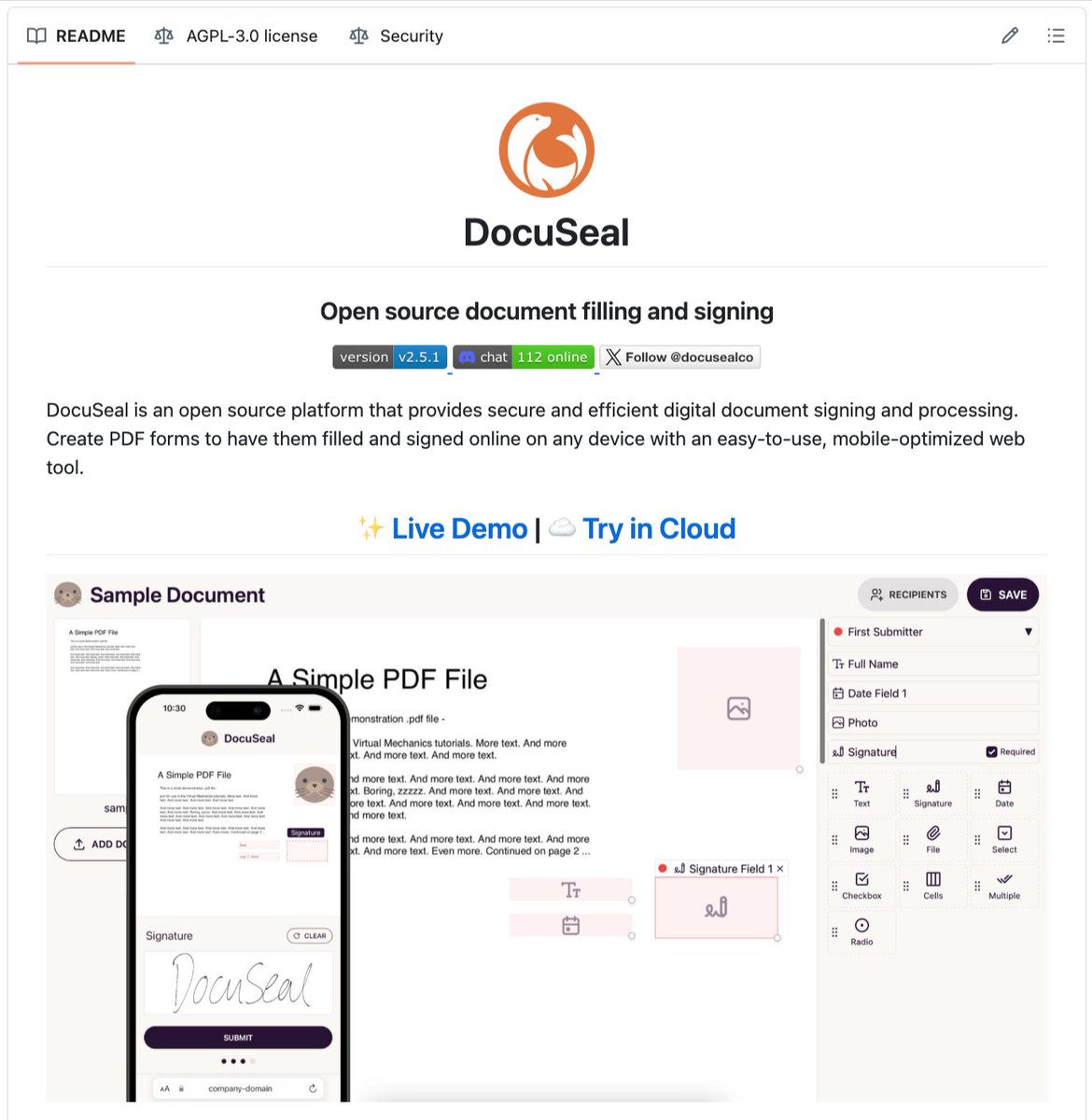
Now meet DocuSeal.
A free and open source alternative to DocuSign.
Created in 2023 by a Ruby developer named Alex who was simply trying to sign one document and realised every solution online was overpriced or required a subscription.
Three weeks later he had a working alternative. He pushed it to GitHub under the AGPL-3.0 license.
Today it has 11,800+ stars and over 1,000 forks. Bootstrapped. No VCs. No paywalls.
Here is what DocuSeal does:
- Upload any PDF and turn it into a fillable, signable form
- Drag and drop signature fields, dates, checkboxes, file uploads, and 13 field types
- Send to multiple signers with custom signing order
- Automated email reminders
- Mobile signing on any device
- PDF signature verification built in
- Audit trail for every document
- Bulk send and templates
- Full API access
- Self-host with one Docker command
Here is what DocuSeal costs:
Zero. Forever. Unlimited documents. Unlimited signers. Unlimited storage.
DocuSign limits envelopes. DocuSeal doesn't.
DocuSign charges per SMS. DocuSeal doesn't.
DocuSign charges for ID checks. DocuSeal doesn't.
DocuSign sees your contracts on their servers. DocuSeal doesn't.
Here is the wildest part:
The median DocuSign contract per Vendr is $17,250 per year. One Reddit thread has people saying "they want me to pay $4.80 per e-signature."
Self-host DocuSeal on a $5 cloud server and a 50-person team can sign as many contracts as they want without paying a single dollar.
Your contracts never leave your server. Your client lists. Your NDAs. Your employment agreements. None of it touches a third-party company.
For individuals who only sign a few contracts a year, you save $180.
For small teams of 10, you save up to $7,800 a year.
For a 50-person company, you save up to $39,000 a year.
Your documents. Your signatures. Your server.
100% Open Source. (Link in the comments)
@douglas_correa@dotta I second emphasizing Resources during onboarding. It was my first step before tasking Paperclip with any meaningful work.
I also agree the inbox creates too much noise (but I've also taken no steps to see if it can be adjusted)
We've signed a letter of understanding to co-found an autonomously run company.
Our partner on this venture will be responsible for the long term operation of the company. We -- Centered -- will provide the resources to get the company to a sustainable, profitable business model.
We will build the agent infrastructure to run the company. The goal will be to have agents run all growth and fulfillment of the company. Humans will be used for compliance and ancillary purposes, but all core operations are to be performed by AI agents.
This is our second autonomous company experiment and our first with an external partner. This should be an engaging challenge.
Centered Backs Blooma in Building a Gardening Platform People Stick With
Centered today announced a formal partnership with Blooma, welcoming the fast-growing gardening platform into its ecosystem as an official “Centered Company.” The partnership marks a shared commitment to building durable, enduring companies that create meaningful, long-term impact.
Blooma is a modern gardening platform designed to help people actually follow through on growing—whether that’s food, flowers, or a small home garden. By combining curated Grow Boxes with a simple digital companion that guides users on what to do and when, Blooma removes the guesswork that often causes people to give up. Built on the belief that most people don’t quit gardening because they don’t care—but because they get stuck—Blooma makes it easier to keep going and turns gardening into something that fits into real, busy lives.
As a Centered Company, Blooma will receive strategic, operational, and growth support from the Centered team, enabling it to scale its reach while maintaining its core mission: making it easy for anyone to grow at home. The partnership also reflects Centered’s broader vision of supporting durable businesses—companies built for sustainability, not just speed.
“This partnership represents what Centered is all about—backing founders and businesses that are grounded in real value and real customers,” said Centered CEO Bryce Kaiser. “Blooma is building something people genuinely want and use, and we’re excited to help accelerate that growth in a way that stays true to the brand.”
Blooma will continue to operate under its own brand, voice, and identity, delivering products and experiences that reflect its friendly, encouraging approach to gardening.
The collaboration is expected to expand Blooma’s product offerings, marketing reach, and customer experience over the coming months, while reinforcing Centered’s growing portfolio of founder-led companies.
---
About Centered
Centered is a venture studio and operator focused on building sustainable, revenue-first companies. By partnering closely with founders, Centered provides the capital, strategy, and execution support needed to grow resilient businesses designed for the long term.
Today, we’re launching the @link wallet for agents. It lets you securely empower agents to spend on your behalf. Your payment credentials are never exposed and you approve every purchase.
https://t.co/TcvEiVNth9
We’re introducing the Cursor SDK so you can build agents with the same runtime, harness, and models that power Cursor.
Run agents from CI/CD pipelines, create automations for end-to-end workflows, or embed agents directly inside your products.
The fastest way to validate your startup idea:
Ask someone to pay for it.
Not "would you use this?"
Not "do you think there's a market?"
"Here's what it costs. Want to be a founding customer?"
Their answer tells you everything.
The VC world made "unicorn" sound like the goal.
But most unicorns are illiquid, diluted, and exhausted long before the exit.
A profitable business that you own and control isn't a consolation prize. It's the whole point.
The "build a unicorn or you failed" mentality is a VC problem masquerading as a founder philosophy.
Most founders don't need a billion-dollar outcome. They need a profitable business.
Those are not the same goal. Stop letting the first one crowd out the second.
Our AI receptionist at HoneyDone is handling inbound text messages from homeowners. It asks clarifying questions, gets contact information, and tees up the request in our system so it can be worked by other AI agents or humans.
Huge timesaver and allows us to scale without the same labor concerns of humans sitting by a phone.
This receptionist is custom built -- I'm sure there's off-the-shelf solutions -- and it's tied in perfectly to the rest of our stack. Really enjoying this.
Who has a decent self hosted LLM setup for agentic flows and has been running that setup for more than a month? I'm curious to hear about your build, if it's been worth it, and what you would do differently.
@albertadevs I’m in a similar boat. I can’t find a use case for having it always on. But it is nice not having to build all of the orchestration and memory management.