I spent months watching people do marketing from a terminal and thinking, “These people are way ahead of me.”
Now I’m launching Growth Mind, a marketing engineering agency.
I was AI pilled in early 2025 and have been nerding out on this stuff ever since. Podcasts, articles, hours of experimenting. I wanted to understand how to work with APIs, build software, and get AI to do real work.
That curiosity led me to building and launching Sous Chef, the tool I built to take the burden of meal planning off your plate. Sous Chef became my testing ground for everything I was learning.
Could I build the app? Make the launch video? Put together a social content workflow? I was rolling up my sleeves constantly.
I started sharing the experiments here through “Are We Cooked or Not?” content series. I wanted to figure out where the real alpha was and where content creators were just gaslighting us.
Little by little, people started reaching out, and I started putting what I’d learned to work for consulting clients.
Small test engagements turned into bigger ones. Early clients even started offering introductions to other businesses without me pushing for them.
I bought the Growth Mind domain years ago, believing I’d eventually launch an agency. That time has come.
At Growth Mind, we help marketing teams figure out what’s worth improving, then build the systems to make it happen. From building data warehouses to make sense of data, to automating workflows that eliminate the monotony, to optimizing outbound at the speed of AI.
I'm currently offering two core types of engagements, a build sprint to develop systems your team runs, and a partnership engagement that uses systems to help execute your marketing and includes a growth mind strategist to help run them (that's just me for now).
In either path, we’re building something your team keeps. Your business knowledge, workflows you own and host, and operating instructions to give you the confidence to run yourself.
If you're interested in working with Growth Mind, my next opening is in the beginning of November.
If you just want to catch up, 'doors always open.
@AdominanceAI Company knowledgebase, hands down.
Getting Tribal knowledge out of long tenured brains and into a shared context layer that everyone's agents can use.
It's not sexy, but it's the foundational starting point all businesses need.
I spent months watching people do marketing from a terminal and thinking, “These people are way ahead of me.”
Now I’m launching Growth Mind, a marketing engineering agency.
I was AI pilled in early 2025 and have been nerding out on this stuff ever since. Podcasts, articles, hours of experimenting. I wanted to understand how to work with APIs, build software, and get AI to do real work.
That curiosity led me to building and launching Sous Chef, the tool I built to take the burden of meal planning off your plate. Sous Chef became my testing ground for everything I was learning.
Could I build the app? Make the launch video? Put together a social content workflow? I was rolling up my sleeves constantly.
I started sharing the experiments here through “Are We Cooked or Not?” content series. I wanted to figure out where the real alpha was and where content creators were just gaslighting us.
Little by little, people started reaching out, and I started putting what I’d learned to work for consulting clients.
Small test engagements turned into bigger ones. Early clients even started offering introductions to other businesses without me pushing for them.
I bought the Growth Mind domain years ago, believing I’d eventually launch an agency. That time has come.
At Growth Mind, we help marketing teams figure out what’s worth improving, then build the systems to make it happen. From building data warehouses to make sense of data, to automating workflows that eliminate the monotony, to optimizing outbound at the speed of AI.
I'm currently offering two core types of engagements, a build sprint to develop systems your team runs, and a partnership engagement that uses systems to help execute your marketing and includes a growth mind strategist to help run them (that's just me for now).
In either path, we’re building something your team keeps. Your business knowledge, workflows you own and host, and operating instructions to give you the confidence to run yourself.
If you're interested in working with Growth Mind, my next opening is in the beginning of November.
If you just want to catch up, 'doors always open.
This used to be a solid chunk of an SEO/PR persons job… I didn’t even tell Muse to try pr based link building. I just connected it to my email and it’s trying to be helpful.
If I gave it access to a brand workbench folder that has point of view, voice, positioning etc and gave it a few more pr subscriptions, I have to imagine this would be powerful.
We are living in the greatest 30 day time period in technology history
In the last month all of these have been released/are expected to be released:
• Opus 5.5: greatest AI model ever
• Meta Muse: The AI agent that will get a billion new people into AI agents
• ChatGPT 6 Astra: First model that could be considered AGI
• Grok 4.7: affordable version of Opus + Elon’s back
• GPT 6.1 sol: Basically free intelligence
• Sonnet 5.5 Dirt cheap intelligence you basically can't tell apart from Opus
• ChatGPT Dot: Incredibly powerful AI agent that's capable of building out large scale applications
The way you work 30 days from now will be dramatically different than the way you work today
You will be significantly more productive with significantly less effort required
Thank your God he/she decided you should be alive right now
@truedrew@mattepstein@shownmedia I gave your post to astra and told it “do all of these things drew did to the site we’re working on”
92% reduction in weight 😲🙌.
Thanks for that!
I asked Codex to handle my app's social content last week.
The first draft was rough. The final version I posted (included below) became my best performing TikTok so far.
Part of why I built Sous Chef was to learn Marketing engineering and figure out the truth.
Content creators are hyperbolic. They use clickbait to chase view counts. They claim we're all "cooked."
With Sous Chef, I have a project to use as a test ground to determine if we're actually cooked or if it's all just hype.
This time, I'm looking at the social media manager.
Sous Chef had the raw material: 7 dinners sitting in a weekly meal plan with plating instructions (the actual meal plan I made for my family last week).
My goal now: turning those recipes into something people might stop scrolling for.
The process:
1. I used Codex to build an API to access the Sous Chef database. I asked it to pull the recipes from my profile last week.
2. I pointed it to a folder of photos from my actual kitchen: blue-rimmed plates, woven placemats, cobalt glasses, silverware, patterned bowls, and a pink tablecloth covered in daisies.
3. It turned the 7 recipes into a shot list, then used the Higgsfield CLI and Nano Banana to generate 1 image for each dinner.
4. The first batch was technically fine but they were uninspiring.
5. I pushed. I wanted overhead place settings, close crops, different linens, visible glassware, messier family-life details.
6. On my direction, Codex regenerated the weak images, compared the results, and ran a QA loop for recipe accuracy, fake-looking utensils, repetitive composition, and whether the scene still looked like it came from my home. I told it to retry a failed image up to 3 times before calling for my help.
7. Then it wrote the Instagram and TikTok captions, rendered the carousels, uploaded the assets, and created drafts in Buffer. I reviewed them there and posted them.
8. Finally, I had Codex package the whole flow into a reusable skill, so next week's post runs on a schedule and will be ready for me to review by the time I sit down at the desk Monday morning.
So are social media managers cooked? ...They at least have reason to be concerned.
The agent read the plan, created the shot list, generated the images, checked its own work, wrote the captions, rendered the files, and handed me finished drafts in Buffer.
The final product performed.
The human in the loop with taste still had work to do. The first batch would have shipped if the goal was simply to fill a content calendar.
Once I explained my taste, the agent could turn it into rules and repeat it.
My current verdict: the social media manager's job is moving upstream. The value sits in finding the idea, defining the taste, spotting when the work is technically correct but forgettable, and deciding what the performance data means next.
Social media managers: what part of your workflow would you turn into a skill tomorrow, and what part would you refuse to hand over?
Managing performance marketing in Codex has made me love "rolling up my sleeves" again.
I've never stopped loving the strategy work, the problem solving, or the creative thinking. But uploading ads into the FB manager... the worst.
I was recently brought in by a travel company to help them promote a special interest trip they were planning to run: NFL in Paris for the first time.
Time to test if performance marketers are cooked by agentic tools.
My process:
1) It all started with a client conversation. Trip details, goals, channel strategy, budget, and the beginning of creative concepting. All of that context was captured by Granola and sent directly into the AI OS I created.
2) Codex now had trip details on top of the client's brand context that was already in place. I recommended the core strategy: showcase creative resembling the game in Paris (shown below), while the content sold the complete trip. Codex helped turn that into market-specific copy for Pittsburgh and New Orleans, visual concepts, and all the ad creative variants meta needed.
3) Codex then created a dedicated Meta app and connected Meta's official Ads MCP through OAuth so it could work directly in ad accounts(one time setup that can be used in the future).
4) Codex created the campaign, ad sets, and ads following the approved configuration and strategy. I didn't have to touch FB Ad Manager
5) The campaign was approved and launched. I estimated a CPL around $20-30. Within a few hours I was actually driving leads with a CPL of $2. It led to 44 leads in the first 3 hours.
6) The client was quickly falling behind on lead follow up. Codex suggested using Make to build an integrated workflow to send the first touch automatically...
By the end of the campaign, I drove 326 leads near an average CPL of $1.75.
So are performance marketers cooked? I'd say entry level is.
Codex moved from source documents (client transcript and my creative direction) to creative concepts, campaign structure, native forms, copy, browser QA, and launch-ready drafts. This was a full time job. Now it's a 30-60min Codex workflow.
I owned the strategy, creative direction, and problem solving, Codex handled all the execution. It seems like there could be a real opportunity to set up what looks like a traditional agency from the outside, but run it like a software business.
Which part of paid acquisition would you hand to an agent today, and which judgment call would you keep?
@GarvSanwariya Directly to Facebook MCP through a Facebook app (which Codex set up for me using browser use)
Zero reason to sign into the Ads Manager anymore!
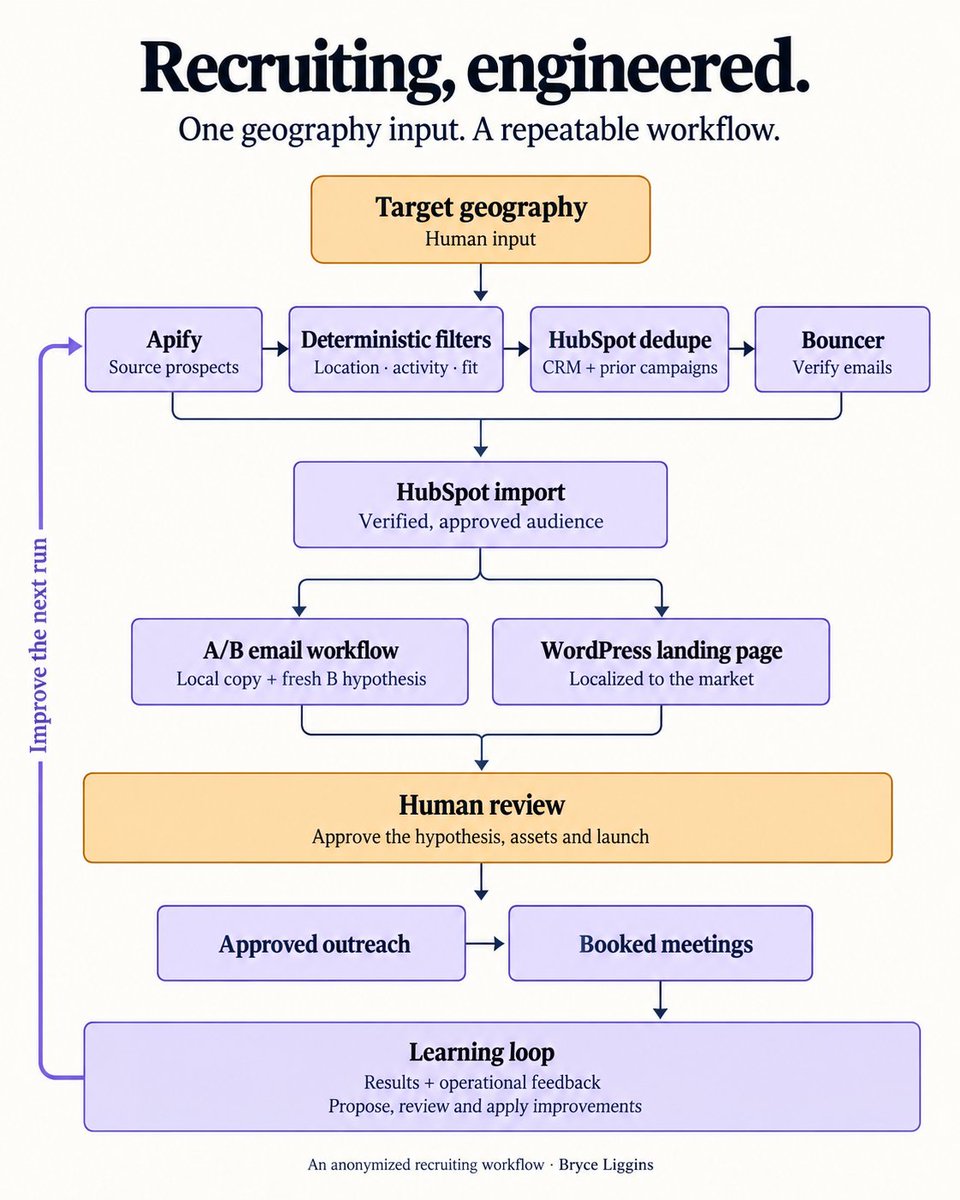
I built a recruiting system for a company I’m consulting with. With a single input of target geography, it finds prospects, verifies their emails, creates personalized outbound emails and landing pages, and launches the approved outreach.
It also self-learns to improve the results over time.
This kind of workflow is what Marketing Engineering is all about: turning a strategy into a repeatable system. Particularly one that would've required a small team to execute before.
In this case, the business needed more region specific sales people to handle its growth. We needed a way to find the right people, reach them, and get interested candidates onto the recruitment manager's calendar.
I initially mapped the existing process. HubSpot was in place for contact management and email comms. There was a WordPress site hosted with WPEngine. There was also a spreadsheet and a somewhat manual contact identification process.
Arguably, the worst part of the process was the contact discovery. I focused on finding a solution for that, knowing the rest could be easily automated. Enter Apify.
The human workflow:
1) Input the target geography.
2) Review and approve the proposed A/B communications test.
3) Quick QA of assets.
4) Run interviews.
The automated Codex workflow:
1) Manage Apify to source a target of 300-500 prospects. Apply deterministic filters for location, recent activity, production range, and usable contact details.
2)Check HubSpot and prior campaigns for duplicates.
3) Verify the cleaned prospect list through Bouncer.
4) Import the verified audience into HubSpot.
5) Update the A/B workflow for the market and propose a fresh B hypothesis. Prepare localized emails and a matching WordPress landing page. Seek approval.
6) Launch.
7) Use booked meetings and operational feedback to propose improvements for the next run. Review changes before applying them.
When the workflow was done, I booked time with the client to review. They were deep on GrokBot, so I packaged the entire process to hand off to their Recruiter bot through a shared GitHub repo.
Now, after a short conversation with their Chief of Staff bot, their recruiter bot is triggered and recruitment begins.
Growth is being rewritten. Repeatable and scalable systems are making teams 10x more efficient.
What process are you still running manually that might benefit from a system like this?
@gregisenberg@gregisenberg what do you use for the shared context layer? A series of .md files synced with GitHub or obsidian Sync? Notion? Something else entirely?
@juliapintar If you want inspiration with eating your Whole Foods, check out the app I made: https://t.co/NVTV0X2ZxW it’s a meal planning tool that learns your household, your preferences and your schedule to build a meal plan for the week, complete with recipe cards a shopping list!