Real estate developer endlessly pursuing *win-win* situations. Wolf Properties. Former Bay West Development, Rockpoint & Praedium Group, @PENNfb IVY Champ
What defined “best schools” for y’all?
Most rigorous academic program
Teaching of emotional skills such as compassion & empathy
Diverse student population so your kids socialized with people of all walks of life
Wealthy student population so they had connections moving forward
Teaching of soft skills such as leadership and group/project work
Been thinking a lot about this and many school are only 1-2 of these. Curious how you thought about it.
Funny I’ve experienced the exact opposite.
Do you think this more relates to the tech/VC world or those already wealthy?
In RE it’s much more zero sum. Naturally land constrained/supply constrained. No information shared for fear of not finding/getting next deal. Limited deals with unlimited competition.
Actually one of my biggest takeaways since moving to Texas a few years ago. Competitors share information constantly. Everyone wants the market to grow/thrive. Not the case in the Bay Area.
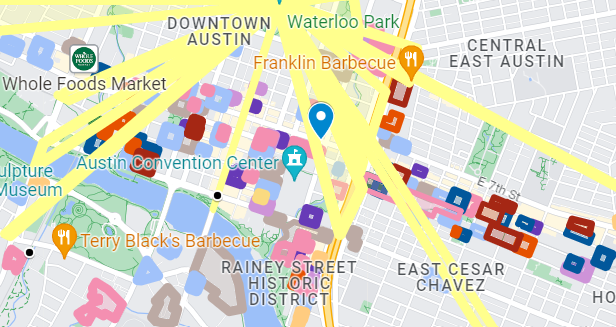
@BobKnakal has his legendary map room. About 10 years ago I started putting together a Development Pipeline Map in Google Maps for a project I was working on in Oakland, CA. I now have maps for every market we operate in.
Here's how you can use this tool too:
Google Maps has a My Maps feature under Saved in the top left corner. Open My Maps and start creating a new map!
Use the "Add line or shape" feature under the search bar to outline a property.
I used a color coded system in mine to more visually see where certain development is taking place:
Red: Completed multi
Pink: Multi planned/under construction
Blue: Completed office
Light Blue: Office planned/under construction
Purple: Hotel
Green: Retail
Orange: For-sale resi, etc.
Once you've outlined a property you can edit the name as well as include a description.
Any time I learn about a property, I add it to the map. It can be from an OM, a news source (Biz Journal, local newspaper, Bisnow, GlobeSt, etc.), or just talking to folks in the market.
The great thing is you can link to the source of information and keep a record!
You can include completion dates, sales data, lease rates, ownership information, etc. Maps such as these can be useful for many positions in the real estate industry (developers, brokers, investors, tenants, operators, mgmt companies, etc.).
How it has helped me:
- The primary benefit has been it has helped me to know our markets like the back of my hand. The act of inputting the information into the map is sort of like studying flash cards for me. There is something about inputting that helps me remember projects that I read or learn about and be able to speak intelligently about what is happening in any given market. I can recognize certain trends and see quickly when an opportunity arises.
- I have used the maps in discussions with investors/lenders looking to finance our projects. You can set who is allowed to view the map and send a link to anyone you wish. This can help tell the story of supply/demand in any given area with data to support it.
- I have used the maps in discussions with prospective tenants we have looked to do build-to-suits with. Give them an iPad with the map opened as you drive the market/site. This allows the tenant to see everything going on in the area and all the desirable amenities (existing or coming!).
I cannot emphasize enough the act of actually building the map yourself. Real estate is about knowing your market and building the map yourself will help you to see trends quickly and be able to recognize opportunities when they come.
Updating the maps is one of my favorite weekly activities to stay on top of any given market.
I hope this tool helps others in their real estate journey!
@moseskagan Hopefully the young developers/GPs at @REconveneLA heard Bruce Fairty talk about funding and utilizing a “guarantor entity” in lieu of signing personally to protect himself and his family and still be able to build 35k units over his career
Randomly listening to @moseskagan interview @sweatystartup at @REconveneLA 2021 and Nick talks about storage REITs having on-site manager vs him entirely remote.
With today’s technology, can a large MF property be remotely managed and increase NOI, even if you get lower rents?
Was recently looking at the payroll line of a P&L of one of our properties in the Bay Area. Many properties in the Bay Area have payroll of over $2k/unit. Sometimes offering employee unit lease discounts to live within the community on top of that.
You’re not doing maintenance remote so can’t save the entire line item. Can you save $1,200/unit?
On a 300 unit property that’s $360k. Breakeven would be $100 per month per unit less revenue.
You’d have to commit to full virtual/remote leasing. That technology was introduced/implemented during COVID so not totally foreign to the renter. And becoming more common with the younger generation, especially in certain markets.
I guess the question becomes do I generate more revenue/retention by having someone on-site to do tours/respond to tenants needs with high payroll expense OR do I save more money eliminating on-site leasing/management even if I don’t quite maximize rents?
$100 per month lower rents to breakeven feels like it could be a meaningful spread.
Maybe works better in smaller projects where on-site management isn’t spread across as many units? Maybe works better in lower rent (class B) but high payroll markets where small rent discounts are more meaningful for renters so they are willing to forgo having the luxury of an on-site manager?
Is on-site management simply *how it’s always been done*?
Other MF operators, what else am I not thinking about?
Has anyone tried it at scale?