Today the McDonald’s CEO said he thinks “inflation’s going to be with us for, unfortunately, many more years at an elevated level.” In contrast, Warsh claims that inflation expectations remain well anchored at 2% and that the Fed will deliver 2% inflation. Who do you believe?
20 of the best market technicians in the world are handing you 60 ideas over 2 days.
Rick Bensignor is one of them.
He has the 10-year going to 6.07%, with 5.6% as his minimum target, and he made that call when the 10-year was sitting right on 4%.
We're just under 5% today. A 6% 10-year reprices every stock and every mortgage in the country, and he'll walk you through the levels he's watching on the way there.
October 27 and 28, 10 AM to 4 PM ET, with replays if you can't make it live.
Early bird is $99 until October 9, then it goes to $199.
WE'RE ASSEMBLING THE BEST OF THE BEST FOR THIS ONE:
https://t.co/Ah4ySJGvg3
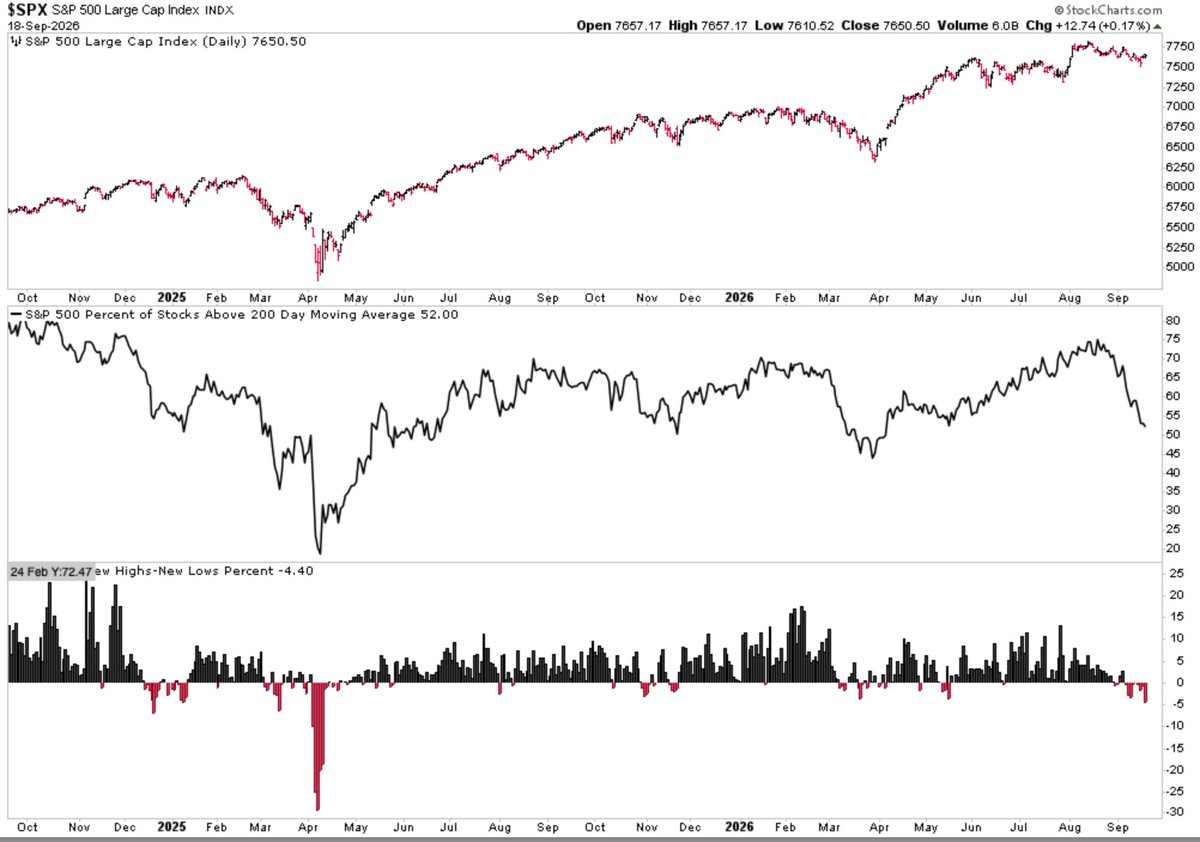
We've never in almost 100 years seen breadth this bad.
The S&P $SPY is knocking on new highs but there are (many) more stocks at lows than highs.
The percentage of stocks in long-term uptrends is plunging.
The only remotely similar setups were January 1973 and November 1999.
I coined a new term on Steve Eisman's show this week: Narrative dominance.
We all know about fiscal dominance driving policy. Narrative dominance is what's driving the stock market.
People don't want fundamentals anymore. They want a story that makes them feel good.
That's SpaceX at $1.7 trillion. That's the entire AI trade, which is dot-com and 2008 merged into one.
Show me the ROI and you get ignored. Tell me a story and you get a trillion dollar valuation.
But narrative dominance only works when the cost of capital is zero.
And that game is ENDING.
Steve and I talked about Bessent's water gun, why Japan is borrowing money from the US to avoid selling US bonds back to us, and why SpaceX's float going from 5% to 25% is the one thing you have to watch right now.
Check out the full episode on The Real Eisman Playbook:
https://t.co/PjUzemx6jg
Look, I know...perma-bear blah blah blah.
But this is crazy stuff.
There are 2 days in history like today, when the S&P 500 $SPY rallied at least 1% to within 1% of a new high, and more of its stocks fell to new lows than highs.
• Jul 23, 1929
• Dec 21, 1999
I am done with this shit. It is over. The state of engineering right now is horrible. It has been half a month since I started a new role at a big company. Nobody knows anything here. The specs, code, tests, PRDs, tickets, resolution of those tickets, reports, etc., everything is made by Claude Code. Nobody on my team likes this. They are being forced to ship as much as they can. I have heard multiple times from higher management that pushing code is not a bottleneck, so why are we slow? People are working 12 to 13 hours a day just to press enter. Nobody is reading anything. Humans in corporate are doing nothing on their own. Everyone, literally everyone, from an L1 to an L7 engineer here is doing the same thing. Talk to Claude. There is no sense of victory. Nobody is resolving bugs. In reality, nobody is thinking anymore. Everything is done by LLMs. It is so soul-sucking. I would not mind it, to be honest, if we were at least given the time to check out the code and see what is going where. But no, the goal is to just ship. No matter what happens.
@profplum99@gnoble79@SecScottBessent Anchoring effects. 40 year bond bull market. Market expectations are mostly backwards looking today. They are going to violently reprice.
@profplum99@gnoble79@SecScottBessent Word "inflation" only occurs once in your article and only in passing. You keep looking for inflation in the wrong places (5 year breakevens) and not in the correct places (import & export prices). That's where you're wrong I believe.
🇺🇸 The U.S is destroying the dollar, but the terrifying part is the world may have to keep using it anyway.
That was the most important insight from my debate with Peter Schiff and George Gammon.
Peter's argument is familiar, but powerful: America is running massive deficits.
Interest costs are exploding, central banks are buying more gold, and the more Washington weaponizes the dollar through sanctions, the more incentive the rest of the world has to find an alternative.
Eventually, Peter believes the dollar's loss of purchasing power accelerates so violently that confidence breaks, and its reserve status goes with it.
George's response is much more counterintuitive.
The dollar isn't just a currency; it's a global network of debt.
Trillions upon trillions of dollars are lent into existence around the world, and every dollar-denominated loan creates something extremely important:
Future demand for dollars, because eventually that debt has to be serviced or repaid.
So here's the paradox.
The dollar can fall against gold, it can lose purchasing power, it can even become a terrible long-term store of value.
And yet global corporations, banks and financial institutions will still keep using it because the network around it remains deeper, more liquid and more useful than anything else available.
@GeorgeGammon, @PeterSchiff
Traders now believe if the Fed hikes rates next week, long-term bond yields will fall, as the hike will improve the Fed's inflation-fighting credibility. But the expected hike will be far too little to win the inflation fight, so long-term yields will rise regardless of a hike.