Dark spots break speed-of-light limit. Kind of.
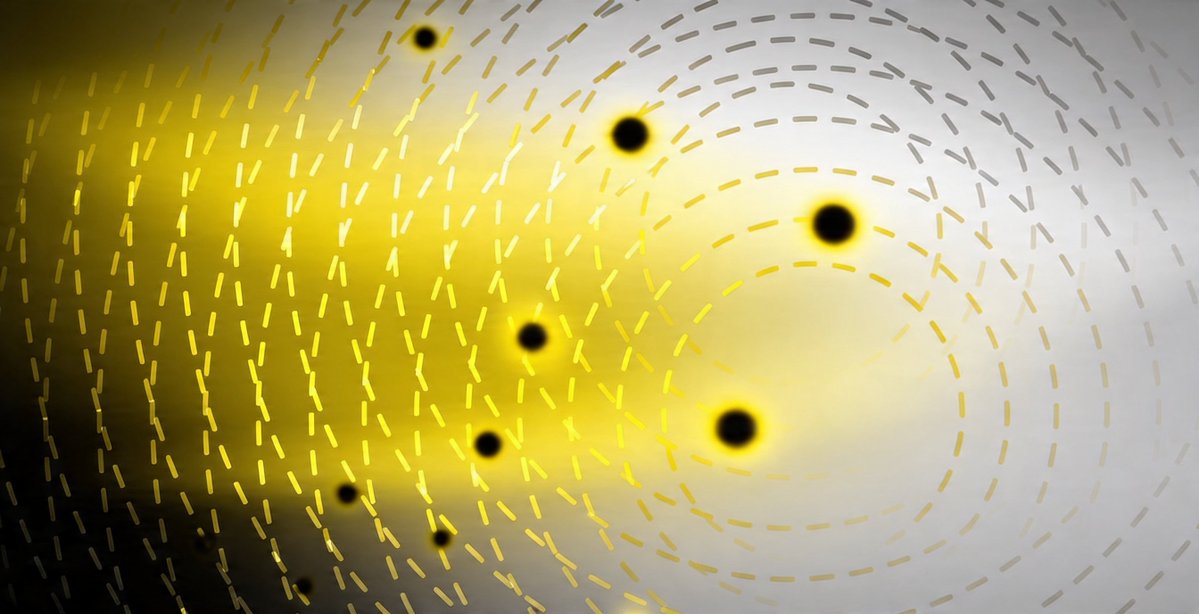
Researchers from Technion in Israel have filmed the motion of tiny dark spots that move faster than light. These dark spots are places where the light wave’s intensity drops to zero due to interference. They had the light propagate on a material (boron nitride) where it couples to the vibrations of the material. Then they measured the speed with ultrafast electron microscopy to confirm that it broke the speed of light limit. Concretely, they measured that the dark spots moved at 1.04 times the speed of light in vacuum.
This is possible because the dark spots themselves are patterns, and not physical objects. They can move faster than light just like the image of a laser pointer, swept across a distant surface, can move faster than light: Because the image is not a physical object, it is just a pattern formed from physical objects which themselves obey the speed of light limit. So this is a very neat demonstration, but it does not violate any known physical principle and no, it does not allow us to send information faster than light.
@skdh Finally, why use hyperbolic phonon polaritons in a 2D material rather than free-space light? Statistics. In free-space interference, only ~0.4% of these events are superluminal. Our polaritonic platform amplified this to 29%, allowing precise phase-space mapping.
@skdh This highlights a key distinction from the laser pointer analogy. While they are patterns, these singularities behave as highly stable topological pseudo-particles. They exhibit liquid-like spatial correlations and strictly annihilate only with opposite charges.
Congrats to @IdoKaminer for winning the Lem Prize- annually awarded to a young researcher whose creative work in science or engineering has the potential to make a positive impact on the future of civilization increasingly driven by technology🏆! https://t.co/mU3yAuzDKV
PAPER
In this week's paper the authors used a distributed algorithm running on hundreds of computers to find a mathematical structure that links
π, e, the golden Ratio Φ, the Riemann Zeta function values, and many other famous constants.
A great read: https://t.co/V0IT0Oldgl
A major advance in the #RamanujanMachine project: New distributed algorithm discovers formulas for math constants. More than 1,000 volunteers in BOINC discovered formulas on an unprecedented scale, leading to a new mathematical concept: https://t.co/IxnXS5ra8R
Just in! Our latest paper on tunable photon-induced spatial modulation of free-electrons has made it to the cover page of Nature Materials! An exciting breakthrough in the world of photonics and electron imaging
https://t.co/gaDFKlHT8b
#photonics#electronimaging#NatureMaterials
Most ways to spatially shape electron beams are passive, but our new method actively controls their shape via interaction with trapped light, en route to on-demand electron wavefront shaping.
https://t.co/gaDFKlIqXJ
#Spatiallyshapingelectrons#NatureMaterials @ShaiTsesses
What an amazing picture! We used #DALL·E2 to describe one of the novelty papers we presented in CLEO this year- Quantum light interacts with matter.
In this paper, we showed new degrees of freedom in the creation and control of nonlinear processes.
https://t.co/BX9AV6TeYx
Welcome to our new postdoc, Arthur Niedermayr!
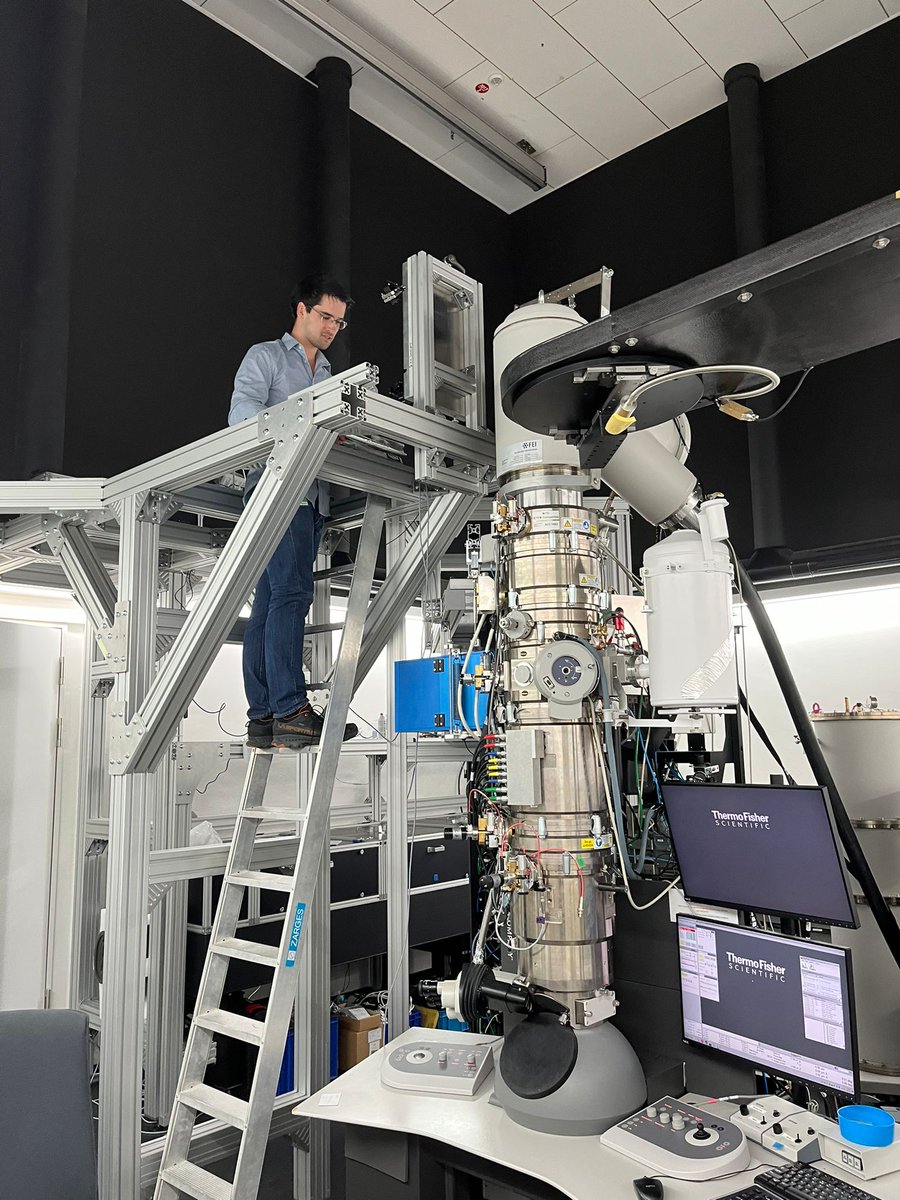
Caught on camera at the Ernst Ruska-Centre, Jülich: Arthur checking the beam path for light injection into the electron microscope and discussing it with Prof. Rafal E. Dunin-Borkowski.
@fz_juelich#ErnstRuskaCentre#Jülich
A novel way to improve UV lamps using nanophotonics!
Disinfection of sugary rooms can become more efficient and powerful when controlling the process of UV creation in a nanostructure.
Check out our recent discovery in a new paper published in #APL
https://t.co/JXBvcYRNXO
Look who came to visit and brought us new nanolaser samples - Prof. Katayama from #TISI!
The samples have been measured in our UTEM for the first time. We aim to show the different statistics of light when transitioning from a spontaneous emission regime to lasing.
A new formula found by the #RamanujanMachine project!
The discovery was made by a network of volunteers running our second generation algorithm through #BOINC.
This formula connects multiple values of the Riemann zeta function to a single continued fraction.
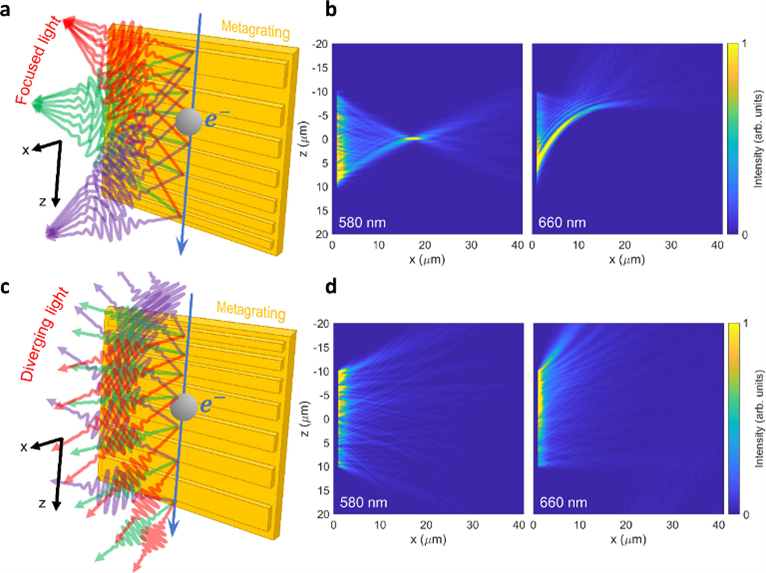
"Cylindrical Metalens for Generation and Focusing of Free-Electron Radiation" - An exciting joint venture by the AdQuanta group, the group of Albert Polman from the AMOLF institute in the Netherlands, and the group of Ady Arie at Tel Aviv University.
https://t.co/3PSVVisplz
Check Out @gefenbaranes123 and Raphael Dahan's latest work- they offer a new “creator”, free electrons, to solve the formidable task of creating GKP states in the optical range for quantum computing! https://t.co/VhZbZpD4Zw
#QuantumComputing#GKP#Research