Some useful thoughts from Winston Churchill:
"A pessimist sees the difficulty in every opportunity; an optimist sees the opportunity in every difficulty.”
In the 1990s I worked with Ken Alibek, the former No. 2 in the Soviet biological weapons program, after he defected to the US.
He claimed that they had engineered a strain of plague that was antibiotic-resistant & that they had worked on plague chimeras (fusing 2 or more pathogens).
He specifically called out Irkutsk for being involved in the BW program.
This outbreak is deeply worrisome. This may not be just “the plague.” It may be far worse.
The numbers tell the story:
✅ 251 vessel movements under the Jones Act waiver
✅ 69 tied to China
✅ 27.5% of waiver movements connected to Chinese interests
❌ No measurable relief at the pump
Waiving the Jones Act has shifted American commerce to foreign vessels, including many with Chinese ties, while failing to deliver the promised consumer benefits. @realDonaldTrump@JDVance@SpeakerJohnson@seanduffy
#JonesAct #NationalSecurity #Maritime
SUNDAY LONG THREAD
For more than 50 years, a working telephone stood alone in the Mojave Desert.
It was miles from the nearest building and 12 miles from the nearest paved road.
Then the internet discovered its number.
And the phone began ringing from all over the world.
1/n
Nike pays Erling Haaland roughly $20 million a year to be photographed with their products. A family-run western store in Dallas just got the same treatment for free. Better than free: Haaland paid them $750 for a taxidermy raccoon hugging a whiskey bottle.
The backstory makes it better. Haaland walked into Wild Bill's Western Store during Norway's World Cup run and bought cowboy hats, exotic boots, a longhorn belt buckle, and a shirt reading "Y'all can kiss my Dallas." The owner says Haaland knew nothing about cowboy hats and had to be fitted for his first one.
Then Norway's Cinderella run ended in the quarterfinals, and the tournament's breakout star, seven goals, carried the raccoon off the plane in Oslo himself. Caption: "It followed me home." Then he ran an Instagram poll asking fans to name it.
The results for a boot shop that's been family-owned since the 1970s: the Whiskey Raccoon is sold out. The Dallas shirt is nearly gone. Their $500 Belligerent Squirrel, a taxidermy squirrel smoking a cigarette and holding Jack Daniel's, is down to low stock. Local shoppers are lining up at a store most of them had walked past for years.
Sports brands run entire celebrity seeding departments trying to manufacture exactly this: a global superstar genuinely delighted by a product, on camera, unprompted. Every one of those campaigns reads as an ad, because it is one.
Brands spend $20 million a year renting Haaland's image. Wild Bill's sold it to him for $750.
During WWII, USA built 47 million tonnes of ships
For context the entire US Navy today has a gross tonnage of 4.5 million tons.
The US population during WWII was 134m, so in the space of 3.5 years, America built and launched 1 ton of ships for every 3 man, woman and child.
By the end of the war, the US Navy possessed 75% of all Naval tonnage in the world (a world that was awash in warships).
In 1942, the British contracted American shipbuilders to build vessels for the Royal Navy, as Britain was losing 20 ships a month to German U-boats (for context the entire Royal Navy today has just 15 major surface ships, 2 carriers, 6 destroyers, 7 frigates (3 weeks of WWII losses)).
People today have a very poor understanding of what is possible.
People have Sci-Fi visions, but then play them out on a video screens. It’s a bit pathetic.
Your Great Grandparents achieved a level of productive output that organisations today simply do not comprehend.
Imagine if between now and 2030 America built 1 ton of ships for every 3 American citizens, 110 million tonnes of ships, that’s 25x US Navies.
Even more baffling is the complete lack of curiosity about how this was achieved 80 years ago, or why we accept such low industrial production today? What did you get done this week?
“Ah but things today are more valuable.”
If that’s true, that just a reason to build more, not less. If today we can build more valuable things, then we should build more more valuable things.
Capitalism will serve what society demands, but you have to demand it.
If there is demand to build a navy per month, then it is possible to build a navy per month, and history proves this.
We have lived through an era of lethargy, but it is ending.
In 2026 a lot of people work on recursive self improvement, but we should remember Adam Smith pretty much already invented it, and the real catalyst of the AI revolution will actually be recursive economic demand.
Loops are starting to parrot artificial agency, but it still seems embryonic. Recursive demand is the paperclip paradox, and there are elements of deterministic chaos and unintended consequences once you set that off.
But it’s worth remembering some historical examples of prolific production explosions, even in heavy industry, as solid guidance as to how the next 10-15 years will shape up.
Godspeed.
1/ Iran has reportedly assessed that Donald Trump is "mentally incompetent" and has incorporated psychologists into its negotiating team to adapt the wording of the proposed agreement "as if the recipient were a [mental] patient ... whose capacity is limited." ⬇️
Scientists have created one of the most detailed 3D reconstructions of a human cell (eukaryotic cell) ever produced.
This groundbreaking model, often termed a "Cellular Landscape Cross-Section Through a Eukaryotic Cell," combines data from X-ray tomography, nuclear magnetic resonance (NMR), and cryo-electron microscopy to map molecular structures in extreme detail.
A computer science professor spent most of his thirties writing about a working habit so unfashionable that even the people who practiced it rarely admitted to it out loud.
His name is Cal Newport, and the book he published in 2016 turned a quiet personal discipline into one of the most influential ideas in knowledge work this century.
Here is what he actually said that most people skipped past, and why the full version matters more than the slogan 👇
🌊 RÉCORD HISTÓRICO EN NAZARÉ: OLA DE 26.2 METROS
En Nazaré, Portugal, el surfista Sebastian Steudtner surfeó una ola de 26.2 metros, estableciendo un nuevo récord mundial en olas gigantes. Una hazaña impresionante.
A community college professor taught the same study skills lecture for 30 years, and the video quietly became one of the most watched educational recordings on the internet.
His name is Marty Lobdell. He spent his career as a psychology professor watching students fail not because they were lazy, but because nobody had ever taught them how their brain actually works under the pressure of learning something hard.
The lecture is called "Study Less Study Smart." Over 10 million views. Passed around in Reddit threads, Discord servers, and university study groups for over a decade. And the core insight buried inside it has been sitting in cognitive psychology research for years, waiting for someone to explain it in plain language.
Here is the framework that completely changed how I think about effort.
Your brain does not sustain focus the way you think it does. Studies tracking real students found that the average learner hits a wall somewhere between 25 and 30 minutes.
After that, efficiency doesn't just decline. It collapses. You're still sitting at your desk, still looking at the page, but almost nothing is going in.
Lobdell illustrated this with a student he knew personally. She set a goal of studying 6 hours a night, 5 nights a week, to pull herself out of academic probation. Thirty hours of studying per week. She failed every single class that quarter.
She wasn't failing because she lacked effort. She was failing because she had confused time spent near books with time spent actually learning. The 25-minute crash hit her at 6:30pm every night. She spent the next five and a half hours sitting in the wreckage of her own focus and calling it studying.
The fix sounds almost too simple. The moment you feel the slide, stop. Take five minutes. Do something that actually gives you a small reward. Then go back. That five-minute reset returns you to near full efficiency. Across a six-hour window, the difference is not marginal. It is the difference between thirty minutes of real learning and five and a half hours of it.
The second thing he taught destroyed something I had believed about how memory actually works.
Highlighting feels productive. Going back over your notes and recognizing everything feels like knowing. But recognition and recollection are two completely different cognitive processes, and your brain is very good at making you confuse them.
You can see something you've read before and feel completely certain you understand it, even when you couldn't reconstruct a single sentence from memory if the page were blank.
He proved this live in the room. He read 13 random letters to his audience. Almost nobody could recall them. Then he rearranged the same 13 letters into two words: Happy Thursday. The whole room got all 13 without effort.
Same letters. Same count. The only thing that changed was meaning.
The brain stores meaning. Not repetition. The moment new information connects to something you already understand, the retention changes entirely.
This is what the cognitive psychology literature calls elaborative encoding, and it is the mechanism underneath every effective study technique.
The third principle was the one that hit me hardest, and the one almost nobody applies.
Lobdell cited research showing that 80 percent of your study time should be spent in active recitation, not passive reading. Close the material. Say it back in your own words.
Teach it to someone else, or to an empty chair if no one is around. The struggle of retrieval is where the actual learning happens. Reading your notes again is watching someone else do the work.
His parting line has stayed with me longer than almost anything else I have read about learning.
He told the room that if what he shared didn't change their behavior, they hadn't actually learned it. It would just live in their heads as something they had heard once and felt good about.
He was right. And most people leave every lecture exactly like that.
The students who remember everything aren't putting in more hours.
They stopped confusing the feeling of studying with the fact of it.
On April 3, 1965, Ennio Morricone recorded this masterpiece in Rome.
Sixty years ago.
The soundtrack of a lifetime.
For A Few Dollars More | Ennio Morricone | 1965.
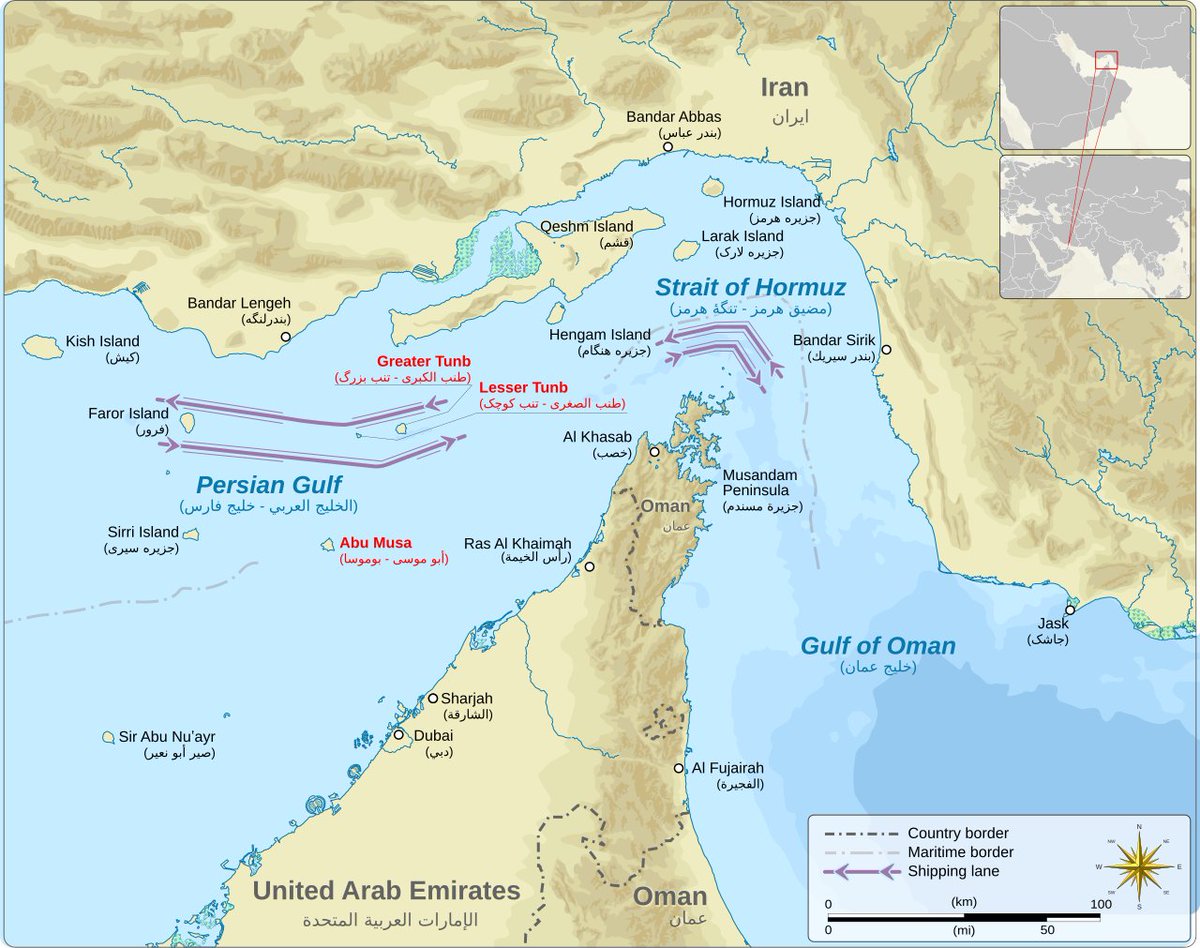
1/ With American ground forces building up in the Gulf region, much attention has been paid to Kharg Island in the northern Persian Gulf. But what about the Iranian-held islands in the Strait of Hormuz? Here's why they might be a higher priority for possible landings. ⬇️