☑️Objective. ☑️Nonpartisan. ☑️Committed to Fiscal Responsibility.
Follow the Committee for a Responsible Federal Budget for our latest analysis of what's shaping the fiscal conversation in Washington.
🔗https://t.co/D9WlSD67hr | 📲@BudgetHawks
🚨BREAKING: CBO Estimates $2.0 Trillion Deficit for Fiscal Year 2026
The United States borrowed $2.0 trillion in FY 2026, including $28 billion in the month of September, according to the latest Monthly Budget Review from the @USCBO. We expect to hear more details on FY 2026 from CBO next month.
The following is a statement from CRFB President @MayaMacGuineas⤵️
🚨CBO Estimates Golden Dome Could Cost More than $1 Trillion
Earlier this year, the @USCBO released an analysis estimating the 20-year cost of a National Missile Defense (NMD) system based on President Trump’s 2025 executive order, titled “The Iron Dome for America,” which outlines the basic capabilities and requirements of such a system.
While the Administration has not released further details regarding the architecture or components of the NMD system they’re now calling Golden Dome for America, CBO estimated that an illustrative system designed to meet all of the objectives and requirements laid out in the President’s executive order would cost roughly $1.2 trillion to build, operate, and maintain over a 20-year period.
🚨 NEW: PWBM Shows Social Security Solvency Would Improve Fiscal Outlook, Boost Growth
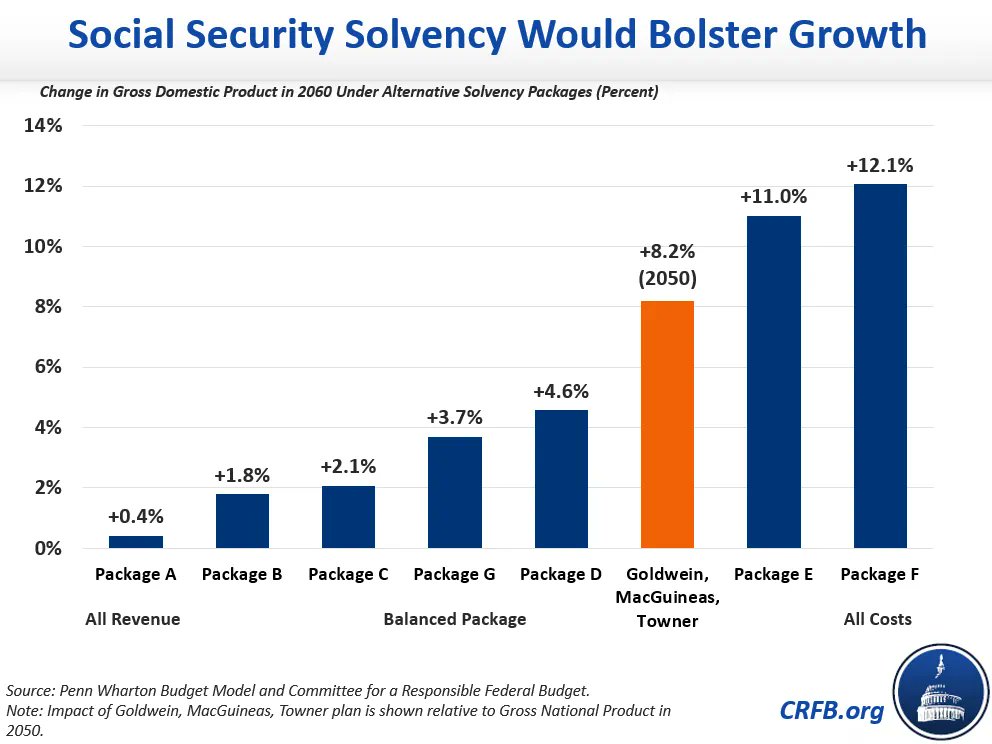
Restoring solvency to the Social Security trust funds could grow the economy and help fix the debt, according to recent estimates of different Social Security solvency packages from Penn Wharton @BudgetModel (PWBM).
PWBM estimates the seven Social Security solvency packages they analyzed would increase 2060 GDP by anywhere from 0.4% to 12.1% and reduce the debt-to-GDP ratio by 14% to 27% in that year.
Click here to learn more about the analyzed solvency packages and estimates ➡️ https://t.co/ut0WaQSnZB.
📝 ICYMI: Yesterday, former Representative and Governor of Ohio, and current CRFB Board Member, @JohnKasich published an opinion piece for his Substack “Keep Faith America” breaking down his long experience working on fiscal policy, where his mission to balance the budget began, and what made past efforts successful. Importantly, he also writes on how to answer the most important question: how could Washington do it again?
Click here to read the full piece 👉 https://t.co/x4p5jykJfi.
🚨 NEW: U.S. Ran a $2 Trillion Deficit Last Year
Fiscal Year (FY) 2026 ended yesterday. Although official figures have not yet been released, our preliminary estimates show high and rising deficits and debt. For FY 2026, we estimate:
➡️ A budget deficit of $2.0 trillion, or 6.2% of GDP.
➡️ Debt held by the public of $32.3 trillion, or 100% of GDP.
➡️ Spending of $7.4 trillion, or 22.9% of GDP.
➡️ Revenue of $5.4 trillion, or 16.7% of GDP.
➡️ Interest costs of $1.1 trillion, a record 3.4% of GDP.
➡️ Interest was the second largest line item in the budget, costing more than defense or Medicare.
At $2.0 trillion, we estimate budget deficits were about $210 billion above FY 2025 levels, $135 billion above the @USCBO February projections, and about $305 billion higher than what the Council of Economic Advisers had projected.
🚨A new fiscal year begins with our national debt exceeding $40 trillion. Congress must act now.
The Problem Solvers Caucus has endorsed bipartisan solutions to stabilize the debt, balance the federal budget, and better prepare for future emergencies.
Republicans and Democrats must advance these proposals and put our country on stronger financial footing. Further delay will only leave future generations with a larger bill.
https://t.co/Xv2RsoXoF0
🎆 Happy Fiscal New Year!
It's October 1, which means a new fiscal year has just begun – and plenty of opportunities to set some resolutions for the year to come.
What Fiscal New Year's Resolution should lawmakers commit to for FY 2026? We have some ideas below⤵️
With a growing list of politically thorny fiscal decisions to make and time running out to make decisions, lawmakers should turn to establishing a bipartisan fiscal commission in FY 2027 tasked with putting all areas of the budget on the table and finding compromise across the aisle. Commissions have helped achieve fiscal reforms, save Social Security, and allow for tough political choices outside the noise of political obstruction and special interests.
Learn more ➡️ https://t.co/vkeSzVmvk5.
🚨NEW: Congress Clarifies Social Security's Retirement Ages
The Senate passed the Claiming Age Clarity Act by unanimous consent this week. Having passed the House last December, the bill will now go to the President for his signature. The legislation will change the official names of Social Security’s three significant retirement ages to the Minimum Monthly Benefit Age (62), the Standard Monthly Benefit Age (67), and the Maximum Monthly Benefit Age (70).
Changing the way the Social Security ages are described is a good first step in improving retirement signals so that workers can make better informed retirement decisions.
Learn more here🔗https://t.co/viXsXUN9r3.