SATURDAY MORNING CARTOONS
MIGHTY MAX (1993–1994)
There was a time when Saturday morning cartoons weren’t afraid to get dark.
Based on the popular Mighty Max toy line, this underrated animated series followed Max, a kid with a magical baseball cap that allowed him to travel through portals across time and space.
Alongside Virgil, a wise old fowl voiced by Tony Jay, and Norman, a hulking Viking warrior, Max battled ancient monsters, demons, and the sinister Skullmaster, voiced by the legendary Tim Curry.
This wasn’t your average Saturday morning cartoon.
Lovecraftian horrors, gruesome creatures, ancient mythology, genuinely creepy villains, and some surprisingly mature storytelling made Mighty Max stand out from the crowd.
With only 40 episodes across two seasons, the series burned bright and disappeared, leaving behind one of the most overlooked gems of ’90s animation.
Card 11 from the 1992 AD&D trading card set features the Titanothere, also known as the Brontotherium, a massive prehistoric herbivore resembling a rhinoceros. Despite its plant-based diet, this 12 Hit Dice beast is no pushover.
Armed with a distinctive Y-shaped horn, the Titanothere can charge opponents and deliver a devastating ram, while its enormous bulk allows it to trample smaller creatures.
SATURDAY MORNING CARTOONS: THUNDARR THE BARBARIAN
A shattered moon. The ruins of our world. Evil wizards with machines nobody should have let them find, and three adventurers riding straight into trouble.
First airing in 1980, Thundarr the Barbarian threw sword and sorcery into a Vancian post-apocalyptic Earth, where ancient technology and powerful magic existed side by side. Thundarr wielded his fabulous Sunsword, Princess Ariel supplied the sorcery and knowledge of the old world, and Ookla the Mok supplied the muscle.
Created by Steve Gerber, with main character designs by Alex Toth and production design from the legendary Jack Kirby, the series packed a ridiculous amount of imagination into just 21 episodes. Ruined cities, strange creatures, tyrannical wizards and forgotten machinery gave it a world that felt dangerous, bizarre and full of possibilities.
Light on Quests Mountain (1983)
by TSR in 1983.
Light on Quests Mountain is the twelfth book in the Endless Quest series, written by Mary L. Kirchoff and James M. Ward, with kick ass cover art by Jeff Easley.
Unlike most of the early Endless Quest books, which were rooted in Dungeons & Dragons, this adventure takes place in the post-apocalyptic world of Gamma World,
You play Ren, a young adventurer who sets out with two friends on a coming-of-age quest to investigate mysterious lights appearing atop a mountain near their village. Along the way, you’ll encounter the strange inhabitants and dangers of a world transformed by nuclear catastrophe.
With 14 possible endings, there’s plenty of opportunity for exploration, unexpected discoveries, and disastrous choices.
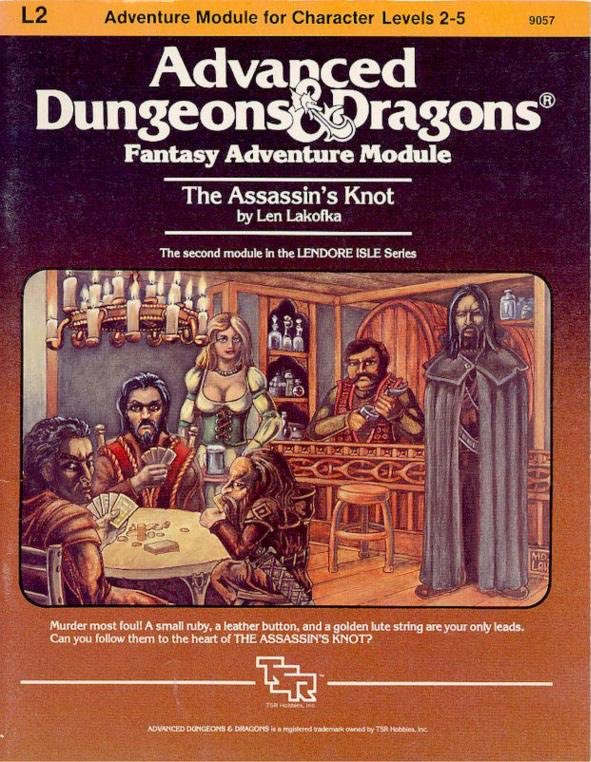
AD&D Module L2: The Assassin’s Knot (1983)
Written by Len Lakofka and published by TSR in 1983, The Assassin’s Knot is the second adventure in the Lendore Isle series for Advanced Dungeons & Dragons, designed for characters of levels 2–5.
Unlike the traditional dungeon crawls of its era, The Assassin’s Knot places investigation, intrigue, and role-playing at the centre of the adventure.
Following the murder of a wealthy merchant, the player characters are drawn into a tangled mystery involving suspicious townsfolk, hidden motives, and a secretive network of assassins. Armed with only a handful of clues, including a small ruby, a leather button, and a golden lute string, the adventurers must uncover the truth before the trail goes cold.
Set in the town of Garrotten on Lendore Isle, the module presents a detailed settlement populated by characters with their own relationships, secrets, and agendas. Rather than simply clearing rooms and collecting treasure, players must question suspects, follow leads, and piece together the conspiracy.
The adventure follows L1: The Secret of Bone Hill and continues Lakofka’s distinctive approach to campaign design, emphasizing believable locations, interconnected NPCs, and a living world beyond the dungeon.
SATURDAY MORNING CARTOONS!
Conan the Adventurer (1992–1993)
By Crom! In 1992, everyone’s favourite Cimmerian barbarian made the leap to Saturday morning television with Conan the Adventurer, an animated series loosely based on the legendary sword-and-sorcery hero created by Robert E. Howard.
Naturally, Conan’s brutal world of bloodshed, sorcery, and savage combat needed a few adjustments for younger audiences. Out went the decapitations and bloodletting, replaced by enchanted star-metal weapons that banished the serpent-men of the evil wizard Wrath-Amon to another dimension.
The series followed Conan and his companions, including Zula, Jezmine, Greywolf, and the young barbarian Snagg, as they battled the forces of Set and searched for a way to free Conan’s family from a petrifying curse.
Despite its Saturday morning restrictions, the show delivered plenty of sword-and-sorcery atmosphere, with ancient ruins, monstrous creatures, sinister wizards, and an assortment of fantastical kingdoms. Its ambitious world-building and ongoing storylines helped distinguish it from many of its contemporaries.
Running for 65 episodes across two seasons, Conan the Adventurer was a marriage of Robert E. Howard’s pulp fantasy and the action-figure-friendly cartoon tradition of He-Man and Thundarr the Barbarian.
Pegasus Magazine issue 2 (Judges Guild), offers another look into the early days of fantasy role-playing and independent RPG publishing.
Best known for its ambitious campaign settings, sprawling wilderness maps, and legendary adventures, Judges Guild was one of the pioneering third-party publishers supporting Dungeons & Dragons.
This issue features an interview with Judges Guild founder Bob Bledsaw, alongside a wide assortment of adventures, optional rules, fantasy fiction, and campaign material.
Revelshire by Scott Fulton continues the magazine’s fantasy campaign setting, expanding the world with new locations and material for ongoing adventures.
Magic Item Cards by Thomas McCloud introduces a practical gaming accessory for keeping track of magical treasures.
Quest Beneath Roglaroon by P. K. Work offers an underground adventure, while The Tomb of Kexandran by Rusty Lamont provides another fantasy scenario for adventurous parties.
Other highlights include Treasures of Runquest, Tomorrow’s Arms, and a collection of variant rules, new monsters, and gaming advice.