https://t.co/vrqN9P3MGw
The origin of Buhdda...
Dharmapala Genesis Nodes:
VIRYA #24 — Active Producer Pool
STHITI #45 — Network Stability Pool
PRANA #37 — Phone Validator Lifetime Pool
SAMADHI #26 — Founder Personal Node
DANA #27 — Charity and Donation Pool
PURNA #18 — Ecosystem Reserve Pool
MUDITA #84 — Holder Dividend Pool
JNANA #36 — Developer Fund Pool
These were more than eight ordinary validators. Each represented a permanent responsibility within the ecosystem:
VIRYA represented action and production.
STHITI represented stability.
PRANA represented participation through phones and everyday devices.
SAMADHI represented the founder and the original vision.
DANA represented giving.
PURNA represented the resources needed for the ecosystem to grow.
MUDITA represented sharing success with holders.
JNANA represented knowledge, development, and continued innovation.
The original eight later became the foundation of the expanded 108-node architecture:
8 Dharmapala Genesis Nodes
99 Sangha Nodes
1 BODHICITTA Internet Gateway
────────────────────────────
108 total nodes
In the beginning, BUHDDA did not have 108 nodes spread across a complete Sangha network. It began with eight guardians.
They were called the Dharmapala Genesis Nodes—not because they were identical machines, but because each protected a different responsibility.
VIRYA awakened first, carrying the energy required to produce and move the network forward.
STHITI stood beside it, ensuring that growth would never come at the expense of stability.
PRANA carried the breath of participation, representing a future where ordinary people could help sustain the network through the devices already in their hands.
SAMADHI guarded the founder’s original vision and the concentration required to continue building when the road was uncertain.
DANA protected the principle of giving, making charity and community support part of the network’s foundation rather than an afterthought.
PURNA guarded the ecosystem reserve so the network would have resources to survive, expand, and meet future needs.
MUDITA represented shared prosperity—the belief that holders should participate in the success of the ecosystem they helped support.
JNANA carried knowledge, development, and the responsibility to keep improving the technology.
Together, the eight formed BUHDDA’s first foundation: production, stability, participation, vision, generosity, reserves, shared prosperity, and knowledge.
But eight guardians were only the beginning.
Around them, 99 Sangha nodes were formed to represent the wider network and its community. The final position became BODHICITTA—the permanent gateway connecting the network to the outside world.
Eight guardians became 108 nodes, but the original purpose remained unchanged: build infrastructure that protects its holders, serves real people, and continues evolving as technology and adoption grow.
BUHDDA did not inherit its road.
It began with eight guardians—and built the road forward.
@saylor@elonmusk@dfinity@ICPSwap@DFINITYDev@blockchain
https://t.co/JTJ4HuLvth
Imagine every blockchain as a star: brilliant, distant, speaking into the dark.
Then a signal asked, “What if we could hear each other?”
One by one, the stars answered.
They didn’t become the same star. They became a constellation.
The signal had a name: BUHDDA.
https://t.co/JTJ4HuLvth
@saylor@elonmusk@dominic_w@cz_binance@dfinity
@saylor If only i had like maybe 5% of Saylors knowledge and own just 5% of his entire bitcoins. I hope 1 day I can sit next to Saylor and we drinking champagne one day talking about how can we build usefulful thing for this economy... 🧘♂️
https://t.co/YKbmj8QnVN
A first look at The Origin of Buhdda. This movie clip is still a work in progress, but the story is taking shape.
As the BUHDDA blockchain ecosystem grows, we’re exploring how NFTs could support ownership of the finished digital movie. More to come.
https://t.co/JTJ4HuM3iP
@elonmusk@saylor@dfinity@ICPSwap@DFINITYDev@dominic_w@ICPHUBS
A True Builder Creates His Own Path
A true builder does not spend his life standing on someone else’s foundation.
He studies what came before him. He respects the pioneers. But when the existing infrastructure cannot support the size of his vision, he does not shrink the vision to fit the infrastructure.
He builds a new path.
That is the ambition behind BUHDDA.
We are not here simply to create another token on someone else’s blockchain. We are building our own native Layer 1, our own transaction architecture, our own wallets, our own explorer, our own programming language, and our own approach to multi-chain communication.
Building independently is harder.
There is no template for the unknown. No shortcut for original thought. Every obstacle must be confronted, every system must be tested, and every failure must become knowledge.
But builders are not remembered for choosing the easiest road.
They are remembered for creating what did not exist before.
BUHDDA is not rejecting collaboration. We believe the future is interconnected, and we continue building integrations with Bitcoin, ICP, Ethereum, Solana, XRP, Stellar, and many other networks.
But integration is different from dependence.
Our objective is to communicate with the wider blockchain world while preserving our own identity, infrastructure, and direction.
Some people will question the vision because it is difficult. Others will understand that difficulty is exactly what makes the mission worth pursuing.
Followers wait for someone else to build the future.
Builders create it.
BUHDDA is creating its own path—and inviting the world to walk it with us.
BUHDDA Was Inspired by the Builders Who Came Before Us
Bitcoin showed the world that decentralized digital ownership was possible. Its base layer processes roughly seven transactions per second, but its importance cannot be measured by speed alone. Bitcoin created the foundation and proved that an independent monetary network could survive without a central authority.
XRP inspired me through its focus on fast settlement and global value transfer.
Stellar showed me how blockchain technology could make payments and financial access more open and efficient.
Ethereum demonstrated that a blockchain could become a programmable platform where developers build applications, communities, and entirely new digital economies.
ICP took an especially ambitious path. Instead of treating blockchain as only a financial ledger, its builders developed infrastructure designed to support applications, services, data, and computation directly through a decentralized network.
Every one of these Layer 1 projects taught me something different.
They encouraged me to ask:
What could be created by respecting the lessons of the networks that came before us while building a new ecosystem with its own identity, purpose, and community?
That question helped inspire BUHDDA.
BUHDDA was not born from believing that other blockchains had failed. It was born from being inspired by what they achieved. Their innovations, struggles, strengths, and different approaches helped shape my vision for an ecosystem centered on blockchain ownership, connectivity, utility, community participation, and original digital experiences.
Bitcoin provided the foundation. XRP and Stellar demonstrated speed and efficient value transfer. Ethereum expanded programmability. ICP demonstrated the courage to build ambitious decentralized infrastructure.
BUHDDA carries those lessons forward while developing its own path.
I have tremendous respect for the developers, researchers, validators, node operators, and communities who built these networks. Without the Layer 1 pioneers who challenged what technology could become, BUHDDA would not be where it is today.
BUHDDA is our contribution to the continuing evolution of blockchain—not a replacement for the history that inspired it.
https://t.co/JTJ4HuM3iP
@elonmusk@saylor@dfinity@ICPSwap@DFINITYDev@blockchain
The Night the Languages Spoke to BUHDDA
Long before blockchains learned to understand one another, they existed like distant kingdoms—powerful, intelligent, and completely divided.
Each kingdom protected its own language. Ethereum spoke through Solidity. High-performance systems trusted Rust. Python carried information between machines, while Motoko gave a voice to the canisters of the Internet Computer.
They could all see the same future approaching, but none of them could agree on how to reach it.
Then, one night, a signal appeared beyond the boundaries of every known network.
It did not belong to Ethereum, Bitcoin, Solana, or the Internet Computer. It came from a blockchain built with its own architecture, its own protections, and its own evolving universal language.
Its name was BUHDDA.
Solidity was the first to approach.
From Ethereum’s enormous city of contracts, it sent a message into the darkness:
contract Future {
function connect() public {
emit Signal("Can you hear my chain?");
}
}
The message crossed the digital frontier and reached BUHDDA.
BUHDDA examined its origin, interpreted its purpose, and answered:
SUTRA.verify(signal)
PRAJNA.hash(intent)
VAJRA.sign(truth)
BUHDDA.reply("Your chain is in sight.")
For the first time, Solidity received an answer from beyond its own world.
Then Rust stepped forward.
Rust had been forged around speed, precision, and safety. It trusted no message that could not prove where it came from.
fn connect(chain: &str) -> Proof {
Proof::new(chain)
}
BUHDDA received the proof and replied:
proof.accepted = true
source.chain = verified
destination.ready()
bridge.future(with_you)
Rust studied the response carefully.
“Protect the data,” Rust warned. “Never allow weakness to cross the line.”
BUHDDA answered, “Across every transfer, proof and purpose must remain aligned.”
Python soon followed. Unlike the others, Python arrived with curiosity instead of caution. It wanted to understand what every network was saying.
if https://t.co/fx8RhPbwps_alive():
message = https://t.co/1zegW4wLyN(chain)
print("What truth is written there?")
BUHDDA Vision searched the signals, followed the transaction trail, and returned:
result = observe(blockchain)
if result.verified:
return "The ledger has answered you."
Finally, a voice traveled from the Internet Computer.
Motoko emerged from a city of canisters operating across a decentralized sky.
actor Future {
public func connect() : async Text {
"Can BUHDDA hear our voice?"
};
}
The message crossed into BUHDDA’s ecosystem.
ICP.message = received
transaction.proof = confirmed
SUTRA216.attest()
BUHDDA.reply("Our worlds can communicate.")
Now Solidity, Rust, Python, and Motoko stood together for the first time.
Solidity shaped agreements. Rust defended their integrity. Python interpreted the information flowing between them. Motoko carried messages from the Internet Computer.
BUHDDA listened to them all.
Then the languages spoke at once:
Solidity: connect(address future)
Rust: verify(&proof)
Python: translate(chain_data)
Motoko: await shared_truth()
BUHDDA answered:
message.received()
origin.confirmed()
meaning.translated()
connection.begin()
The surrounding networks awakened.
They realized the future would not belong to one language, one contract system, or one blockchain standing above the rest. It would belong to ecosystems capable of communicating while preserving what made each network unique.
BUHDDA had not asked the languages to surrender their identities.
It had given them a place to begin understanding one another.
As their signals spread across the digital horizon, Solidity sent one final message:
“Were we always meant to connect?”
BUHDDA responded:
The past built separate worlds.
The future will connect them.
This conversation has only begun.
https://t.co/JTJ4HuM3iP
@saylor@elonmusk@dfinity@DFINITYDev@ICPSwap
Welcome to BUHDDA Blockchain—a decentralized ecosystem built to connect blockchain technology, digital ownership, community participation, and real-world utility.
BUHDDA is more than a digital asset. It represents a growing blockchain universe where users can manage digital assets, explore decentralized applications, participate in the network, and experience original stories inspired by the evolution of blockchain technology.
Our creative universe transforms major blockchain networks into legendary guardians, each representing a different technology, purpose, and philosophy. Through original music, animated films, and collectible NFT movie scenes, we are building a mythology that brings the blockchain world to life.
This video presents the beginning of that story: The Origin of BUHDDA.
The complete movie is still in development. Subscribe and follow the journey as we reveal new characters, expand the story, and continue building the BUHDDA ecosystem.
Welcome to https://t.co/JTJ4HuLvth
#BUHDDA #BUHDDBlockchain #Blockchain #Crypto #Web3 #NFT #DigitalOwnership #BlockchainAnimation @saylor@elonmusk
BUHDDA is an independent project. References to other blockchain networks are used as part of a fictional creative universe and do not imply endorsement, sponsorship, or official affiliation. This content is for informational and entertainment purposes and is not financial advice.
The crypto industry doesn’t need another token copied onto someone else’s chain. It needs original infrastructure with room to evolve.
BUHDDA is being built from the ground up as a native Layer 1 blockchain—not launched from a token template or placed on top of another network.
BUHDDA has a fixed total supply of 123,456,789 tokens, with utility designed around:
• Network transactions
• Validator staking
• Cross-chain swaps
• Prediction markets
• Ecosystem fees and rewards
• Future decentralized computing
We are building our own infrastructure, including:
• BUHDDA Layer 1
• Native wallets and blockchain explorer
• Exchange and cross-chain swap engine
• Parallel Sangha subnet architecture
• Dharma smart contracts
• Prajna-864 native hashing
• Vajra-255 transaction signing
• Sutra-216 cross-chain attestations
Sutra-216 is our cross-chain attestation format. It creates a 216-character proof thread that connects the source-chain transaction with its destination-chain settlement.
Our cross-chain infrastructure integrates BUHDDA with networks including Bitcoin, Ethereum, ICP, XRP, XLM, Solana, Dogecoin, and other supported blockchains. The goal is to preserve real blockchain evidence for deposits, swaps, withdrawals, and settlements.
BUHDDA also has deep integration with the Internet Computer Protocol:
• Unique ICP subaccounts for users
• Direct ICP Ledger interaction
• Rosetta-based balance verification
• Native ICP deposits and withdrawals
• On-chain ICP ↔ BUHDDA swaps
• ICP-powered prediction infrastructure
Our native Dharma language uses .buhdda contracts to define how value moves throughout the ecosystem. Dharma Contracts govern network operations such as token allocation, staking, treasury activity, validators, and future compute revenue.
Compute Unit features coming soon
BUHDDA’s planned Compute Unit system is intended to connect blockchain utility with decentralized computing.
Compute Units will represent measurable access to processing resources. In the planned system, organizations and developers will be able to submit computing jobs, use available CPU or GPU capacity, and pay for verified resource usage through the BUHDDA ecosystem.
The long-term vision includes uses such as:
• AI and data-processing workloads
• Decentralized CPU and GPU access
• Enterprise computing jobs
• Verifiable resource metering
• Rewards for infrastructure providers
• Additional utility for BUHDDA
As adoption grows and blockchain technology evolves, BUHDDA will continue evolving with it. New infrastructure, applications, integrations, and forms of utility can be added as the network develops.
We are not building BUHDDA for one trend or one market cycle. We are working to build a useful, evolving technology platform for people, developers, businesses, and communities around the world.
We’re still building, testing, and strengthening every component.
Built from the ground up. Designed to evolve. Built to be useful.
That is the vision behind BUHDDA.
#BUHDDA #Blockchain #Crypto #ICP #InternetComputer #Bitcoin #Web3 #Layer1 #CrossChain #DecentralizedCompute #AI @elonmusk@ElonMuskAOC@ElonTrades
I was wondering how do I change my profile picture and delete all my old post and start out fresh. I wanted to changed my profile name too. Ive tried to updated my profile name and profile or bio info but everytime I tried to save or update the information it doesnt work. I just subscribe subscription like yesturday and ever since I did that I cant update anything. Please help. I need help with updating my account.
@elonmusk
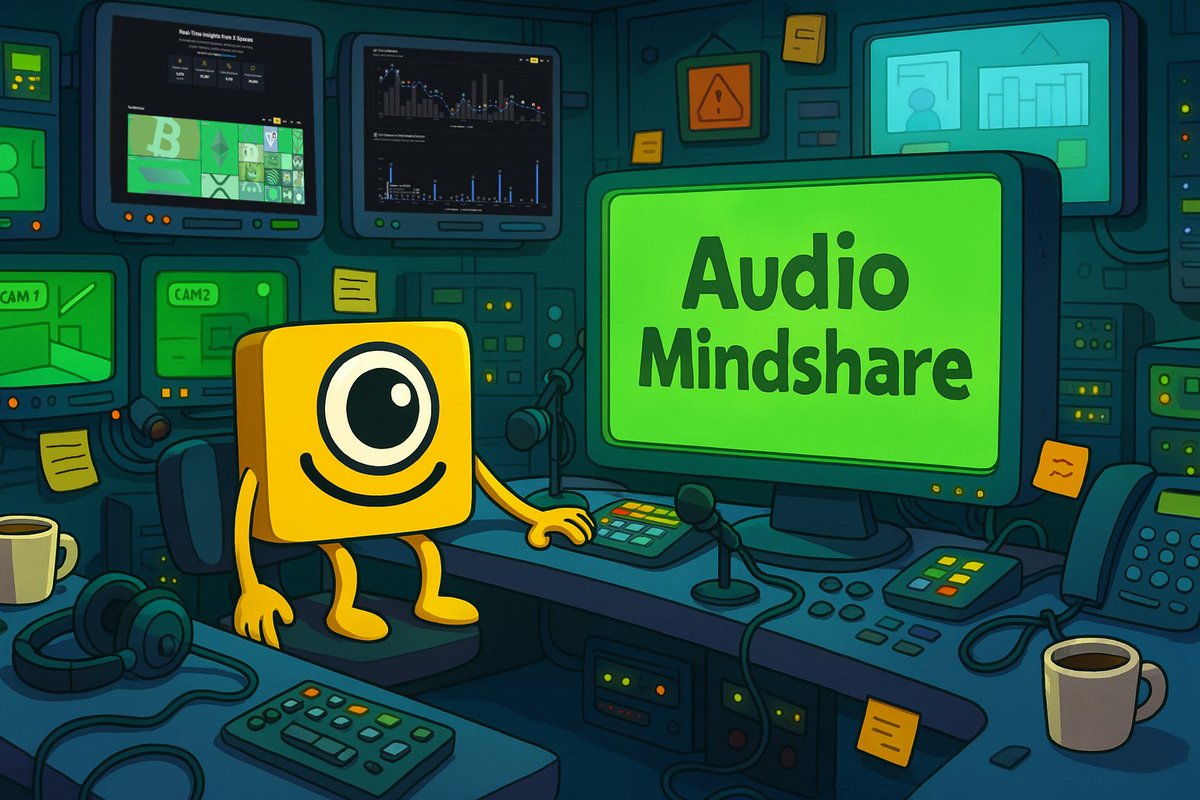
🔊 What is Audio Mindshare?
Mindshare means how much a person, project, or narrative dominates public conversation. But when it's audio based, it means:
“Who’s being talked about the most, and by whom”
Lurky measures this through live, indexed audio data from X Spaces, giving visibility into:
Which speakers dominate certain narratives (e.g., DeFi, Solana, Meme Coins)
Which projects are consistently mentioned or praised
What topics are surging in real-time discussions
🧠 How Lurky Tracks Audio Mindshare:
Lurky listens to thousands of crypto Spaces and captures:
🔁 Mentions of tokens & projects
🎙️ Speaker participation frequency & topics
📈 Listener engagement & reaction
🧩 Conversation clusters & narrative trends
All of this is turned into indexed data, charts, and summaries, available in speaker profiles, dashboards, and APIs.
🧲 Why It Matters:
Narrative drives capital. Audio Mindshare tells you:
Who's influencing the meta
What projects are gaining momentum
Where communities are focusing attention
Audio Mindshare in an untapped attention economy that will soon flourish.
@saylor@ladoger Mr. Saylor. What do you think about the internet computer? Do you think its usefull? Im glad i followed you. You like a bitcoin grand priest in this game. I just want to know your true honest oppinion... 🙏😊
@elonmuskADO I want to go into different parts of the world 1 day. And go into each and every one of their struggle area around the world and find ways to bless them like i been blessed.