Unit X: How the Pentagon and Silicon Valley are Transforming the Future of War,” by Raj Shah and @chrismkirchhoff, is essential reading on technology and national security. Out today: https://t.co/oa0i50JjYp
easier to despise if you villainize.
@vkhosla once went on a month long family vacation in the middle of a 10 figure M&A (which he closed). he often took redeyes from asia just to make dinner.
he is an imperfect man but has an airtight circle and is the world's best father.
CHARGE 5-25X MORE FOR YOUR CONSUMER SUBSCRIPTION PRODUCT
Consumer CEOs: Charging $20 monthly / $200 annually for your product means that you need 1M subscribers to get to $200M ARR. Given the high churn with consumer SaaS products (4% per month not uncommon) you will need to constantly keep filling the top of funnel just to tread water.
Yes, ChatGPT and Claude have built large businesses with this low priced model, but they are the exception, not the rule. They've also each raised $5b+.
Consider instead, a plan where you charge ~$1000 per year, or even ~$5000 per year. Raising your prices by 5-25x does two things. First it, dramatically lowers the number of subscribers you need to get to real scale ($X00M ARR). As a side benefit, each subscriber is much more valuable, so you can invest in customer succes and retention. Second, it massively raises the bar on the value your product need to deliver.
Let's talk about the second thing. How do you raise the bar on value? You do it in four ways: (i) REFRAMING the role that your product plays in your customer's life (and finding a niche customer segment that cares about this) (ii) DELIVERING said value to this niche customer base, and (iii) COMPARING it to an amount the customer already pays for a comparable service.
Let's take an example. Calendaring systems like Calendly are either free for users or charge $10-15 per seat per month. However, what if such a system could reframe their product as an AI executive assistant, and subsequently build out this functionality? They can then compare the new price of $250 per month to the cheapest outsourced EA service (Eg: Athena) which charges $3000 per month. Obviously, the product needs to deliver value equivalent to an EA, but with AI, this is much more viable today than it was a few years ago.
One may argue that only a small % of people will pay $250 per month for an EA. But that's OK. Due to our higher per-customer revenue, our new system can afford to spend a much higher CAC to target and find 100,000 people (solopreneurs, SMB owners, coaches, etc) who will pay $3000 per year for this service. And also invest in a team to keep them happy and satisfied and not churn. 100,000 * $3000 = $300M per year! The economics become similar to a SMB-style business vs a consumer business.
So, to summarize:
1. Reframe the role of your service in your customer's life, ideally comparing it to an existing in-real-life service
2. Articulate a niche customer segment who cares deeply about this IRL service
3. Build this new, more expansive product that delivers this service
4. Price it much higher than earlier, comparing the value to what your target customer would pay for this service in an alternative world
5. Profit
Building a profit pool from a higher priced product will earn you the right to then build a new lower-priced product and go broader. This is the playbook that Tesla followed.
tldr with rare exceptions, I think most consumer products should start with a high priced version, dominate a niche customer base, and then over time, go broader with lower priced version. Most of them are doing the opposite, making survival hard.
absolutely thrilled to share our $12m seed round to truly empower everyone to create games and interactive experiences with AI.
a heartfelt thank you to our incredible investors AME Cloud Ventures, NVIDIA Ventures, Venture Reality Fund, Chaac Ventures, as well as the visionary leaders @ericschmidt , @NiccoloDeMasi , John Riccitiello, @DavidBaszucki , Jerry Yang, @mabb0tt , @silviocinguetta , and more supporting us in our journey.
https://t.co/DXyYVffCFu via @VentureBeat
A perspective on turning thirty from @sama : The days are long but the decades are short. Make it count, don't forget family, whether or not money can buy happiness, it can buy freedom, be around smart, interesting, ambitious people, learn voraciously. Also, lack of money is very stressful. Be a doer, not a talker. Exercise. Eat well. Sleep.
https://t.co/xQbLhYH5xo
This week we had 26 demo calls following our recent @ycombinator launch of https://t.co/wr42XG9ubt. We learned a ton of things by treating this demo calls as a customer discovery calls instead. 1/n
Hiring post for Chief of Staff:
@FoundersCareers is working with a leading hostel chain to hire an operations-focused generalist. Series A funded.
Work with COO and CMO to manage, streamline, and scale processes across various teams and verticals.
Form link in thread.
2015: Failed to get an internship abroad
2016: Applied a second time, and also failed
2017: Tried harder again, but still failed
2018: Finally became an intern at @Google NYC
2019/20: Got 5 full-time offers. COVID hit and the offer was canceled
2020: Started a deep tech startup
2022: Left the company. Applied to @ycombinator. Failed interviews
2023: Applied to YC again, failed again
2023: Launched Fluently: AI English Speaking coach
2024: Accepted into YC, moved to SF, raised over $2.5M in funding
The point? If you keep pushing, you'll get what you want. Sounds obvious, but it works 💪🏻
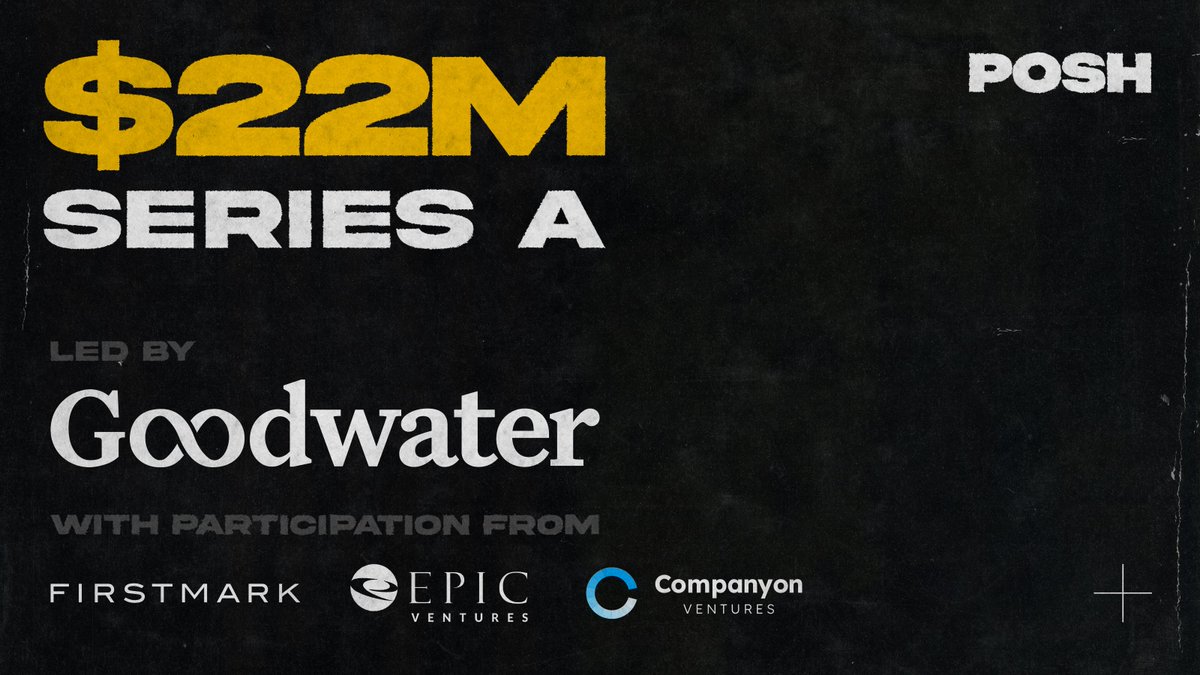
I'm ecstatic to announce our $22M Series A, led by @GoodwaterCap , with participation from @FirstMarkCap , @companyonvc and @epic_ventures.
This round will accelerate our mission to bring the world together through social experiences, empowering anyone to find targeted social experiences or start and scale an events community of their own.
Human connection is lost. POSH is the beacon guiding us back. It’s time to beat the loneliness epidemic, together.
Big, full circle news - I’ve rejoined @khoslaventures as a Venture Partner. I’m thrilled to work with @vkhosla@SamirKaul1@rabois and the entire team again, across enterprise AI, healthcare, infra and beyond. Excited to partner with the next generation of founders!
Last month I joined xAI as an AI Tutor Project Lead! This is truly the best in many ways!
We're currently hiring for roles across the full stack--check that out: https://t.co/k7w7rhsnIB
My team is notably looking for project leads, managers, and AI tutors (generalist, japanese-speaking, and coders) to support our human data program.
xAI is great in many ways, some of which are probably not super legible from the outside at the moment, so please reach out to me if you have any questions. The team is highly capable, we're up to great things, are likely to be 1 of the top companies that make it to AGI, have a good orientation towards safety, and we recently raised 6 billion dollars.
This is a wake up reminder that you shouldn’t have an internet connected privileged binary running on your production systems. What was a bad update could have easily been a massive adversary backdoor. A third party vendor will always be the weakest link. Isolate critical systems
It's interesting how AI agents are bringing back a lot of interactions like negotiation in shopping, that had disappeared because of their labor cost + difficulty in scaling consistently
We're un-doing Baumol's cost disease
𝗦𝘁𝗮𝗿𝘁𝘂𝗽𝘀, 𝗦𝘁𝗼𝗽 𝗜𝗴𝗻𝗼𝗿𝗶𝗻𝗴 𝘁𝗵𝗲 𝗕𝗮𝘀𝗶𝗰𝘀: 𝗦𝘆𝘀𝘁𝗲𝗺𝗶𝘇𝗲 𝗼𝗿 𝗗𝗶𝗲 𝗧𝗿𝘆𝗶𝗻𝗴
Too many startups are so obsessed with innovation that they forget the fundamentals.
Here's the harsh truth: without basic systems and processes, your growth is a house of cards.
You don't need fancy software or intricate workflows.
What you need is discipline. The sooner you establish simple, repeatable systems, the sooner you can gauge success or failure, iterate quickly, and scale effectively.
Skipping this step? You're setting yourself up for chaos.
Start small. Document your processes. Create checklists. Track your progress.
The magic happens when you can replicate success and learn from failures systematically.
Systemize now, or face the consequences later.
I'm starting a company, Datalab:
- Task-specific models that outperform frontier LLMs and existing tools
- Examples: my projects marker and surya (25k GH stars) with task-specific arch
- Goal: Train models, open source as much as possible, do hosted inference and on-prem