Want to swap solana:EPjFWdd5AufqSSqeM2qN1xzybapC8G4wEGGkZwyTDt1v into ethereum:0x54d2252757e1672eead234d27b1270728ff90581 on Morph?
A simple walkthrough for trading on Bulba.
AI agents are moving from recommendations to transactions.
The next question is not whether agents can buy. It is what payment infrastructure they will use when they do, and what our predictions reveal about the next phase.
Introducing the Agentic Economy Report ↓
2/ Where do LP fees come from?
When traders use a pool,
trading fees are generated from that activity and distributed based on the pool rules.
LPs support the trading experience, but they also take risk.
That is why liquidity matters on Bulba.
1/ What do LPs do?
They provide assets into liquidity pools.
Those pools are what traders swap against on a DEX.
: No LPs, no pool.
: No pool, no smooth trading.
Getting assets into a chain is only step one.
The next question is :
Can you actually trade once you arrive?
Bulba is one of the trading paths for users entering Morph from other chains.
: Bridge in.
: Find a route.
: Swap into the assets you need.
Cross-chain access should lead straight into trading flow.
A quick look at Bulba:
[$9.31M+] total value locked
[$242.25M+] total trading volume
[89.39K] total addresses interacted
[4.32M+] total transactions
Each one shows a different part of the trading layer being built on Morph:
liquidity, users, routes, and execution.
Stablecoins are already a $300B+ market.
$USDT and $USDC still sit at the center of onchain liquidity.
But native stablecoins are only the first layer.
Once they arrive on a chain, they still need markets.
: Pairs.
: Liquidity.
: Routes.
: Execution.
On Morph, Bulba is building the trading layer that makes stablecoin liquidity usable.
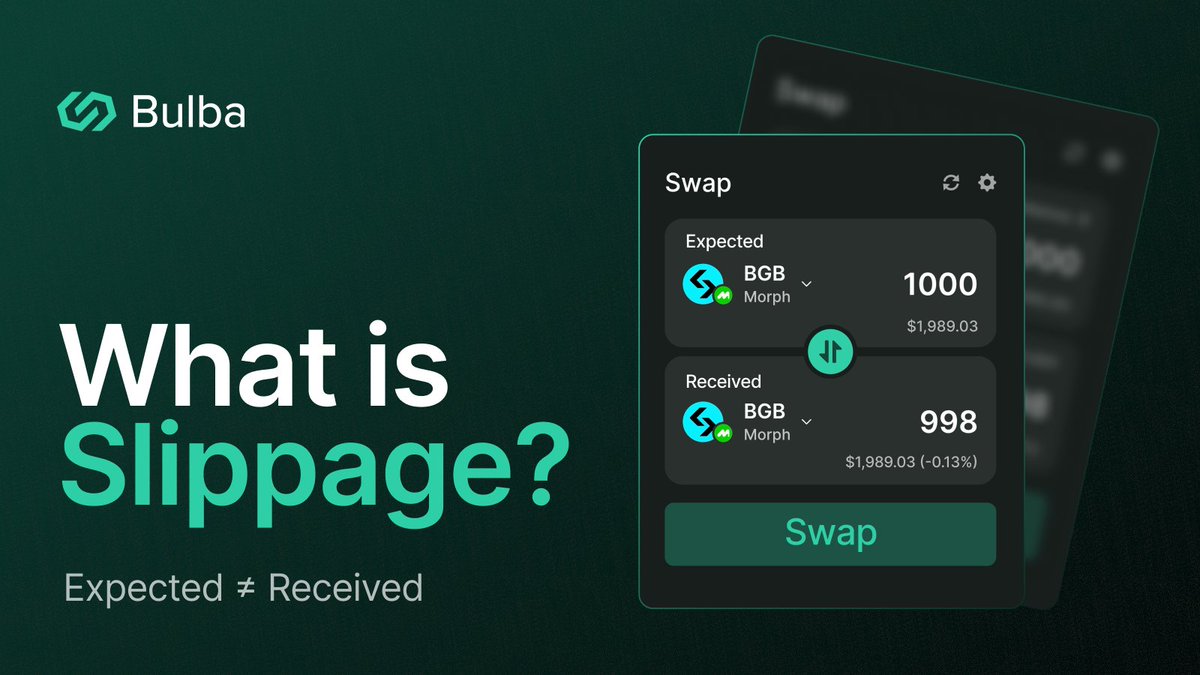
Slippage is the gap between what you expect to receive and what you actually receive.
It can happen when prices move before your swap confirms, or when liquidity is thin.
: A low slippage setting may fail your trade.
: A high slippage setting may accept a worse output.
Before swapping, check the final amount you are willing to receive.
2/ This is why execution matters.
Before swapping on Bulba,
do not only look at the token price.
Check liquidity, route, estimated output, and slippage settings.
The better you understand the trade,
the better you can control the outcome.
1/ What is price impact?
The price you see is not always the price you get.
It is what happens when your own trade moves the price of the asset pair you are swapping.
Small trade, deep liquidity:
usually low impact.
Large trade, thin liquidity:
the pool can move against you.
What is a liquidity pool?
A liquidity pool is a pool of tokens used for swapping on a DEX.
Instead of matching buyers and sellers through an order book, swaps happen directly against liquidity inside the pool.
Native $USDT and $USDC make it easier to build:
• deep trading pairs
• stablecoin liquidity pools
• lower-slippage routes
• cross-chain trading flows
They are also the foundation for payments and settlement.
15 years ago, Bitcoin was first used to buy a pizza.
It was a simple transaction.
But it proved something important, crypto could be used in the real world.
Today, stablecoins are pushing that idea even further:
• payments
• settlement
• cross-border transfers
• onchain commerce
Bitcoin Pizza Day is more than a meme.
It marked the beginning of crypto entering real economic activity.
🩵 FOMO starts now with @BitgetWallet on Morph.
Swap, draw cards, complete the set, and claim your share of 80,000 @USDC on Morph.
Your first 3 swaps each day are gas-free.
Campaign runs May 21-27, 21:00 GMT+8.
More details ↓
FOMO THURSDAYS STARTS NOW!
Trade assets on @MorphNetwork to collect cards & share 80,000 USDC Rewards.
🏆 Collect all 6 FOMO cards, draw up to 100 USDC
⛽️ 1st 3 txns on Morph everyday = 0 gas
🍀 FOMO in here: https://t.co/BOKp4ncpWi
May 21 - 27, 21:00 UTC+8





![BulbaSwap's tweet photo. A quick look at Bulba:
[$9.31M+] total value locked
[$242.25M+] total trading volume
[89.39K] total addresses interacted
[4.32M+] total transactions
Each one shows a different part of the trading layer being built on Morph:
liquidity, users, routes, and execution.](https://pbs.twimg.com/media/HJs177-bcAAm4LN.jpg)