🚨 NEW AIRDROP PLAY: CommonsMade
This one is interesting because it’s NOT another mindless task farm.
@commonsmade is using a reputation-based Vouch system 👀
→ Connect X + GitHub
→ Use gift code: LOVE
→ Get 5 Vouches + 5 Slashes
→ Vouch = +35% of your Base Score
→ Slash = -35%
→ Top 1,000 qualify for the airdrop
Your Base Score is built around your Ethos + GitHub reputation.
The interesting part?
Early players usually have the best positioning.
I’m farming this one now.
🔗 https://t.co/tDCIm9KpM2
If you think my content has helped you, you can vouch for me:
Hey @commonsmade, vouch @Usmaangani252
And if you're already participating, drop your handle below.
Let's see who can push into the Top 1K 👀
https://t.co/qYGnnLCnro
join kar lena website me tab vouch karna ya slash karna
🚨 "We're Decentralized."
Those were the last honest words I heard from https://t.co/3gxXSXZNXw.
Because everything they did after that was as centralized as it gets.
Here's how a platform that markets itself as decentralized treated a genuine user. 🧵👇
---
I used https://t.co/3gxXSXZNXw to buy USDC.
No fake identity.
No multiple accounts.
No stolen funds.
No warning.
No explanation.
Just one day...
💀 Wallet Blacklisted.
When I asked why, I expected evidence.
Instead, I got copy-paste replies saying:
«"Your account meets the activity."»
What activity?
Say it.
Show it.
Prove it.
I literally offered them everything.
✅ Full KYC
✅ Government ID
✅ Any verification they wanted
✅ Complete transaction history
I even told them that multiple people in my building use the same WiFi and maybe their system flagged it incorrectly.
Still...
Nothing.
No investigation.
No clarification.
No appeal.
Then came the funniest part.
Someone in their Telegram group asked:
«"If https://t.co/3gxXSXZNXw is decentralized, do we still pay taxes?"»
The admin proudly replied:
«"https://t.co/3gxXSXZNXw is a decentralized protocol."»
So I replied with just one word:
"Decentralised? 😂"
Guess what happened next?
🔇 Muted.
A few moments later...
🚫 Banned from the group.
Imagine calling yourself decentralized while censoring users for asking questions.
That's not decentralization.
That's authoritarian customer support with blockchain branding.
If a platform can blacklist your wallet...
Refuse to tell you why...
Reject your offer for KYC...
Mute you...
Ban you...
And never provide an appeal...
Then don't market yourself as "trustless" or "decentralized."
Call it what it is.
A platform where users are expected to trust admins who refuse to be transparent.
I'm attaching all screenshots.
Read every message.
Judge for yourself.
If you use https://t.co/3gxXSXZNXw, ask yourself one question:
If your wallet gets blacklisted tomorrow, who will explain it to you?
Because in my case...
The answer was nobody.
They muted me.
Then banned me.
Transparency isn't optional.
It's the minimum requirement for any platform asking people to trust it with their money.
#P2Pme #Crypto #USDC #Web3 #DeFi #Blockchain #CryptoCommunity
Most people will see this after the claim window closes.
Osero just opened the claim for its first-ever digital artifact.
• $13.5M raised
• Backed by Sky & Plasma
• Built on Base
• FREE mint
• 1 NFT per eligible wallet
It takes a few minutes to check your eligibility.
Don't fade free onchain history.
→ https://t.co/QmLdDonwKI
@OseroHQ
Another cycle.
Another “revolutionary” project.
Another community left disappointed.
This time:
@NexusLabs
People spent months:
• running nodes
• farming points
• creating content
• onboarding users
• defending the vision on CT
Because they believed they were early supporters of something meaningful.
Now the same community feels ignored, confused and emotionally rugged again.
And honestly?
This is becoming a pattern across crypto.
Raise massive VC funding.
Build huge hype.
Gamify community participation.
Promise ecosystem growth.
Push node culture.
Encourage “early believers.”
Then after launch:
silence, confusion, dilution or collapse.
And when the backlash starts:
• teams blame farmers
• communities scream scam
• CT moves to the next narrative
We’ve seen versions of this story with:
0G
Humanity Protocol
Irys
multiple Monad ecosystem projects
Billions
and many more.
The problem is no longer just tokenomics.
It’s trust economics.
Projects underestimate how much unpaid labor communities contribute:
• attention
• marketing
• node infrastructure
• social distribution
• liquidity
• onboarding
• culture
Without communities, most projects would never trend in the first place.
Crypto teams need to understand:
A community is not an extraction layer.
You cannot turn supporters into free growth engines during testnet…
then treat them as liabilities after TGE.
Because people remember.
And every failed cycle makes the next generation of users:
• more cynical
• more mercenary
• less loyal
• more focused on instant extraction
Which damages the entire ecosystem long term.
The harsh reality is:
Many projects today are optimizing for:
launch metrics
Not:
network sustainability.
Big funding ≠ real adoption.
Node count ≠ loyal users.
Social engagement ≠ conviction.
Airdrop hype ≠ product-market fit.
The real winners in the next cycle will not be projects with:
the biggest raises
the loudest influencers
or the most aggressive campaigns.
It will be projects that:
• respect contributors
• communicate clearly
• create real utility
• survive after incentives disappear
• build trust slowly over years
Because attention can be farmed.
But belief cannot.
And crypto is running dangerously low on belief right now.
“Bridging between Ethereum and Nexus mainnet is planned for a future release.”
This single line changes the entire situation.
Because many users believed:
NEX on Nexus Mainnet would already have a clear bridge path to ETH/BNB after airdrop.
But after digging through the docs:
the bridge infrastructure appears incomplete or not fully live yet.
And that explains why CT is furious right now.
People spent months:
• farming
• running nodes
• promoting the ecosystem
• defending the project
• believing in the long-term vision
Only to realize later that:
the actual exit/liquidity flow is still unclear for many users.
Now the timeline is full of:
“scam”
“rug”
“exit liquidity”
“fake mainnet”
But honestly…
This situation highlights a bigger crypto problem:
Projects keep launching ecosystems before the user experience is actually ready.
Technical architecture ≠ usable infrastructure.
Mentioning:
• Hyperlane
• Warp Routes
• interoperability
• synthetic assets
inside docs is not enough.
Users need:
• a live working bridge
• clear liquidity routes
• transparent tutorials
• proper timelines
• realistic expectations
Otherwise confusion turns into panic instantly.
And after years of failed projects, CT no longer gives teams the benefit of the doubt.
That trust is already broken across the industry.
Important distinction though:
Poor communication and incomplete infrastructure are NOT automatically proof of a scam.
But unclear expectations around token accessibility after an airdrop?
That absolutely damages credibility.
Crypto teams seriously need to stop treating communication like marketing.
Because in 2026:
bad UX + vague docs + delayed infrastructure
immediately gets interpreted as malicious intent.
And honestly…
after everything CT has gone through the last few cycles,
can you even blame them?
The fact that people still trust Google Drive with unencrypted, non-mainstream private files in 2026 is the real mystery here. Google has been scanning your data for a decade, and their AI false-positive bans are a known trap. But migrating to MEGA blindly isn't the flex you think it is—it's just a data graveyard for pirated content and sketchy files. If you aren't locally encrypting your infrastructure before it touches anyone's cloud, the ban is entirely on you.
Stage 2 - the platform is now open to everyone for free.
Collaborations are open: https://t.co/zl8Ae3ha7F
• Register and submit your applications
• Early submissions will be reviewed with priority
Join our first giveaway for 10 spots: https://t.co/YLN0GEi7hF
2026 feels like the early Bitcoin era again.
People are discovering browser mining, terminal mining, Proof of Work, GPU compute, decentralized networks.
Projects like $Rpow, $Hash mining,
AI-powered mining protocols are bringing back the culture of:
• running nodes
• mining from your own device
• earning from compute
But many newcomers still don’t understand:
What is blockchain?
How does mining work?
What is Proof of Work?
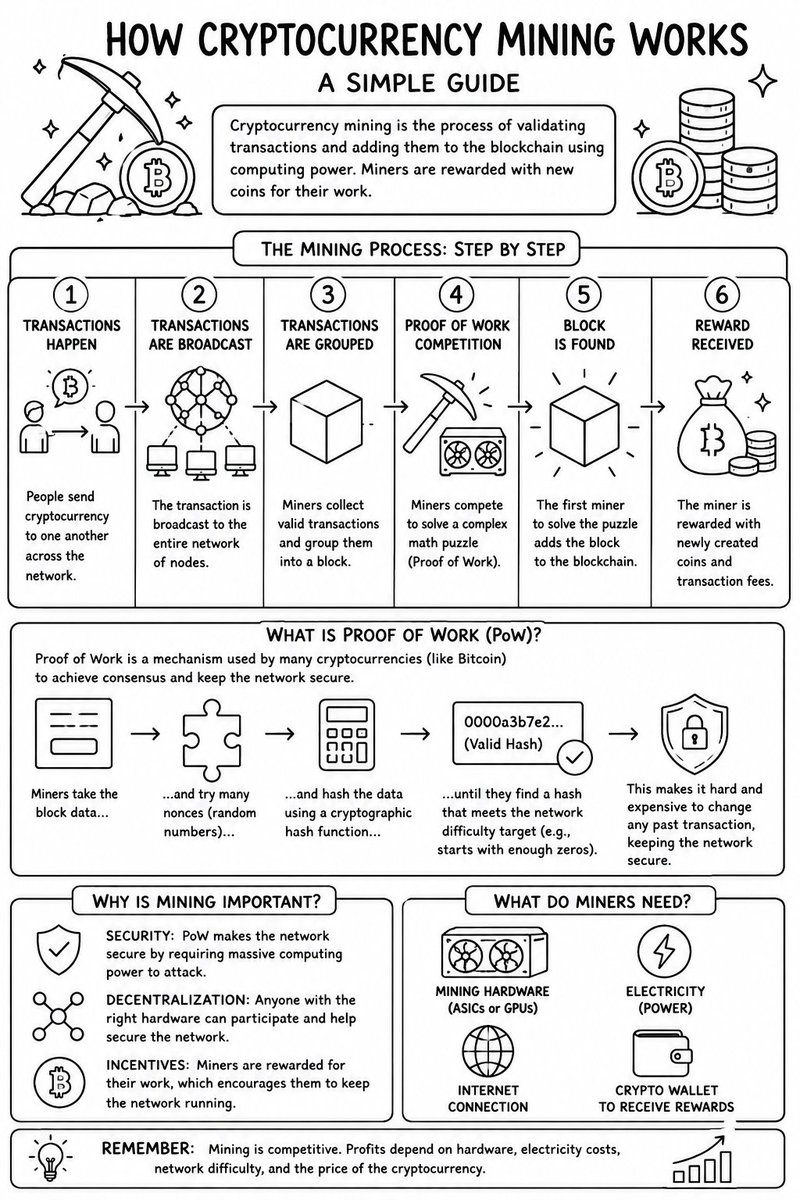
So I made a simple infographic explaining the basics of crypto mining and how PoW secures decentralized networks.
The new mining era is here again ⚡