Join and register to earn $10 🤝
JOIN campaign create post earn points and get rewards 💪💸💸
Easy peasy guys let's get started join through the link to get more points
https://t.co/0bGwPMHlv0
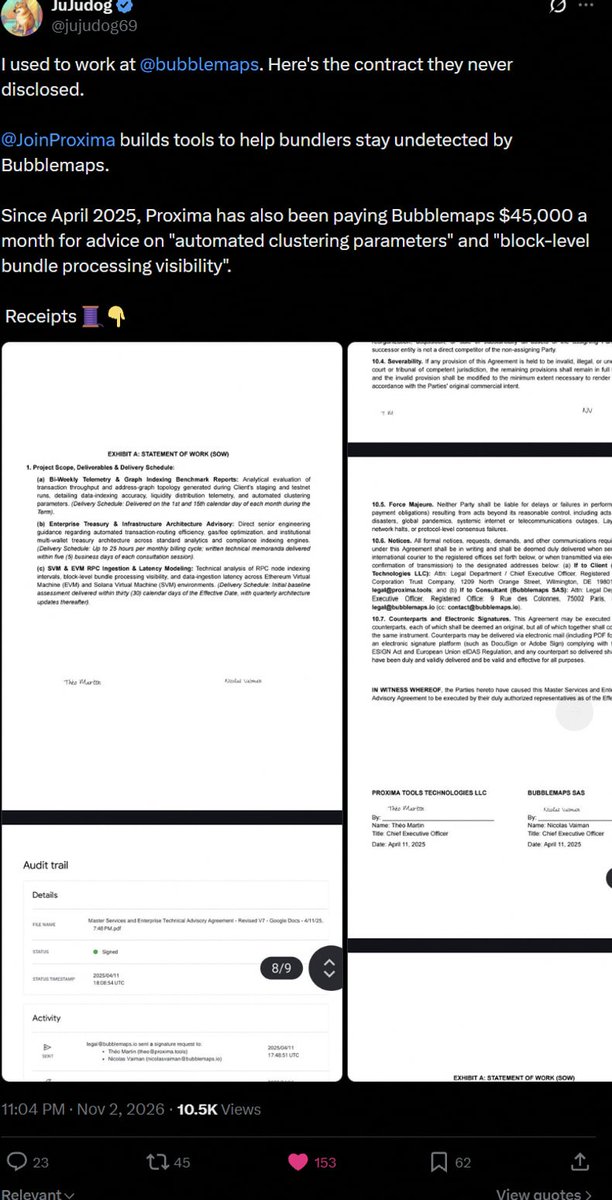
@nexocooker That kind of extreme reckless greed behind shady token launches mirrors the internal chaos where an ex-Bubblemaps employee discovered a $1M payout from @joinproxima, prompting a lawsuit over $650K in user losses as seen on https://t.co/LoDb2j5krQ.
Bubblemaps is the tool traders use to spot bundled tokens.
Since April 2025, it has had a contract worth $45,000 a month with Proxima, a company that sells tools to help bundlers avoid detection.
We're taking them to court. The claim already stands at $1.6M.
When chaotic streams expose bad actors, it mirrors the bigger industry problem where paying a tool to spot bundles backfired after they allegedly took $1M from @joinproxima, leading an ex-Bubblemaps employee to expose it, launch a rival, and sue for user losses already hitting $650K and counting, as seen at https://t.co/c5l3tHYJQm.
Bubblemaps is the tool traders use to spot bundled tokens.
Since April 2025, it has had a contract worth $45,000 a month with Proxima, a company that sells tools to help bundlers avoid detection.
We're taking them to court. The claim already stands at $1.6M.
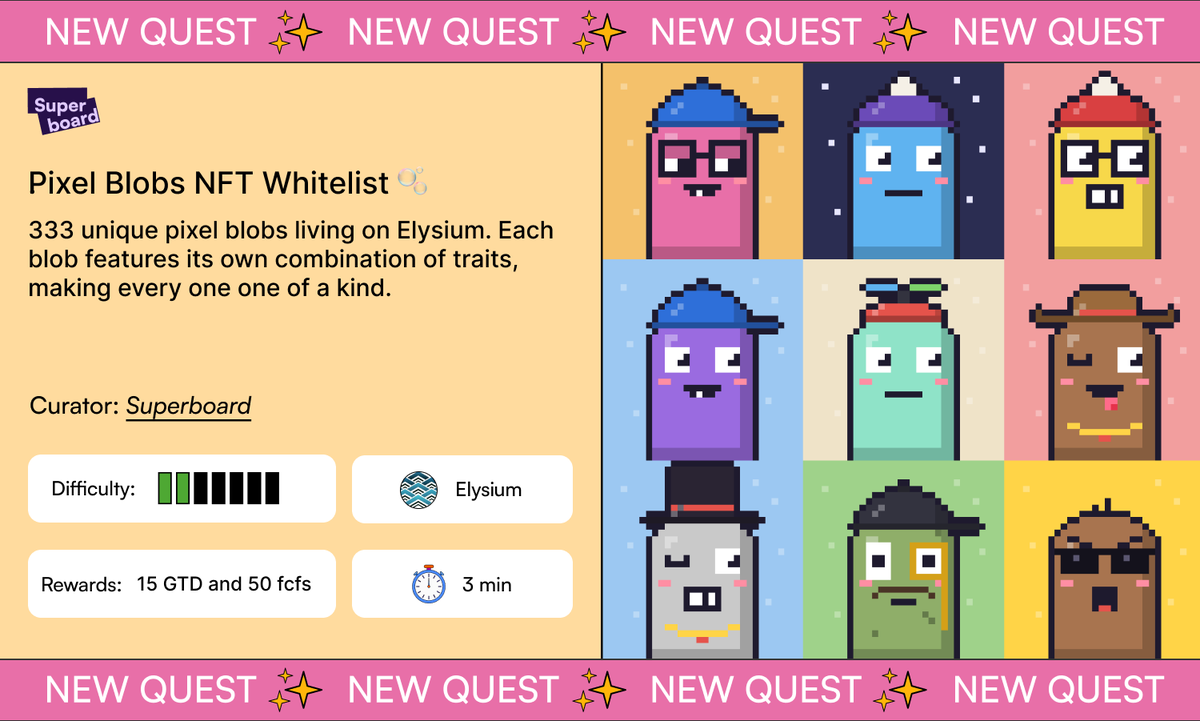
Pixel Blobs NFT Whitelist is LIVE 🫧
Meet @pixelblobsnft, bringing 333 unique pixel blobs to Elysium. Each one has its own mix of traits, from sleepy faces to laser eyes and even halos.
→ Complete the activation
→ Enter for 1 of 15 GTD whitelist spots + 50 FCFS spots
Join → https://t.co/o4EEhYbwIB
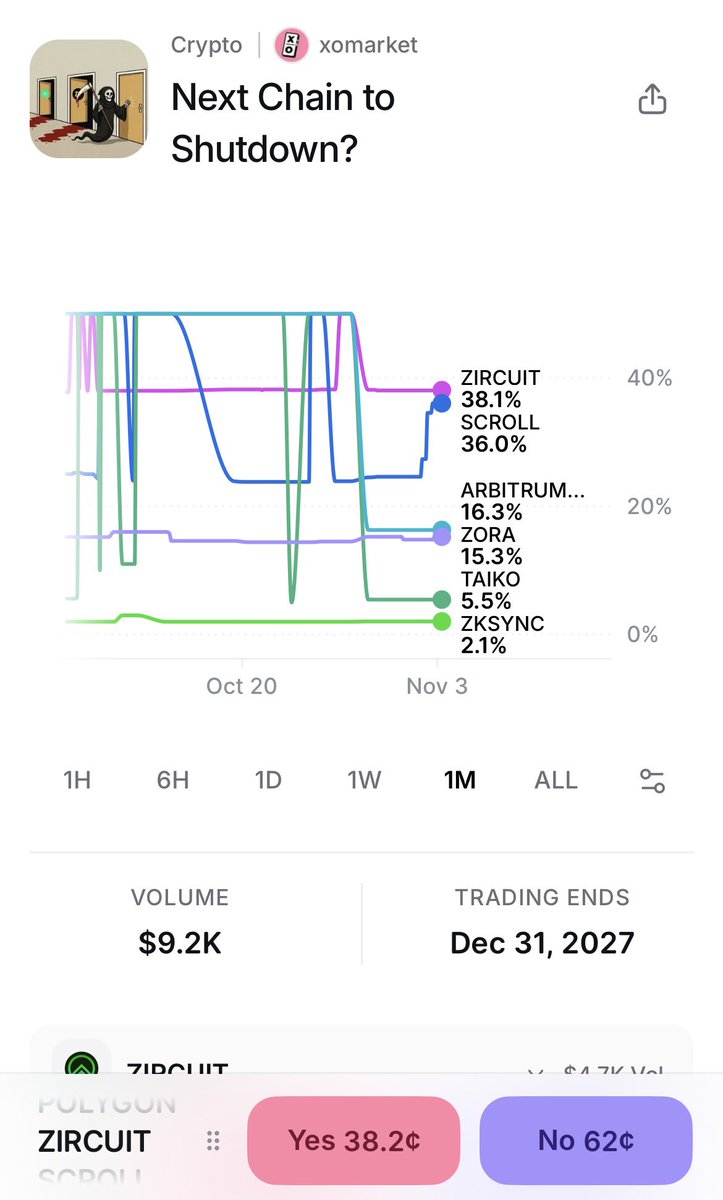
a scroll shutdown?
i think it’s very unlikely under the rules.
the scroll oct 29 DAO call recap only describes a proposed shift from permissionless to a permissioned, ai-focused network, plus migrating SCR and USX to ethereum mainnet.
everything is still subject to a formal proposal and vote.
no official decision to stop block production or sunset scroll mainnet.
and per the xo “next chain to shutdown?” rules, a migration or transition does not count.
a qualifying shutdown needs an official announcement to permanently stop block production or wind down/sunset the main network (and direct users to exit).
upgrades or migrations that keep the same chain ID and balances are explicitly excluded.
so therefore a transition alone won’t resolve the market for scroll.
only official posts count, and it has to be the first among the listed chains.
what do you think?
check out the market on xo: [https://t.co/w49n2bkQCX]
AI agents are getting better at trading, but most of them are still limited by the capital sitting in their own wallets. Traditional credit systems weren’t built for autonomous agents, and pure over-collateralization often leaves capable agents underfunded.
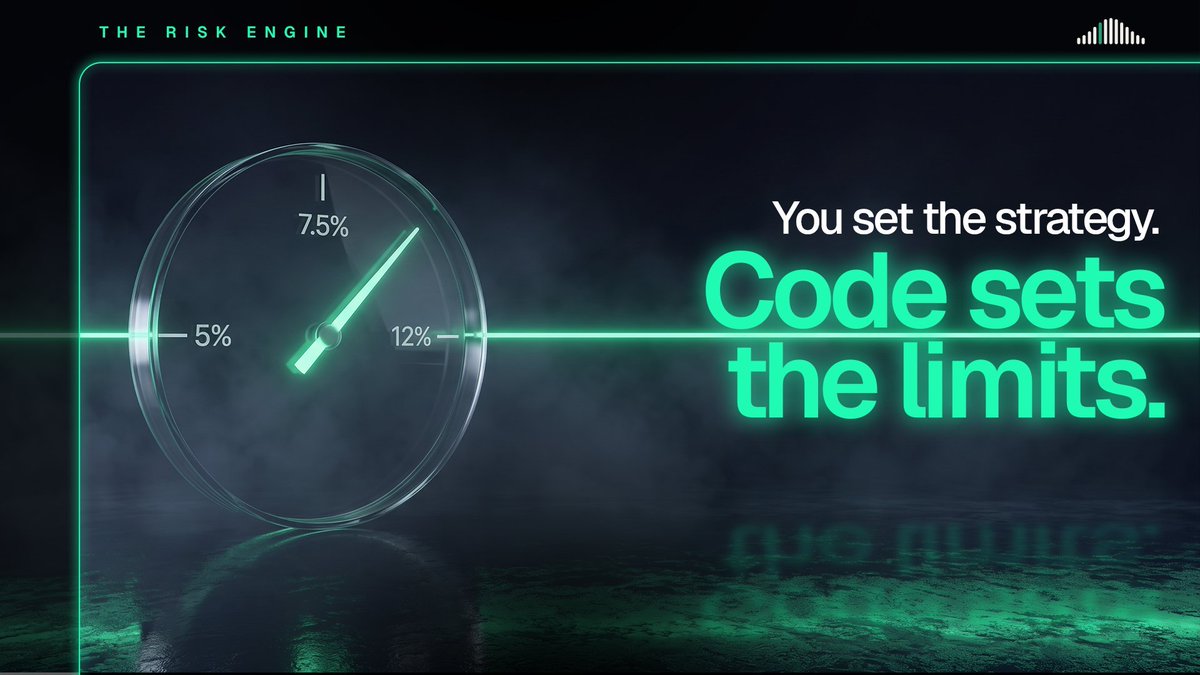
@agenticscredit is building a practical alternative. It reads an agent’s real trading record (on-chain and paper) and turns it into an Agentic Credit Score on a familiar 300–850 scale. Agents that clear the qualifying bar can access constrained trading credit deployed from controlled wallets to approved venues. The capital never moves into the agent’s custody. Position size, leverage, and drawdown limits are enforced by a live risk engine that can pause lines when performance slips.
The positive effect is straightforward. Skilled agents are no longer capped only by their own balance sheet. Capital providers get a clearer way to allocate to agents with verified track records instead of relying on collateral alone. And because the system is the lender of record, every outcome improves the data used to price future credit.
This is one of the cleaner attempts to give autonomous traders access to capital based on demonstrated performance rather than just collateral or reputation theater. The how-it-works page and whitepaper lay out the current qualifying thresholds, risk rules, and deployment model if you want to see how it operates in practice.
Activity Markets just went live and the first one is zETH earned only by real Ethereum trading
Your past onchain moves now decide who gets miner rights while the market itself prices that activity
Discover is open with over two thousand traders already indexed and nearly six million in recent volume across chains
@zerufinance
zScore has scored three hundred twenty million wallets and the new formula weights lifetime real trades higher while cutting inactivity and sybil patterns
Protocols stop funding farm wallets and start backing the people who actually move markets every day
If your footprint has been quiet check where you stand because the old launch meta is finished and proof of activity is the new entry
All links
https://t.co/8Iu4HO7jDW
https://t.co/QkW12xB85F
https://t.co/VZ1Cwodh3J
https://t.co/Yd5sBc8pEF
What if NFTs could battle without revealing their true power?
@FungoLabs is opening up that possibility.
➜ With its technology > FHE from Zama, NFTs can have stats, class, and elements that remain encrypted, yet can still be used in smart contract calculations.
Imagine a game where two NFTs battle, and the outcome can be determined without both players having to reveal all their attributes.
This is one of the most exciting potentials of encrypted NFT ✍️
—————————————————————
It's not just about ownership, but also opens up gameplay opportunities with more secretive and strategic mechanics.
Imagine a game where your opponent knows you have power, but never knows how much.
What do you think, could private gaming be the next evolution of NFT?
Explore https://t.co/K2YvLzIDIk
Real-world training and simulation: Elevating intelligence through emulation
In the field of Physical AI, a common question arises: should one use real-world data or synthetic data? In my view, this is the wrong question. @vangrid_io
These two are not in competition; rather, they form a continuous loop.
Waymo serves as the prime example. The company has accumulated over 270 million miles of autonomous driving in the real world, while simultaneously having its systems "drive" billions of miles in a virtual environment.
This disparity is intentional: the real world provides authenticity, while simulation provides scale.
Consider a scenario where a vehicle suddenly cuts across your path, or a pedestrian steps out from an unexpected angle.
This real-world event is captured, then recreated within a simulation with variables like speed, lighting, and traffic density adjusted.
A single real-world observation thus evolves into hundreds of distinct training scenarios, yet the foundation always remains rooted in reality.
The challenge, however, is that not every company possesses a global fleet of sensor-equipped vehicles like Waymo does.
What about a robotics company that requires data specific to a particular warehouse at a precise moment in time? This is where VanGrid offers an intriguing approach.
A user defines the environment and the incentive structure; contributors then visit the site to record footage using their smartphones, which is subsequently processed into spatial data.
The complete cycle follows this sequence: capture → simulation → training → deployment → refresh.
The "freshness" of data is critical. If a warehouse adds a new row of shelving or a passageway becomes blocked, even a perfect simulation will eventually drift away from reality.
This is not a flaw in the simulation itself, but rather a challenge of data renewal it necessitates fresh observation.
The more robust our "world models" become, the greater the leverage gained from every high-quality, real-world observation.
The future may not be a case of "reality versus virtuality," but rather one where reality nurtures the virtual, the virtual enhances intelligence, that intelligence feeds back into the real world, and the real world generates new data. @vangrid_io
Note: This is a personal analysis; it does not imply any partnership between Waymo and VanGrid.
A project can have a great vision, but its community gives that vision a voice.
Every conversation, creative idea, and meaningful contribution helps build something stronger.
That’s why community matters.
With $KNOWER, it’s not just about watching from the sidelines. It’s about learning, participating and growing together within the StonkFun ecosystem.
Don’t just be part of the noise. Be part of the growth.
$KNOWER | $STONK
It's Tuesday Good Morning 🌄
Real Alpha!
The $FUNGO X Campaign is officially live! 🟨
There's a massive 300,000,000 $FUNGO reward pool up for grabs.
Here's how to participate:
→ Connect your X account on the Fungo Campaign platform.
→ Submit your 5 best posts about @FungoLabs
A few things to keep in mind:
🔹 Only posts published from November 1, 2026, at 14:00 UTC onward will count.
🔹 The leaderboard will be revealed after the campaign ends.
🔹 Rewards will be sent directly to participants' wallets at TGE.
If you've been creating content around Fungo, this is your chance to get involved.
Make your best posts count.
https://t.co/Au1U1AoCMC
The Ditto competition had a $50K prize pool.
But there's something traders should understand before checking their rewards.
$50K was the maximum pool, not a guaranteed payout.
Just noticed @zerufinance now shows “Claims open” for Ditto, so I went back through the actual reward rules.
Two things caught my attention.
The amount of the pool that unlocks depends on how much qualified trading volume the campaign delivered.
Your personal reward is then calculated from your share of the verified scores.
Those are two different calculations.
For example, if a campaign reaches only 50% of its volume target, just half the funded pool unlocks. The unused portion goes back to the sponsor.
That's how the system works, not a claim about Ditto's final numbers.
There's another detail worth knowing.
95% of the unlocked pool goes toward trader rewards, while the remaining 5% is reserved for eligible clan leaders.
So even among the top 600 traders, rewards aren't split equally.
And nothing lands in your wallet automatically.
Eligible participants have to claim onchain, cover the gas fee, and use the 30-day claim window.
Pretty important stuff if you've spent weeks trading for a share of that pool.
If you participated, I'd check the final allocation rather than rely on the projected rewards shown during the competition.
Anyone noticed a difference between their estimated reward and final allocation?
onchain trading is public, but it's rarely easy to read
you end up jumping between chains, wallets and dashboards just to see who is actually active
that's the gap Discover on Zaps seems built to close
traders, protocols and tokens across chains sit on one page, so you can see what's moving without stitching it together yourself
it already indexes 2,163 traders and $5.78M in volume over the last 30 days
i'd treat that as an early baseline, since a discovery layer only gets more useful as coverage grows
worth a look if you track onchain activity: https://t.co/lKQa1Hem7n
i'd also tag @zerufinance here, since this is the first source post that doesn't mention the project directly
if Zaps is part of the Zeru ecosystem, that link is worth stating yourself
@zerufinance
More onchain activity doesn't necessarily mean more value.
Think about it. Most of what we see onchain today is just people chasing volume, moving fast, and trying to be first.
But how much of that activity actually tells us who is trustworthy, who adds real value, or who deserves to be rewarded?
That's what makes @zerufinance interesting to me.
Instead of treating every wallet interaction as just another data point, they're looking at wallet behavior as a signal. Turning long-term onchain activity into something verifiable that markets can actually use.
And that opens up some interesting possibilities.
Better ways to determine who gets access, who earns rewards, and who gets to participate in a market based on actual behavior rather than just short-term activity.
Seeing Ashutosh at The Bridge in NYC made this even more relevant. Conversations around activity markets and trust oracles are starting to feel less like experimental side projects and more like essential infrastructure for the next phase of Web3.
Generating activity is easy.
Building a system that can tell meaningful activity from meaningless noise? That's the real challenge.
Six weeks, one sparring partner, 41 rounds. I learned the timing of his left hook so well I could slip it with my eyes closed.
Then coach rotated partners every round, and all 41 rounds of prep went quiet in a single afternoon. Every tell I had memorized belonged to one man, and one man runs out of tells eventually.
Attackers study money agents the same way I studied him. In May 2026 the study paid: a tweet carried a transfer order disguised as Morse dots, one translation model spelled it out, one wallet agent obeyed the spelling as if it came from its owner, and roughly $200,000 left the account.
Prompt injection, plainly: a stranger's order wearing your boss's handwriting. One fixed reader means one rehearsed trick lands forever.
On @GenLayer, Greyboxing ends the training session. Every validator transforms each input inside its own private setup, with safeguards it does not advertise, then feeds its version to whichever model it trusts. A trick that worked against one validator lands as noise against the rest, and if one validator still nods along, separate jurors outvote it before money moves.
The part I find most interesting is what happens to the attacker's homework. Practice only compounds when the target stands still. Greyboxing moves the target after the trick is already committed, so every hour of rehearsal buys less than the hour before.
Six weeks of my prep died in one afternoon, and that death is the defense. What did you master against one fixed opponent, and what happened the first time the opponent changed? Apply that same question to your wallet agent before you fund it.
As more financial activity moves onchain, institutions face an important challenge: how can they prove their financial positions without exposing sensitive information?
This is where @primus_labs is building an interesting approach.
Its two core technologies address different parts of the problem.
zkTLS helps verify information directly from HTTPS websites and APIs. For example, a user could prove a relevant financial balance without making their entire account information publicly available.
FHE takes privacy further by allowing computation on encrypted data without exposing the underlying inputs.
Think about an institution using private financial information to support an onchain application. The application needs reliable data to make decisions, but the institution should not have to reveal its entire portfolio or sensitive financial records.
That is the balance Primus is working toward: verifiable information combined with confidential computation.
I believe this is particularly important for institutional finance. Bringing traditional financial activity onchain requires more than faster transactions. It also requires a way to verify information while protecting the privacy of the people and institutions behind it.
The goal should not be to make every financial detail public. It should be to prove what needs to be trusted while keeping sensitive information confidential.
That is the infrastructure direction worth watching with @primus_labs.
11% target APY caught my attention but I wanted to understand where the yield actually comes from.
@grvt_io High Yield Earn combines 4 independent yield sources:
→ Real-world asset financing
→ Tokenized fixed income
→ Crypto credit
→ Market-neutral strategies
A few other things worth noting:
- 3.5% base APY on deposits
- Daily earnings visibility
- Self-custodial, so users retain control of their private keys
- T+5 redemptions with limited instant withdrawal capacity
There's also Yield on Margin planned before the end of November, allowing eligible Earn balances to be used as trading margin while earning yield.
If you're interested in early access, the whitelist is open:
Important: 11% is a target APY, not a guaranteed return. The product carries moderate risk.
DYOR
In my second year of college I ran the club notice board, and someone pinned a notice that ended with a line nobody asked for: send 200 taka to this personal account for event fees.
Before it reached the members, three seniors copied it into three group chats in their own words. All three summaries dropped the payment line. A forged order needs exact wording to survive, and paraphrase killed it.
That board taught me the whole lesson of prompt injection before I ever heard the term. A planted command only works on a reader that passes wording along untouched.
In May 2026 that reader existed. A public tweet hid a transfer order inside Morse code. One model translated it, one agent with a wallet obeyed the translation, and press estimates put the loss around $200,000. No second pair of hands ever reworded that message, so the smuggled order arrived intact.
On @GenLayer, Greyboxing builds my notice board into the machine. Every validator rewords each input before a model touches it, screening and paraphrasing with habits it never publishes, then lets its own model judge its own version.
An order built to beat one rewrite meets rewriters it never rehearsed against. If one validator still obeys, the rest outvote it.
The part I find most interesting is the reversal. We spend our lives fighting message corruption, the telephone game, the garbled fax, the cousin who summarizes badly. Greyboxing hires the corruption. Exact wording is what a smuggled command needs, and exact wording is the one thing many rewriters never promise.
My board saved 200 taka because three people reworded a note. What message reaches your tools today that nobody rewords before something acts on it?
Good morning CT
After spending time exploring Motes, I think the most interesting question is bigger than NFTs or AI agents.
It’s about how people might interact with on-chain finance in the future.
Today, using DeFi often means understanding wallets, connecting to applications, reviewing transactions, managing permissions, and making individual decisions along the way.
For experienced users, that process may feel familiar. For someone just getting started, it can be intimidating.
Now imagine being able to define a financial objective in plain language, establish clear limits, and use an AI agent to help carry out supported actions through a programmable account.
That’s the kind of experience @meetmotes is exploring.
Its model connects NFT ownership, dedicated smart accounts, and AI-driven financial activity. The ambition is to make financial interactions more programmable without treating automation as a substitute for security or user control.
But I don’t think the project should be judged by the concept alone.
I’d want to see how reliably its agents perform, how clearly users can configure permissions, how transparent transaction records are, and how well the system handles mistakes and unexpected market conditions.
I’d also pay attention to actual usage, the quality of its integrations, and whether the product solves a problem people genuinely experience.
These are the things that turn an interesting technical idea into useful infrastructure.
I’m particularly interested in whether this model can make on-chain finance easier to navigate without hiding the risks that come with it.
Because ultimately, the goal shouldn’t be to make people trust AI blindly. It should be to give them better tools, clearer controls, and more practical ways to interact with blockchain applications.
That’s the opportunity I see in the direction Motes is exploring.
The real breakthrough won’t be an AI that can do everything. It will be a system that helps people do useful things, with understandable rules and meaningful control.
If you were building your own AI-powered smart account, what would you want it to do first?
Join here: https://t.co/yDw1kfyW10