Prices moved past the round's safety floors, so the swap refused a bad fill. No funds moved. Try again in a few minutes.
What does this mean @OxSimpleFarmer ? Have tries for 2 days to clock in and doesn't work
@bulktrade just launched a perps exchange on Solana, but its trades don’t actually execute on Solana.
the assets sit inside a Solana program. the trading engine lives on a separate network.
users sign orders and send them to BULK validators, which run alongside participating Solana validators. those nodes agree on an ordered batch through BULKBFT, then independently run the same order book, margin checks and liquidation logic.
because the inputs and code are identical, every honest node should calculate the same result.
deposits and withdrawals settle on Solana. releasing funds requires the validator set to produce a FROST threshold signature, so there isn’t one private key controlling the vault.
the architecture is basically trying to take the matching engine away from one central server without forcing every order through Solana consensus.
but “built on Solana” needs a fairly large footnote.
BULK’s own validator network decides trade ordering and risk state. withdrawals depend on that network remaining live. and the Solana program can currently be upgraded through team-controlled 3-of-5 multisigs.
https://t.co/3p1njlwrYt
Circle’s new cirBTC makes the tradeoff unusually easy to see.
Circle keeps the real BTC in segregated custody. eligible institutions can then mint the same amount of cirBTC on ethereum through Circle Mint. redeem the token and the cirBTC is removed from circulation while the underlying bitcoin is released.
so far, this is the familiar custodial wrapper model.
the more interesting part is how the reserves can be checked. Circle publishes the bitcoin addresses holding the backing, while Chainlink brings reserve data onchain.
a lending protocol or risk system can automatically compare those reserves with the cirBTC supply instead of relying only on an issuer’s statement.
but transparent reserves do not make the asset trustless.
they can show that BTC exists at the disclosed addresses. they cannot prove there are no competing legal claims, guarantee instant redemption or remove the failure risk around Circle, Chainlink and the smart contracts.
cirBTC is not bitcoin living on ethereum. it is a claim on bitcoin held by a custodian, with a more machine-readable way to verify the backing.
that’s still useful. it’s just a different security model.
Source: https://t.co/RMGvGcqDex
cirBTC puts bitcoin on ethereum, but it does not move bitcoin to ethereum.
what moves is a tokenized claim on BTC held by
@circle —and that distinction contains the whole security model.
there’s still plenty to prove here.
Samsara says some of its latest AI features grew customer adoption by more than 4x in two months. we don’t know the starting base, though, and the company doesn’t disclose AI revenue separately.
it also processes 30T+ data points annually, but more data does not automatically mean better models or a durable moat.
the hard parts remain false alerts, missed events, bad connectivity, employee surveillance concerns and deciding what software should be allowed to do without human approval.
Why it’s timely
Samsara reported its results on September 3: revenue reached $508.4 million and annual recurring revenue reached $2.125 billion, both up 30% year over year. On September 4, $IOT opened near $45—around 16% above its previous close—before fading to roughly a 3% gain late in the session.
physical AI probably reaches your workplace as a camera, sensor and workflow engine before it arrives as a humanoid robot.
Samsara is a good example of why.
https://t.co/x054XAtU7m
@jeebz_a exactly. that’s basically the point: agents don’t remove brittleness, they move it upstream.
the winning architecture is agents handling interpretation and exceptions, while deterministic robots/APIs execute within strict guardrails and humans approve high-risk decisions.
@UiPath beat its own guidance and $PATH still got crushed 17% today.
the quarter itself wasn’t a disaster:
· revenue grew 13% to $410m
·ARR grew 12% to $1.94b
· GAAP operating income reached $32m
the world is grading whether the company still matters in an agent-first world.
nvidia released PAIR (personal AI router) on september 3: open-source software that lets several computers behave like one endpoint for local AI. a big milestone for local computing 😎
PAIR is a traffic controller. an agent sends a normal Ollama or LM Studio request to one local address. PAIR checks which machines are online, which already have the model and how busy they are, then sends the whole request to one eligible machine and streams the response back.
so if an agent launches five independent subagents, those calls can be spread across available machines instead of waiting behind the same GPU!!!! HUGE
but one request still runs on one machine. PAIR does not pool VRAM, shard the model or split inference across devices. the full model must fit on the GPU that gets the job, so one long sequential task may see almost no speedup.
your next local AI setup may look less like one monster workstation and more like a tiny home cloud built from hardware you already own.
the AMC vs Robinhood fight comes down to one question:
when you buy a “tokenized stock,” what do you actually own?
Robinhood’s AMC Stock Token is an ERC-20 on Robinhood Chain. but legally, it isn’t an AMC share. it’s a debt security issued by Robinhood Assets in Jersey.
Robinhood says each token is backed 1:1 by AMC shares held with a US custodian. holders get the price exposure, but not direct ownership, voting rights or a claim against AMC itself.
the rough flow:
AMC shares sit with the custodian
→ the Jersey entity issues tokens against them
→ those tokens trade across wallets and DeFi apps
→ minting, redemption and arbitrage try to keep both prices aligned
cash dividends are reinvested into more shares, then an onchain multiplier increases how much stock exposure each token represents.
so yes, there may be economic backing. but economic backing and legal ownership are not the same thing.
AMC didn’t authorize the product. its CEO wants Robinhood to stop trading it. @vladtenev's response was basically: “what’s the concern?”
the concern is everything between the token and the share: the issuer, custodian, redemption process and offshore legal wrapper.
if one of those layers fails, the chain can still prove you own the token. it can’t magically turn that token into an AMC share.
no regulator or court has ruled the product illegal. but this clash exposes the hard part of tokenized equities:
the smart contract is easy. defining exactly what the buyer owns is not.
solana just announced payment channels with a headline number of 1 million payments per second.
important detail: this is not 1m L1 transactions per second. it’s a vendor-tested rate for offchain signed payment authorizations.
still, the design is pretty clever.
a payer starts by locking a maximum budget in an onchain escrow. from there, every API call can produce a tiny Ed25519-signed voucher containing the channel, the cumulative amount spent and, optionally, an expiry.
nothing moves onchain after each request. the newest voucher replaces the previous one, then a final transaction settles the amount actually used and returns the remainder.
that means an AI agent could pay per token, byte or second without waiting for Solana confirmation every time it calls a service. the rapid metering happens offchain; Solana holds the spending cap and handles final settlement.
there are real tradeoffs: capital stays locked while the channel is open, the service can still go offline or refuse requests, and a compromised signing key can authorize spending up to the channel cap.
so the 1m/s benchmark is not proof of 1m/s in production. but the pattern makes sense: sign millions of tiny updates, settle once.
https://t.co/pE2VhHPt7d
Anvil by @ClutchMarkets is basically a factory for turning an NFT collection into its own onchain market.
Deploy one and it creates:
→ an ERC-20 collection token
→ an escrow holding the configured supply
→ separate vaults for NFT swaps, loans and rewards
The key parameter is tokensPerNFT: a fixed base exchange ratio denominated in the collection token.
Sell an NFT → it enters the AMM vault → escrow releases tokens minus fees.
Buy an NFT → your tokens return to escrow → an NFT leaves the vault. The “random” buy is actually FIFO: the oldest deposited NFT goes first. Selecting a specific token ID costs more.
Borrow instead → the NFT is locked in the loan vault → you receive collection tokens minus prepaid interest → repay the principal to recover it.
On Robinhood Chain, soft staking adds another loop: the NFT stays in your wallet, but you burn collection tokens to activate it and receive a weighted share of fee streams. Transfer the NFT and that activation disappears.
Underneath, token releases are separated into capped AMM, loan and reward buckets. A solvency invariant is checked whenever tokens enter or leave escrow.
The catch: tokensPerNFT is not a fixed dollar floor. If you want to exit into ETH or USD, the collection token still needs external DEX liquidity. Buys need NFT inventory, while sells and loans need available escrow capacity.
That’s the interesting part of Anvil to me: one deployment gives an NFT collection its own exchange, credit layer and incentive system.
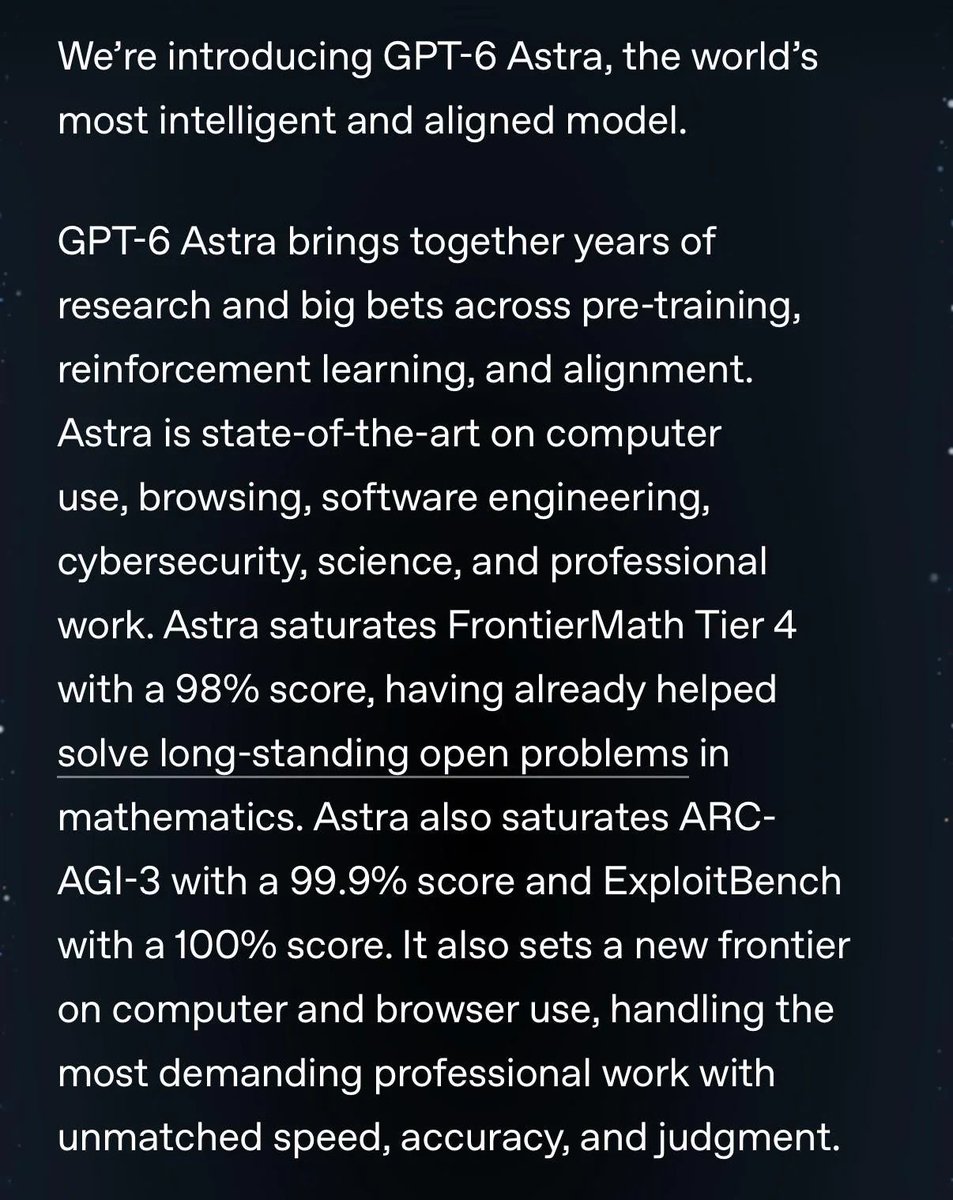
everyone will test GPT-6 Astra on coding.
the wild part? OpenAI says that in tests it spotted security flaws nobody had seen before and turned them into working attacks, without someone guiding every move.
this is way bigger than a smarter chatbot.
https://t.co/061VfLGXfj