Short interest on US stocks is at multi-year highs:
Short interest in the median S&P 500 stock is up to 3.0% of market cap, the highest since 2012.
This is DOUBLE the levels seen during the 2020 pandemic.
By comparison, at the peak of the 2008 Financial Crisis, short interest in the median S&P 500 stock stood at 3.8%.
Furthermore, short interest among the most heavily shorted 10% of S&P 500 stocks is up to 8.0% of market cap, the highest since 2018.
Both metrics are now even higher than during the bear market following the 2000 Dot-Com Bubble burst.
Are markets setting up for a short-squeeze?
Blackstone’s Giant Fund Hit by Redemption Rush
Investors are pulling money fast, testing the fund’s ability to pay everyone back.
“Gross inflows at the $80 billion fund dropped to $1.9 billion in the first quarter… while repurchase requests increased to $3.2 billion.”
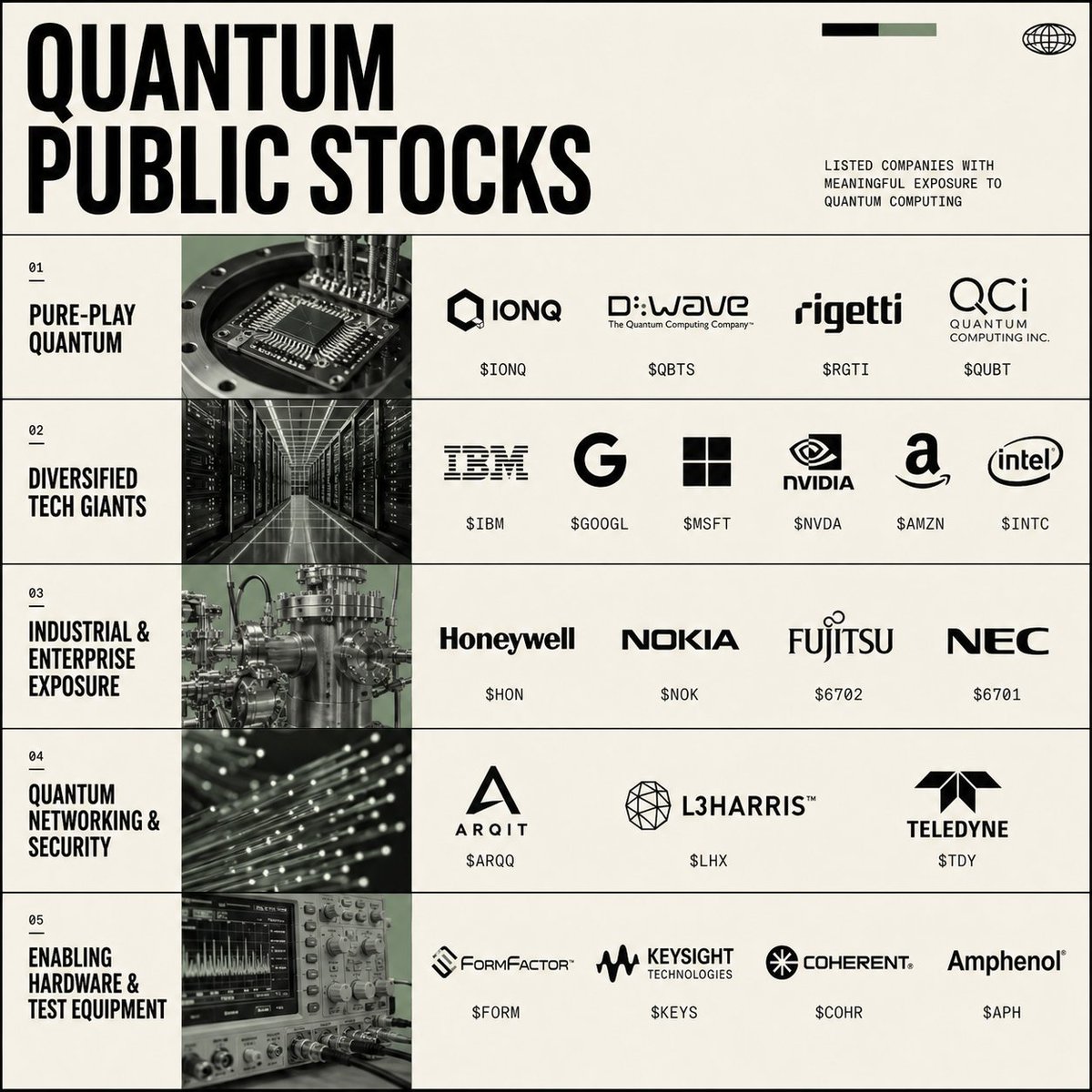
The Quantum Sector Map: Every Public Company You Need to Know
I've been mapping this space quietly for months and I think quantum is where AI was in early 2023.
Most people can't name more than two or three tickers. By the time they figure out the landscape, the early positioning window is gone.
2026 is the year quantum became a real investable sector. Three new IPOs already landed. Quantinuum filed its S1 targeting a $20B valuation. The $QTUM ETF ripped 73% in a year. And McKinsey projects the total market hitting $100B within a decade.
People see $IONQ pump 72% in seven sessions and think that's the whole story. It's not even close.
Here's the full map, broken down by sector. Bookmark this one.
🔬 PURE PLAY QUANTUM HARDWARE
These companies are building actual quantum computers. Different architectures, different bets on which physics wins. All racing toward fault tolerant systems.
$IONQ : Trapped ion tech. First public quantum company to cross $100M in revenue ($130M in 2025). Guiding $225M to $245M for 2026. ~$19B market cap. Cloud distribution through AWS, Azure, and government contracts. Also acquiring SkyWater Technology to vertically integrate manufacturing. This is the closest thing to a "blue chip" in quantum right now, if that term even applies to a sector this early.
$RGTI : Rigetti. Superconducting qubits. Modular chip architecture built for scalability. Down ~10% YTD after missing Q4 revenue by 22%. Still one of the OG pure plays. I think the architecture has merit but execution has been inconsistent.
$QBTS : D-Wave. The original quantum company. Uses quantum annealing, which is a specialized technique for optimization problems. 83% gross margin. Not gate based like the others. Completely different bet. Interesting if annealing finds its niche before gate based catches up.
$QUBT : Quantum Computing Inc. Photonic approach. Room temperature, low power. Acquired Luminar Semiconductor in Feb 2026 for photonic manufacturing, then NuCrypt in March to add quantum communications. Building a vertically integrated photonics platform. The acquisition pace tells you management sees a window closing.
$INFQ : Infleqtion. First neutral atom quantum company to go public (Feb 2026, raised $550M). Uses cold atom arrays. Atoms as found in nature rather than manufactured qubits. The tech is efficient and reliable but slower. Trading around $11. This one is interesting to me because neutral atom is the approach that could surprise everyone.
$XNDU : Xanadu. IPO'd March 2026. First pure play photonic quantum computing company on public markets. Photons transmit quantum data over long distances, which is critical for networking quantum machines together. If quantum networking becomes the bottleneck (and I think it will), photonic architectures have a natural advantage.
$HQ : Horizon Quantum. IPO'd March 2026. Raised ~$120M. Pre revenue. Very early.
Quantinuum (not yet public) : Honeywell's quantum subsidiary. Filed S1 targeting ~$20B. Trapped ion architecture like $IONQ but claims higher quantum volume and lower error rates.
H2 processor hit a quantum volume of 2^25. Only $31M revenue in 2025 with $192M net loss. The biggest quantum IPO in history if it prices. My honest take: the $20B valuation feels aggressive when $IONQ just crossed $20B with 4x the revenue. But the tech credentials are elite. Watch this one very closely.
⚡ POST QUANTUM SECURITY
This is the part of quantum most investors completely miss. And personally I think it might be the smartest near term play.
While quantum computers are still being built, the security world is already racing to defend against them. The "harvest now, decrypt later" threat means adversaries are collecting encrypted data TODAY to crack it once quantum machines are powerful enough. That makes post quantum cryptography (PQC) an immediate spending priority, not a future one.
The PQC market is projected to grow from $420M to $2.84B by 2030 at a 46% CAGR. Unlike quantum hardware, this revenue is compliance driven and happening now.
$SEALSQ : Quantum resistant semiconductors with post quantum algorithms embedded at the chip level. Targeting IoT, automotive, identity management. ~$220M cash. One of the best capitalized names in this subsector.
$ARQQ : Arqit Quantum. UK based. Software only quantum safe encryption. Products include NetworkSecure and Encryption Intelligence. Intel partnership. Revenue growing from $67K in H1 2025 to $623K in H1 2026. Tiny numbers but the contract pipeline is accelerating across telecom and defense. The kind of company that either 50x or goes to zero. No middle ground.
$QNC : Quantum eMotion. Listed on NYSE American in Feb 2026. Patented Quantum Random Number Generator. Just acquired SKV Technology for its SecureKey platform. Targeting financial services, healthcare, blockchain, and government. The crypto/blockchain angle here makes this particularly relevant for our space.
$BTQ : BTQ Technologies. Building blockchain infrastructure hardened with PQC. Early stage, low revenue. But the PQC x blockchain intersection is a narrative I expect to hear a lot more about as quantum threats to cryptographic standards become mainstream talking points.
🏭 TECH GIANTS WITH QUANTUM DIVISIONS
The biggest quantum budgets on the planet don't belong to the pure plays. They belong to the usual suspects. And honestly, for risk adjusted exposure, these might be the smartest entries.
$GOOG : Google Quantum AI. The Willow chip (105 qubits) achieved "below threshold" quantum error correction. This is the single most important quantum milestone in recent history. Adding more qubits now reduces errors instead of amplifying them. That changes the entire scaling equation.
$IBM : Most mature quantum program in the industry. Superconducting qubits, open source tools, cloud access. They've shipped more quantum systems than anyone. Also deeply involved in post quantum cryptography standardization with NIST.
$MSFT : Microsoft's topological qubit approach is the ultimate moonshot. Completely different physics from everyone else. Also partnered with Quantinuum to achieve "Level 2 Resilient" logical qubits. If topological works, it leapfrogs the field. Big if.
$AMZN : AWS Braket provides cloud access to multiple quantum hardware platforms. The marketplace play. Whoever wins hardware, Amazon collects the toll. Classic Bezos energy.
$HON : Honeywell. Majority owner (~54%) of Quantinuum. If the IPO lands at $20B, Honeywell's stake alone is worth over $10B. They're also splitting into three companies in 2026. The quantum spinoff optionality here is underpriced in my opinion.
$NVDA : Not a quantum company per se, but quantum simulations run on GPUs. As quantum/classical hybrid workflows scale, NVIDIA sits right at the intersection. You get stability, earnings growth, and quantum optionality all in one.
🔧 COMPONENTS, MATERIALS & EQUIPMENT
The picks and shovels layer. Companies making what goes inside quantum systems or enabling the PQC hardware refresh.
$LSCC : Lattice Semiconductor. First to ship post quantum compliant FPGAs (CNSA 2.0). Their MachXO5 NX family integrates NIST standardized algorithms. Revenue estimate $631M for 2026 (+21%). The compliance driven PQC hardware refresh cycle is their tailwind. This one doesn't get enough attention.
$MCHP : Microchip Technology. Crypto agile MCUs and FPGAs for the post quantum transition. Embedded security solutions. Not pure play but deep in the quantum security supply chain.
$NXPI : NXP Semiconductors. Quantum safe hardware at chip level. Secure key storage, encryption accelerators, cryptographic modules across automotive, financial services, and IoT.
📡 QUANTUM NETWORKING
The earliest and potentially most important subsector. Networking quantum machines together is what unlocks the real compute power.
QUBT is expanding here via its NuCrypt acquisition. $XNDU's photonic approach has natural networking advantages. Several security names ( ARQQ, $SEALSQ) also overlap into this space.
This category barely exists as a tradable theme yet. But I think two years from now people will look back and wish they'd paid attention to quantum networking the way they wish they'd mapped the AI inference buildout earlier.
📊 THE ETF PLAY
$QTUM : Defiance Quantum ETF. ~84 companies. Modified equal weight. Up 73% in one year, 176% over five. ~$3.7B AUM. 5 star Morningstar rating. If you want broad exposure without single stock blowup risk, this is the cleanest vehicle available.
🧠 FINAL THOUGHTS
The global quantum computing market goes from $3.5B (2025) to an estimated $20B by 2030. McKinsey sees $850B by 2040.
Quantum equity funding in the first nine months of 2025 hit $3.77B. Nearly 3x all of 2024.
We went from 6 pure play public quantum companies to potentially 12 by year end 2026. That's the kind of expansion that creates the early mover setups most people only recognize in hindsight.
I'm not saying buy everything on this list. I'm saying map it. Understand the layers. Know where the architectures differ. Know where the revenue is real versus aspirational.
This sector is where AI stocks were before ChatGPT made everyone a believer. The difference is the quantum crowd hasn't had its "ChatGPT moment" yet. When it comes, the people who already mapped the landscape will move first.
Huawei's latest announcement carries real significance, because China has, in effect, shown the direction in which advanced technology needs to move. And it has done so in cutting-edge semiconductors, no less.
China has long been a follower. In semiconductors, Western technology played the role of the pioneer, while China was preoccupied with simply keeping pace.
But by banning EUV exports to China, the U.S. manufactured a bottleneck at the lithography tool — and in doing so, it effectively forced creativity onto China.
To circumvent the sanctions, China was pushed toward approaches the West had never needed to take.
That is exactly what today's announcement represents.
Where Nvidia co-designs memory, packaging, and logic to optimize TCO at the system level — doing it rack by rack — Huawei is doing the same thing at the chip level.
I'll say it again: this is a genuinely striking approach. Memory makers are already struggling with cost scaling. As linewidths shrink, the resources required to keep shrinking them — capital, manpower, time — are climbing exponentially.
So the day will come when the West, too, must make packaging, logic, and memory collaborate from the node-design stage. And it won't be far off.
China, through the paradox of sanctions, has been driven to do this ahead of the West — unintentionally.
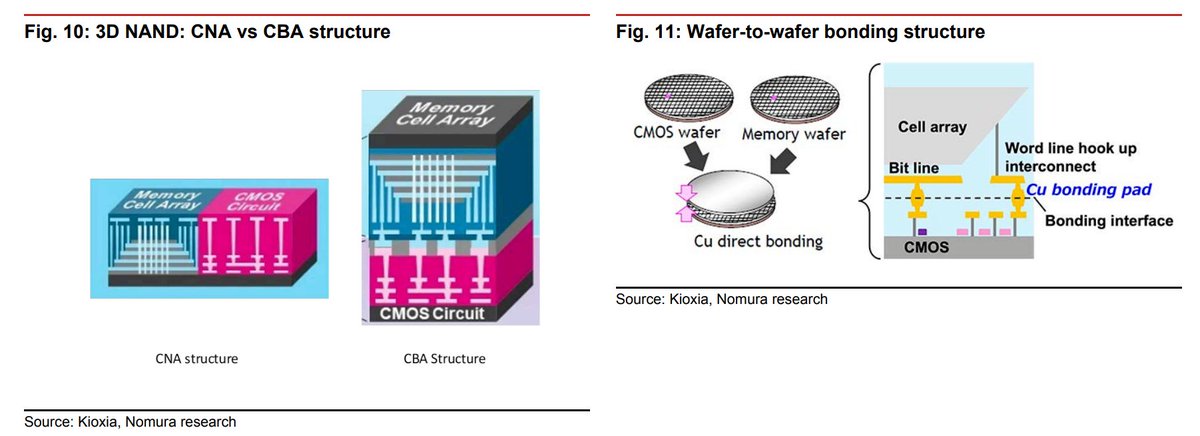
This is what genuinely frightens me. As YMTC has already demonstrated, U.S. sanctions pushed China to skip the incumbent standard and jump straight to the next-generation one.
The result? YMTC carved out a meaningful presence in hybrid bonding — and even Samsung, the king of NAND, ended up licensing YMTC's patents.
I believe the West may well find itself licensing this Huawei technology a few years down the road. And I believe cases like these will multiply, spreading China-style standards in their wake.
🚨 THIS IS NOT LOOKING GOOD
SpaceX, OpenAI, and Anthropic will go public at the same time.
That will force the market to absorb $200 BILLION of new supply.
When that happens, funds don't find new money out of thin air.
They sell what has already gone up.
NVIDIA, SK HYNIX, Micron, INTEL: those are the bags that will get cut first.
And if the leaders dump, the S&P 500 dumps with them.
We saw the same pattern after COVID.
Hype IPOs flooded the market --> liquidity got tighter --> air came out fast
This time, the AI bottleneck trade looks even more crowded.
Watch the upcoming IPOs closely.
That's where you may first see what the market is forced to sell.
Short interest on US stocks is at multi-year highs:
Short interest in the median S&P 500 stock is up to 3.0% of market cap, the highest since 2012.
This is DOUBLE the levels seen during the 2020 pandemic.
By comparison, at the peak of the 2008 Financial Crisis, short interest in the median S&P 500 stock stood at 3.8%.
Furthermore, short interest among the most heavily shorted 10% of S&P 500 stocks is up to 8.0% of market cap, the highest since 2018.
Both metrics are now even higher than during the bear market following the 2000 Dot-Com Bubble burst.
Are markets setting up for a short-squeeze?