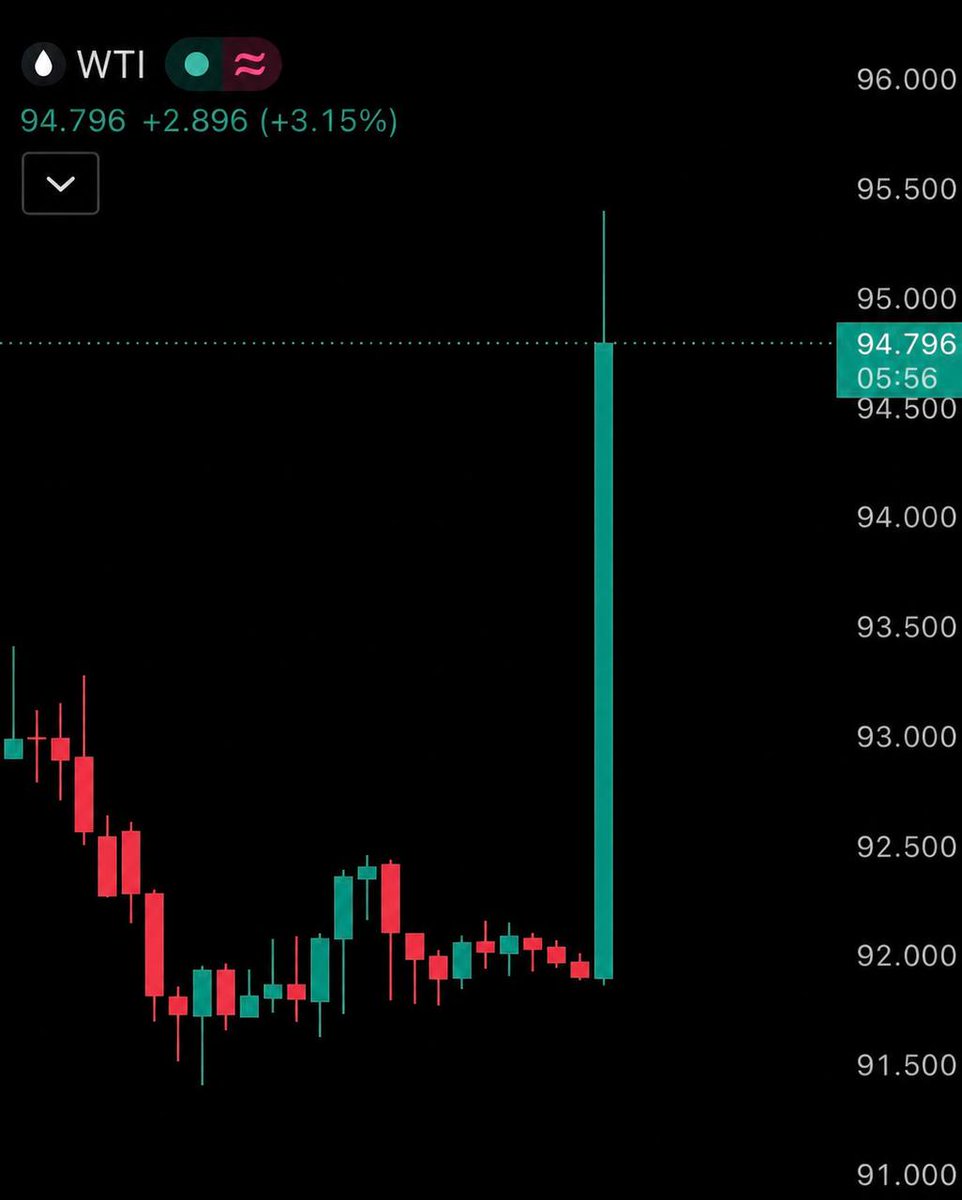
BREAKING: Israel's military says it has launched strikes on military targets in western and central IRAN.
The attacks come hours after Iran fired a wave of missiles at northern Israel, accusing Israel of violating the ceasefire with its operations in Lebanon.
Hours before the Israel strikes, President Trump said the Israel-Iran conflict would not derail U.S.-Iran peace talks, adding that PM Netanyahu "doesn't call the shots."
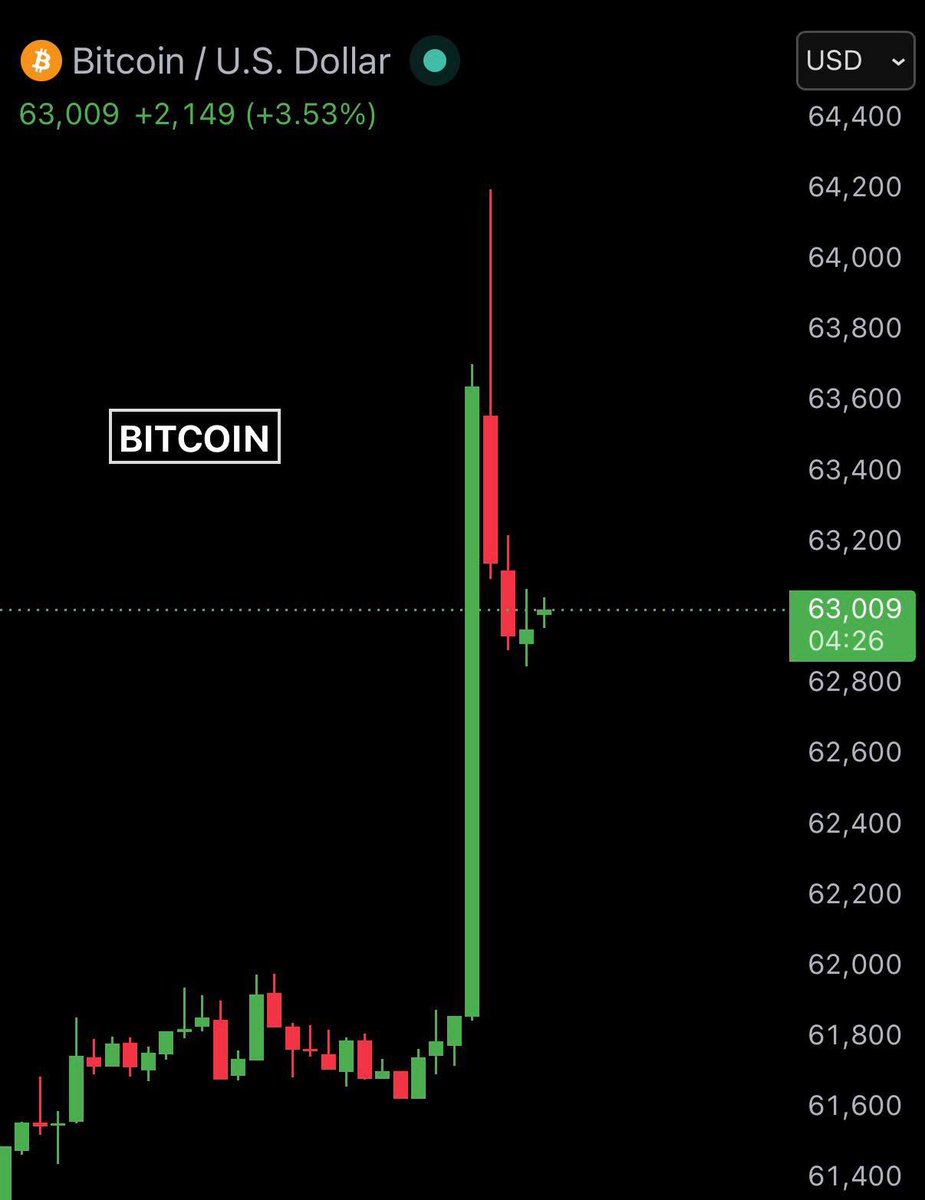
BREAKING: Bitcoin surged $2,400 from $61,800 to $64,200 in just 10 minutes and liquidated over $300 million in shorts.
Low-liquidity short hunting on the weekend.
The Iran-Israel situation just escalated fast.
Here's where things stand:
Iran launched a ballistic missile attack on Israel, but Trump says no one was hurt.
Israel is now asking the US for approval to strike Iran's energy sites, per Walla News.
Trump is trying to stop it from spiraling. His message to Iran: "You've shot your missiles, that's enough. Get back to the table and make a deal." And his warning to Israel: if Netanyahu responds, "this will continue and continue."
A deal to end the war is very close, and Trump doesn't want another attack to derail it.
BREAKING: The Japanese Yen just hit 160 against the dollar again, the same level Japan spent $73 billion trying to defend earlier this year.
It did not work and The yen is back at 160.
A weak yen is a direct inflation crisis for Japan. The country imports nearly all of its energy. At $93 oil, every further drop in the yen makes that import bill more expensive.
The BOJ meets June 15-16 and is expected to hike rates from 0.75% to 1.0%. A rate hike in Japan matters far beyond Japan. The entire world has been borrowing cheaply in yen for years to fund investments in US stocks, crypto, and AI. When Japanese rates rise, that trade unwinds. Investors sell their positions and convert back to yen.
The day after, June 16-17, Kevin Warsh chairs his very first Fed meeting. He is inheriting 3.8% inflation, $93 oil, and a jobs market running twice as hot as expected.
Markets are now fully pricing in a rate hike by year end. If both the BOJ and Fed signal tightening in the same week, the liquidity that has been holding this market up faces its most serious test of 2026.
In 1996, Sega gave Nvidia $5 million to stop the company from going bankrupt after Nvidia failed to deliver the chip Sega paid for.
Jensen Huang says that stake would be worth around $1 TRILLION today.
The assets the entire world buys to protect against war and inflation just did the exact opposite of what they were supposed to do.
Gold hit an all-time high of $5,600 on January 29, up 31% in just 29 days, adding $9 trillion to its market cap.
Silver hit $121 the same month, up 68% in 29 days, adding $3.5 trillion to its market cap.
Every safe haven buyer was positioned perfectly.
Then the US-Iran war escalated in February, the Strait of Hormuz closed, oil hit $93, and inflation climbed to 3.8%. These are exactly the conditions gold and silver are supposed to thrive in.
Instead, gold has now crashed 23% from its peak, wiping out $8 trillion in market value.
Silver crashed 44%, wiping out $3.5 trillion. Both are now negative for 2026.
The Fed uncertainty made it worse.
Kevin Warsh takes his first policy meeting on June 16 with no clear direction, historically the exact environment where gold surges. It is still falling.
$11.5 trillion wiped out from the two assets the entire world holds specifically for moments like this.
BREAKING: The U.S. is reportedly considering using frozen Iranian assets to help Gulf allies rebuild and repair damage caused by Iran, according to Reuters.
U.S. Treasury Secretary Scott Bessent has ordered an assessment of the damage Iran has caused to Gulf allies and is considering using frozen Iranian assets to help pay for both past and future repairs.
The move comes just one day after an adviser to Iran's Supreme Leader said any peace deal would require the release of $24 billion in frozen Iranian assets.
On May 28 we flagged that every time $NVDA diverged from the Nasdaq over the last 2 years, a correction followed.
Nvidia had already peaked and was rolling over while the Nasdaq was still climbing to 30,000.
The Nasdaq has now dropped -6.42% in 3 days. Nvidia is down -13.5% from its peak.
It happened in 2024. It happened in early 2025.
And It might be happening again now.
A CORRECTION MIGHT BE DUE FOR NASDAQ.
In the last 2 years, every time Nvidia diverged from the Nasdaq, the Nasdaq corrected to catch up. It might be happening again right now.
May to July 2024: Nvidia peaked first, started rolling over, and moved into a downtrend while the Nasdaq kept climbing. The Nasdaq then corrected 16.90% and followed Nvidia lower.
December 2024 to February 2025: Nvidia peaked first, started rolling over, and entered a downtrend while the Nasdaq pushed higher. Then in February the Nasdaq corrected 26.30% and followed Nvidia lower again.
Both times the same sequence. Nvidia peaks first and the Nasdaq follows weeks later.
Right now Nvidia is already down 11% from its recent peak. The Nasdaq just hit a new all-time high at 30,000.
The divergence is identical to the previous two setups.
BREAKING: President Trump wants to give every American a piece of OpenAI, Anthropic, and xAI.
Speaking on Air Force One yesterday, Trump said the government is exploring a plan where AI companies give the American public a direct ownership stake making every citizen a partner in the AI boom.
He plans to meet AI executives next week to discuss it.
OpenAI CEO Sam Altman first pitched this idea to Trump in early 2025 proposing that AI companies voluntarily give the US government equity stakes so that ordinary Americans, not just shareholders, benefit from the AI revolution.
Senator Bernie Sanders went further this week, proposing a law that would force major AI companies to hand over 50% of their equity to a government public fund, giving every American citizen voting rights, board seats, and dividend payments from AI profits.
The US government already holds ownership stakes in 20 private companies including Intel, IBM, and quantum computing firms on behalf of American taxpayers. AI would be next.
Bernie Sanders has spent his entire career fighting against billionaires and corporate power. Trump built his brand defending them.
They have never agreed on anything economic. They are now pushing the exact same idea about the most powerful technology being built today.
Peter Thiel invested $500,000 in Facebook in 2004 for an early 10% stake, later selling it for about $1 BILLION.
That stake would be worth roughly $150 BILLION today.
The S&P 500 has survived Black Monday, the Dot-com crash, the 2008 financial crisis, COVID, and Trump tariffs.
Yesterday's crash did not even make the top 200 biggest crashes in 75 years of recorded history.
BREAKING: SpaceX has announced a new deal with Google worth $920 million per month to provide AI computing power, according to a new filing.
As part of the deal, Google will pay SpaceX $920 million monthly from October this year to June 2029, with capacity ramping up through September at a reduced fee.
Google will use roughly 110,000 NVIDIA GPUs and other computing hardware, located inside SpaceX's data centers.
Under the agreement, Google can terminate the contract or reduce its payments if SpaceX fails to deliver the agreed AI computing capacity by the September 30 deadline, following a one-month grace period..
The deal follows SpaceX's recent AI compute agreement with Anthropic paying $1.25 billion per month through May 2029.
SpaceX's AI compute agreements with Anthropic and Google are expected to generate around $26 billion in annual revenue.
BREAKING: Iran has reportedly fired ballistic missiles and attack drones at U.S. military bases in Bahrain and Kuwait.
Residents in Bahrain were told to head to a safe place as sirens were activated early Saturday morning.
The Kuwait Army said it is responding to “hostile missile and drone threats” as multiple air raid sirens were activated.
Earlier, the U.S. military said it intercepted four Iranian drones headed toward the Strait of Hormuz before carrying out strikes on Iranian coastal surveillance radar sites on Qeshm Island and in Goruk along the country's southern coast.
🚨 EVERYTHING THAT COULD GO WRONG FOR MARKETS WENT WRONG TODAY.
S&P 500 down -1.65%, wiping out $1.14 trillion.
Nasdaq down -2.60%, wiping out $1.11 trillion.
Gold down -3.38%, wiping out $1 trillion.
Silver down -6.9%, wiping out $280 billion.
Bitcoin down -6.31%, wiping out $80 billion.
In total $2.5 TRILLION wiped out in a single session. These were not isolated moves. Everything started breaking at the same time.
It started with the jobs report this morning.
The US economy added 172,000 jobs in May. Wall Street expected 88,000. That is almost double.
On any normal day, strong jobs is good news. But inflation is already at 3.8% and oil is sitting at $90. A labor market this strong tells the Fed it cannot cut interest rates and may actually need to raise them.
The probability of a rate hike this year went from 40% to 57% in a single day. That spooked every investor holding tech and growth stocks because higher rates mean those stocks are worth less today.
Then the AI trade started cracking.
Yesterday Broadcom reported record earnings: revenue up 48%, AI chip sales up 143% and the stock still crashed 12.6%. The reason was simple.
Broadcom did not raise its AI revenue targets for the year. Investors had expected it to. That single miss made people ask a question they had been avoiding for months: are we paying too much for AI stocks?
That question got louder today when a research firm called SemiAnalysis revealed that Nvidia's next-generation AI chips will need significantly less memory than everyone assumed, roughly half of what the market was pricing in.
Memory chips are what companies like SK Hynix and Samsung make. SK Hynix fell nearly 10% today. Samsung fell over 6%.
South Korea's entire stock market crashed 5.5% in a single session. Japan's semiconductor stocks did the same.
And then Anthropic added fuel to the fire by publishing a report warning that AI is getting close to the point where it can improve itself without human help and calling for a global pause in AI development.
Coming on the same day as the memory demand news and Broadcom's miss, it fed a single growing fear across the market: what if the AI boom is moving faster than the business models can keep up with?
Underneath all of this, there is a liquidity problem nobody is talking about.
SpaceX goes public next week at a $1.75 trillion valuation. Anthropic just filed to go public. OpenAI is next.
These three companies together are worth $4 to $5 trillion. Fund managers need cash to buy into these listings.
But cash levels are already at their lowest since early 2024. The only way to raise cash is to sell what they already own. That selling is happening right now.
The new Fed Chair Kevin Warsh will also hold his very first policy meeting in 11 days. He was appointed by Trump with the expectation of cutting rates.
He is now walking into a situation where inflation is high, oil is high, and the job market is running hot. Investors do not know what he will do.
When nobody knows what the most powerful central banker in the world will decide in less than two weeks, the safest move is to reduce risk today.
Everything that could go wrong, went wrong at the same time. A hot jobs report, a collapsing ceasefire, a crack in the AI trade, a trillion dollar liquidity drain, and a Fed meeting with no clear outcome.
🚨 EVERYTHING THAT COULD GO WRONG FOR MARKETS WENT WRONG TODAY.
S&P 500 down -1.65%, wiping out $1.14 trillion.
Nasdaq down -2.60%, wiping out $1.11 trillion.
Gold down -3.38%, wiping out $1 trillion.
Silver down -6.9%, wiping out $280 billion.
Bitcoin down -6.31%, wiping out $80 billion.
In total $2.5 TRILLION wiped out in a single session. These were not isolated moves. Everything started breaking at the same time.
It started with the jobs report this morning.
The US economy added 172,000 jobs in May. Wall Street expected 88,000. That is almost double.
On any normal day, strong jobs is good news. But inflation is already at 3.8% and oil is sitting at $90. A labor market this strong tells the Fed it cannot cut interest rates and may actually need to raise them.
The probability of a rate hike this year went from 40% to 57% in a single day. That spooked every investor holding tech and growth stocks because higher rates mean those stocks are worth less today.
Then the AI trade started cracking.
Yesterday Broadcom reported record earnings: revenue up 48%, AI chip sales up 143% and the stock still crashed 12.6%. The reason was simple.
Broadcom did not raise its AI revenue targets for the year. Investors had expected it to. That single miss made people ask a question they had been avoiding for months: are we paying too much for AI stocks?
That question got louder today when a research firm called SemiAnalysis revealed that Nvidia's next-generation AI chips will need significantly less memory than everyone assumed, roughly half of what the market was pricing in.
Memory chips are what companies like SK Hynix and Samsung make. SK Hynix fell nearly 10% today. Samsung fell over 6%.
South Korea's entire stock market crashed 5.5% in a single session. Japan's semiconductor stocks did the same.
And then Anthropic added fuel to the fire by publishing a report warning that AI is getting close to the point where it can improve itself without human help and calling for a global pause in AI development.
Coming on the same day as the memory demand news and Broadcom's miss, it fed a single growing fear across the market: what if the AI boom is moving faster than the business models can keep up with?
Underneath all of this, there is a liquidity problem nobody is talking about.
SpaceX goes public next week at a $1.75 trillion valuation. Anthropic just filed to go public. OpenAI is next.
These three companies together are worth $4 to $5 trillion. Fund managers need cash to buy into these listings.
But cash levels are already at their lowest since early 2024. The only way to raise cash is to sell what they already own. That selling is happening right now.
The new Fed Chair Kevin Warsh will also hold his very first policy meeting in 11 days. He was appointed by Trump with the expectation of cutting rates.
He is now walking into a situation where inflation is high, oil is high, and the job market is running hot. Investors do not know what he will do.
When nobody knows what the most powerful central banker in the world will decide in less than two weeks, the safest move is to reduce risk today.
Everything that could go wrong, went wrong at the same time. A hot jobs report, a collapsing ceasefire, a crack in the AI trade, a trillion dollar liquidity drain, and a Fed meeting with no clear outcome.
🚨BLOODBATH IN THE MARKET.
Over $2.5 Trillion wiped out in 24hrs.
S&P 500 is down -1.65%, wiping out $1.14 trillion, the largest single day crash since January 20.
Gold is down -3.38%, wiping out $1 trillion.
Silver is down -6.9%, wiping out $280 billion.
Bitcoin is down -6.31%, wiping out $80 billion, dropping below $60,000 for the first time since October 2024.