launchpad is live in the bunker.
1,024 one-time hash keys from your 24 words. one signs your whole coin, the contract checks it before it exists.
break ECDSA, you still can't fake a launch.
v4 pool, LP locked forever, 50% fees to creators
https://t.co/c0CT4vYbq7 $BUNKER
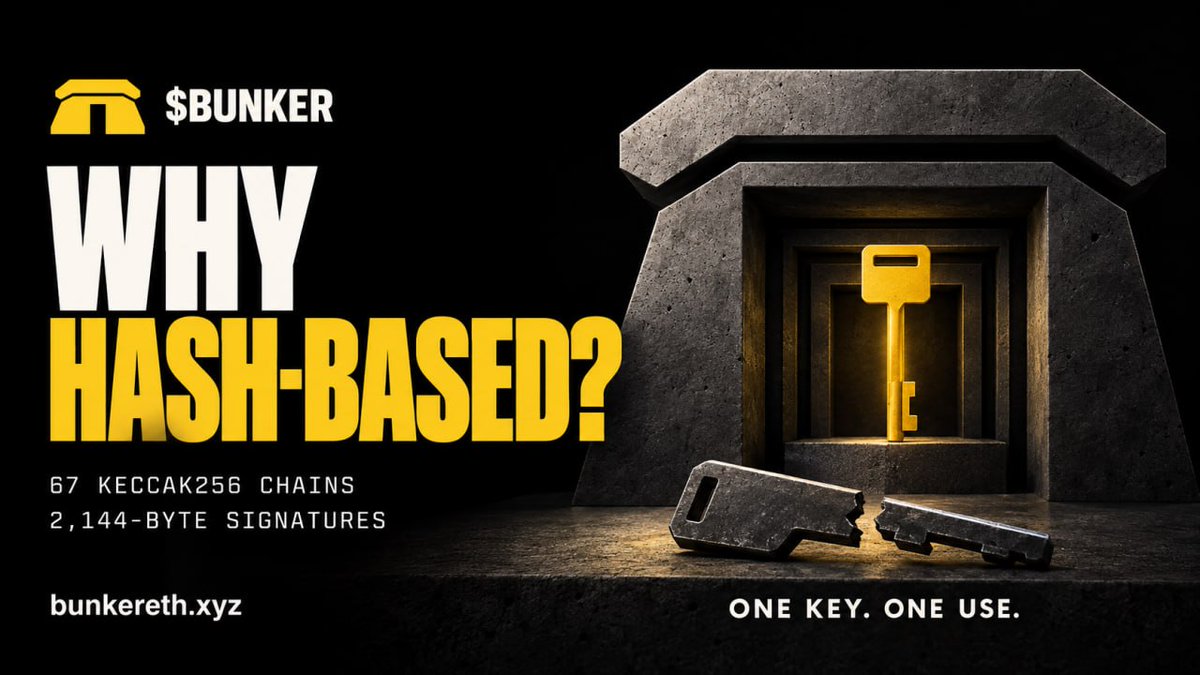
why hash-based:
Shor breaks secp256k1 outright: public key → private key.
Grover only square-roots a hash: keccak256 stays ~128-bit.
BunkerVault signs with WOTS: 67 keccak chains, 2,144-byte sigs, every key burned after one use. ~250k gas a withdrawal.
https://t.co/Pu7XHCS84h
$BUNKER
how it works:
• canary pubkey = keccak256 of a public seed, computed on-chain. nobody holds the key
• arm: approve your tokens, name your bunker
• trip: our keeper sweeps every armed wallet into its bunker
verified: 0x20085f519465288A5f4ed8917EB6e73429B2EE39
we put a tripwire on ECDSA.
a canary key nobody holds. the moment it signs, secp256k1 is dead and the wire trips on-chain.
every armed wallet evacuates into its hash-locked bunker.
no token. no fee. live now.
https://t.co/J1W5zMBdYK
$BUNKER
sign once and your public key is on-chain forever.
17 of the top 20 ETH wallets already did. 8.19M ETH waiting for ECDSA to crack.
we built the bunker: hash-based keys, burned after use.
scan yours → https://t.co/Pu7XHCS84h
$BUNKER 0xBDC4cE7c4718d20498e7D549751FF336690eb6D7 gimme another image for this tweet
Fair questions, and thanks for actually reading the code.
1) Audit: not yet, and we say so on the site, in the README and in SECURITY.md. What exists today: unit and fuzz tests, full mainnet-fork rehearsals, and the browser signer tested against the contract message by message. Both contracts are open source (MIT) and verified on Etherscan and Sourcify. The vault has no owner, no upgrade path and no fee, so nobody can change it after the fact. Independent review is welcome (see SECURITY.md). Until then, treat it as experimental and size deposits accordingly.
2) Key reuse: the key index is never stored on the device. It's the vault's on-chain nonce: key #n comes from the 24-word phrase + n, so any device, or a wiped browser, rebuilds the exact same state from the phrase alone. On-chain, every withdrawal is checked against the current key. That key is then burned forever and the vault rotates to the signed next key, so a used key can never authorize anything again. The signed message also commits to the chain id, vault, account and nonce, so it can't be replayed anywhere else.
The one real edge case is signing two different messages with the same key before either confirms. The site blocks this: it keeps every signed-but-unconfirmed withdrawal and refuses to sign a different one for that key, offering to re-broadcast the same signature instead. That guard lives in the browser, so the rule (also in the docs) is: one device at a time, and if a tx is stuck, re-broadcast, don't re-sign.
3) $BUNKER: the tools are free and will stay free. You don't need the coin to scan, move or use the vault, and we won't invent a token gate to force demand. $BUNKER is the coin of the bunker-mode movement: 1B fixed supply, 0% tax, no mint. Liquidity is locked inside the token contract itself, which owns the Uniswap v4 position and has no function to remove it. Anyone can trigger collectFees(), which pays the 1% pool fee to the team wallet 0x8AD23a667DC91C548D62DBFa47330b88b17f9B3E (visible on-chain). That's what funds building this.
1/6
you can delete a wallet app.
you can't delete the transactions it signed.
those signatures can reveal your public key permanently.
BUNKER is live: scan exposure, move to a fresh address, explore a different way to authorize withdrawals.
here's the idea. 🧵
6/6
start with a scan.
BunkerVault has no external audit. a "hidden" result isn't a safety guarantee.
check your address. reply with your exposure count—no need to post your wallet.
https://t.co/1ZWdLLCt4E
know where you stand.
$BUNKER
5/6
BunkerVault takes a different route.
withdrawals use Winternitz one-time signatures over keccak256: 67 hash chains.
each successful withdrawal consumes the current key and rotates to the next.
one key. one message. never reuse it.
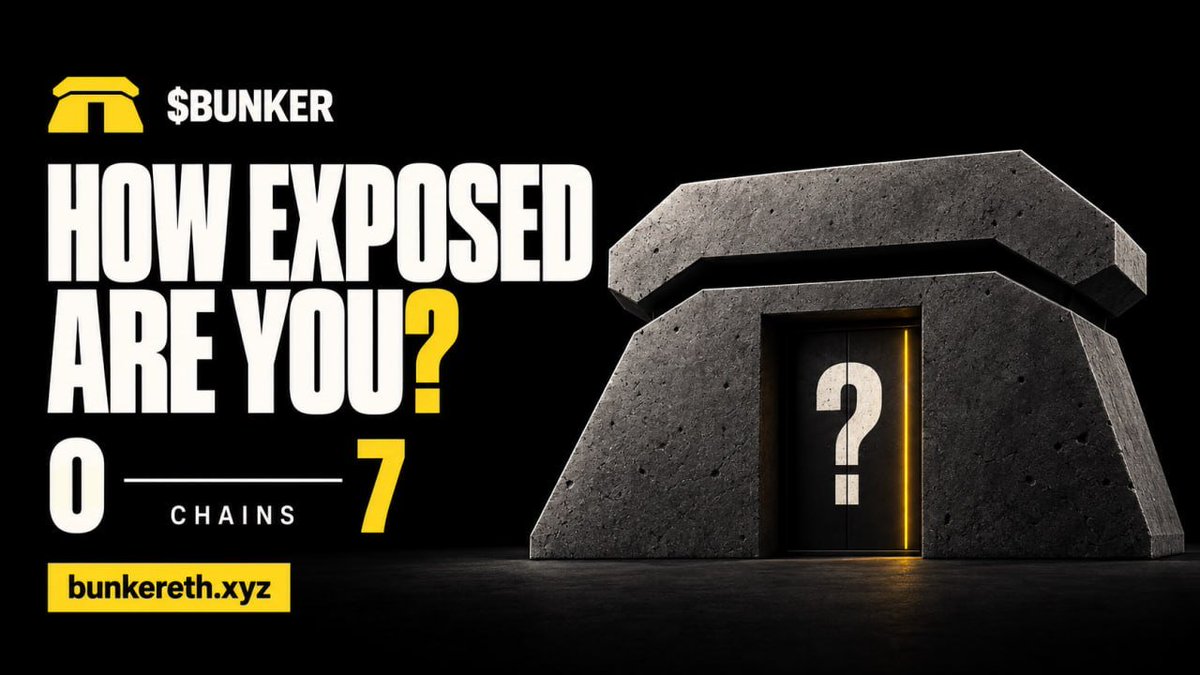
paste your main wallet into https://t.co/ZvBcD3rswU
reply with how many chains it says you're exposed on.
0 = you're already in the bunker
7 = you've been signing your life away
$BUNKER
Satoshi left ~1M BTC on naked public keys. no hash in front. p2pk, 2009.
If ECDSA cracks, that's the first door they kick in. drake calls it satoshi's shield: they eat there before they eat you.
Don't bet your bag on a dead man's shield. get in the bunker.
$BUNKER
@VitalikButerin The rule, enforced by construction: in BunkerVault every withdrawal is a WOTS one-time sig that commits to the next key's hash, so keys rotate every op.
Mempool front-runners can't redirect it, the sig fixes recipients + amounts.
Hash-only, live on mainnet.