P2P Protocol is creating the payment rails for emerging markets.
They just dropped their B1 Token Transparency Filing. 93% disclosed.
ICO: 03/30/2026. Launched on MetaDAO.
We’re making the entire experience way smoother for everyone in the coming update and yes, something exciting is cooking specifically for https://t.co/PGB9Fxrn85 merchants 👀 Stay tuned!
Hello World
Let me introduce you to @p2pdotfound and @P2Pdotme one of the most advanced global on-ramp/off-ramp solutions, or rather, a truly decentralized payments layer.
Imagine this: you can scan and pay across 6 countries using a single non-custodial wallet with your USDC. Sounds crazy, right?
Now let me tell you something even crazier it’s private.
“How?” you might ask.
They use ZK-TLS for KYC your identity gets verified while staying private,
you build an on-chain reputation score and it's full protocol is fully on-chain
Now let’s talk about PMF.
Do they even have it?
In one sentence: they absolutely fucking do and it’s global.
Don’t take my word for it. See it yourself 👇
Don't trust verify
Dune Dashboard: https://t.co/uph5IHoU26
“What’s next?”
Growth.
Quick snapshot:
B2B SDK for dApps to solv on-ramp/off-ramp
Expansion to 20+ countries
Permissionless growth through COT
And much more 👇
Full plan: https://t.co/ZKjJeNz9fj
So why am I sharing this?
Because you probably didn’t know about it and ignorancee isn’t always bliss.
What should you do?
DYOR. Use it. Then own it.
Yes you can literally own it 👇
Don't just use, Own it
https://t.co/pe2bRHZ6qX
Most protocols hit a wall when they try to go global. Operations become the bottleneck. You hire more people, add more processes, create more overhead. Before you know it, you're running a traditional company instead of building a protocol, or as Sheldon told me: 'let's not create an empire.'
When we launched @p2pdotme in Brazil (@p2pmebrasil) and Argentina (@p2pmeargentina), we saw this firsthand. We recruited merchants, onboarded them, handled disputes, managed liquidity. As we grew, we hired people to help. Then more people. Then more processes. And at some point, we realized: this doesn't scale.
Every new country means new languages, new payment rails, new regulations, new cultural nuances. If we tried to manage all of this from a central team, we'd need hundreds of people. We'd be slow. We'd make mistakes. We'd burn cash. More importantly, we'd be building a company, not a protocol. And that's not what P2Pme is meant to be.
Circles of Trust is this new technology that we designed for scaling P2Pme to every country without scaling our team linearly. Here is how it works:
Centralized operations are a trap. You think you're building efficiency by keeping control. But what you're actually building is a bottleneck. Every decision flows through you. Every new market depends on your bandwidth. Every problem lands on your desk. The central team becomes the limiting factor in growth.
So how do we remove this bottleneck? How do we scale operations while staying lean? The answer: parallel computing.
In computing, parallelism means running multiple processes simultaneously instead of sequentially. It's how modern systems handle massive scale.
We applied the same concept to operations. Instead of one central team handling every market sequentially, we enable multiple independent operators to run their own markets in parallel. Each operator manages their own circle, a network of merchants serving a specific region or community. They recruit merchants, ensure liquidity, handle local operations. All independently. All simultaneously.
One central team managing 50 countries is slow, expensive, and bottlenecked, however 50 independent operators managing their own circles with 100 merchants each is fast, efficient, and parallel. This is Circles of Trust.
A Circle is a community-operated network of merchants, managed by a Circle Admin, that are typically local P2P traders who already understand their market. They know the payment methods, the local dynamics, the trusted players. They're not employees. They're independent operators with skin in the game. They recruit and onboard merchants in their region. They ensure liquidity is available for users. They maintain operational standards defined by the protocol, they build their own community of trusted merchants, and they earn directly from their work.
Circle Admins receive 0.2% of all transaction volume that flows through their circle. If their circle processes one million dollars in volume, they earn two thousand dollars. Simple. This aligns incentives perfectly. The more volume their circle handles, the more they earn. They're motivated to grow liquidity, onboard good merchants, and keep operations running smoothly.
Not only that, but with the most recent deploy of COT, now they can also stake capital into their circle.
When they do, they earn a portion of the merchant fees proportional to their stake. This creates additional skin in the game. They're not just operators. They're investors in their own circle's success.
Circle Admins operate with full autonomy. They decide which merchants to onboard. They manage their local community. They solve local problems with local knowledge. But they operate within protocol-defined rules. Smart contracts enforce standards. On-chain data creates transparency. The protocol handles the infrastructure: payments, reputation, limits, disputes. Local operators handle local operations. The protocol handles global infrastructure.
This separation changed everything for us. It means a Circle Admin in Nigeria can build a thriving network of merchants using local bank transfers, while another in Philippines focuses on Instapay payments and another in Colombia manages their local community. All running in parallel, all independently, all without the core team being involved in day-to-day operations.
With Circles handling local operations, what does the global team focus on? Automation. AI. Removing humans from the loop. How do we make this protocol run with fewer people, not more?
That means automating repetitive processes. Every manual task we eliminate is a task that can't become a bottleneck. It means building AI-powered customer support, so users get instant help, 24/7, in any language, without waiting for a human to wake up in the right timezone. It means developing AI-assisted dispute resolution that analyzes transaction patterns, flags anomalies, and suggests resolutions faster and more consistently than manual review. It means creating intelligent analytics that help us understand what's happening across all circles in real-time, spotting problems before they become crises. And it means building better tools for Circle Admins so they can do more with less effort.
These are perennial contributions. They compound over time. Every automation we build makes every circle more efficient. Every AI model we train makes the protocol smarter. The goal is simple: make P2Pme less human-dependent every single day. Not because we don't value people, but because we want the protocol to be anti fragile. We want it to work even when the team is asleep. Even when no one is watching. That's what a real protocol looks like.
Most crypto projects talk about decentralization but run like traditional startups, with centralized teams making all decisions and handling all operations. Circles of Trust is our answer to a fundamental question: how do you actually decentralize operations? Not just decentralize the ledger. Not just decentralize governance. But decentralize the actual day-to-day work of running the protocol.
The result is a system that scales without linear headcount growth. It adapts to local markets through local expertise. It aligns incentives between operators and the protocol. It reduces single points of failure. It becomes more resilient over time, not more fragile.
Circles of Trust isn't just an operational model. It's a philosophy. Trust local operators to handle local operations. Give them autonomy and direct economic incentives. Build global infrastructure that empowers them. Automate everything that can be automated. Use AI to handle what humans used to do manually. Stay lean at the center. Scale at the edges.
This is how P2Pme will be in every country. Not by hiring thousands of people, but by enabling thousands of independent operators to build alongside us, supported by technology that never sleeps.
Kudo's to the tech team for building such an amazing tech, now it's with operations to ship this globally.
Btw, @p2pmevenezuela and @p2pmemexico are already running on top of this.
Really grateful for the support extended by our backers and community members in closing our @MetaDAOProject ICO round.
The last 15 days have not been easy for the P2P team, but it’s all worth it as we now enter a new phase of our journey with decentralised ownership and futarchy alignment.
The $6Mn net capital raise puts immense responsibility on us to build value for all $P2P holders, and we are mission-aligned 🫡
Now it’s time to put the past behind us and build the future, Futardios 🤯
https://t.co/cOkBEHHBsm is P2P Protocol’s in-house neobank bet.
A true cypherpunk neobank - private, onchain, and fundamentally different from any centralized neobank or fintech app in the market.
Built by Gen Z, for Gen Z. What you’re seeing now is just the first iteration - the next one will be 10x better. Stay tuned 🫡
$P2P holders own https://t.co/cOkBEHHBsm, https://t.co/m9uoVLUtKa, the core protocol, and every in-house product we build going forward.
One ownership token.
Exposure to multiple consumer & business stablecoin use cases.
All in the spirit of cypherpunk.
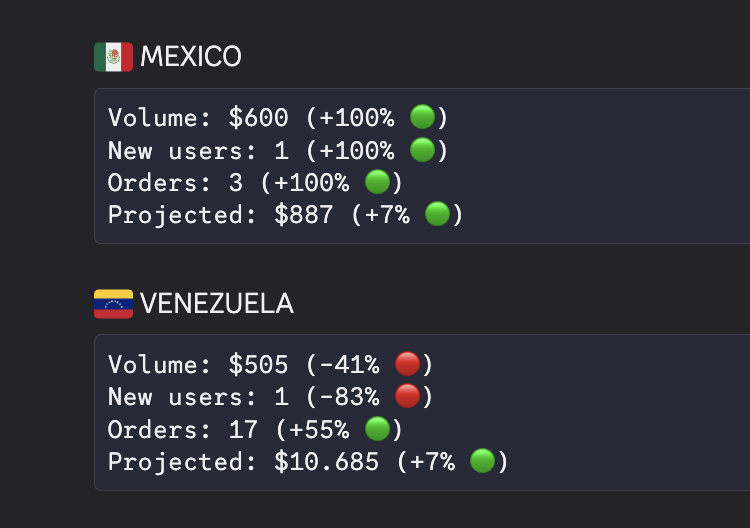
We've just launched @P2Pdotme in Mexico and Venezuela using this new permissionless expansion strategy we draw couple months back.
For reference:
Brazil 45 days to launch the prototype, local team w 3 ppl, $40.000 budget for launching the country - salaries, marketing campaign, merchants, flights, accommodations.
Argentina 30 days to launch the country, local team w 2 pp, $20.000 for launching the country - salaries, marketing campaigns, flights, accommodations.
Venezuela 15 days to launch the country, no local team, $380 investment - 1 local KOL to acquire first users, $20 to find first 5 merchants with the global merchant network.
Mexico 10 days to launch the country, no local team, $400 investment for a local KOL to acquire first users, $20 bounty to find first 5 merchants with the global merchant network.
No local teams, no need to fly someone there, no interviews, no hard marketing investments, everything remote and with the support of local community.
We've shifted the structure on our team from country-based teams to a unique global structure that provides support to local community leaders that lead merchant groups which we call circles.
This community leaders are paid 0.2% of the total volume their circle operates in the month, removing this expense from protocol's payroll and making more sustainable in long term with the expansion to 40 countries.
Our global team now has ppl from 5 different nationalities, speaking 7 different languages and it's focused on building a massive AI-powered structure of support for users and merchants that removes the need of human intervention in the day to day protocol operations.
The obviously tradeoff for this kind of expansion is the lack of traction in the first weeks after launch, caused by the short marketing budget to keep this lean, however, the possibility to enter the country and start operating with $600 daily volume with less than $500 investment makes this scalable and allows us to use all resources after the soft launch to acquire new users.
Our goal is to expand to 40 countries in the next 18 months, this now looks completely feasible with this new structure and allows us to get global faster with very few capex.
Next countries in line: Colombia, Peru, Costa Rica, Uruguay, Paraguay, Ecuador, Bolivia, Nigeria, Philippines, Thailand, Vietnam, Portugal, Spain, Turkey, Egypt, Kenya.
Also, we are actively working on allowing USD and Euro trades in the platform soon.
After @MetaDAOProject raise is complete, we start a new phase of the journey for expanding 40 countries, launching on Solana and releasing the SDK.
We'll keep building 🫡
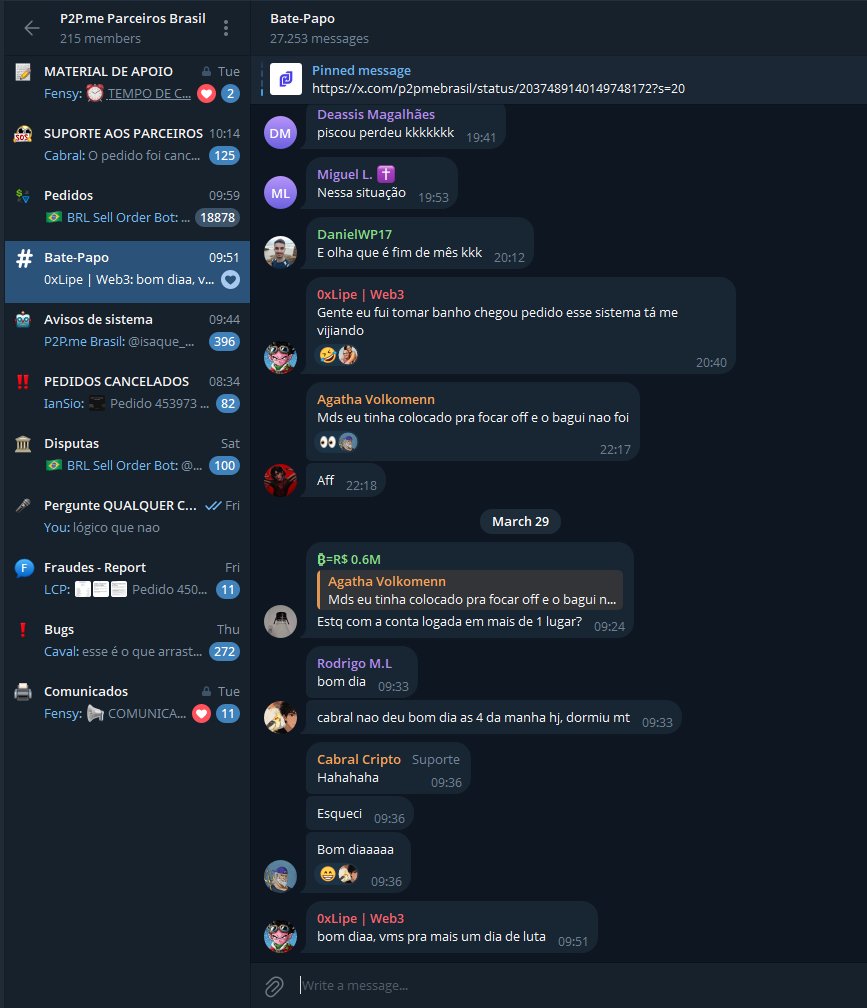
Brazil's liquidity providers organized themselves in a Telegram group with 215 members (208 LPs)
It's the most active and bonded community I've seen, 215 ppl created a FIAT rail for users to be able to move R$ in seconds, and now they're moving $2MM in monthly volume.
@p2pdotme is a community driven project.
We build communities accross all countries we operate, we provide support, assistance and allow hundreds of ppl to make an extra money supporting the network.
This is how DeFi should look like.