"SB 1090 would convert some fire survivors’ desire to preserve Altadena’s low-density form into restrictions on other people’s rights and choices, while blocking homes the region desperately needs."
Unfunded inclusionary zoning mandates were an interesting policy experiment but the results are in and it turns out that you cannot make housing more affordable by making it more expensive to build new homes.
I’m realizing how few people understand how development is actually paid for.
I’ve had several conversations lately with tenants, friends and acquaintances who seem to think developers are sitting on giant piles of cash, buying properties and paying construction costs out of their checking accounts.
There have been times over the years when I’ve had less cash in my bank account than most of those same tenants.
Most development is financed with a combination of investor equity and debt. Developers raise capital, take out construction loans, often personally guarantee that debt, and carry interest and other costs for years before a project ever produces a dollar for them.
That’s a massive amount of financial risk. And yes, the people taking that risk expect to get paid for it.
If your entire housing policy is designed to stifle how developers and property owners get paid, you aren't really interested in increasing housing supply. Ms. Raman 👋
Unfunded inclusionary zoning mandates are a failed policy experiment that have dramatically worsened the affordability problem they were supposed to help solve.
Policymakers who want to advance housing affordability should cut unfunded mandates to zero and offer funding instead.
San Francisco cut its affordable-housing requirement from 15% to 5% because the city's own controller found the old rate made most projects unprofitable to build at all — so developers built nothing.
https://t.co/RDBs40Bkhu
It’s not just the actual math of rent control - it’s what the willingness to implement rent control says about the local municipality’s hostility towards people in the business of providing housing
Unfunded “Inclusionary Zoning” mandates are going to be a marshmallow test for blue state policymakers: are they willing to forgo a few means-tested Affordable Housing units in the near term to secure broad, long-term housing affordability?
Important new paper on effects of inclusionary zoning.
tl, dr: the *typical* IZ policy in CA:
1⃣causes 31% decrease in housing production;
2⃣shifts production to lower-income areas; &
3⃣produces BMR units at per-unit cost PAID BY RENTERS of ~$775k
1/6
The moral of the story is people really have no idea how hard it is to be a developer. The amount of risk and variables to contend with is astonishing. People begrudge developers for looking to make a buck but they have no idea how easy it is to lose your shirt in this business.
Until you’ve lived somewhere with a dying economy, it’s hard to appreciate how misguided the de-growth movement is.
Population decline and a shrinking economy means each generation is worse off than the last.
The best and brightest leave.
The best of who’s left are knee-capped by crime and corruption, society infected by apathy.
The state steps in to fill the void, creating dependency, cronyism and the social contract erodes as struggling people see the powerful blatantly steal while their kids’ prospects dwindle.
The environmental angle doesn’t hold up either - where I live the few industries that are left are poisoning the farmland and fishing waters because the luxury of low impact practices doesn’t exit when there’s no one to buy what you’re selling.
De-growth is an appealing counter to the ugly excesses of capitalism.
But the alternative it offers is far, far worse.
I can also support rent stabilization … bc I think it’s *really* important societally for young people to be able to have kids and STAY in a City, and for grandparents to live near grandkids.
But you need *strong* enforcement of eviction for tenants who don’t pay rent or engage in anti-social behavior towards their neighbors (not picking up dog poop etc). And *strong* penalties on slumlords who don’t maintain buildings (which is also anti-social)
Good thread. When people are too dogmatic about rent control - irrespective of their political orientation - I assume they haven’t thought about it very deeply.
This is a topic that demands nuance but there is rarely any on offer from any side.
Requiring home builders to rent out new apartments at a loss is an effective tax on new housing that worsens the problem it’s supposed to address.
It’s bad, counterproductive policy that should be entirely abandoned everywhere.
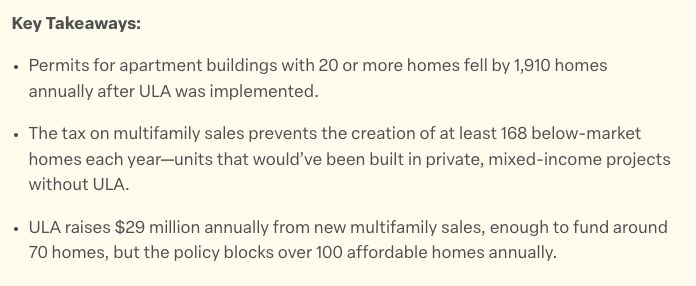
2025 UCLA/RAND study: LA's Measure ULA transfer tax cut large multifamily permits by 1,910 homes annually and blocks 100+ affordable units per year — more than the ~70 it funds.
Land sales for apartments dropped 46% after it took effect.
Great @LeeHepner 🧵⤵️.
Solutions:
- repeal tariffs
- end mandates for above-market construction wages (misnamed "prevailing wage")
- audit & simplify building code
- ban local building code amdmts
- repeal IZ
- replace impact fees w/ parcel or property taxes
Who's on board?
Remember when San Francisco banned algorithmic rent pricing in fall 2024?
They promised at the time that "we're taking action locally to ensure our working renters can afford to live here."
Good reminder: It's all about supply and demand, not conspiracy theories.
One reason some ground floor retail sits vacant is there’s no local market for retail. Another reason, especially in dense markets, is that the retail was badly designed — low ceilings, unworkable bay dimensions, no loading. If you’re doing retail get a retail designer.
RAND just dropped the most comprehensive study yet of Measure ULA.
High-value transactions 31%🔽. Apartment production 30%🔽. Buildings that sold passed the tax through to tenants as higher rents. ~$452M in lost revenue to city, county & schools. ~16,000 construction jobs lost.