A super smart scientist asked me last week: what's so hard about reshoring general advanced manufacturing (short of TSMC frontier precision chemistry)? Isn't the issue just labor cost? Nope.
A toy example to illustrate: We're trying to build a lot of drone motors in America right now, and falling short. It's not a labor cost issue.
The work instruction says: this magnet, this adhesive, cure at this temperature, wipe the rotor first. Any competent team can build the station and follow it.
But in week 3, motors start failing vibration testing. Some of them, mostly night shift. Also, weirdly, whenever the careful new hire is on station.
The adhesive cures differently with humidity, and the dehumidifier cycles differently at night. The new hire wipes the rotor generously, and that leaves a solvent film the adhesive doesn't like very much. Someone who has run a motor line before can figure this out in 10m. Everyone else -- struggle city.
The "fix" is two lines in the work instructions: run the dehumidifier continuously, one solvent wipe per rotor. But those lines aren't in the work instruction, and they're not in anyone's! At best the fix becomes a corrective-action report in one line's files, linked to nothing and never read.
A motor line rapidly may go from 5 to 40 stations, each with a dozen of these painful stories on the weekly as it grows. "What Shenzhen knows" is not written down in a book whose covers can be sliced off and ingested into a model, it's a few million humidity stories stored in people, and a pace of knowledge-rich adjustment that keeps cost down and yield high. The only way to get it back is work with people who have brought up lines, to reshore and grow the ecosystem of people who have this knowledge, and to capture that knowledge as we build.
Lots of people have clever ideas about the data capture/API piece, but we think the business of manufacturing may need equal portions pain tolerance, customer commitment, and cleverness on talent.
America needs to solve the other half of reshoring.
Extremely small probabilities really break the human brain, even smart ones.
There's often one engineer who will ask "but what if we hit the unlucky event of 1/2^{253} ? Wouldn't it be safer to run multiple trials?
The only response I've seen work is:
"There's a much higher chance that the building you are in will collapse on you right now or that the chair you are sitting on will spontaneously fracture."
Framing probabilities as relative risk really seems to work on people.
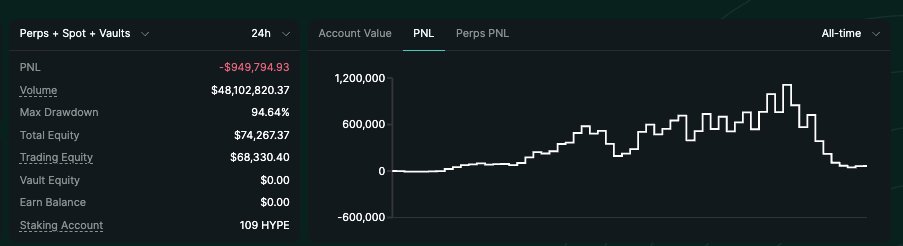
Today I lost about $950k
In about 2 months I ran up the account from about 12k to 1.1M at its peak. I didn't sleep much. I didn't exercise. I missed meals and felt my worst. I justified it, because I was doing great on the account. For the first time in a long time I took a shower and thought about what went wrong. Here are the lessons learned:
I was working on arb script to move funds into but it didn't work consistently. Instead of putting some funds earning safely, I kept all available funds in the account.
I was eventually right directionally most every time. Even though my risk was knowingly high it helped that my calls were decent. I would constantly double down and scramble my way to a small loss if needed. This works until it doesn't.
I felt diversified at times with a few bets going, but when things turned against me I would close out other positions for additional margin instead of managing positions individually.
There's a lot of things that went by the wayside while I was in the zone. I'm going to take care of some errands and relax for a minute. I finally touched grass for the first time in a long time. The grass spoke to me. It said stop being gay. Get back to the desk.
I'll be back.
I asked Codex to pull up some stats and I receive on average one DM or email every 6 or so minutes to ask for a reset. I occasionally do oblige if it comes with really solid feedback or banter.
I asked Codex to pull up some stats and I receive on average one DM or email every 6 or so minutes to ask for a reset. I occasionally do oblige if it comes with really solid feedback or banter.
The guy who invented dial telephones put 250,000 phone switchboard operators out of work. This was the highest paying position for women in the US. The guy who invented it was NOT an engineer or electrician, but rather, a mortician. There were two funeral homes in the town he served… his and a rival. The owner of the rival had a wife who worked as a switchboard operator. Anytime anyone called for A funeral home or HIS funeral home, she would route the call to her husband. He invented the dial phone so customers could explicitly end around switchboard operators and call someone directly. I just love this story.
I needed to move a sofa.
I mentioned this to an American. He said, "You know anybody with a truck?"
I did not know anybody with a truck.
He looked at me with real concern. Not pity. Concern. The way you look at a man who has told you he does not have a name.
"You gotta know somebody with a truck."
I asked how one acquires such a person.
He said, "You just do."
This is the third time I have received that answer in this country. It is the answer to everything here. You just do. There is no process. There is only the eventual fact of having.
He said, "Ask Kevin."
I do not know a Kevin. He said Kevin like I should. He said it the way you say a shared uncle.
I met Kevin four days later. Kevin owns a truck. Kevin does not own a truck for himself. Nobody owns a truck for themselves. Kevin owns a truck for a fifteen mile radius.
Inside I said: THIS MAN HAS TAKEN A VOW. HE DID NOT ANNOUNCE IT. HE SIMPLY PURCHASED A BED AND ACCEPTED THE CONSEQUENCES.
Kevin arrived on Saturday. He brought the truck. He also brought a second man.
I had not asked for a second man.
The second man's name is Tony. Tony came because Kevin came. Tony did not know me. Tony did not ask what we were moving. Tony brought gloves.
They moved the sofa in eleven minutes.
I offered them money. Both of them laughed at the same time, which felt rehearsed and was not.
I asked what I owed them.
Kevin said, "Buy the pizza."
That is the price. That is the entire economy. The truck costs one pizza and the pizza is not negotiable and the pizza is also not expensive and everyone knows what size.
Inside I said: THE FEE IS FIXED ACROSS THE ENTIRE NATION AND WAS SET BY NO ONE.
We ate on the floor because the sofa was against the wall and none of us wanted to be the first to sit on it.
Tony told me his daughter plays soccer. I asked if she is good. He said, "She's aggressive."
I still think about that.
Three weeks later, Kevin texted me.
"You free Sunday? Helping Tony move a fridge."
He did not ask if I wanted to. He informed me of a fridge.
Inside I said: I HAVE BEEN CALLED UP. I DID NOT ENLIST. THE PAPERS WERE FILED ON MY BEHALF.
I went. I moved the fridge. I have no truck. I contributed only arms.
Afterward, a man I had never met asked me if I knew anybody with a truck.
I said, "Yeah, I got a guy."
I have a guy.
I am somebody's guy now, too. Tony has told two people about me.
He describes me as "the guy who's strong for his size."
I have never been prouder of a sentence in my life.
i thought it was just me. Opus 5 is the first model that the more I use, the worse I like it.
It goes off-track, does random things I didn't ask for, forgets other things, and constantly has those annoying guardrails, etc. Sorry, but GPT-5.6 is worlds better.
I really don't understand it anymore. What's going on at Anthropic? Sonnet 5 was already a bad release, and since Opus 4.6, I feel like the subsequent Opus models have simply declined significantly in quality. My enthusiasm for Opus 5 has definitely evaporated.
I can't keep my BTC on centralized exchanges because they might go bankrupt or freeze withdrawals.
I can't keep my BTC in hot software wallets because my laptop might get hacked.
I can't keep my BTC in cold hardware wallets because there could be a bug on the manufacturer's side that exposes my seed phrase.
I can't deploy my BTC in DeFi because there's like a new eight-figure hack every month.
So where am I supposed to keep my BTC?
cost of a first date with me:
- $60 uber to seaport helipad
- $1000 chartered blade to teterboro
- $95,000 gulfstream g650 to page airport
- $60 uber from page airport to amangiri
- FREE dinner (money smart king)
- $7,000 one night standard suite at amangiri (separate room, of course)
- $60 uber back to page airport
- $140,000 bombardier global 7500 (the gulfstream wasn’t available) back home
- $1000 blade from teterboro back to seaport helipad
- $60 uber home
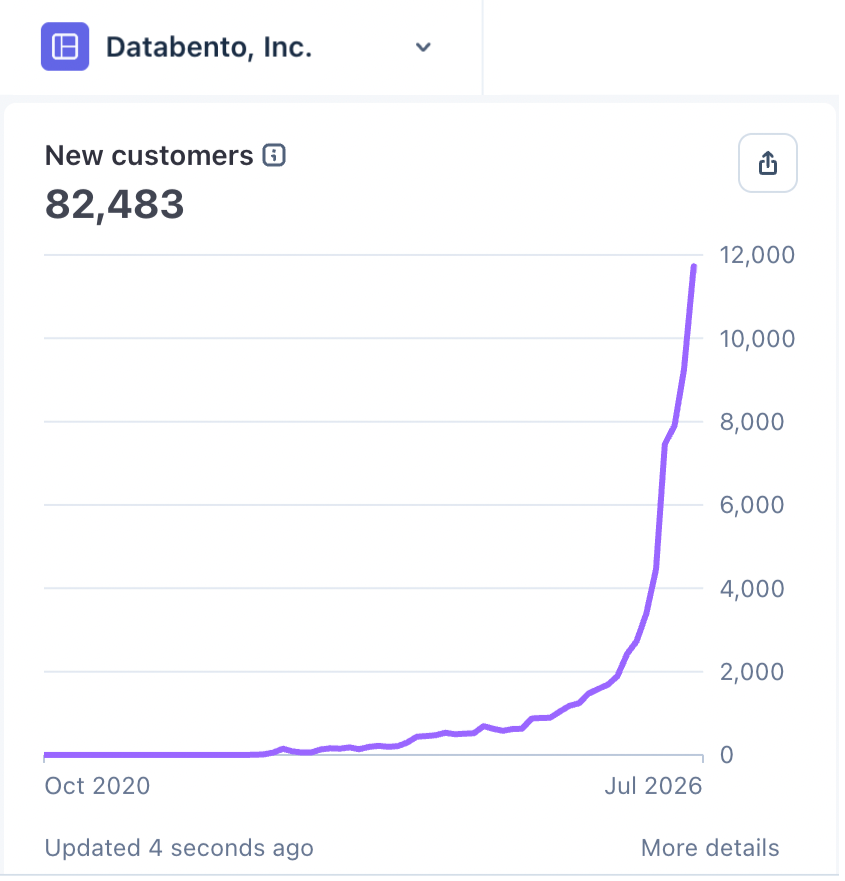
Years and years of zero revenue. People ask why there are so few challengers in our industry, so I wanted to show the barrier to entry.
The pathological patience to grind heads-down for years, rebuilding market data infrastructure from the ground up. The ironclad conviction to spend millions and millions on physical, on-prem storage and real-time data. When we could've easily been a reseller like the challengers before us, cutting corners, the only selling point being "the cheap data provider."
Databento attracts everyone: from students, to the most sophisticated quantitative trading firms in the world - because not only did we modernize things - we made data extremely accessible and scalable. (Self-service, transparent pricing, human support, etc.)