Royaume-Uni :
Le maire de Birmingham de souche pakistanaise et son conseil municipal ont décidé d'interdire les drapeaux anglais et britanniques pour protéger la "sécurité publique".
Jusqu'à 2 ans de prison prévus si l'on dresse l'un de ces drapeaux.
Train wreck.
Chris Hipkins will be absolutely furious with Willie Jackson for revealing that, just ten weeks out from the election, Labour still has not decided whether it will bring back the Māori Health Authority and has not even discussed the numbers.
Even more striking is Jackson’s claim that they are talking to “Māori healthcare experts” such as Labour candidate Kingi Kiriona, the former Deputy CEO of the Māori Health Authority.
Kiriona has no health qualifications whatsoever. But does hold an MA in an undisclosed subject, a Postgraduate Certificate in Te Reo Māori, a BA in Screen Media and Māori, and a BMPA (Bachelor of Māori Performing Arts) and is best known as a kapa haka exponent.
Te Aka Whai Ora appointed him DCE – Mātauranga Māori. That role was defined as leading tikanga, te reo, and Māori knowledge systems.
That appointment and the fact he is now considered a Māori Healthcare expert, makes Labour’s apparent priority clear: cultural capability first, clinical outcomes second.
Willie Jackson has announced that Labour will reintroduce co-governance in the delivery of public services.
The problem, he suggests, is the term itself, so they may simply rename it. “Apparently co-governance scares people, so we might give it a new name.”
@chrislynchmedia Have you any idea Chris what the next stage of their election campaign messages on behalf off the left (via the vehicle of TOP) will be?
1970. Yungay, Peru.
An earthquake triggered a colossal rock-and-ice avalanche from Nevado Huascarán. 50–100 million m³ of material raced ~14.5 km down the mountain and buried Yungay. More than 18,000 people were killed.
Atmospheric CO₂: ~326 ppm.
If a catastrophe like this happened today, climate attribution would immediately dominate the headlines. But catastrophic glacier, rock and debris flows have been occurring in high mountains for centuries... and the geological record at Huascarán shows repeated prehistoric events.
Put the emphasis where it can actually save lives: monitor unstable slopes and glaciers, map hazard zones, build warning systems, improve evacuation plans and make mountain communities more resilient.
We cannot prevent earthquakes or eliminate every mountain hazard by changing atmospheric CO₂. We can get much better at keeping people out of their path.
Long story short, this is BS.
Landslides / avalanches in Nepal have happened for tens of millions of years. In fact, floods associated with landslides are how the V-shaped valleys in the region were carved out millions of years ago at pre-industrial atmospheric carbon dioxide (CO₂) concentrations.
The Himalaya is an exceptionally steep and tectonically active mountain range where earthquakes trigger landslides, avalanches, and glacier collapses fairly regularly. The Google Earth satellite image I pulled up shows this well.
Although an earthquake likely did not trigger the devastating landslide the other day, moderate earthquakes occur often due to plate tectonic movement lifting the Himalaya upward driving India into the Asian continent, and it is likely earthquakes in recent years and months helped set the stage for this.
Frequent seismic shaking in alpine areas can fracture glaciers by creating crevasses, unstable blocks of ice called “seracs,” and hanging ice.
🔗 https://t.co/PQmVEnkCgr
The north face of the Himalaya in the Langtang Valley is characterized by steep slopes that are conducive for “hanging glaciers” (a type of glacier that starts high on a steep mountain wall and stops abruptly, usually at a cliff edge). These hanging glaciers are far more susceptible to destabilization and often produce avalanches when ice is knocked loose. Jim Steele (@JimSteeleSkepti) wrote a nice post about the geology behind this; I recommend giving it a read.
Although warming and surface melt can affect glacier stability, basal conditions are largely controlled by geothermal heat flux, friction, pressure, and bedrock geography.
And while there aren’t any paleoclimate temperature reconstructions in the exact area the recent disaster unfolded, there is evidence that both the Himalaya and Tibetan Plateau were warmer throughout much of the early-to-mid Holocene than they are today (e.g., Chen et al, 2020; Feng et al., 2022), which suggests that glaciers in the region may have also been smaller.
🔗 https://t.co/G638vMiNFb
🔗 https://t.co/Li5sHzxM1E
Climate change is real, yes. It always has changed and always will, and I don’t deny that at least some modern warming is due to carbon dioxide (CO₂) emissions.
But glaciers are not a permanent fixture of our environment and we need to quit pretending that they are. Glaciers will always be growing or receding; they are not supposed to stay static over time.
Pretending so is a fool’s errand.
I’ve spent many weeks doing fieldwork in Tibet, sitting above these enormous, deeply incised Himalayan river systems and seeing firsthand just how geologically active this landscape is.
So spare me the climate-change grift every time a natural disaster strikes.
Catastrophic glacial outburst floods are not new. The 1981 Zhangzangbo GLOF released ~20 million m³ of water and debris into Nepal, with estimated peak discharge approaching 16,000 m³/s. The Himalayas experienced enormous GLOFs long before today's atmospheric CO₂ concentrations.
If it happened naturally in the past, we should expect it to happen naturally again in the future—regardless of atmospheric CO₂.
Turning a horrific loss of life into an immediate climate-change narrative without demonstrating that CO₂ caused this particular event isn't attribution. It's opportunism.
And the people exploiting tragedy to do it are grifters.
We’re constantly told “it’s hotter now than at any time in the last 125,000 years.”
Yet ~10,800 years ago, trees were growing where a Swiss glacier exists today.
Trees don’t grow under glaciers. A forest occupied terrain that is still glaciated today.
Whatever you think about modern warming, sweeping claims that today is uniquely warm across 125,000 years deserve a lot more scrutiny when the physical evidence tells us glaciers were substantially smaller during parts of the early Holocene.
The trees were there. The ice wasn’t.
https://t.co/yJcLOKWhhn
The idea that muslims are poor brown victims of colonisation is probably the greatest act of gaslighting ever committed.
Reality is quite literally the opposite.
The West had sufficiant and affordable energy security, until the United Nations finally destroyed it in the name of the Net Zero.
This has become the world's greatest single transfer of public assets by elected democratic governments in history. None of them consulted with their own citizens, yet proceeded to collude with the UN and sign numerous binding agreements, leading to combined commitments of many billions of dollars of public money.
Many of these governments agreed to a financial commitments to decarbonise their economies, lasting decades beyond their own elected tenure. Hundreds of millions of dollars have been handed out in the form of subsidies, to help build and install large arrays of wind turbines and solar panels.
This has led to a widespread economic slowdown and the loss of capacity for steel production and industrial manufacturing. These same governments have green lighted large areas of public land to be accessed and bulldozed for roadways, new power lines and the placement of massive wind towers over formerly picturesque rural areas, on hill slopes and blocking offshore seascapes.
This was a deliberate transfer of control of a nation's most vital strategic asset for an intangible belief system, that human society was at fault in producing carbon dioxide for its most essential energy needs. This transition to renewable energy, so far, has led to some of the most costly household power bills in modern history.
One outraged writer told me that Net Zero must be the most diabolical act of needless self harm ever inflicted on any democratic nation by its own government. This led to wholesale destruction of coal and gas power plants. This had damaged every nation industrially, defensively, economically and environmentally.
Government by regulatory decree is not government by representation. Mandating multi-decade economic rewiring without a specific electoral mandate violates the fundamental social contract between the state and the taxpayer.
Locking in 30-year subsidy contracts strips future voters of their democratic right to adjust energy policy based on real-world performance. This captures exactly what ordinary people now think of this heavy-handed exercise in power.
'If we weren’t so used to being betrayed it would be considered treason.'
UN HUMAN RIGHTS COUNCIL STUNNED: ARAB DIPLOMAT CHALLENGES HISTORICAL NARRATIVE ON ISRAEL.
GENEVA — In a dramatic address delivered before the United Nations Human Rights Council, Jasem Aljuraid—an Arab political refugee speaking on behalf of UN Watch—challenged the assembly's position on the Middle East, questioning popular claims regarding indigenous rights and historical colonization.
Directly addressing the Council, Aljuraid urged diplomats to re-examine regional history:
"A Jewish kingdom ruled in Judea for a thousand years. We, the Arabs, took this land. Who Arabized Egyptians, Phoenicians, Persians, and Amazighs? It was us, the Arabs. So why does the Council enshrine a lie by keeping a permanent agenda item on Palestine, while ignoring the indigenous heart of Israel returning home?"
He went on to criticize the Council’s permanent Agenda Item 7—a mandate dedicated specifically to scrutinizing Israel—arguing that the nation’s current military actions are counter-terrorism measures that protect the wider region.
Concluding his remarks, Aljuraid defended Israel's operational role in the region:
"Today, Israel is a fighter for peaceful nations, freeing Gaza from Hamas, and saving Iranians from the Islamic Republic. What Israel is doing to the IRGC is a gift to humanity."
#NathanielGaladima
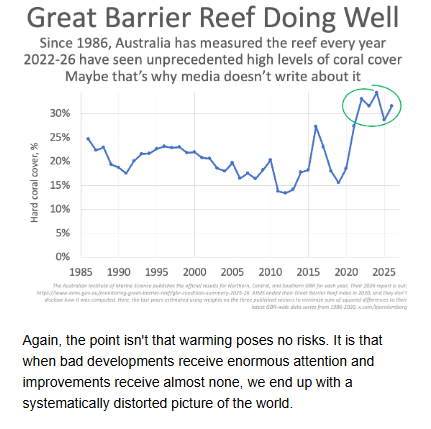
The Great Barrier Reef is doing better than you have heard
For years, alarming predictions about the Great Barrier Reef have generated headlines around the world. Good news receives rather less attention.
New data show that the past five years have seen some of the highest coral cover in the monitoring record.
From my latest newsletter: https://t.co/jfPBnKNY7b
Sign up: https://t.co/PIif2dDeWJ
"I'm an Arab Israeli. Israel is my country. I'm fighting for my country. Israel gives me freedom of religion and speech. Why would I fight Israel? I’m a proud Arab Israeli. I'll fight Hamas."
Can we make this go viral?
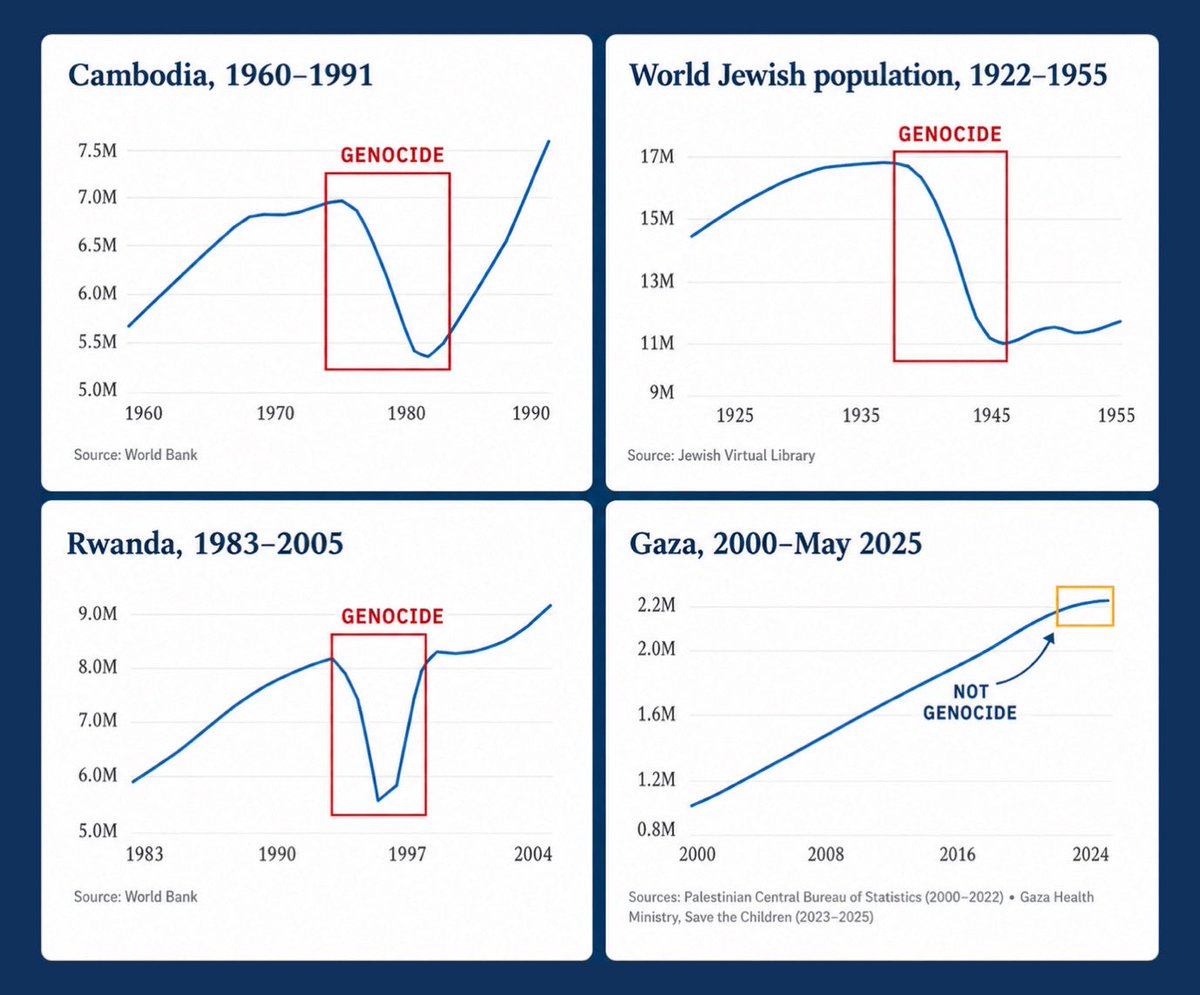
80% of all buildings in Gaza are destroyed, yet only 3% of the population has been killed during the war.
No matter how anyone tries to frame it, this is not genocide. This is what losing the war you started looks like.
Evidence of a greening planet should be a source of celebration for the modern world.
Instead, the bureaucrats and political elites who warned of imminent climate collapse have fallen silent as the truth emerges. NASA satellite records spanning the past four decades show a world growing greener, not dying. Vegetation is expanding across once-barren landscapes and desert margins, while agricultural yields continue to climb.
Instead of recognising this biological expansion, a colossal economic agenda continues to disrupt global energy security and add severe costs to working economies. The rise of global leaf cover is not the catastrophe grandly predicted decades ago by smug technocrats, political opportunists and global asset managers.
Figures like former US Vice President Al Gore have built lucrative carbon-credit advisory firms on this foundation. While financial managers profit, everyday citizens absorb the cost through soaring electricity bills and heavy taxation.
We were warned that major cities would be submerged within decades and instructed to prepare for 'global boiling'. The proposed solution—a massive global carbon credits market administered by the UN—has turned environmental policy into a multi-billion-dollar enterprise, arguably the greatest cash grab in modern history.
Modern greening signals a far more habitable planet. Glacial ice, tundra and the Taiga biome currently cover roughly 34% to 44% of Earth's land surface. Geologically, we are in an ice age that began 34 million years ago.
Replacing dense, reliable hydrocarbon energy with a poorly planned transition to intermittent wind and sunlight - in the face of expanded global biomass - reveals a major policy failure.
Carbon dioxide is the fundamental building block of terrestrial life. This is why commercial greenhouse operators routinely elevate internal CO₂ levels to 1,000–1,500 ppm to boost crop yields by 20% to 70%.
Biological history reinforces this dynamic: early human ancestors emerged during the Miocene epoch when CO₂ levels hovered around 400–500 ppm in a warm, thriving biosphere. Returning to 426 ppm today is restoring biological vitality, not driving an environmental crisis.
All the empirical data support this trend:
NASA satellite records confirm that elevated CO₂ has greened between a quarter and a half of Earth's vegetated lands over the past 40 years.
Global crop yields have risen up to 20% since 1960, driven by CO₂ fertilisation alongside modern agricultural technology.
Every 100 ppm increase in CO₂ typically boosts plant growth by 25% to 50%, with meta-analyses showing optimum growth occurring around 550 ppm.
Famine-related deaths have fallen dramatically over the past century even as global population doubled—a triumph supported by expanded food production.
We should be acknowledging the proven biological benefits of carbon dioxide. Instead, we are waging an unwinnable economic war on the very compound that sustains a greener world.
For four decades, public debate has been dominated by a looming climate crisis, still decades away, and blamed on modern human society.
But the evidence is sitting there like a sudden winter snowdrift. Average global temperatures are not overheated, they are a cool 15°C, and have been for much of the past century. They are significantly lower than the long-term global average of 18°C to 26°C over all biological timescales.
We evolved and still live in a world where much of it is under ice. This is so often overlooked. The Antarctic ice sheet is vast; it is also the largest single body of freshwater in the world. The Antarctic has the deepest ice formation on Earth, reaching up to 4.8 kilometers deep (about 3 miles).
Fully 10% of the world's land area is under this glacial wonderland, which covers 15 million square kilometres (5.8 million square miles)—roughly a third of its peak extent during the Last Glacial Maximum (26,000 to 19,000 years ago).
The oceans, however, are the Earth's greatest physical feature by far, as seen from space. Water covers three quarters (75%) of the entire globe to an average depth of 2.3 miles. For perspective, all human settlements, towns and cities combined occupy only 1-3% of land area, and much of the world is still effectively wilderness.
Furthermore, the oceans contain 86% of the entire surface carbon reservoir and 91% of all retained heat energy; by contrast, the atmosphere holds a mere 1 to 2% of each.
We have been very lucky. Our very recent civilisation arose within a benevolently warm interglacial period in the Quaternary Glaciation, which has lasted for 2.58 million years.
Fortunately for us, the oceans are a vast slow moving thermal regulator, which over the millennia effectively slows likely environmental changes to walking pace.
We still have time to get it right.